In This Article
A treadmill for beginners is a motorized or manual walking-and-running machine built around forgiving speed ranges, simple controls, and a low learning curve, rather than marathon-training horsepower. That’s the whole idea in one sentence, and it’s worth remembering, because the fitness industry loves to make this decision feel more complicated than it is.
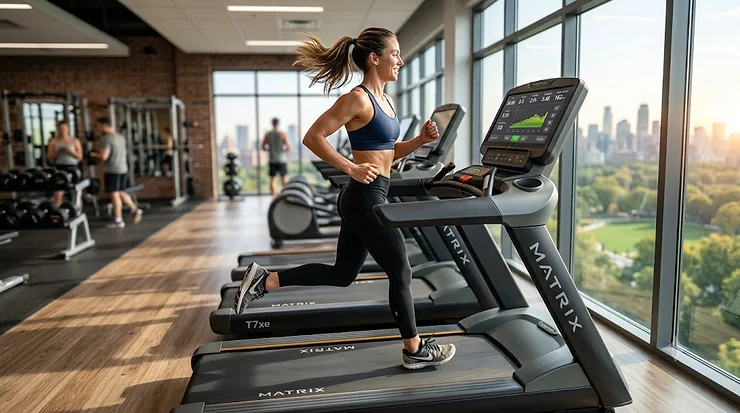
Here’s the truth nobody tells you at the big-box store: most people shopping for their first treadmill don’t need a 4.25 continuous-horsepower motor or a 24-inch touchscreen streaming virtual hikes through the Alps. They need something quiet enough not to wake the baby, sturdy enough to trust, and simple enough that they’ll actually use it instead of draping laundry over it by March. If you’ve ever bought a piece of home workout equipment with big ambitions and watched it become a very expensive coat rack, you already know the stakes here.
This guide walks through seven real, currently available machines — spanning true budget picks, sensible mid-range options, and a couple of premium units worth the splurge — plus the practical stuff nobody puts in the product description: how to set the thing up without a fight, which “features” are marketing noise, and how a treadmill for beginners at home compares to a walking pad if floor space is tight. According to the CDC’s physical activity guidelines, adults need about 150 minutes of moderate activity a week, and a treadmill parked in your living room is one of the most reliable ways to actually hit that number regardless of weather, daylight, or your neighborhood’s sidewalk situation.
Quick Comparison Table
| Product | Best For | Price Range |
|---|---|---|
| Horizon T101 | Absolute beginners on a budget | Around $500 |
| Goplus 2-In-1 Treadmill | Walking + light jogging hybrid | $300-$400 range |
| WalkingPad C2 | Small apartments, under-desk use | $500-$600 range |
| Bowflex T6 | First “real” treadmill under $1,000 | Around $900 |
| Sole F63 | Beginners who plan to start running | Around $1,300 |
| Sole F80 | Joint-friendly cushioning, long-term use | $1,800-$2,000 range |
| NordicTrack Commercial 1750 | Tech-driven motivation, guided workouts | $1,900-$2,100 range |
Looking at the spread above, notice how price climbs alongside motor size, deck cushioning, and screen sophistication — not necessarily “quality” in some abstract sense. A beginner walking three times a week at 2.5 mph has almost nothing in common, mechanically speaking, with someone training for a 10K, so the right pick genuinely depends on which end of that spectrum describes you. Budget-conscious shoppers shouldn’t feel like the Horizon T101 is a consolation prize; for pure walking-based cardio, it does the job the $2,000 machines do, minus the screen.
💬 Just one click — help others make better buying decisions too!😊
💬 Found a favorite already? Bookmark this page and keep comparing — the right pick is worth the extra five minutes.
Top 7 Treadmills for Beginners: Expert Analysis
1. Horizon T101 — simple treadmill, no bells and whistles
The Horizon T101 is the closest thing on this list to a genuinely simple treadmill with no bells and whistles, and that’s precisely the point.
Its 2.6 continuous-horsepower motor and 55-inch deck aren’t built for speed demons — they’re built for people who want to walk briskly, maybe jog a little, without paying for horsepower they’ll never touch. Based on the spec comparison across this list, that’s actually the T101’s biggest advantage: you’re not subsidizing a 4-horsepower motor to walk at 3.5 mph. Folding storage and a basic console with pre-set programs round out a machine that gets out of your way rather than demanding your attention.
Reviewers consistently describe the T101 as the treadmill they recommend to first-time buyers who felt overwhelmed by 40-page manuals and app subscriptions elsewhere. This is a treadmill for beginners at home in the truest sense — assembly is manageable solo, and there’s no learning curve beyond “press start.” It’s not the machine for someone training for a half-marathon, but for walking-based cardio, rehab-style movement, or simply building a daily habit, it’s honestly hard to beat at this price.
Pros:
- ✅ Genuinely simple controls with no subscription required
- ✅ Compact folding frame fits small apartments easily
- ✅ Quiet motor suitable for early mornings or late nights
Cons:
- ❌ Thin cushioning noticeable during longer sessions
- ❌ Console lacks incline range for hill-training later
Expect the T101 to sit around $500, occasionally dipping lower during seasonal sales — check current price before buying, since fitness equipment pricing shifts often. For a first treadmill with zero pretense, it’s a strong value pick.
2. Goplus 2-In-1 Treadmill — walking pad that also jogs
The Goplus 2-In-1 Treadmill splits the difference between a walking pad and a full treadmill, and that flexibility is its whole appeal.
With a removable handlebar, it functions as a low-profile walking pad for desk workouts, then converts into a slightly more traditional treadmill setup for light jogging sessions. Its 2.25 CHP motor tops out modestly, which — per Consumer Reports’ testing of under-desk models — is typical for this compact category, where the tradeoff for portability is a lower ceiling on speed and incline.
What most buyers overlook about hybrid units like this one is that they’re not trying to replace a “real” treadmill — they’re solving a specific problem: limited space plus a desire for both seated-desk walking and occasional standing workouts. Aggregated reviewer sentiment describes the Goplus as reliable for its price tier, with the most common complaint being remote-control battery life rather than any structural issue.
Pros:
- ✅ Converts between walking pad and treadmill modes
- ✅ Low profile slides under most desks and beds
- ✅ Budget-friendly entry point into home workout equipment
Cons:
- ❌ Top speed too low for anyone wanting to run
- ❌ Handlebar attachment feels less sturdy than fixed rails
Priced in the $300-$400 range, this is one of the most accessible ways to add a treadmill for beginners at home without committing serious closet space or budget.
3. WalkingPad C2 — most foldable walking pad for tight spaces
The WalkingPad C2 folds nearly flat, which single-handedly solves the biggest objection most apartment dwellers have to owning a treadmill for beginners at home.
Its foldaway hinge lets the whole unit collapse to a slim profile that slides under a bed or behind a couch — no permanent floor footprint required. Reviewers testing walking pads for Tom’s Guide noted the C2’s belt size and app pairing are solid, though the companion app can be glitchy compared to premium alternatives. On paper, this means you’re trading some software polish for genuinely excellent space efficiency.
Here’s what to weigh: a walking pad like the C2 isn’t built for running, and it has no side rails, so this is squarely a walking-and-light-jog tool — which happens to be exactly what most treadmill beginners actually need in year one. If your goal is more daily steps and low-impact cardio rather than marathon training, the compromise is a reasonable one.
Pros:
- ✅ Folds nearly flat for genuinely easy storage
- ✅ Quiet enough for video calls and shared walls
- ✅ Lightweight design two people can move solo
Cons:
- ❌ No handrails, which some beginners find less secure
- ❌ Companion app reported as inconsistent by users
Expect the WalkingPad C2 in the $500-$600 range, with color variants sometimes priced slightly higher — always check current price on the listing before adding to cart.
4. Bowflex T6 — best first “real” treadmill under $1,000
The Bowflex T6 is the machine for someone who’s outgrown the idea of a walking pad but still doesn’t want anything resembling gym equipment in their living room.
Its motor and 20-inch-wide deck are noticeably more substantial than budget picks, and the console includes basic Bluetooth syncing for fitness apps without locking you into a subscription. What most buyers overlook about the T6 is that its ergonomics — handrail height, step-on clearance — score well specifically because Bowflex designed it around comfort rather than raw performance numbers. That’s a deliberate beginner-friendly choice, not a limitation.
Aggregated customer sentiment on the T6 skews positive for stability and quiet operation, with the most repeated critique being that the incline motor responds a beat slower than pricier machines. Based on the spec comparison, that’s a reasonable tradeoff at this price point, and it rarely bothers walkers who aren’t constantly toggling incline mid-session.
Pros:
- ✅ Sturdy deck feels stable at walking and jogging speeds
- ✅ No required subscription for basic functionality
- ✅ Reasonable footprint for a full-size folding treadmill
Cons:
- ❌ Incline adjustments lag slightly behind premium motors
- ❌ Console screen is basic compared to smart-treadmill rivals
Sitting right around $900, the T6 lands just under the psychological $1,000 barrier — a smart pick for someone ready to commit to home workout equipment without going premium yet.
5. Sole F63 — best for beginners who plan to start running
The Sole F63 is built with just enough headroom that a committed walker can grow into jogging without needing to upgrade machines within a year.
Its 3.0-horsepower motor and 60-inch deck comfortably fit a range of stride lengths, meaning taller users won’t feel cramped as pace increases. Reviewers at Garage Gym Reviews specifically called out the F63 as a strong choice for a “new and beginner athlete” wanting to build toward more serious cardiovascular training, which lines up with how it’s positioned here. Based on the spec comparison, the extra deck length is the detail that actually matters for beginners — a longer deck means less anxiety about stepping off the back edge as your stride opens up.
What the spec sheet won’t tell you, but reviewer sentiment consistently notes, is that assembly runs long — plan for real setup time, not a rushed 20 minutes before your first workout.
Pros:
- ✅ Longer deck accommodates growing stride length
- ✅ Strong motor headroom for future jogging goals
- ✅ Lifetime frame and motor warranty from Sole
Cons:
- ❌ Assembly takes longer than most budget models
- ❌ Console features are functional but not flashy
Priced around $1,300, the F63 is a mid-range investment that rewards beginners planning to stick with the habit long-term rather than testing the waters.
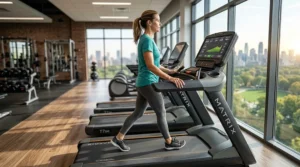
6. Sole F80 — best cushioning for low-impact cardio
The Sole F80 exists for one core reason: joints that need a break, without giving up the cardio benefit entirely.
Its Cushion Flex Whisper Deck is engineered to reduce impact meaningfully compared to pavement, based on manufacturer testing, which matters enormously for beginners easing into low-impact cardio after injury, arthritis, or simply years of inactivity. As the Cleveland Clinic notes, low-impact doesn’t mean low-intensity — you can still elevate your heart rate meaningfully while sparing your joints, and a cushioned deck like the F80’s is exactly the kind of equipment that makes that tradeoff work in practice.
Reviewers who’ve logged extended time on the F80 describe the cushioning as noticeably softer underfoot than comparable machines, with the most common critique being that speed changes respond a touch slower than sportier rivals. That’s a fair tradeoff: this is a treadmill built for comfort over responsiveness, and for a beginner prioritizing joint health, that’s exactly the right compromise.
Pros:
- ✅ Cushioned deck meaningfully reduces joint impact
- ✅ Lifetime warranty covers frame, motor, and deck
- ✅ Tablet holder supports streaming without extra fees
Cons:
- ❌ Heavy unit is difficult to assemble solo
- ❌ Speed changes lag behind faster-adjusting rivals
In the $1,800-$2,000 range, the F80 sits at the upper edge of what a beginner typically needs — but for anyone whose primary goal is protecting joints while staying active, the value case is strong.
✨ Ready to protect your joints while still hitting your step goals? Check current pricing before the next sale window closes.
7. NordicTrack Commercial 1750 — best tech-driven motivation
The NordicTrack Commercial 1750 leans hardest into guided, screen-based motivation, which works wonders for beginners who need structure more than raw hardware.
Its 4.25 CHP motor and adjustable -3% to 12% incline/decline range give it far more headroom than anything else on this list, and the pivoting HD touchscreen supports iFit’s automatically-adjusting guided workouts. Based on the spec comparison, the incline/decline range is the standout detail for beginners specifically — it lets a coach-guided program vary intensity for you, which removes a lot of the guesswork that stops new users from progressing.
Reviewer sentiment consistently ranks the Commercial 1750 near the top of home treadmill lists, citing its cushioned running zone and console responsiveness as major strengths. The honest tradeoff: iFit’s full experience requires an ongoing subscription, so the sticker price is really only part of the total cost of ownership here.
Pros:
- ✅ Wide incline/decline range adds real workout variety
- ✅ Guided programming removes decision fatigue for beginners
- ✅ Strong reputation for cushioning and console responsiveness
Cons:
- ❌ Full feature set requires an ongoing subscription
- ❌ Larger footprint needs dedicated floor space
Typically priced in the $1,900-$2,100 range, the 1750 is a premium pick best suited to beginners who know they respond well to structure and coaching rather than self-directed workouts.
Treadmill for Beginners at Home: Your First 30 Days
Getting a treadmill through the door is the easy part — figuring out what to actually do with it is where most beginners stall out.
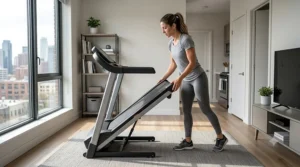
Start with placement: leave at least two feet of clearance on each side and roughly six feet behind the machine, both for safety and so you’re not squeezing past furniture every session. Once it’s assembled, resist the urge to jump straight to a “workout” pace. Spend your first two or three sessions simply walking at a comfortable 2-2.5 mph to let your body relearn the sensation of a moving belt under fixed room lighting — it’s a different feel from outdoor ground, and most new-user stumbles happen in week one for exactly that reason.
A simple maintenance rhythm prevents most early problems: wipe down the belt and console after sweaty sessions, check belt tension monthly (a belt that slips when you step on it needs tightening), and lubricate the deck per the manufacturer’s schedule, typically every three months for regular use. The single most common first-30-days mistake, according to running coaches, is skipping the safety clip because it “feels unnecessary” — don’t. It’s the cheapest insurance you’ll ever ignore at your own risk.
⚡ Ready to build a routine that actually sticks? Browse the treadmills above and pick the one that matches your real habits, not your ambitions.
Real-World Scenarios: Which Treadmill Fits Your Life
Consider Maria, a remote worker in a 650-square-foot apartment who wants more movement during her workday without leaving her desk for an hour. The WalkingPad C2 or Goplus 2-In-1 Treadmill fit her situation almost perfectly — foldable, quiet, and built around walking rather than running, which is exactly what she needs squeezed between video calls.
Then there’s Derek, a 45-year-old easing back into cardio after a knee scope, whose doctor recommended low-impact activity a few times a week. The Sole F80‘s cushioned deck is the obvious match here — its impact-reducing design directly addresses his biggest concern, even though it costs more upfront than he initially wanted to spend.
Finally, think about Priya, a college student training for her first 5K on a tight budget and an even tighter dorm-adjacent apartment. The Horizon T101 covers her walking-to-jogging progression without breaking her budget, and its folding frame respects her limited space. Three very different people, three very different “right answers” — which is really the whole argument against treating any single treadmill as universally “the best.”

How to Choose a Treadmill for Beginners: 7 Steps
- Measure your space first. Know your available footprint, including clearance, before falling in love with any specific model.
- Decide walking vs. running. A beginner focused on walking needs far less motor and deck length than someone planning to run within a year.
- Set a realistic budget band. Decide whether you’re shopping budget, mid-range, or premium before browsing — it narrows choices fast.
- Check weight capacity honestly. Match the treadmill’s rated capacity to actual household users, with margin to spare.
- Prioritize cushioning if joints are a concern. Low-impact cardio benefits hinge heavily on deck quality, not motor size.
- Skip subscription-dependent features you won’t use. A flashy screen means little if you’ll never open the app.
- Read the warranty fine print. Frame, motor, and deck warranties vary wildly between brands — this often matters more than the sticker price.
Common Mistakes When Buying Your First Treadmill
The single biggest mistake beginners make is buying based on horsepower numbers alone, without considering how they’ll actually use the machine. A 4-CHP motor sounds impressive, but if you’re walking three days a week, that spec is functionally decorative.
A close second: underestimating assembly time and space requirements. As the Sole F63 example shows, “some assembly required” can mean well over an hour, and skipping the clearance measurements leads to treadmills wedged awkwardly against walls. Reviewers across nearly every source referenced here flag this same pattern — buyer’s remorse tied not to the machine’s quality, but to a mismatch between the product and the buyer’s actual space and habits.
Simple Treadmill, No Bells and Whistles: Features That Actually Matter
Marketing copy loves to bury the features that actually matter under flashier ones that don’t. Deck length and width matter — a shorter deck genuinely limits stride comfort as your fitness improves. Motor continuous horsepower matters, but only relative to your actual use case, not as an abstract “bigger is better” number. Cushioning quality matters enormously for anyone dealing with joint sensitivity.
What doesn’t matter nearly as much for a true beginner: touchscreen size, built-in speaker quality, or app ecosystems requiring monthly fees. A simple treadmill with no bells and whistles, like the Horizon T101, proves you can get a genuinely useful piece of home workout equipment without any of that. Save the premium tech spend for after you’ve built the habit — not before.
Walking Pad vs Treadmill: Which Belongs in Your Home Workout Equipment Lineup
A walking pad and a full treadmill solve overlapping but distinct problems, and conflating them leads to disappointment either way.
A walking pad — like the WalkingPad C2 or Goplus 2-In-1 — trades incline range, side rails, and higher top speeds for a dramatically smaller footprint and near-silent operation, making it ideal for desk-based movement throughout the day. A full treadmill, even a beginner-focused one like the Horizon T101, offers a proper safety clip, handrails, and enough speed range to progress from walking into jogging over time. If your home workout equipment goal is “more daily steps while I work,” a walking pad wins easily. If it’s “build a real cardio habit that might eventually include running,” a proper treadmill is the safer long-term investment.
Low-Impact Cardio: What to Expect on Week One
Physically, low-impact cardio on a treadmill feels far gentler than most beginners expect — and that’s a feature, not a shortfall. As Mayo Clinic explains, aerobic exercises like walking that are gentle on joints still build real cardiovascular fitness over time, working toward that same 150-minutes-a-week benchmark the CDC recommends.
Expect mild muscle soreness in your calves and shins during week one — this is normal adaptation, not injury, provided pain doesn’t sharpen or persist. Your heart rate should climb enough that conversation gets a little harder but doesn’t stop entirely; that’s the moderate-intensity zone worth living in for most beginner sessions. By week three or four, many beginners notice the same walking pace that once felt challenging now feels comfortably sustainable — a genuinely satisfying, measurable sign of progress.
Long-Term Cost & Maintenance of Home Workout Equipment
The sticker price is only one line item in a treadmill’s real cost. Subscription-dependent machines like the NordicTrack Commercial 1750 carry an ongoing iFit membership fee on top of the hardware, which adds up meaningfully over a few years — worth factoring into any budget-per-use calculation.
Maintenance costs are modest but real: belt lubricant every few months, occasional belt or motor belt replacement after a few years of heavy use, and electricity draw that’s negligible compared to a gym membership’s monthly fee. Comparing cost-per-workout against a $50-80 monthly gym membership, most beginner treadmills pay for themselves within roughly a year of consistent use — assuming, crucially, that “consistent use” actually happens, which brings us back to picking a machine that matches your real habits rather than your aspirational ones.
Treadmill Safety & Regulations Guide
Treadmill safety deserves real attention, not just a mention in the manual’s fine print. According to Consumer Reports, leaving roughly two feet of clearance on each side and six feet behind the machine helps prevent falls into walls or nearby furniture, and always using the safety clip means the belt stops immediately if you lose your footing.
Keep children and pets away from a treadmill whenever it’s plugged in, and remove the safety key when the machine isn’t in use so it becomes fully inoperable — a simple habit that prevents the overwhelming majority of household treadmill incidents. Straddle the belt before starting your session rather than stepping onto a moving deck, and never step off while the belt is still in motion. These habits take about ten extra seconds per session and meaningfully reduce your risk.
Frequently Asked Questions
❓ What is the best treadmill for a total beginner?
❓ Is a walking pad enough for a beginner?
❓ How much does a treadmill for beginners cost?
❓ Can beginners do low-impact cardio safely on a treadmill?
❓ What home workout equipment pairs well with a beginner treadmill?
Conclusion
Choosing a treadmill for beginners really comes down to matching the machine to your actual life, not the most impressive spec sheet in the store. A tight apartment and a desk-heavy schedule point toward a walking pad; joint concerns point toward cushioned decks like the Sole F80; a genuine plan to start running points toward something with more deck length and motor headroom, like the Sole F63.
None of the seven options here is objectively “best” in isolation — they’re built for different budgets, different spaces, and different versions of what a beginner’s first year with a treadmill actually looks like. Whichever you choose, the real determining factor in whether it earns its price tag isn’t the machine at all. It’s whether you use it.
✨ Don’t Miss These Exclusive Deals!
🔍 Take your home workouts to the next level with these carefully selected treadmills. Click on any highlighted pick above to check current pricing and availability before you decide.
Recommended for You
- 7 Best Negative Incline Treadmill Picks for Serious Runners (2026)
- Treadmill for Downhill Running Training: 7 Real Picks (2026)
- Manual Incline Treadmill: 7 Top Picks Reviewed for 2026
Disclaimer: This article contains affiliate links. As an Amazon Associate, I earn from qualifying purchases. If you purchase products through these links, we may earn a small commission at no additional cost to you.
✨ Found this helpful? Share it with your friends! 💬🤗
