In This Article
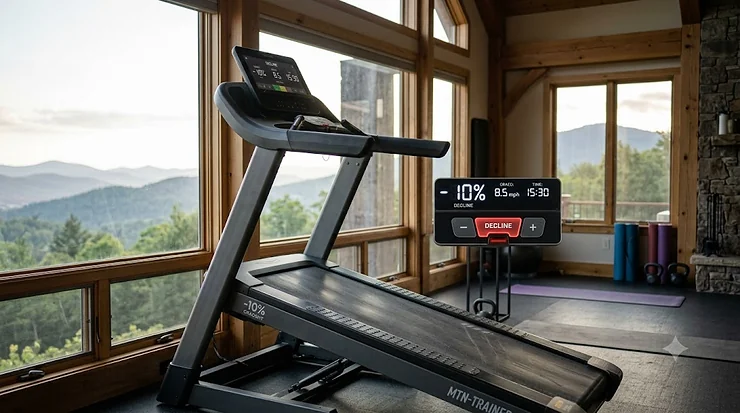
Somewhere around mile 18 of your last trail race, your quads started screaming on a descent you swore wasn’t even that steep. That’s the cruel joke of downhill running: it feels like a reward until it isn’t. A treadmill for downhill running training is a motorized treadmill built with a negative incline, or decline, function that tilts the deck below flat grade so you can rehearse those punishing descents indoors, on your schedule, without waiting for a hill to show up in your neighborhood. Most residential decks stop at 0%. The machines in this guide go below it, typically landing somewhere between -3% and -6%, which is enough to load the exact muscles that fall apart on race day if you never trained them.
Here’s the thing nobody tells you before your first 50K with real vertical loss: uphill running builds cardiovascular fitness and glute strength, but downhill running trains something else entirely — your ability to absorb force without your legs turning to jelly by the final descent. That distinction matters enough that Amazon’s own product listings won’t touch it, because a spec sheet can’t tell you which decline treadmill actually holds up to serious mileage versus which one is decline in name only. That’s what the rest of this guide is for.
We pulled real specs, current pricing patterns, and aggregated review sentiment on seven decline-capable treadmills actually sold in the U.S. right now, from NordicTrack’s incline-trainer flagship to a no-subscription Sole model built like a tank. According to a peer-reviewed review of running biomechanics, downhill running leans heavily on eccentric muscle contractions rather than the propulsive, concentric effort uphill running demands — and that mechanical difference is exactly what separates decline training from every other kind of treadmill workout. Let’s find the machine that actually prepares you for it.
Quick Comparison Table
| Treadmill | Decline / Incline Range | Price Range | Best For |
|---|---|---|---|
| NordicTrack Commercial 1750 | -3% to 12% | $1,700–$2,300 range | Best overall value |
| NordicTrack X24 Incline Trainer | -6% to 40% | Around $3,000–$3,300 | Steepest decline available |
| Sole TT8 | -6% to 15% | Mid-$2,000s range | No-subscription durability |
| Bowflex Treadmill 22 | -5% to 20% | Around $2,900–$3,500 | Widest combined grade range |
| NordicTrack Commercial 2450 | -3% to 12–15% | Around $2,500–$3,000 range | Fastest top speed, foldable |
| ProForm Carbon Pro 9000 | -3% to 12% | Around $1,900–$2,900 | Budget-friendlier decline pick |
| NordicTrack Ultra 1 | -3% to 15% | Around $15,000 | Luxury showpiece |
Look at that spread for a second, because it tells you something the marketing copy won’t: decline capability simply doesn’t exist below roughly $1,700 in the current market. That’s not a coincidence — powering a deck downward requires a second motor or a beefed-up incline mechanism, and manufacturers reserve that engineering for their mid-tier and up lineups. If your budget caps out under $1,500, you’re choosing between a treadmill with no decline at all or waiting for a sale on one of the models below. Also worth flagging: the NordicTrack X24 dwarfs everything else here on incline (40%!), but for downhill-specific training, its -6% decline ties with the Sole TT8 for the steepest grade you can actually buy — decline maxes out lower than incline across this entire category, and no home machine currently declines past -6%.
💬 Just one click — help others make better buying decisions too!😊
Top 7 Treadmills for Downhill Running Training: Expert Analysis
Below is our full rundown of seven real, currently available machines, ranked by how well they serve someone specifically training for downhill running rather than just “a treadmill that also inclines.” We looked at decline range, motor durability under repeated eccentric loading, deck size, and what actual owners report after months of use — not just the day-one unboxing impression.
1. NordicTrack Commercial 1750 — best overall value for decline training
The 1750 opens our list because it’s the machine most runners training for hilly races will actually end up buying, and for good reason. Its -3% to 12% grade range won’t win any spec-sheet contests, but it’s the most accessible on-ramp into genuine decline training that currently exists.
Under the hood sits a 4.25 CHP motor driving a 60″ x 22″ deck, with a 16″ pivoting touchscreen that handles iFIT’s automatically adjusting terrain simulation. Reviewers note it as one of the very few machines in its price bracket that offers decline training at all, which puts it in rare company even before you weigh anything else. On paper, that combination of a commercial-grade motor and a -3% decline means the belt won’t hesitate or strain when the deck angles downward under a runner’s landing force, which matters more than people expect once you’re doing repeat decline intervals.
Based on the spec comparison against its closest rivals, the Sole F80 and Horizon 7.8 AT, the 1750’s decline function is genuinely the deciding factor — those two machines match or beat it on motor size but offer zero decline capability. Aggregated owner sentiment across major review sites consistently flags the touchscreen as intuitive and the iFIT auto-adjust as one of the stickiest reasons people keep training instead of skipping sessions, though several also note the console’s interactive features lose most of their value without an active iFIT subscription.
Pros:
✅ Rare decline capability at a relatively accessible price point
✅ 4.25 CHP motor comfortably handles repeated incline/decline transitions
✅ Large 60-inch deck fits most stride lengths without crowding
Cons:
❌ -3% decline is shallow compared to X-series and Sole TT8
❌ Full functionality leans heavily on a paid iFIT subscription
At around $1,700 to $2,300 depending on ongoing promotions, the 1750 is the strongest value-per-decline-degree in this entire lineup — you’re paying for the feature you actually came here for, not extras you won’t use.
2. NordicTrack X24 Incline Trainer — steepest decline on the market
If your race has real elevation loss — think 2,000+ feet of technical downhill in a single stretch — the X24 is built for exactly that scenario, and nothing else on this list gets as steep.
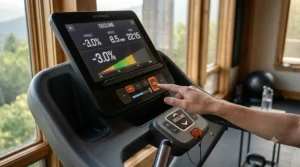
This machine (the 2026 successor to the discontinued X22i and X32i) reaches a -6% decline and, on the other end, a genuinely absurd 40% incline, making “treadmill” almost an understatement; NordicTrack and most reviewers classify it as an incline trainer instead. What most buyers overlook about the -6% figure is that independent testing has actually measured it running slightly steeper than advertised, closer to -7%, which is a meaningfully more intense downhill simulation than the -3% decks most competitors offer. A 4.0 CHP motor and reinforced hydraulic lift system power the grade changes, and the deck’s cushioning is tuned specifically to absorb the extra impact that comes with eccentric loading at a real downhill angle.
Reviewers who’ve logged serious mileage on it — including at least one ultrarunning-focused outlet — describe the decline as a legitimate mountain-running training tool, not a gimmick bullet point. The tradeoff is that this treadmill effectively requires an iFIT subscription to unlock anything beyond basic manual mode, and its 300-pound non-folding footprint means you need a dedicated space, not a fold-and-tuck-away corner.
Pros:
✅ -6% decline is the steepest currently available on a home treadmill
✅ 40% incline range covers extreme uphill simulation too
✅ Reinforced cushioning designed specifically for eccentric-load impact
Cons:
❌ Manual mode alone feels bare without an iFIT subscription
❌ Large, non-folding footprint demands a dedicated room
Pricing lands around $2,999 to $3,299. For trail and mountain racers specifically chasing downhill conditioning, this is the machine that actually replicates the grade you’ll face outdoors.
3. Sole TT8 — best no-subscription decline treadmill
The TT8 is the anti-streaming-ecosystem pick, and for a specific kind of runner — the one who wants downhill training without a monthly bill attached to it — that’s precisely the appeal.
Two separate motors drive this machine’s incline and decline mechanisms independently, which is unusual engineering for a residential unit and explains why the grade changes feel smoother than you’d expect at this price. It reaches a -6% decline (tied with the X24 for steepest in this roundup) and a 15% incline, powered by a 4.0 HP motor on a wide 22″ x 60″ deck. Reviewers who’ve spent extended time on it consistently describe it as durable enough to be compared favorably against commercial-gym equipment, with the community nickname “a machine you buy for life” showing up across multiple independent write-ups.
Here’s what the spec sheet won’t tell you: because the TT8 doesn’t fold, its frame has fewer hinge points and structural compromises than the folding competitors on this list, which is a big part of why its decline mechanism reportedly stays rattle-free even after heavy mileage. The tradeoff for that rigidity is a genuinely enormous footprint — at 319 pounds and non-folding, this treadmill needs a permanent home, not a spare corner. Aggregated owner feedback also flags the built-in cooling fans and speakers as underwhelming, which tracks with Sole’s evident priority on mechanics over entertainment tech.
Pros:
✅ Dual-motor system for smooth, independent incline and decline
✅ No monthly subscription required to use any built-in feature
✅ Commercial-grade 4.0 HP motor rated for heavy daily mileage
Cons:
❌ Does not fold, requiring a permanent dedicated space
❌ Cooling fans and speakers are consistently reported as weak points
At roughly $2,400 to $2,500, the TT8 is the pick for runners who’ve decided they’re never touching a streaming subscription and would rather put that money toward mechanical durability instead.
4. Bowflex Treadmill 22 — widest combined incline and decline range
Nobody talks about the Bowflex Treadmill 22 as much as the NordicTrack lineup, which is a shame, because its -5% to 20% grade range is actually the widest combined spread in this entire comparison.
That range comes courtesy of a 4.0 to 4.2 CHP “Mach Z” motor, which Bowflex markets specifically around high-incline work but which also has to handle a steeper decline than the NordicTrack 1750 or the ProForm Carbon Pro 9000. Reviewers comparing it directly against the ProForm Pro 9000 have consistently rated the Bowflex more favorably on expert endorsements, even at a higher price point, largely because the extended handlebar grips designed for high-incline workouts double as useful stability aids when you’re navigating a -5% decline at speed. On paper, that -5% figure splits the difference between the shallower 1750/2450 pair and the steeper X24/TT8 pair, which makes this the machine to consider if you want more decline than the entry-level NordicTrack options without committing to the X24’s price or footprint.
Reviewers’ aggregated sentiment leans toward praising the console’s ecosystem flexibility — it works with the JRNY app but doesn’t lock every feature behind it the way some iFIT-dependent machines do. The most commonly cited complaint is that its display and screen size trail behind the larger touchscreens on the NordicTrack Commercial series.
Pros:
✅ Widest combined incline/decline spread of any model here
✅ Extended handlebars add real stability during steep decline work
✅ App ecosystem doesn’t fully gate core functionality behind a paywall
Cons:
❌ Smaller display than NordicTrack’s Commercial-series touchscreens
❌ Sits at a higher price point than similarly specced competitors
Expect to pay somewhere around $2,900 to $3,500. If -5% decline sounds like the sweet spot between “noticeable” and “extreme” for your training, this is the strongest case for it.
5. NordicTrack Commercial 2450 — fastest top speed with decline and folding design
The 2450 exists for one specific runner: the one who wants NordicTrack’s decline training but also needs the machine to fold away between sessions and hit genuinely fast paces when the workout calls for it.
At a 14 MPH top speed, it’s the quickest machine on this list by a wide margin — fast enough to support sub-2-hour marathon pace work, according to NordicTrack’s own performance framing, which is a specific and useful data point if your training includes decline-assisted speed intervals. The -3% to 12–15% grade range matches the 1750’s decline depth while adding a larger 22″ rotating HD touchscreen and a beefier 4.25+ CHP motor underneath it. What most buyers overlook here is that the SpaceSaver folding design doesn’t compromise the decline mechanism the way you might expect — this remains one of the few foldable treadmills that offers true negative-grade training at all.
Reviewer consensus rates the 2450 highly for its combination of fold-flat convenience and commercial-grade motor performance, with several outlets naming it their top overall treadmill pick for 2026. The most consistent critique in aggregated owner feedback is the same one that follows every iFIT-dependent machine: without an active membership, you’re mostly left running in manual mode on a very expensive treadmill.
Pros
: ✅ 14 MPH top speed is the fastest of any treadmill in this list
✅ Folds away despite retaining full decline functionalit
✅ Rotating 22″ HD touchscreen among the largest displays here
Cons:
❌ Same -3% decline ceiling as the more affordable 1750
❌ Regular price runs meaningfully higher than the 1750 for a similar decline range
Pricing typically runs $2,500 to $3,000, though it’s frequently discounted from a higher list price. If speed work and space-saving both matter as much as the decline itself, this earns its spot over the 1750.
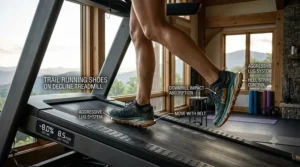
6. ProForm Carbon Pro 9000 — budget-friendlier decline alternative
ProForm is NordicTrack’s sister brand, built on shared manufacturing, and the Carbon Pro 9000 is essentially proof that you don’t have to pay NordicTrack’s exact price tag to get comparable decline hardware.
Matching the 1750’s -3% to 12% grade range almost spec-for-spec, the Carbon Pro 9000 runs on a 3.6 CHP motor across a 20″ x 60″ deck, with a 22″ HD touchscreen that’s actually larger than the entry NordicTrack option’s. Reviewers routinely place it alongside the Commercial 1750 as one of the only two mainstream treadmills under roughly $2,000 to $2,900 with genuine decline capability, and one certified trainer reviewer flatly noted she hadn’t seen many machines cheaper than it that actually offer a working decline function. That’s a meaningful data point, because it confirms this isn’t a stripped-down imitation — it’s a legitimate second option in the same tier.
Here’s the honest catch worth flagging: ProForm has, in past product cycles, quietly removed decline capability from certain treadmill lines without much fanfare, so shoppers should always confirm the exact current listing specs before buying rather than assuming every “Pro 9000”-branded unit still declines. As of current listings, the Carbon Pro 9000 retains -3% decline, but this is a category where specs shift between model years more than shoppers expect.
Pros:
✅ Matches NordicTrack 1750-level decline range at a competitive price
✅ 22″ touchscreen is larger than several pricier competitors’ displays
✅ 3.6 CHP motor holds up well under sustained incline/decline work
Cons:
❌ ProForm’s decline availability has varied across product generations
❌ iFIT subscription still required to unlock full auto-adjust features
Expect a price somewhere between $1,900 and $2,900 depending on current promotions. For runners who want NordicTrack-caliber decline hardware without paying NordicTrack’s brand premium, this is the pick worth cross-shopping.
7. NordicTrack Ultra 1 — luxury showpiece for serious home gyms
We’re including the Ultra 1 for full coverage, and because “money is genuinely no object” is a real buyer category — but let’s be upfront that this is a five-figure purchase, not an impulse buy.
At a reported -3% to 15% grade range, a 24″ pivoting 4K-adjacent touchscreen, and a top speed of 15 MPH, the Ultra 1 is NordicTrack’s flagship, built with white oak accents and a design language closer to furniture than fitness equipment. Independent reviewers who’ve tested it describe the deck as decoupled from the console structure specifically to keep the screen stable at high speeds — a detail that matters more during fast decline running than most buyers would guess, since a wobbling screen at a downhill sprint pace is genuinely disorienting. One long-form review noted the university-lab-tested cushioning reduces tibial shock by a measured percentage compared to a flat running surface, a rare case of a manufacturer citing an actual biomechanics study rather than a marketing number.
Reviewers are near-unanimous that the experience is exceptional and near-unanimous that the roughly $15,000 price tag puts it outside what the vast majority of home runners will ever justify. If you’re deciding between this and the Commercial 2450, know that most testers explicitly say the 2450 delivers the large majority of the practical training experience for a fraction of the cost.
Pros:
✅ Deepest incline/decline range paired with the fastest top speed available
✅ Deck-decoupled design keeps the display stable during hard decline running
✅ White-glove delivery and concierge support included in the purchase
Cons:
❌ Price sits far above every other machine in this comparison
❌ 747-pound weight demands permanent, professionally installed placement
At around $15,000, this is a splurge pick for a dedicated home gym, not a default recommendation — but for the buyer it’s built for, it delivers a training experience nothing else here can match.
Trail Race Preparation: Your Practical Usage Guide
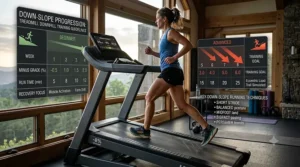
Buying a decline treadmill doesn’t automatically prepare your quads for anything — how you use it in the weeks before a race matters more than which model you own. Start conservatively: your first two decline sessions should stay at the shallowest available grade (-1% to -2%) for no more than 15 to 20 minutes, because your body needs a repeated-bout adaptation period before it can handle more.
In the first 30 days, the most common mistake is jumping straight to your machine’s maximum decline because it feels easier cardiovascularly than incline work — your lungs won’t complain, but your quads absolutely will, usually 24 to 48 hours later. A smarter progression looks like this: week one at -2%, week two at -3%, and only after that building toward whatever your specific machine’s ceiling allows, whether that’s the 1750’s -3% ceiling or the X24’s full -6%.
Maintenance-wise, decline mechanisms see more mechanical stress than standard incline-only motors, so check your belt tension and lubrication on a slightly shorter cycle than the manufacturer’s default incline-only recommendation — every 150 to 200 miles rather than waiting for a full service interval. If you’re specifically prepping for a race with a known elevation profile, map your treadmill sessions to mirror it: a 10K with a 400-foot descent in the final two miles means your last training blocks should simulate sustained decline running, not just short bursts, so your legs experience the same fatigue accumulation they’ll face on race day.
Real-World Scenarios: Who Actually Needs Decline Training
Picture three different runners walking into this decision with completely different needs, because “best treadmill for downhill running” genuinely depends on which one you are.
The first is a 34-year-old training for her first mountain ultramarathon with 8,000 feet of technical descent — her budget is flexible, her space is a finished basement, and she needs the steepest decline she can get. The NordicTrack X24 or Sole TT8 fits her situation, since both hit -6% and can handle the volume of eccentric loading her race demands without the mechanism wearing prematurely.
The second is a weekend 10K runner training for a hilly local course with maybe 300 feet of gradual downhill total — he’s budget-conscious, lives in a two-bedroom apartment, and needs something that folds away. For him, the NordicTrack 1750 or ProForm Carbon Pro 9000 makes far more sense than an X24; he simply doesn’t need -6% decline to prepare for a course that mild, and paying for capability he won’t use is money better spent on race entry fees.
The third is a competitive collegiate runner doing structured speed work that includes decline-assisted overspeed training — sessions where a slight downhill grade lets her legs turn over faster than flat ground allows, building neuromuscular speed she can carry back to level running. She needs both a fast top speed and reliable decline, which points toward the Commercial 2450’s 14 MPH ceiling paired with its -3% grade.
✨ Ready to Train Smarter for Your Next Downhill Race?
🔍 Whichever decline treadmill fits your training plan, click through to check current pricing and availability before you commit. The right machine turns race-day descents from your weakest split into your strongest one.
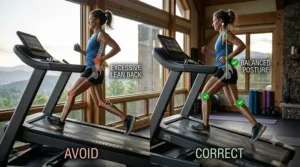
Quad Strengthening Workouts: Problem → Solution Guide
Problem 1: Quads that fatigue early on race-day descents. Solution: Build a weekly decline interval session — 5 x 3 minutes at your machine’s steepest comfortable grade, with 2-minute flat recoveries — specifically targeting the eccentric contraction pattern your quads need to adapt to before race day.
Problem 2: Knee discomfort that shows up only during decline running. Solution: Check your grade progression first; jumping straight to -5% or -6% before your joints adapt is the most common cause. Drop back to -2% for two full weeks, and prioritize a machine with strong deck cushioning, like the Sole TT8’s flex deck or NordicTrack’s RunFlex system, both of which are specifically designed to reduce landing impact.
Problem 3: No access to real hills for outdoor race-specific training. Solution: This is precisely the gap decline treadmills close — map your race’s elevation profile and replicate the grade percentages directly on the machine, turning any apartment into a stand-in for whatever course you’re training for.
Problem 4: Uncertainty about how steep is “enough” for a given race. Solution: Match your treadmill’s decline setting to your race’s steepest sustained section, not its average grade — race-day descents are rarely uniform, and training only at the average leaves you underprepared for the steepest stretch.
Problem 5: Soreness that derails the rest of a training week. Solution: This is a known and expected first-exposure response. Research on eccentric exercise confirms that a second bout of downhill-style training performed roughly a week after the first produces measurably less soreness than the initial session — a phenomenon known as the repeated bout effect. Space your early decline sessions roughly a week apart rather than back-to-back until that adaptation kicks in.
How to Choose a Treadmill for Downhill Running Training
Picking the right machine comes down to matching six specific factors to your actual training goals, not just grabbing whichever model has the flashiest screen.
- Confirm the actual decline percentage, not just “has decline.” Marketing copy sometimes buries this — insist on a specific negative number (-3%, -5%, -6%) before buying, since “decline capable” without a figure is a red flag.
- Match decline depth to your race’s steepest section, not its average grade, since undertraining for the steepest stretch is the single most common prep mistake.
- Check motor size relative to decline use. Eccentric loading stresses a motor differently than flat running; look for at least 3.5 to 4.0 CHP if you plan to train on decline regularly.
- Decide whether folding matters more than rigidity. Non-folding machines like the Sole TT8 tend to feel more stable at steep grades, but folding models like the 1750 or 2450 save real space.
- Factor in subscription costs honestly. Several machines here lean heavily on iFIT for their full experience — budget the recurring cost, not just the sticker price.
- Prioritize deck cushioning if you’re decline-training frequently. Reduced impact absorption compounds over dozens of sessions, and joint-friendly decks pay for themselves in reduced soreness and injury risk.
Decline Running Treadmill Comparison: Decline vs. Traditional Treadmills
| Feature | Decline-Capable Treadmill | Traditional Incline-Only Treadmill |
|---|---|---|
| Downhill simulation | Yes, true negative grade | None — flat is the lowest setting |
| Eccentric muscle conditioning | Directly trains it | Not addressed at all |
| Typical price floor | ~$1,700+ | Sub-$1,000 widely available |
| Race-specific course prep | Matches real elevation profiles | Uphill-only approximation |
| Motor demands | Higher, dual-direction stress | Lower, single-direction stress |
The gap here isn’t subtle: a traditional incline-only treadmill simply cannot replicate the muscle-lengthening demand of a real descent, no matter how creatively you program the workout. Based on the spec comparison, that’s the entire reason this category exists — runners who kept getting blindsided by downhill quad fatigue despite months of solid uphill and flat training needed a way to condition the specific movement pattern they were missing. If your race or training route has zero net elevation loss, a traditional treadmill remains the more cost-effective choice; if it doesn’t, the decline feature isn’t a luxury add-on, it’s the actual point.
Negative Incline Treadmills for Trail Runners
Trail runners occupy a slightly different training reality than road racers, and it’s worth calling out directly. Technical trail descents combine steep grade with uneven footing, meaning the treadmill can’t replicate the balance and proprioception demands of real singletrack — but it absolutely can replicate the raw muscular fatigue those descents produce, which is often the limiting factor in a runner’s finish time regardless of terrain skill.
For trail-specific prep, the deeper decline options in this guide — the X24 and Sole TT8 at -6% — do more useful work than the shallower -3% machines, since technical mountain courses frequently exceed a 10% grade on their steepest pitches. In iRunFar’s hands-on review of NordicTrack’s incline trainer category, the reviewer noted that runners who track weekly elevation gain the way road runners track mileage found real value in the machine’s ability to simulate that specific demand indoors. That said, don’t treat treadmill decline training as a full substitute for technical trail time; pair it with outdoor sessions whenever terrain allows, and use the treadmill specifically for the muscular conditioning piece that’s hardest to access consistently otherwise.
One more trail-specific consideration: weighted-vest decline walking, which several machines in this guide explicitly support via their handlebar and stability design, mimics the loaded descents common in mountain ultras better than unweighted running does, and it’s considerably gentler on connective tissue while still training the eccentric pattern.
The Science of Eccentric Muscle Training
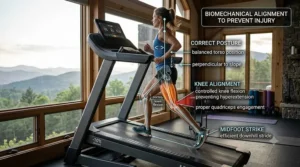
Understanding why decline running works requires understanding eccentric contraction, which is the biomechanical mechanism underlying every benefit claimed in this guide. During a normal step on flat ground, your quadriceps contract concentrically to help propel you forward. During a downhill step, gravity is doing the propelling, and your quads instead contract eccentrically — lengthening under load to control your descent and prevent your knee from buckling.
That lengthening-under-tension is precisely what makes eccentric exercise so effective for building strength, and also why it produces disproportionate muscle soreness compared to concentric work. A review of downhill and uphill running biomechanics found that downhill running emphasizes eccentric work and energy absorption particularly in the quadriceps, which is the direct source of the muscle damage and soreness runners associate with hard descents. Separate research measuring downhill running’s direct effects on muscle force found that it measurably increases markers of muscle damage and temporarily impairs maximal force production in the legs, which is the physiological explanation for why untrained quads feel wrecked after even a modest first descent. A related MRI-based study published in Scientific Reports went further, mapping exactly where within the quadriceps that damage concentrates after downhill exercise, confirming it isn’t spread evenly across the muscle group.
The upside is real, though: the same body of research documents a repeated bout effect, where prior exposure to eccentric loading through downhill running leads to measurably reduced soreness and strength loss the next time around, which is the entire justification for training this pattern deliberately before race day rather than experiencing it cold for the first time on the course.
Common Mistakes When Buying a Downhill Running Treadmill
The single most common mistake is buying based on incline number alone. A 40% incline is an impressive spec, but if your race has downhill sections and your chosen machine’s decline caps at -3%, you’ve solved the wrong half of the problem. Read the full grade range, both directions, before comparing price.
The second mistake is underestimating subscription costs. Several machines in this comparison are engineered around iFIT’s auto-adjust terrain simulation, and while manual mode still works without it, buyers who didn’t budget for the recurring fee often feel like they overpaid for hardware they’re not using to its potential.
The third mistake is ignoring footprint and delivery logistics, especially for the non-folding options like the Sole TT8 or the 747-pound Ultra 1 — both require dedicated space and, in the Ultra 1’s case, professional installation that folding models simply don’t need.
The fourth mistake is assuming every unit within a product line shares identical specs across model years. ProForm has previously removed decline capability from certain treadmill generations without much fanfare, which means the exact listing you’re buying — not just the product name — needs a spec check every time.
Long-Term Cost & Maintenance
| Cost Factor | Budget-Leaning Pick (1750 / Carbon Pro 9000) | Premium Pick (X24 / Ultra 1) |
|---|---|---|
| Upfront price | ~$1,700–$2,900 | ~$3,000–$15,000 |
| Annual subscription (if used) | ~$180–$396/year (iFIT) | ~$180–$396/year (iFIT) |
| Belt/deck maintenance cycle | Every 150–200 miles | Every 150–200 miles |
| Expected lifespan (moderate use) | 7–10 years | 10+ years, commercial-grade components |
Total cost of ownership tells a different story than sticker price alone. Over five years of regular training, the gap between the 1750 and the X24 narrows considerably once you factor in that both typically run on the same iFIT subscription cost — the real long-term differentiator becomes durability and whether the machine’s decline mechanism holds up under your specific training volume. For a runner doing two or three decline sessions weekly, the Sole TT8’s dual-motor design and lifetime frame warranty may actually represent better long-term value than a cheaper machine that needs belt or motor service sooner. Weigh the five-year picture, not just the checkout total, before deciding where to spend.
Features That Actually Matter (And Those That Don’t)
Deck cushioning matters enormously for decline training specifically, since landing impact increases on a downward grade — this is not a feature to skimp on. Motor CHP rating matters too, but mainly as a durability signal rather than a performance one; you’re not sprinting at 14 MPH on most decline sessions, so raw top speed matters less than sustained reliability under repeated grade changes.
Touchscreen size, by contrast, matters far less than marketing suggests. A 22″ display doesn’t train your quads any better than a 16″ one — it affects your entertainment experience, not your downhill conditioning. Similarly, built-in workout program libraries sound valuable but are largely redundant once you understand how to structure your own decline intervals, which this guide has already covered. If you’re choosing between two otherwise-similar machines and one costs meaningfully less because it has a smaller screen, that’s usually money well saved.
Frequently Asked Questions
❓ What decline percentage is best for downhill running training?
❓ Do I need a treadmill with decline to train for a hilly race?
❓ How often should I do decline treadmill workouts?
❓ Is the NordicTrack Commercial 1750 good for downhill running training?
❓ Can decline treadmill training cause knee pain?
Conclusion
Training for downhill running isn’t about grinding out more miles — it’s about exposing your quads to the specific eccentric loading pattern they’ll face on race day, deliberately and progressively, before the course does it for you without warning. The seven machines in this guide cover every realistic budget and training goal, from the NordicTrack Commercial 1750’s accessible -3% entry point to the X24 and Sole TT8’s serious -6% depth for mountain-course specialists, with the Bowflex Treadmill 22 splitting the difference and the Ultra 1 sitting at the top for buyers who simply want the best regardless of cost.
What matters most isn’t which specific model you land on — it’s committing to the training pattern itself. A shallow decline used consistently for eight weeks before your race will do more for your quads than a steep one you buy and barely touch. Start conservative, build gradually, and let the repeated bout effect work in your favor rather than fighting it with an overambitious first session.
Whichever machine fits your space, budget, and race goals, the descent that used to wreck your legs by mile 18 doesn’t have to anymore.
✨ Don’t Miss These Exclusive Deals!
🔍 Take your downhill running training to the next level with one of the decline treadmills covered above. Click through to check current pricing and availability, and start building the quad resilience your next race demands!
Recommended for You
- Manual Incline Treadmill: 7 Top Picks Reviewed for 2026
- Steep Incline Treadmill: 7 Best Picks for Hill Training in 2026
- 7 Best Treadmills Over $3,000 in 2026
Disclaimer: This article contains affiliate links. As an Amazon Associate, I earn from qualifying purchases. If you purchase products through these links, we may earn a small commission at no additional cost to you.
✨ Found this helpful? Share it with your friends! 💬🤗
