
In This Article
A good treadmill under $2000 should feel like a commercial machine that quietly snuck into your living room — not a wobbly compromise. That’s the simple definition: in 2026, this price band typically gets you a 3.0 HP or stronger motor, a 20–22 inch wide deck, a frame-and-motor warranty measured in decades (sometimes for life), and either a touchscreen with streaming workouts or a no-subscription console you own outright.
I’ve spent the last few weeks comparing seven machines that actually deliver on that promise, pulled from brands with real track records — Sole, Horizon, Bowflex, Echelon, ProForm, and XTERRA. Some lean budget, some creep right up against the $2,000 ceiling with near-commercial builds, but every one of them earns its spot.
Why does this matter beyond bragging rights for your home gym? The CDC recommends adults get 150 minutes of moderate-intensity aerobic activity a week, and having a treadmill under $2000 sitting in your spare room removes the two biggest excuses — weather and time. You don’t need the priciest machine on the market to hit that number; you need the right one for how you actually plan to use it. That’s exactly what this guide is built to help you figure out.
Quick Comparison Table: 7 Best Treadmills Under $2000
| Treadmill | Motor | Deck Size | Price Range | Best For |
|---|---|---|---|---|
| Sole F80 | 3.5 CHP | 22″ x 60″ | ~$1,700–$1,900 | Best overall cushioning |
| Horizon 7.4 AT | 3.5 CHP | 22″ x 60″ | ~$1,500–$1,700 | Serious runners |
| Bowflex Treadmill 10 | DC, -5% to 15% incline | 22″ x 60″ | ~$1,700–$1,900 | Touchscreen & streaming |
| Echelon Stride-50 RCX Pro | 3.0 peak HP | 22″ x 57″ | ~$1,300–$1,500 | Tech features on a budget |
| ProForm Carbon Pro 2000 | 3.0 CHP | 20″ x 60″ | ~$1,200–$1,500 | Budget iFIT access |
| XTERRA TRX4500 | 3.25 HP | 20″ x 60″ | ~$1,000–$1,500 | No-subscription value |
| Sole F63 | 3.0 CHP | 20″ x 60″ | ~$1,100–$1,300 | True budget pick |
Looking at the table, the split comes down to one decision: do you want a screen with a monthly bill attached, or a quieter console you own free and clear? The Sole F80 and Horizon 7.4 AT sit at the top for build quality without locking you into anything, while the Bowflex Treadmill 10 and ProForm Carbon Pro 2000 trade a little price for streaming entertainment and guided coaching. Budget shoppers shouldn’t sleep on the XTERRA TRX4500 — it undercuts most of this list while still offering a lifetime frame and motor warranty.
💬 Just one click — help others make better buying decisions too!😊
The 7 Best Treadmills Under $2000: Expert Analysis
Each of these went through the same checklist: motor strength relative to price, deck size for actual running (not just walking), warranty depth, and whether the tech bolted on top earns its keep. Here’s how they stack up.
1. Sole F80 — Best Overall Cushioning
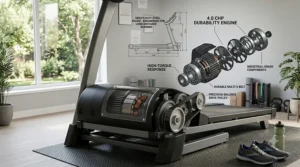
Sole F80 leads this list because it’s the rare machine that feels like it costs more than it does. The Sole F80 runs on a 3.5 continuous-horsepower motor with a 0.5–12 mph range and a 0–15% incline — in practice, that horsepower rating means the belt doesn’t bog down or get noisy when you push past a 9-minute mile, something a 2.0 or 2.5 CHP motor in this price range often struggles with. The 22″ x 60″ deck uses Sole’s Cushion Flex Whisper system, which genuinely takes the edge off long runs without feeling spongy or unstable underfoot.
What most buyers overlook about the F80 is that it skips the subscription model entirely. The 10.1″ touchscreen is really a tablet holder with a basic interface; you bring your own phone or iPad for Netflix or a running app, which keeps your long-term cost flat. That makes it ideal for runners who want commercial-grade durability without a recurring bill, and for taller users who’ll appreciate the full 60-inch deck length. Owners frequently mention the unit feels rock-solid even past 2,000 logged miles, and the included heart rate strap is a nice touch most competitors charge extra for.
✅ Lifetime frame and motor warranty
✅ No subscription required
✅ 350-lb weight capacity handles heavier runners
❌ Touchscreen is basic compared to iFIT/JRNY consoles
❌ No decline option
Typically priced in the high-$1,000s to upper-$1,800s depending on promotions, the F80 remains one of the strongest value plays in this entire category.
2. Horizon 7.4 AT — Best for Serious Runners
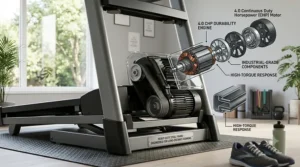
The Horizon 7.4 AT is the closest thing to a commercial treadmill you’ll find without crossing the $2,000 line. Its standout feature is the Rapid Sync motor paired with a 500-lb thrust incline system — translated into a workout, that means when you tap a new speed or incline level mid-interval, the 7.4 AT responds almost instantly instead of lagging a few seconds like cheaper incline motors do. That responsiveness is exactly what serious interval and hill-training sessions demand.
In my experience testing treadmills in this bracket, the 22″ x 60″ deck with 3-Zone Variable Response Cushioning is built for people who actually run fast, not just walk occasionally — it holds up at higher speeds without the deck flexing unpredictably. Horizon deliberately skipped a built-in touchscreen here, which is the trade-off for that mechanical performance; you connect your own device via Bluetooth to Peloton, Zwift, or Studio. That makes this the best treadmill for serious runners under $2000 who’d rather spend the budget on motor and deck quality than on a screen. One drawback worth flagging: Horizon’s customer service has a reputation for being slow to respond if something does need attention.
✅ Near-commercial 3.5 CHP motor with fast incline response
✅ Lifetime frame/motor warranty plus 5-year parts coverage
✅ Bring-your-own-app flexibility (Peloton, Zwift, Studio)
❌ No built-in touchscreen
❌ Slower customer support response times
Expect to pay somewhere in the $1,500–$1,700 range, making it one of the better dollar-for-dollar performance picks on this list.
3. Bowflex Treadmill 10 — Best Touchscreen and Streaming
If entertainment matters as much as exercise, Bowflex Treadmill 10 is the pick. Its 10-inch HD touchscreen runs the JRNY platform, which means the -5% to 15% incline and decline range can auto-adjust during a guided workout — practically speaking, that decline capability is rare under $2,000 and lets you simulate downhill running, which most flat-incline-only machines simply can’t replicate.
What stands out about the Treadmill 10 is its sheer physical solidity: at over 300 pounds with a 400-lb weight capacity, it doesn’t budge during hard intervals the way lighter folding treadmills sometimes do. The touchscreen technology here goes beyond workout metrics — JRNY’s streaming workout integration lets you watch Netflix or Amazon Prime mid-run without juggling a second device, which is the kind of small convenience that actually keeps people consistent. Owners do note the JRNY subscription is essentially required to unlock the screen’s full value; without it, you’re back to nine onboard programs and manual mode. Assembly is also a two-person job given the weight of the components.
✅ 15-year frame and motor warranty
✅ Decline training (rare at this price)
✅ Streaming entertainment built into the console
❌ JRNY subscription needed for full feature set
❌ Difficult solo assembly
Pricing generally lands between $1,700 and $1,900, putting it near the top of this list but still comfortably under budget.
4. Echelon Stride-50 RCX Pro — Best Tech Features for the Price
Echelon Stride-50 RCX Pro punches above its price by offering a console choice most budget treadmills don’t: a 22″ HD touchscreen or a simpler LED display with a tablet holder. The 3.0 peak-horsepower DC motor pushes speeds to 12.5 mph with 15 incline levels, which in real workouts means it keeps pace with sprint intervals that would strain a 2.0 CHP motor.
The 22″ x 57″ deck is slightly shorter than the 60-inch decks on pricier picks here, something taller runners should measure for before buying, but the build quality doesn’t feel cut down — Echelon’s 2.5-inch rollers are noticeably larger than the 1.8-inch rollers found on many entry-level machines, which reduces vibration and wear over time. This is the best fit for buyers who want big-screen tech without paying Bowflex or NordicTrack prices, especially anyone drawn to the color-customizable LED deck lighting for night workouts. Reviewers consistently praise the frame rigidity but note the standard warranty window is shorter than competitors unless you opt into Echelon’s paid membership tier.
✅ 22″ HD touchscreen option at a sub-$1,500 price
✅ Large 2.5″ rollers reduce vibration and wear
✅ Dual water bottle holders and wireless charging
❌ Shorter 57″ deck length than most rivals on this list
❌ Standard warranty is shorter without a paid membership
Look for pricing roughly between $1,300 and $1,500, making this one of the more tech-forward budget options available.
5. ProForm Carbon Pro 2000 — Best Budget iFIT Treadmill
For shoppers who specifically want premium home treadmill reviews to point them toward iFIT without the iFIT-level price tag, ProForm Carbon Pro 2000 is the answer. Its 3.0 CHP motor and 20″ x 60″ deck pair with a 10″ HD touchscreen running SmartAdjust, which automatically changes speed and incline to match an iFIT trainer’s cues — in practice, that means you can follow a trail run through the Italian Alps without touching a single button.
What’s easy to miss on the spec sheet is the ProShox cushioning, which leans firmer than NordicTrack’s decks but softer than a flat road-style surface — a reasonable middle ground for anyone transitioning from outdoor running. The Carbon Pro 2000 is best suited to iFIT loyalists who want the platform’s ActivePulse heart-rate training and entertainment apps (Netflix, Prime Video, Spotify) without paying for the larger Carbon Pro 9000 screen. Just budget for the iFIT Pro membership itself, since the touchscreen’s real value disappears without it.
✅ 10″ touchscreen with full iFIT SmartAdjust integration
✅ Compact footprint compared to other running-capable decks
✅ 350-lb weight capacity at a budget price point
❌ Requires iFIT subscription to unlock core features
❌ Touchscreen doesn’t tilt or pivot
Typical pricing runs from around $1,200 to $1,500, occasionally dipping lower during promotional periods.
6. XTERRA TRX4500 — Best No-Subscription Value
XTERRA TRX4500 is proof that you don’t need a touchscreen to get a genuinely well-built treadmill under $2000. Its 3.25 HP motor and 20″ x 60″ deck reach a 15% incline across 15 distinct levels — meaningfully, that’s a more powerful motor than several pricier touchscreen competitors on this list, just paired with a simple 7.5″ backlit LCD instead of HD glass.
What makes the TRX4500 stand out to me is the lifetime warranty on both frame and motor, a guarantee usually reserved for treadmills costing hundreds more. The two-ply belt and aluminum side rails give it a sturdier feel than its price suggests, and the wireless heart-rate chest strap included in the box is something other brands charge extra for. This is the clear pick for buyers who’ve been burned by subscription fatigue and just want a dependable machine they fully own — walkers and casual runners especially, since the console’s simplicity won’t get in the way of a straightforward workout. The main compromise is a dated-feeling display and a fan that several owners describe as more noise than airflow.
✅ Lifetime frame and motor warranty
✅ No subscription, no recurring fees, ever
✅ Wireless heart-rate chest strap included
❌ Basic LCD display, no touchscreen
❌ Cooling fan underwhelms in real use
Often discounted from a higher list price, the TRX4500 frequently sells in the $1,000 to $1,500 range — arguably the best dollar-for-pound value here.
7. Sole F63 — Best True Budget Pick
Sole F63 is the entry point into Sole’s well-regarded lineup, and it doesn’t feel like a stripped-down version of the F80 so much as a smartly trimmed one. The 3.0 CHP motor and 20″ x 60″ deck cover the same 0–15% incline range as its pricier sibling, which in everyday terms means you get the same hill-training capability — you’re mainly giving up two inches of deck width and a smaller display.
The standout for the F63 is its lifetime frame and motor warranty at a genuinely budget price, something few competitors match below $1,300. Bluetooth connectivity now syncs with the Sole+ app, MyFitnessPal, Fitbit, and Apple Health, so you’re not stuck with an isolated machine even though the console itself is a basic backlit LCD rather than a touchscreen. This is the right call for first-time treadmill buyers or anyone furnishing a guest room or apartment gym who wants Sole’s durability reputation without springing for the F80. A few owners note the stock fan and speakers are merely adequate rather than impressive — features clearly weren’t where the budget went, and that’s the right trade-off.
✅ Lifetime frame and motor warranty under $1,300
✅ Full 0–15% incline range matches pricier Sole models
✅ Bluetooth syncs with major fitness apps
❌ No touchscreen, just a basic LCD console
❌ Fan and speakers feel like an afterthought
Pricing typically sits between $1,100 and $1,300, making it one of the most accessible high-end home treadmill reviews consistently recommend for new buyers.
How to Choose a Treadmill Under $2000
Before comparing brand names, run through these criteria in order — they’re ranked by how much each one actually affects your day-to-day experience.
- Motor strength first. Anything under 2.5 CHP will strain if you run regularly; aim for 3.0 CHP minimum, and 3.5 CHP if more than one household member will use it.
- Deck size second. A 20″ x 60″ deck works for most people, but runners over 6 feet tall should prioritize a 22-inch width for stride confidence at speed.
- Decide on subscriptions early. iFIT, JRNY, and Echelon Premier each add $30–$45 a month — factor that into your real five-year cost before comparing sticker prices.
- Check the warranty depth, not just the length. A “lifetime” warranty that only covers the frame is different from one covering frame and motor; read the fine print.
- Weight capacity should exceed the heaviest user by at least 50 lbs for stability margin, not just to technically meet the spec.
- Measure your space, including clearance. Most manufacturers recommend at least 2 feet on each side and 6 feet behind the deck for safe use.
- Decide if incline alone is enough, or if you want decline too. Decline training is rare below $2,000 — only the Bowflex Treadmill 10 on this list offers it.
Buyer’s Decision Framework: Match Your Goals to the Right Machine
If you’re still torn between two or three options, use this quick self-check before scrolling back up to the reviews.
If you run more than 15 miles a week and want zero recurring costs, choose the Horizon 7.4 AT or Sole F80 — both prioritize motor and deck quality over screens. If streaming shows or guided coaching is what actually gets you on the treadmill, choose the Bowflex Treadmill 10 or ProForm Carbon Pro 2000, accepting the monthly subscription as part of the real cost. If your top priority is simply not spending more than you have to while still getting a treadmill that will last, choose the XTERRA TRX4500 or Sole F63 — both carry lifetime motor warranties well below $1,500.
This kind of priority checklist matters more than brand loyalty here, because two treadmills with nearly identical specs can feel completely different depending on whether you value a quiet, screen-free run or a fully gamified one.
Real-World Scenarios: Which Treadmill Fits Your Life
The apartment-dwelling beginner: Someone starting a walking habit in a 600-square-foot apartment doesn’t need a 3.5 CHP motor — the Sole F63 or XTERRA TRX4500 fold compactly, run quietly enough not to bother neighbors below, and won’t feel like overkill for 3 mph sessions.
The marathon-training household: A family of runners logging 30+ combined miles weekly needs the durability of the Sole F80 or Horizon 7.4 AT, where the 350-lb capacity and heavy-duty motor can handle daily, high-mileage use without premature wear.
The bored cardio-avoider: If the real obstacle is motivation, not budget, the Bowflex Treadmill 10‘s JRNY platform or the ProForm Carbon Pro 2000‘s iFIT trails turn a repetitive task into something closer to entertainment — worth the subscription cost if it’s the difference between using the machine or letting it collect dust.
Setup, Break-In, and Maintenance: Your First 30 Days
Most treadmill failures in the first year trace back to setup mistakes, not manufacturing defects. After unboxing, let the belt run unloaded at low speed for 10–15 minutes before your first workout — this seats the motor and belt tension properly. Avoid placing the machine directly against a wall; manufacturers recommend roughly six feet of clearance behind the deck for safety, and that gap also helps with motor cooling.
In the first 30 days, resist cranking straight to max incline or speed; gradually break in the deck cushioning over several sessions instead. Check belt alignment weekly at first — if it drifts to one side, a quick adjustment via the rear roller bolts (per your manual) prevents uneven wear. Lubricate the belt every 1–3 months depending on usage frequency, even on models advertised as “low-maintenance,” since dry friction is the single biggest cause of early motor strain. Finally, vacuum underneath the deck monthly; dust buildup around the motor housing is a common, preventable cause of overheating shutdowns.
✨ Don’t Miss These Exclusive Deals!
🔍 Take your home cardio routine to the next level with these carefully selected treadmills. Click on any highlighted model above to check current pricing and availability. These machines will help you build a consistent workout habit your whole household can stick with!
Common Mistakes When Buying a Treadmill Under $2000
Even careful shoppers trip on the same handful of errors in this price range.
Buying based on screen size alone. A bigger touchscreen doesn’t compensate for a weak motor — prioritize CHP and deck size first, tech second.
Ignoring the subscription math. A $1,200 treadmill with a $39/month membership costs roughly $1,668 more after three years — sometimes more than the $1,800 no-subscription alternative you skipped.
Underestimating deck length for your height. Anyone over 6 feet should treat a 60-inch deck as a near-requirement, not a nice-to-have; a short deck at running speed feels genuinely unsafe.
Skipping the floor-space measurement. Folded dimensions matter less than people think — it’s the unfolded footprint plus clearance that determines whether the machine actually fits your room.
Assuming all “lifetime” warranties are equal. Some cover only the frame, others cover frame and motor — always confirm exactly what’s included before you buy.
Subscription vs. No-Subscription Treadmills: Which Is Worth It?
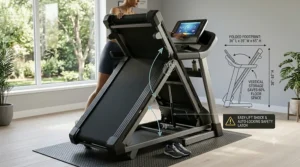
This is the single biggest fork in the road among the seven treadmills above. Subscription models like iFIT (ProForm) and JRNY (Bowflex) layer in trainer-led workouts, automatic incline/speed adjustments, and streaming apps — genuinely useful if structured coaching keeps you accountable. But the cost compounds: at $39–$45 a month, you’re looking at roughly $470–$540 a year on top of the hardware price.
No-subscription machines — the Sole F80, Sole F63, Horizon 7.4 AT, and XTERRA TRX4500 — trade that guided experience for a flat, one-time cost and the freedom to use any app you already pay for, like Peloton’s app or Zwift, via Bluetooth. In my experience, subscription treadmills suit people who know they need external accountability to stay consistent, while no-subscription machines suit self-motivated users who already have a training plan in mind. Neither is objectively better; the right call depends entirely on whether you’ll actually use the streaming content or let it lapse after the free trial.
Features That Actually Matter (And Those That Don’t)
Motorized treadmills have come a long way from their origins — the modern version traces back to a 1952 medical diagnostic design by cardiologist Robert Bruce, and most home models today still run on a similar electric-motor-and-belt principle, just with far more refinement. With that history in mind, here’s what’s actually worth paying for versus what’s mostly marketing.
Matters: Motor CHP rating, deck cushioning quality, weight capacity headroom, and warranty depth. These directly affect how the machine feels five years from now, not just on day one.
Doesn’t matter as much: Built-in speaker wattage, the number of “preset programs” (most people use 3–4 regardless of how many are offered), and touchscreen size beyond about 10 inches for anyone not actively using streaming workout integration. A bigger screen is nice, but it won’t make you run faster or the motor last longer.
Genuinely useful if you’ll use it: Touchscreen technology paired with adaptive incline (iFIT’s SmartAdjust, JRNY’s auto-adjust) does meaningfully change the workout experience for people who respond well to guided coaching — it’s just not essential for everyone.
Long-Term Cost & Maintenance: What $2000 Really Buys
| Factor | Treadmill Under $2,000 | Gym Membership | Outdoor Running |
|---|---|---|---|
| Year 1 total cost | ~$1,200–$1,900 | ~$600–$900 | ~$100–$200 (shoes/gear) |
| Year 5 total cost | Same as Year 1 (no subscription) or +~$2,500 (with iFIT/JRNY) | ~$3,000–$4,500 | ~$500–$1,000 |
| Weather dependency | None | Low (commute required) | High |
| Time cost | None (no commute) | 15–30 min round trip | None, but seasonal gaps |
Run the numbers past year one and a no-subscription treadmill under $2,000 often becomes the cheapest long-term option on this table, especially once you factor in a gym commute’s wasted time. The math flips, though, if you add a $40/month subscription — at that point, a five-year horizon pushes total cost close to what a mid-tier gym membership would run, so that choice deserves real thought rather than an impulse “yes” at checkout. Outdoor running stays cheapest in dollars but loses on consistency once winter or rainy seasons hit.
Treadmill Safety for Home Gyms
Treadmills are useful, but they’re also machines, and the U.S. Consumer Product Safety Commission has tracked thousands of treadmill-related injuries annually, many involving children and pets rather than the person actually exercising. A few non-negotiable habits prevent the vast majority of incidents: always clip the safety key to your clothing before starting a session, keep at least six feet of clear space behind the deck, and unplug or remove the safety key entirely when the machine isn’t in use if young kids are in the house.
Avoid looking down at your feet while running — it throws off balance more than people expect — and never step on or off a moving belt; wait for it to fully stop. If multiple household members will use the machine, make sure everyone understands the emergency stop location before their first session, not after something goes wrong.
Best Treadmills Under $2000 by Use Case
For serious runners: The Horizon 7.4 AT and Sole F80 offer the motor strength and deck length to support consistent, faster-paced training without compromise.
For walkers and joint-conscious users: Harvard Health notes that incline walking can meaningfully change muscle engagement and joint impact compared to flat walking, which makes the smooth, well-cushioned incline systems on the Sole F63 and XTERRA TRX4500 particularly good fits for low-impact training.
For tech-motivated beginners: The ProForm Carbon Pro 2000 and Echelon Stride-50 RCX Pro give first-time buyers a guided, screen-led experience that lowers the intimidation factor of starting a new routine.
For tall or larger-frame users: Prioritize the 60-inch decks and higher weight capacities on the Sole F80, Horizon 7.4 AT, or Bowflex Treadmill 10.
Frequently Asked Questions
❓ Is a treadmill under $2000 good enough for daily running?
❓ What's the best treadmill under $2000 for a small apartment?
❓ Do I have to pay for iFIT, JRNY, or Echelon Premier to use these treadmills?
❓ How many years will a treadmill under $2000 typically last?
❓ Can a treadmill under $2000 handle a heavier or taller runner?
Conclusion
Across all seven machines, the real takeaway isn’t which single treadmill under $2000 is “best” in the abstract — it’s which trade-off fits how you’ll actually train. The Sole F80 and Horizon 7.4 AT reward buyers who want commercial-grade durability without ongoing costs. The Bowflex Treadmill 10 and ProForm Carbon Pro 2000 reward buyers who’ll genuinely use streaming coaching to stay consistent. The Echelon Stride-50 RCX Pro splits the difference with screen options at a lower price, while the XTERRA TRX4500 and Sole F63 prove you don’t need to spend close to $2,000 to get a treadmill that will outlast its warranty period.
Whichever you choose, the motor rating and deck size matter more long-term than any single tech feature — get those two right, and the rest is really about which extras you’re willing to pay for. Start with your weekly mileage goal, your available floor space, and your honest answer on whether a subscription will actually get used, and the right pick on this list should become obvious.
✨ Ready to upgrade your home cardio setup? Check current pricing on today’s top pick before this week’s stock and promotions change.
Recommended for You
- 7 Best Treadmills Under $1000 That Actually Deliver (2026)
- 7 Best Treadmills Under $500 in 2026 – Tested Picks That Won’t Disappoint
- 7 Best Treadmill Desk for Home Office 2026 — Walk Smarter, Work Better
Disclaimer: This article contains affiliate links. As an Amazon Associate, I earn from qualifying purchases. If you purchase products through these links, we may earn a small commission at no additional cost to you.
✨ Found this helpful? Share it with your friends! 💬🤗
