
In This Article
Here’s an uncomfortable truth the fitness industry would rather skip: the average home treadmill is a very expensive clothes hanger. The machine usually isn’t the culprit. The mismatch is. A runner’s machine ends up with a walker, a $2,000 touchscreen beast goes to someone who just wanted to start moving, or a wobbly bargain-bin special gets retired after six weeks. If you’re shopping for a budget treadmill for beginners weight loss, the goal is smaller and smarter. You want a machine sturdy enough to survive your good intentions, simple enough that you’ll actually step on it, and priced so a missed week doesn’t feel like a financial crime.
So what can a treadmill honestly do for weight loss? Quite a lot, with one caveat. The CDC’s physical activity guidance says adults need at least 150 minutes of moderate-intensity aerobic activity a week, plus two days of muscle-strengthening. It also notes that most weight loss comes from eating fewer calories, while regular movement is what helps you keep the weight off. A treadmill won’t melt fat by itself. It’s a consistency machine. It deletes the weather, the dark evenings, and the “I’ll go after work” excuse.
This guide is built for starting a fitness routine on a real-world budget, whether it’s your first home gym purchase or your fifth attempt. You’ll get seven real models spanning roughly $300 to $2,000, a plain-English read on what each spec means for a newcomer, and a 30-day plan. One honesty note up front: I haven’t personally tested these machines. Every opinion below is analysis grounded in published specs and independent expert testing. Prices are ranges at the time of research and may vary, so check current pricing before you buy.
Quick Comparison: Budget Treadmill for Beginners Weight Loss at a Glance
| Treadmill | Price Range* | Motor | Max Speed | Best For |
|---|---|---|---|---|
| Goplus 2-in-1 Folding Treadmill | Under $350 | 2.25 HP | 7.5 mph | Desk walkers and tiny spaces |
| Sunny Health & Fitness SF-T4400 | High-$300s | 2.2 HP | 9 mph | Tightest budgets, walking plus light jogging |
| WalkingPad P1 | $450-$550 | Not specified | 3.75 mph | Apartment dwellers who only walk |
| Horizon T101 | $600-$700 | 2.5 HP | 10 mph | Walkers who want incline and cushioning |
| Horizon 7.0 AT | $1,000-$1,100 | 3.0 CHP | 12 mph | Beginners who plan to start running |
| Sole F63 | $1,000-$1,200 | 3.0 HP | 12 mph | Long-term value and a lifetime warranty |
| NordicTrack Commercial 1750 | $1,800-$2,200 | 3.5 CHP | 12 mph | Guided classes and joint comfort |
Ranges reflect pricing at the time of research and change often. Check current price.
Look at the table and one pattern jumps out: motor strength and top speed climb together, but the real jump comes at the $1,000 mark, where you get a 60-inch deck and a lifetime frame-and-motor warranty. If you know you’ll walk for the first few months, the Sunny Health & Fitness SF-T4400 and Horizon T101 deliver the best cost-to-capability ratio. If running is even a vague ambition, the Horizon 7.0 AT and Sole F63 are the safer long-term bets. The WalkingPad P1 is a different animal entirely, a walking-only device that wins on storage, not speed.
💬 Just one click — help others make better buying decisions too!😊
Top 7 Budget Treadmill for Beginners Weight Loss: Expert Analysis
Quick note on method: I couldn’t verify a large, reliable pool of aggregated customer ratings for every model. So the “review sentiment” lines below summarize what published expert testing and reviews report. I’ll say plainly where something couldn’t be verified instead of dressing it up.
1. Goplus 2-in-1 Folding Treadmill — slides under a desk, folds nearly flat
The party trick here is the two-mode design. Handrails down, it’s a walking pad about 5 inches tall. Handrails up, it becomes a compact jogger.
The 2.25 HP motor tops out at 7.5 mph with the handles raised and about 2.5 mph with them lowered. In practice, handles-up mode is the one that serves weight-loss goals, because a 2.5 mph stroll is often gentler than the brisk pace that counts as moderate intensity. It supports up to 265 pounds and weighs roughly 70 pounds, so it moves easily.
My read: this is the lowest-risk way to test whether you’ll stick with a treadmill at all. It suits desk workers who want extra steps and beginners with a very small budget. It’s not for anyone planning a running habit.
Published testing praised the remote control and the tiny footprint. It flagged an underpowered motor that can struggle to start the belt with weight on it, LCD metrics that didn’t feel reliable, and a modest durability score. The warranty is short, at 90 days.
Pros:
- ✅ Fits under most standing desks
- ✅ Remote makes speed changes effortless
- ✅ Lowest entry price on this list
Cons:
- ❌ Motor struggles to start under load
- ❌ Short warranty and modest durability
Price: under $350 range. Verdict: great trial machine, not a long-term workhorse.

2. Sunny Health & Fitness SF-T4400 — manual incline at a bargain price
Incline on a treadmill this cheap is the standout, and it’s a genuine upgrade over a flat belt.
The SF-T4400 reaches 9 mph with a 2.2 HP motor and offers three manual incline levels up to about 4.3 percent. Manual means you adjust it while standing off the belt, so don’t expect mid-workout changes. The 49-inch running surface is shorter than the 55 to 60 inches experts recommend for running, which is fine for walking and gentle jogging. The weight limit is 220 pounds. It folds from roughly 62 inches long down to about 36, with a soft-drop hydraulic system so the deck doesn’t slam your floor.
This is a textbook entry-level weight loss treadmill: honest, simple, and priced for hesitant starters. Heavier users or future runners will outgrow it.
Independent testers called it well suited to staying active and burning calories, not to racing, and they scored its footprint and portability perfectly. The 2.2 HP motor was described as better for newcomers than for sustained hard efforts. Warranty is three years on the frame and 180 days on parts.
Pros:
- ✅ Incline options at a very low price
- ✅ Soft-drop folding is easy and safe
- ✅ Compact when stored upright
Cons:
- ❌ Short 49-inch deck limits running
- ❌ 220-pound capacity excludes many users
Price: high-$300s range. Verdict: the best pure value for walkers.
3. WalkingPad P1 — folds in half and hides under a couch
Most folding treadmills fold upright. The WalkingPad P1 folds in half, shrinking from about 56 inches to roughly 32 inches, and it’s only about 5 inches tall.
The catch is speed: 3.75 mph maximum on a 47-inch deck. That’s a steady walk, and it’s the point. The FootSense feature lets you speed up or slow down by drifting toward the front or back of the belt, or you can use the remote or phone app. There’s no display on the machine, so your numbers live in the app. It arrives pre-assembled and supports 220 pounds.
My take: this is for people whose real barrier is space or noise sensitivity, such as apartment dwellers, shift workers, and desk walkers. For weight loss, a walking pad works if you accumulate minutes, but it won’t take you through a jogging phase.
Reviewers who tested the P1 and its sibling praised the pre-assembled setup and the easy lift-and-store design. The common complaints were no on-board display and the low top speed. The warranty is one year.
Pros:
- ✅ Folds in half for under-bed storage
- ✅ Arrives pre-assembled, zero setup stress
- ✅ Quiet, desk-friendly walking
Cons:
- ❌ Max speed too low for jogging
- ❌ No built-in display for metrics
Price: $450-$550 range. Verdict: pay for the storage, not the power.
4. Horizon T101 — the easiest setup in its price class
Setup is where the Horizon T101 shines. Expert testers called it among the easiest treadmills they’d ever assembled, which matters when you’re already nervous about a first home gym purchase.
The T101 pairs a 2.5 HP motor with a 10 mph top speed and up to 10 percent incline. Ten percent turns a flat walk into a calorie-demanding hill climb, which is the cheapest way to raise intensity without running. The three-zone cushioned deck is softer where your foot lands and firmer where you push off, which can feel kinder on knees. It supports 300 pounds. The lighter aluminum frame is typical at this price but less rugged than steel.
My analysis: this is the sweet spot for a walker-who-might-jog. EasyDial knobs make speed and incline changes simple, and the lifetime motor and frame warranty speaks well for the machine.
Published testing praised the cushioning and the effortless setup, and marked the minimal tech and limited programming as the trade-off.
Pros:
- ✅ Ten percent incline boosts walking workouts
- ✅ Cushioned deck is gentler on joints
- ✅ Lifetime motor and frame warranty
Cons:
- ❌ No interactive programming or touchscreen
- ❌ Lighter aluminum frame is less durable
Price: $600-$700 range. Verdict: the most balanced budget-friendly all-rounder.
5. Horizon 7.0 AT — a runner’s deck without a subscription
This model hits a rare combination: a 60-inch deck, a 3.0 CHP motor, and no required subscription.
Specs worth translating: 12 mph top speed, 15 percent incline, a 20 by 60-inch cushioned deck, and a 325-pound capacity. That 60-inch deck is the length experts recommend for running, so you won’t feel cramped when your stride lengthens. Bluetooth lets you pair with apps such as Zwift and Peloton, so you can bring your own programming. Reported noise runs about 48 to 65 dB, quiet for a treadmill. It’s heavy, near 277 pounds, so plan the location before delivery.
My read: this is the “buy once” option for beginners who suspect they’ll move from walking to jogging. Prices vary widely by retailer and promotion, with list prices well above typical street pricing, so compare before buying.
Reviews highlight the responsive, quiet motor and the lifetime frame and motor warranty. Common critiques include imperfect Bluetooth heart-rate pairing and a console that feels less modern than rivals’.
Pros:
- ✅ Full 60-inch deck suits running strides
- ✅ Quiet, responsive 3.0 CHP motor
- ✅ No subscription required to use
Cons:
- ❌ Console feels dated next to rivals
- ❌ Heavy and bulky to move
Price: $1,000-$1,100 range lately. Verdict: strongest long-term value if you can stretch the budget.
6. Sole F63 — lifetime warranty and a no-nonsense build
Sole’s entry model is the safest choice for buyers who hate surprises.
The 3.0 HP motor supports 325 pounds, hits 12 mph, and tilts to 15 percent incline over a 22 by 60-inch deck. The wider belt gives a bit more room than many competitors. It includes nine built-in programs (hill, fat burn, cardio, strength, interval, plus user and heart-rate modes) and ships with a chest-strap heart rate monitor. Bluetooth speakers and a tablet holder let you stream your own shows. It folds from about 77 inches down to roughly 50, with four transport wheels and hydraulic-assisted lowering.
My take: that built-in “fat burn” program and heart rate monitor give beginners structure without a monthly fee. It’s the most complete package in the ordinary-budget tier.
Independent testers reported smooth incline and a reasonable noise level, with some wobble at the highest speed and incline settings. The warranty is lifetime on frame and motor, two years on parts, and one year on labor.
Pros:
- ✅ Lifetime frame and motor warranty
- ✅ Heart rate chest strap included
- ✅ Wide 22 by 60-inch deck
Cons:
- ❌ Slight wobble at top speed and incline
- ❌ Basic LCD, no guided classes built in
Price: $1,000-$1,200 range. Verdict: the dependable, set-and-forget pick.
7. NordicTrack Commercial 1750 — the splurge with adjustable cushioning
I’m including the NordicTrack Commercial 1750 as the premium reality check. It’s not budget, but it shows what extra money buys.
You get a 3.5 CHP motor, -3 to 12 percent incline and decline, a 14-inch touchscreen, and Runners Flex cushioning that testers could adjust with a knob on early models. Newer versions may have the setting fixed, so check the listing. It’s large, about 80 by 38 inches, and weighs around 340 pounds, and it takes two people to assemble.
My analysis: the iFIT subscription, around $40 a month at research time, is what makes this machine worth the price. Without it, you’re paying for hardware you don’t fully use. Over two years that subscription adds roughly $900 to the real cost.
Reviewers praised the cushioning, the motor, and the trainer-led programming, and criticized the footprint and the ongoing fee. Warranty is ten years on the frame, two on parts, one on labor.
Pros:
- ✅ Adjustable deck cushioning for joints
- ✅ Powerful 3.5 CHP motor
- ✅ Guided classes make workouts fun
Cons:
- ❌ Needs a paid subscription to shine
- ❌ Large footprint and two-person assembly
Price: $1,800-$2,200 range. Verdict: lovely, but beyond most first-timers’ budgets.
Top 7 Specs Compared
| Treadmill | Deck Length | Incline | Weight Capacity | Warranty Highlights | Best For |
|---|---|---|---|---|---|
| Goplus 2-in-1 Folding Treadmill | Compact | None | 265 lb | 90 days | Trial and desk use |
| Sunny Health & Fitness SF-T4400 | 49 in | Up to about 4.3% (manual) | 220 lb | 3-year frame, 180-day parts | Frugal walkers |
| WalkingPad P1 | 47 in | None | 220 lb | 1 year | Small apartments |
| Horizon T101 | About 55 in | Up to 10% | 300 lb | Lifetime frame and motor | Walkers who may jog |
| Horizon 7.0 AT | 60 in | Up to 15% | 325 lb | Lifetime frame and motor | Future runners |
| Sole F63 | 60 in | Up to 15% | 325 lb | Lifetime frame and motor | Long-term value |
| NordicTrack Commercial 1750 | 60 in | -3% to 12% | 300 lb | 10-year frame | Guided class fans |
Read the deck and warranty columns together and the story gets clear. Below the $700 line, you’re buying walking-focused machines with short or limited warranties, so treat them as lower-risk experiments. Above $1,000, the Horizon 7.0 AT and Sole F63 offer nearly identical muscle, with the Sole adding a wider belt and bundled heart rate monitor, and the Horizon adding open app compatibility. Heavier beginners should pay particular attention to the capacity column, since 220 pounds is a real ceiling on two of these.
What Is a Budget Treadmill for Beginners Weight Loss?
A budget treadmill for beginners weight loss is an entry-level motorized running or walking machine, typically priced from about $300 to $1,200, that offers simple controls, a forgiving deck, adjustable speed and some incline, and enough durability to support regular, low-to-moderate-intensity cardio sessions that help a new exerciser burn calories alongside a calorie-aware diet.
In plainer words, it’s a treadmill designed to be approachable, not impressive. You’re not paying for a 22-inch touchscreen or a 12 percent decline. You’re paying for a belt that doesn’t stutter, a motor that doesn’t whine, and a frame that doesn’t shake when you pick up the pace.
Why does this category exist? Because the barrier to most beginners isn’t fitness. It’s friction. The more steps between your couch and your first mile, the lower the odds you’ll take them. A treadmill removes the trip to the gym, the parking, the judging stares, and the forecast. That convenience is what you’re really buying, which is why a cheaper machine you use four times a week beats a premium one you use twice.
How to Choose a Budget Treadmill for Beginners Weight Loss
- Decide walk, jog, or run first. Walkers can thrive on a smaller, cheaper deck. Runners need roughly 55 to 60 inches of belt, so a cramped stride doesn’t become a tripping hazard.
- Match the motor to your plan. Lower-horsepower motors handle walking and light jogging. If you’ll log many sustained running miles, look at continuous-duty (CHP) motors that don’t overheat.
- Check weight capacity with margin. Choose a rating comfortably above your weight so the motor and frame aren’t straining from day one.
- Prioritize incline over gadgets. A climb is the cheapest intensity booster for walkers, and experts routinely point to the broad cardiovascular and wellbeing benefits of regular walking.
- Read the warranty like a durability report card. Lifetime frame and motor coverage signals confidence. A 90-day warranty says “treat this as disposable.”
- Measure your space and ceiling. Folding helps, but you also need clearance behind the machine and overhead.
- Budget for the hidden extras. Subscriptions, a mat, and delivery or assembly help can move the real cost.
The Affordable Treadmill for Fitness Beginners Test: Three Numbers
When comparing any affordable treadmill for fitness beginners, boil the spec sheet down to three numbers: deck length, warranty length, and weight capacity. Deck length decides whether you’ll outgrow it, warranty length predicts how much the maker trusts the build, and weight capacity tells you whether it’s built for you. Everything else, including the speaker quality and the LCD color, is a rounding error beside those three.
What to Expect: Real-World Performance of an Entry-Level Weight Loss Treadmill
Spec sheets rarely tell you how a machine feels at 7 a.m. on a Tuesday, so here’s what an entry-level weight loss treadmill is likely to feel like, based on expert reviews.
The motor. Smaller motors can hesitate when you step on, and some testers noted this on the cheapest models. The workaround is simple: start the belt first, then step on at low speed.
The deck. Shorter belts, around 47 to 49 inches, feel fine for walking but cramped when you jog. A cushioned deck, like the three-zone design on the Horizon models, takes the harsh edge off each footfall.
The wobble. Even better machines can shake a little at their top speed and steepest incline, as testers noted of the Sole F63. Beginners rarely hit those extremes, so don’t panic over it.
The noise. Budget motors can be loud on thin floors. Reported noise on the Horizon 7.0 AT is about 48 to 65 dB, which is conversation-friendly for a treadmill, while ultra-slim walking pads like the WalkingPad P1 are built with quiet desk use in mind.
The calorie question. Your treadmill’s calorie readout is an estimate, not gospel. Testers specifically flagged unreliable metrics on the Goplus 2-in-1 Folding Treadmill. Treat the screen as a rough guide, and let weekly consistency and your food habits do the real work.
Your First 30 Days: Beginner Cardio Plans That Stick
Most beginners fail by being heroic. The smarter route is a gentle ramp. This framework is general, not medical advice, so check with your doctor before you start, especially if you have health conditions. The goal is steady progress toward the CDC’s 150-minute weekly target, which draws on well-established findings about the health benefits of regular aerobic exercise.
Week 1: Learn the machine. Three days, 15 to 20 minutes of easy walking. Practice stepping on, clipping the safety key, and adjusting speed.
Week 2: Build the habit. Four days, 20 to 25 minutes at a pace where you can talk but feel slightly breathless.
Week 3: Add hills. Four days, 25 to 30 minutes. Include two or three 2-minute climbs using whatever incline you have, such as the manual 4.3 percent on the Sunny Health & Fitness SF-T4400 or the 10 percent on the Horizon T101.
Week 4: Add one interval day. Four or five days, 30 minutes. Alternate 2 minutes brisk and 2 minutes easy on one session.
Common first-month mistakes
Don’t start by running, don’t grip the handrails (it reduces effort and throws off posture), and don’t skip rest days. Put sessions on the calendar like appointments, because beginner cardio plans only work when they survive Wednesday.
Real-World Scenarios: Which Treadmill Fits Your Life?
Three imaginary buyers show how the right pick depends on budget, space, and goals.
Scenario 1: The desk-bound apartment dweller
Priya works from home in a one-bedroom apartment with thin floors and a $500 ceiling. She wants more daily movement and a gentle weight-loss push. Her best match is the WalkingPad P1 for storage and quiet, or the Goplus 2-in-1 Folding Treadmill if she wants a jogging option and a cheaper entry. She walks 30 to 45 minutes across two sessions most days.
Scenario 2: The “I’ve quit before” starter
Marcus has tried and abandoned two gym memberships. Starting a fitness routine, for him, means removing every obstacle. A Horizon T101 gives easy setup, incline for variety, and a cushioned deck, all without a subscription. He plans four 30-minute sessions a week.
Scenario 3: The future runner with a bigger budget
Dana wants to lose weight and eventually run a 5K. She can stretch to about $1,100. The Horizon 7.0 AT or Sole F63 gives her a 60-inch deck, a strong motor, and a lifetime warranty, so she won’t need to upgrade in a year. She starts walking, adds jog intervals around week four, and builds from there.
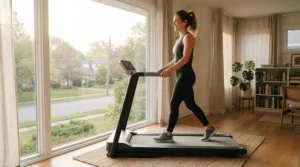
Treadmill vs Alternatives: Is It the Right First Home Gym Purchase?
A treadmill is a smart first home gym purchase for many people, but not everyone. Here’s the honest comparison.
| Option | Cost Pattern | Weather-Proof? | Joint Impact | Best For |
|---|---|---|---|---|
| Home treadmill | One-time purchase, possible subscription | Yes | Low to moderate, depends on deck | Daily walkers and future runners with a Horizon T101 or Sole F63 |
| Outdoor walking or running | Free, shoes only | No | Moderate | Anyone with safe routes and good weather |
| Gym membership | Ongoing monthly fee | Yes | Varies by equipment | Those who want variety and social energy |
| Budget exercise bike | Typically lower upfront | Yes | Low | Heavier beginners or sensitive knees |
The table shows treadmills win on convenience and climate control, but they carry the highest upfront cost and the largest footprint. Outdoor walking is unbeatable on price, and a gym membership makes sense if you crave variety and company. A treadmill earns its place when your biggest barrier is access, not motivation. If your budget is truly tight, the Sunny Health & Fitness SF-T4400 keeps the entry cost low.
Long-Term Cost & Maintenance: What You’ll Actually Spend
Sticker price is only chapter one. A treadmill’s real cost includes subscriptions, maintenance, and how long it lasts.
| Tier | Price Range | Example | Approx. Cost per Session* | Best For |
|---|---|---|---|---|
| Starter | Under $400 | Goplus 2-in-1 Folding Treadmill, Sunny Health & Fitness SF-T4400 | Under $1 | Testing the habit |
| Mid | $450-$700 | WalkingPad P1, Horizon T101 | About $1-$1.50 | Walkers wanting comfort |
| Value runner | $1,000-$1,200 | Horizon 7.0 AT, Sole F63 | About $2.50-$3 | Long-term users |
| Premium | $1,800-$2,200 | NordicTrack Commercial 1750 | About $5, or roughly $7 with iFIT | Class lovers |
Assumes four sessions per week for two years, about 416 sessions. Rough illustration only.
The numbers reveal a counterintuitive truth: a pricier treadmill used consistently can cost less per session than a cheap one abandoned in month three. Still, only commit to the higher tiers if you’re confident you’ll use them. For maintenance, follow your owner’s manual on belt lubrication and keep the deck clear of dust. Motor and frame warranties, like the lifetime coverage on the Horizon T101, Horizon 7.0 AT, and Sole F63, protect the expensive parts, while the 90-day coverage on the Goplus 2-in-1 Folding Treadmill means you’re largely on your own.
Treadmill Safety Guide for First-Timers
Treadmills are machines with moving parts, so a little respect goes a long way. News coverage of Consumer Product Safety Commission data reported more than 22,000 treadmill injuries treated in U.S. emergency rooms in 2019, with children and pets especially vulnerable.
A few non-negotiables:
- Always clip the safety key to your clothing. If you stumble, the belt stops. Experts quoted in NBC News’s treadmill safety guide stress following the manufacturer’s instructions.
- Straddle the belt, start slow, then step on.
- Keep kids and pets away. Remove and store the safety key and unplug the treadmill when finished.
- Leave clearance behind the machine and avoid placing it where a fall could hit furniture.
- Check your doctor’s clearance if you have heart, joint, or other health concerns.
Folding models such as the Sunny Health & Fitness SF-T4400 and the Sole F63 add safety through soft-drop hydraulic lowering, so the deck doesn’t crash down. Take this stuff seriously. It costs seconds and prevents months of regret.
Frequently Asked Questions
❓ What's the best treadmill under $500 for weight loss beginners?
❓ Can I lose weight walking on a cheap treadmill?
❓ Is a folding treadmill good for a small apartment?
❓ Do I need incline to lose weight on a treadmill?
❓ Is a treadmill subscription worth paying for?
Conclusion
Choosing a budget treadmill for beginners weight loss comes down to honesty with yourself. If you’ll walk for the first few months and money is tight, the Sunny Health & Fitness SF-T4400 and Horizon T101 give you the best bang for the fewest dollars. If space is the enemy, the WalkingPad P1 and Goplus 2-in-1 Folding Treadmill tuck away. If you suspect running is in your future, stretching to the Horizon 7.0 AT or Sole F63 buys a longer deck, a stronger motor, and a lifetime warranty. The NordicTrack Commercial 1750 is wonderful but sits at the premium edge for most first-timers.
Remember the bigger picture. A treadmill supports weight loss by making consistency easy, while food choices do much of the heavy lifting. Treat your first month as practice, follow a gentle plan of beginner cardio plans, and let the habit build before the intensity does. Your first home gym purchase shouldn’t feel like a gamble. Pick the machine that fits your space, your budget, and your real goals, and you’ll find the clothes-hanger fate is entirely avoidable.
✨ Ready to start? Your future self is already thanking you!
🔍 Compare the seven treadmills above, check current pricing and availability on the products that fit your plan, and take the first step today. A few minutes at a time adds up to a new routine you’ll be proud of!
Recommended for You
- HIIT Treadmill Workout Machine Review: 7 Proven Picks 2026
- Incline Treadmill For Calorie Burning: 7 Proven Picks 2026
- Treadmill For Weight Loss Under $1000: 7 Best Picks (2026)
Disclaimer: This article contains affiliate links. As an Amazon Associate, I earn from qualifying purchases. If you purchase products through these links, we may earn a small commission at no additional cost to you.
✨ Found this helpful? Share it with your friends! 💬🤗
