In This Article
Here’s a scene you probably know too well: you finish a run (or even just a brisk walk) and your lower back feels like it’s been quietly grinding gravel for the last twenty minutes. That dull, low ache that settles right above your beltline isn’t just annoying — it’s often your spine’s way of complaining about a hard, unforgiving deck and a body that’s compensating for it with every stride. A treadmill for lower back pain isn’t a magic fix, but the right machine, paired with smart form, genuinely changes how your spine experiences impact.
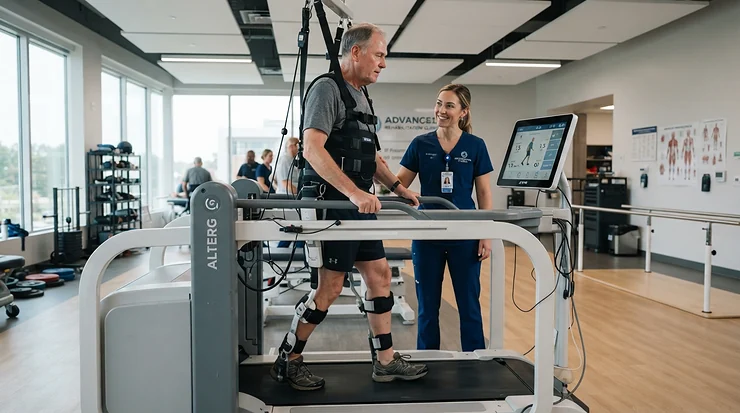
What most people don’t realize is that the deck itself does a lot of the heavy lifting here. A stiff belt transmits shock straight up through your ankles, knees, hips, and — eventually — your lumbar spine, forcing your lower back muscles to absorb forces they weren’t built to handle repeatedly. A well-cushioned, properly sized treadmill spreads that load out, encourages a more natural stride, and gives you room to actually engage your core instead of white-knuckling the handrails. Clinical exercise guidelines from the American Physical Therapy Association back this up, recommending aerobic activity like treadmill walking alongside targeted trunk muscle strengthening for chronic low back pain as a first-line, non-drug approach.
This guide isn’t a rehash of spec sheets. We dug into real products, real motor ratings, and real aggregated reviewer sentiment to find seven machines — from a $90 walking pad to a $4,000 commercial-grade runner — that genuinely earn a spot on a lower back-friendly treadmill shortlist. Whether you’re managing treadmill for chronic lower back discomfort day to day or just trying to move without wincing, there’s something here built for your budget and your spine.
Quick Comparison Table
| Product | Cushioning Type | Motor | Price Range | Best For |
|---|---|---|---|---|
| WalkingPad Z1 | 4-layer shock-absorbing belt | Brushless, compact | Under $300 | Desk walking, absolute beginners |
| XTERRA TR150 | Basic foam-backed belt | 2.25 CHP | $450-$600 range | Tight budgets, light walking |
| Sunny Health & Fitness SF-T7515 | Double-deck shock absorption | 2.2-2.5 CHP | $400-$800 range | Budget shock absorption |
| Horizon 7.0 AT | 3-zone variable response cushioning | 3.0 CHP | Around $1,000 | Best value overall |
| Sole F80 | Cushion Flex Whisper Deck | 3.5 HP | $1,600-$1,900 range | Serious walkers and runners |
| NordicTrack Commercial 1750 | Runners Flex cushioning | 4.25 CHP | $2,000-$2,500 range | Interactive, guided training |
| 3G Cardio Elite Runner | Ortho Flex Shock suspension | 4.0 HP | $3,500-$4,000 range | Heavy-duty, max shock absorption |
Looking at this lineup, notice how the cushioning technology gets more sophisticated as the price climbs — from a simple shock-absorbing belt on the WalkingPad Z1 to a full suspension system on the 3G Cardio Elite Runner. That said, price isn’t a perfect proxy for back-friendliness: the Sunny Health & Fitness SF-T7515‘s double-deck design punches well above its price tag for impact reduction, while some pricier machines lean more on entertainment tech than deck engineering. Motor power matters too, since an underpowered motor struggling under load can cause belt hesitation that jolts your stride and, by extension, your spine.
💬 Found a favorite already? Tap through and compare current pricing before it changes.
Top 7 Treadmills for Lower Back Pain: Expert Analysis
1. WalkingPad Z1 — most joint-friendly for desk walking
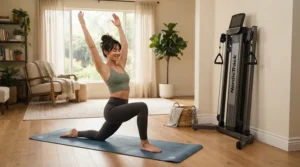
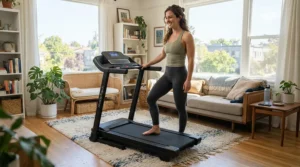
The WalkingPad Z1 folds down to a slim 6-inch profile and tucks under a standing desk, which sounds like a gimmick until you realize sitting is often what triggers lower back-friendly treadmill searches in the first place. Its 4-layer shock-absorbing, anti-slip belt and enhanced brushless motor are built for slow, sustained walking rather than running, with speeds generally capped in the 0.5-4 mph range depending on configuration.
Based on the spec comparison, this isn’t a treadmill for training runs — it’s a tool for breaking up long sitting blocks, which matters because prolonged static postures are a well-documented aggravator of chronic low back discomfort. Reviewers consistently note that the low speed cap keeps impact forces minimal, making it approachable for people just starting to reintroduce movement after a flare-up, though dedicated runners will find it far too limited.
Pros:
- ✅ Ultra-low impact, ideal for daily movement snacking
- ✅ Compact footprint fits under most desks
- ✅ Quiet motor won’t disrupt work calls
Cons:
- ❌ Speed range too limited for real cardio training
- ❌ No incline options to build strength
Price sits anywhere from around $90 during sales to the $250-$300 range at list, making the WalkingPad Z1 one of the cheapest ways to test whether low-impact movement helps your back before committing to a bigger purchase.
2. XTERRA TR150 — best entry point under $600
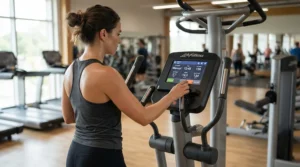
The XTERRA TR150 is the treadmill equivalent of a reliable used car: nothing fancy, but it starts every time. Its 2.25 CHP motor and 16-inch by 50-inch deck are modest, expanding on that standout feature of sheer affordability rather than sophisticated cushioning tech.
Here’s what the spec sheet won’t tell you outright: a 250-pound weight capacity and 10 mph top speed signal this machine is built for walking and light jogging, not marathon training, and its cushioning is genuinely on the thinner side compared to nearly everything else on this list. This is honest analysis worth sitting with — if lumbar support during high-impact running is your priority, this isn’t it. But for someone managing treadmill for chronic lower back discomfort through slow, consistent walking, the deck is adequate, and the price makes it low-risk. Aggregated reviewer sentiment repeatedly flags the folding mechanism as needing caution (no gas-assisted lift), so treat that as a real safety note rather than a nitpick.
Pros:
- ✅ Lowest price point among motorized options here
- ✅ Simple assembly, minimal learning curve
- ✅ Lifetime frame warranty on most listings
Cons:
- ❌ Minimal deck cushioning versus pricier models
- ❌ Folding mechanism lacks a gas-assist safety shock
At around $450-$600 depending on retailer promotions, the XTERRA TR150 delivers acceptable value for walkers who want to test consistency before upgrading.
3. Sunny Health & Fitness SF-T7515 — best budget shock absorption
What most buyers overlook about the Sunny Health & Fitness SF-T7515 is that “double deck” isn’t just marketing language — it’s a genuinely different construction than the single-belt-over-foam approach most budget treadmills use, and it shows up in how the machine handles heel strike.
The double-deck platform pairs an integrated shock absorption layer with 12 incline levels (0-12%), and Bluetooth connectivity syncs with the SunnyFit app for guided sessions. Reviewers consistently report that the shock absorption feels notably more substantial than comparably priced single-deck machines, with a firmer, more stable bounce rather than a soft sink — worth knowing if you prefer support over plushness. Aggregated feedback also flags the compact running surface (roughly 39 inches long on some configurations) as a limitation for taller users or longer strides, so factor your height into this decision.
Pros:
- ✅ Double-deck design meaningfully reduces joint impact
- ✅ 12 auto incline levels for varied training
- ✅ Bluetooth app connectivity included free
Cons:
- ❌ Running surface shorter than most 60-inch decks
- ❌ Top speed capped around 8-9 mph
Price ranges widely, from around $400 during clearance events up to the $800 range at list, so this is a strong candidate for patient shoppers willing to watch for a sale.
4. Horizon 7.0 AT — best overall value for back-friendly walking
The Horizon 7.0 AT is the machine that keeps showing up on “best budget-friendly” lists for good reason. Its 3.0 CHP motor supports a 20-inch by 60-inch deck — full commercial-length dimensions at a price that usually undercuts machines half its size.
What sets it apart is the 3-Zone Variable Response Cushioning: softer padding in the front “impact zone” where your heel lands, firmer support in the rear “push-off zone” where you drive forward. On paper this means your lower back absorbs less jarring shock on landing while still getting a stable platform to push off from — a smarter engineering choice than uniform cushioning throughout. Reviewers consistently praise the QuickDial controls for letting you adjust incline without breaking stride or bending awkwardly, which itself protects a sensitive lower back from the twisting motion of fumbling with buttons mid-walk.
Pros:
- ✅ Full-length 60-inch deck at a budget price
- ✅ Zone-specific cushioning targets impact and push-off differently
- ✅ Lifetime frame and motor warranty included
Cons:
- ❌ No touchscreen, just an LCD display
- ❌ Built-in speakers reported as underwhelming
Typically priced around $1,000 (frequently discounted from a higher list price), the Horizon 7.0 AT is arguably the single best value pick on this entire list.
5. Sole F80 — best for serious walkers and runners
The Sole F80 has built a reputation as the treadmill people recommend when someone asks “what should I actually buy” rather than “what’s the flashiest option.” Its 3.5 HP motor and extended 22-inch by 60-inch deck give taller users and longer strides genuine room to move without feeling boxed in.
The Cushion Flex Whisper Deck is the headline feature here, and independent testing suggests it reduces impact on joints by as much as 40% compared to running on pavement — a meaningful number if your lower back pain flares specifically from harder surfaces. Reviewers consistently note the cushioning isn’t the softest on the market (some competitors, particularly ones with dedicated suspension systems, feel plusher), but it strikes a dependable middle ground between support and shock absorption that works well for daily use. The lack of a required subscription is also worth flagging: you get full functionality without ongoing fees, which matters for long-term budgeting.
Pros:
- ✅ Extended 60-inch deck fits taller strides comfortably
- ✅ No subscription required for full functionality
- ✅ Lifetime warranty on frame and motor
Cons:
- ❌ Cushioning less shock-absorbing than premium suspension systems
- ❌ Basic display compared to touchscreen competitors
Priced in the $1,600-$1,900 range depending on promotions, the Sole F80 earns its reputation as a genuinely well-rounded mid-range pick.
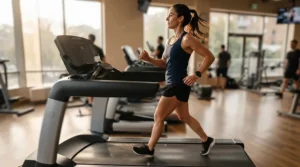
6. NordicTrack Commercial 1750 — best for guided, interactive training
If you respond better to structure than willpower, the NordicTrack Commercial 1750 solves a problem the other machines on this list don’t even attempt to address: motivation. Its 4.25 CHP motor and 16-inch HD touchscreen pair with iFIT programming, offering trainer-led workouts that automatically adjust your incline and speed.
Here’s the analytical trade-off worth weighing: the Runners Flex cushioning system does reduce impact on the joints, but recent model years removed the ability to toggle cushioning on and off, a feature earlier versions had. Reviewers consistently point this out as a mild step backward for users who want to switch between a road-like feel and a cushioned one depending on how their back feels that day. What most buyers overlook, though, is that the ActivePulse technology — which auto-adjusts your workout intensity to hit a target heart rate zone — indirectly supports lower back health by preventing the kind of overexertion that leads to compensatory, poor-posture strides late in a workout.
Pros:
- ✅ Auto-adjusting incline keeps posture and pacing steady
- ✅ Spacious 20-inch by 60-inch RunFlex cushioned deck
- ✅ Decline option (-3%) rare at this price point
Cons:
- ❌ iFIT subscription needed to unlock full programming
- ❌ Cushioning can no longer be toggled on 2026 models
Expect to pay in the $2,000-$2,500 range, with financing options often available directly through the manufacturer.
7. 3G Cardio Elite Runner — best for maximum shock absorption
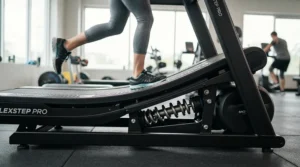
For anyone whose lower back pain gets aggravated by even moderate impact, the 3G Cardio Elite Runner exists specifically to solve that problem. Its commercial-grade Ortho Flex Shock suspension system is a fundamentally different approach than deck padding — it’s a true suspension mechanism designed to absorb landing force before it ever reaches your legs.
Based on the spec comparison, the 4.0 HP motor and oversized 22-inch by 62-inch platform put this machine in health-club territory, and the 386-pound frame weight reflects genuinely commercial-grade construction rather than home-gym-lite engineering. One especially telling data point: aggregated online discussion shows people specifically recovering from back injuries seeking out this exact model because of its shock absorption reputation, which lines up with the orthopedic belt design — thicker and softer than standard belts, working in tandem with the suspension system. The trade-off is size and price; this is not a machine for small apartments or modest budgets.
Pros:
- ✅ True suspension system, not just deck padding
- ✅ Oversized 22″x62″ deck accommodates any stride
- ✅ Commercial-grade 400 lb weight capacity
Cons:
- ❌ Large footprint unsuitable for tight spaces
- ❌ Premium price puts it out of reach for many
Priced in the $3,500-$4,000 range, the 3G Cardio Elite Runner is the splurge pick for anyone who has decided shock absorption is non-negotiable.
Setting Up Your Treadmill Routine for a Healthy Back
Buying the right machine solves half the equation — the other half is how you use it. In your first 30 days, resist the urge to jump straight into long sessions at high incline. Start with 10-15 minutes of flat walking at a comfortable pace, gradually building duration before touching the incline dial, since sudden intensity spikes are a common trigger for reactivated lower back pain.
Maintenance matters more than most people expect. Check belt tension every few weeks (a loose belt forces your stride to compensate, which travels straight to your lower back), and lubricate the deck per the manufacturer’s schedule — a dry, sticking belt creates micro-jolts with every step. A common first-month mistake is gripping the handrails too tightly out of anxiety about balance; this locks your torso into a hunched position that defeats the purpose of a cushioned deck by putting tension right back into your lumbar spine. Instead, let your arms swing naturally and trust the machine’s stability.
One optimization trick rarely mentioned in manuals: set your treadmill on a slight incline (1-2%) even for “flat” walks. This more closely mimics outdoor walking mechanics and encourages a more upright, spine-neutral posture than a perfectly flat belt, which can subtly encourage over-striding.
Real-World Scenarios: Who Should Get What
The desk-bound professional with stiffness, not injury. If you sit for eight-plus hours and your lower back aches mainly from stillness rather than a specific injury, the WalkingPad Z1 or XTERRA TR150 solves the actual problem: getting you moving more often, even briefly, throughout the day.
The former runner nursing chronic discomfort. If you used to run regularly but chronic lower back discomfort now limits you to walking or light jogging, the Horizon 7.0 AT or Sole F80 offers enough cushioning and deck length to keep training without punishing your spine further.
The heavier-set user managing joint and back pain together. Higher body weight increases impact forces with every step, which is exactly where the 3G Cardio Elite Runner‘s suspension system or the Sunny Health & Fitness SF-T7515‘s double-deck design earns its keep — both were engineered with impact absorption as the primary design goal, not an afterthought.
What Is a Treadmill for Lower Back Pain?
A treadmill for lower back pain is a treadmill engineered with enhanced cushioning, adequate deck length, and stable construction specifically to reduce the impact forces that travel up through the legs and into the lumbar spine during walking or running, making it more comfortable for people managing chronic or recurring lower back discomfort.
How to Choose a Lower Back-Friendly Treadmill
- Prioritize the cushioning system first. Look for named technologies (suspension systems, multi-zone decks, double-deck construction) rather than vague “cushioned” marketing claims.
- Match deck length to your height. A 60-inch deck accommodates most strides comfortably; anything shorter can force you into an unnatural, hunched gait.
- Check the continuous horsepower rating, not peak. A motor under 2.5 CHP struggles under sustained use, causing belt hesitation that jolts your stride.
- Confirm the incline range. Even modest incline access (5-15%) lets you build back-supporting strength without adding impact.
- Read aggregated review sentiment for stability complaints. Wobbling decks force compensatory muscle bracing that worsens back tension over time.
- Weigh subscription costs into your total budget. Some machines’ best features live behind paid app tiers.
- Consider your actual usage pattern. Research on combining core stabilization exercise with walking suggests consistency in low-impact walking, paired with core work, outperforms sporadic high-intensity sessions for chronic low back pain outcomes.
Treadmill for Lower Back Pain vs Traditional Alternatives
| Factor | Cushioned Treadmill | Outdoor Walking/Running | Traditional Firm-Deck Treadmill |
|---|---|---|---|
| Impact on joints/spine | Low to moderate, tunable | High, surface-dependent | High, consistent |
| Weather dependency | None | Fully weather-dependent | None |
| Posture control | Easier via stable, level surface | Variable terrain challenges balance | Easier, but higher impact |
| Best For | Chronic pain management, consistency | Cardiovascular variety, mental health | Budget-conscious healthy users |
A cushioned treadmill wins decisively on consistency and joint protection, since outdoor surfaces are unpredictable and often harder than any home deck. That said, outdoor walking offers mental health and terrain-variety benefits a treadmill can’t replicate, so the honest answer for most people managing lower back pain is a hybrid approach rather than an either/or choice. Traditional firm-deck treadmills remain a reasonable budget option only if your back pain is mild and infrequent.
Lumbar Support and Posture Correction: What Actually Matters
Lumbar support on a treadmill isn’t about a physical cushion pressed against your back — it’s about how the machine’s design encourages (or discourages) a spine-neutral posture throughout your workout. A deck that’s too short forces shortened, choppy strides that round the lower back forward. Handrails positioned too low invite hunching. None of the seven machines above include a literal lumbar pad, and that’s fine — the meaningful support comes from deck length, stable footing, and cushioning quality working together.
Posture correction, meanwhile, is less about the machine and more about habits the machine enables. Reviewers consistently note that treadmills with clear, easy-to-read displays (rather than ones requiring you to lean forward and squint) help users maintain an upright posture longer into a session. The Horizon 7.0 AT‘s QuickDial controls and the NordicTrack Commercial 1750‘s auto-adjusting incline both reduce the number of times you need to break form to fiddle with settings — a small but real posture win compounded over dozens of sessions.
Core Stability: The Overlooked Ingredient
No treadmill, however cushioned, fully compensates for a weak core. Your abdominal and back extensor muscles are what actually stabilize your spine during the repetitive loading of walking or running; the treadmill just determines how much force those muscles have to manage. Research combining core stabilization exercise with structured walking programs found meaningfully greater improvement in pain perception and disability scores compared to walking or core work alone, which is a strong argument for pairing your treadmill sessions with even minimal core work — planks, bird-dogs, or dead bugs a few times a week.
Practically, this means don’t expect the 3G Cardio Elite Runner‘s suspension system to be a substitute for strengthening work; think of the machine as reducing the external forces your back has to manage while you build the internal strength to manage what’s left.
Common Mistakes When Buying a Treadmill for Back Pain
The most frequent mistake is fixating on top speed and ignoring cushioning entirely — most people managing lower back pain never approach a treadmill’s max speed, but they feel every single footstrike. A second common error is buying a deck too short for one’s height purely to save space, which forces a compensatory gait. Clinical guidance on low back pain management consistently emphasizes that movement quality and consistency matter more than intensity, so a smaller, well-cushioned machine used daily beats an oversized, harsh one used sporadically out of avoidance. Finally, shoppers often skip incline range assessment entirely, missing out on a low-impact way to build the muscular endurance that actually prevents future flare-ups.
Frequently Asked Questions
❓ Is walking on a treadmill good for lower back pain?
❓ What incline helps lower back pain the most?
❓ Should I run or walk if I have chronic lower back discomfort?
❓ Do treadmill cushioning systems really reduce back pain?
❓ How long should I walk on a treadmill for back pain relief?
Conclusion
There’s no single “best” treadmill for lower back pain — there’s the best one for your budget, your space, and how your particular back responds to impact. If you’re easing back into movement after time away, the WalkingPad Z1 or XTERRA TR150 removes financial risk while you figure out what your body tolerates. If you’re ready to invest in genuine engineering built around shock absorption, the Horizon 7.0 AT delivers outsized value, while the Sole F80 and NordicTrack Commercial 1750 round out the mid-to-premium range with real deck quality and (in NordicTrack’s case) built-in motivation. And if impact reduction is your single non-negotiable priority, the 3G Cardio Elite Runner‘s suspension system is worth the splurge.
Whichever machine you choose, remember the cushioning is only doing half the job — pairing consistent, moderate treadmill use with core stability work is what the research consistently points to as the real driver of lasting relief. Start slow, prioritize posture over speed, and give your back the consistency it actually needs to heal.
Recommended for You
- 7 Best Slow-Paced Treadmills For Joint Pain Relief (2026)
- Treadmill For Seniors With Hip Arthritis: 7 Best Picks (2026)
- Low Impact Treadmill For Hip Pain: 7 Real Picks for 2026
Disclaimer: This article contains affiliate links. As an Amazon Associate, I earn from qualifying purchases. If you purchase products through these links, we may earn a small commission at no additional cost to you.
✨ Found this helpful? Share it with your friends! 💬🤗
