In This Article
Here’s the thing nobody tells you when your back first betrays you: the hardest part isn’t the pain. It’s the fear of making it worse. You used to run, or at least walk briskly enough to feel like a functioning adult, and now every treadmill in the gym looks like a loaded gun. A treadmill with shock absorption for herniated disc concerns is exactly what it sounds like — a machine engineered with a cushioned deck, softer suspension, or a shock-absorbing belt system designed to reduce the jolt that travels up through your ankles, knees, hips, and spine with every single step.
That distinction matters more than most shoppers realize. A herniated disc is a spinal condition where the soft inner material of a disc pushes through its tougher outer casing, and depending on where that happens, it can irritate nearby nerves and cause pain that ranges from “annoying” to “can’t-get-out-of-bed.” According to the National Library of Medicine, this is one of the more common causes of chronic back and leg pain in adults, which is exactly why so many people go shopping for gentler ways to stay active.
This guide walks through seven real, currently available treadmills built around genuine cushioning engineering — not marketing fluff — plus how to actually choose one, how to set it up so it doesn’t bite you back, and where good footwear fits into the picture. We’ll get into disc-friendly treadmill cushioning specifics, compare low-impact treadmill options for spinal disc issues against the alternatives, and talk honestly about what a cushioned deck can and can’t do for you. One quick note before we dive in: nothing here replaces your doctor or physical therapist. Think of this as the research they’d want you to have walked in with.
Quick Comparison Table
| Treadmill | Cushioning Tech | Price Range | Best For |
|---|---|---|---|
| Sunny Health & Fitness Ultra T10 | Double-deck cushioning | Budget (roughly $500–$650) | First-time buyers easing back into walking |
| XTERRA TR150 | Basic cushioned deck | Budget (roughly $400–$550) | Casual walkers on a tight budget |
| SOLE F63 | CushionFlex Whisper Deck | Mid-range (roughly $1,100–$1,300) | Steady daily walkers wanting durability |
| Horizon 7.0 AT | Variable Response Cushioning | Mid-range (roughly $1,300–$1,600) | Mixed walk/jog routines |
| SOLE F80 | CushionFlex Whisper Deck (upgraded) | Upper-mid (roughly $1,800–$2,200) | Heavier users or longer sessions |
| NordicTrack Commercial 1750 | RunFlex cushioning | Premium (roughly $1,900–$2,400) | Interactive training + joint protection |
| 3G Cardio Pro Runner X | Ortho Flex Shock™ suspension | Premium (roughly $3,000–$3,600) | Serious rehab-focused buyers wanting commercial-grade cushioning |
Looking at this lineup, there’s a clear line between decks that use foam or rubber layering (the Sunny Health & Fitness Ultra T10, the XTERRA TR150, both SOLE models) and machines that build shock absorption into actual suspension hardware, like the 3G Cardio Pro Runner X. Neither approach is “wrong,” but if you’re managing an actual disc injury rather than general joint achiness, the suspension-based systems tend to hold their cushioning quality longer under repeated use. Budget shouldn’t be the only lens here — the Horizon 7.0 AT‘s adjustable firmness is arguably more clinically useful than a pricier machine with fixed cushioning, because your tolerance for impact will change week to week as you recover.
💬 Found a model that fits your budget? Bookmark this page and keep scrolling — the full breakdown is below.
Top 7 Treadmills With Shock Absorption for Herniated Disc: Expert Analysis
1. Sunny Health & Fitness Ultra T10 — double-deck cushioning without the four-figure price
The Ultra T10 makes a decent case that you don’t need to spend fifteen hundred dollars to get real shock absorption. It layers two separate cushioning materials underneath the running belt instead of relying on a single foam pad, which is the difference between “soft-ish” and actually engineered.
Specs that matter here: a compact folding frame, a 10-inch Wi-Fi touchscreen that can stream guided walking routes, and a motor sized for walking and light jogging rather than serious running. In practice, that touchscreen is a small but real win — most machines in this price bracket hand you a bare LCD readout and call it a day, so having something that can nudge you through a structured walking program is a nice bit of accountability built in for free.
Who should buy this: someone newly cleared for treadmill walking who wants to start slow, doesn’t have $1,500 sitting around, and needs the machine to fold away in a small apartment. Reviewers consistently describe the double-deck system as noticeably gentler than a standard flat-deck budget treadmill, particularly at walking speeds — this isn’t a machine built for speed work, and it shows if you push it there.
Pros:
- ✅ Genuine double-layer cushioning at a budget price point
- ✅ Built-in touchscreen with guided walking programs
- ✅ Compact, foldable frame for small spaces
Cons:
- ❌ Motor isn’t built for sustained running
- ❌ Cushioning softens the ride but won’t match commercial-grade suspension
Priced in the $500–$650 range at the time of research, the Sunny Health & Fitness Ultra T10 is a smart entry point if you’re testing whether treadmill walking even agrees with your back before committing to a bigger investment.

2. XTERRA TR150 — the no-frills option for casual walkers
If the Ultra T10 is the budget pick with a bonus feature, the TR150 is the budget pick with no bonus feature at all — and for some buyers, that’s exactly the point. This is a straightforward cushioned-deck treadmill built for walking and light jogging, nothing more.
The 2.25 HP motor tops out around 10 mph with manual incline adjustments up to 10%, which tells you immediately this is a “get moving” machine rather than a training tool. What most buyers overlook about entry-level treadmills like this one is that the motor size directly limits how consistently the belt speed holds under load — a lighter motor working hard tends to introduce more vibration, which partially works against the cushioning system it’s paired with. It’s not a dealbreaker for slow, steady walking; it becomes more noticeable if you try to push the pace.
Who this suits: someone who wants the cheapest legitimate cushioned deck on the market, walks rather than runs, and doesn’t need incline automation or streaming features. It’s the treadmill equivalent of a reliable used sedan — unglamorous, but it gets you there.
Pros:
- ✅ Genuinely low price point among cushioned models
- ✅ Simple, low-learning-curve console
- ✅ Manual incline adds variety to flat walking
Cons:
- ❌ Motor strains at higher speeds, adding vibration
- ❌ No streaming or app-based coaching features
At around $400–$550, the XTERRA TR150 is the floor of what “legitimate cushioning” looks like — anything cheaper tends to skip the cushioned deck entirely and just call itself one.
3. SOLE F63 — the deck cushioning most physical therapists have actually seen
SOLE’s CushionFlex Whisper Deck technology isn’t new marketing language — it’s been around long enough that it shows up in gym equipment recommendations fairly often, which counts for something. The system uses elastomer compression points designed to absorb impact and rebound slightly, cutting down on the jarring “hard stop” feeling of a rigid deck.
On paper this means a wider comfort margin across a range of walking and jogging speeds, rather than cushioning that only feels good at one specific pace. Reviewers frequently mention the F63’s build quality holding up well over years of daily use, and the frame’s sturdiness matters more than people expect — a wobbly frame undermines a good cushioning system by introducing its own vibration on top of foot-strike impact.
Who it’s for: the person who wants a machine they’ll still trust in three years, not just three months, and who’s willing to spend a bit more than rock-bottom to get there.
Pros:
- ✅ Well-regarded, field-tested cushioning system
- ✅ Sturdy frame that doesn’t add its own vibration
- ✅ Good balance of comfort and push-off responsiveness
Cons:
- ❌ Console features are basic compared to premium rivals
- ❌ Bulkier footprint than budget folding models
Landing in the $1,100–$1,300 range, the SOLE F63 is the mid-tier workhorse — less flashy than the machines above it on this list, more dependable than the ones below.
4. Horizon 7.0 AT — cushioning that actually adapts to what you’re doing
This is the one worth paying attention to if your pain levels are unpredictable week to week, which — let’s be honest — is basically the defining feature of living with a disc issue. The Horizon 7.0 AT’s Variable Response Cushioning divides the deck into softer front, medium-transition, and firmer rear zones, so your heel strike lands somewhere forgiving while your push-off still gets the stability it needs.
What most buyers overlook about zone-based cushioning is that it solves a real trade-off: a deck that’s uniformly soft everywhere tends to feel mushy and unstable at push-off, like walking on sand, while a deck that’s uniformly firm defeats the purpose of cushioning at all. Splitting the difference by zone is a smarter piece of engineering than it sounds. Paired with a motor that adjusts speed and incline noticeably faster than older Horizon models, this machine handles interval-style walk/jog sessions — the kind physical therapists often prescribe during recovery — without feeling like it’s lagging behind your pace changes.
Who should buy it: someone whose activity level fluctuates with their symptoms and needs one machine that works whether today is a “brisk walk” day or a “light jog” day.
Pros:
- ✅ Zone-based cushioning adapts to foot-strike vs. push-off
- ✅ Fast speed/incline response for interval-style routines
- ✅ Handrail controls let you adjust mid-stride
Cons:
- ❌ Pricier than single-zone cushioned decks
- ❌ Larger footprint needs dedicated floor space
At roughly $1,300–$1,600, the Horizon 7.0 AT earns its price tag through genuinely smarter engineering, not just a bigger screen.
5. SOLE F80 — the upgraded deck for bigger frames and longer sessions
Think of the F80 as the F63’s older, sturdier sibling. It carries the same CushionFlex Whisper Deck philosophy but on a wider, longer running surface with a higher weight capacity, which matters more than it sounds like — a deck rated for a higher body weight distributes and absorbs impact more consistently rather than bottoming out under load.
Here’s what the spec sheet won’t spell out directly: a treadmill’s shock absorption is only as good as its weight headroom. A 300-pound-capacity deck cushioning a 280-pound user is working near its limit, and cushioning quality degrades faster under that kind of strain. The F80’s higher rating gives heavier users, or anyone carrying extra weight during recovery, real cushioning margin instead of a system that’s technically present but functionally maxed out.
Who it’s for: users above average body weight, taller walkers who need a longer deck, or anyone planning on 45-plus minute sessions where a smaller deck starts to feel cramped.
Pros:
- ✅ Higher weight capacity preserves cushioning quality
- ✅ Longer, wider deck suits taller users
- ✅ Same trusted cushioning platform as the F63, scaled up
Cons:
- ❌ Meaningfully more expensive than the F63
- ❌ Takes up more room than mid-tier folding models
Expect to pay in the $1,800–$2,200 range for the SOLE F80 — a fair jump over the F63, justified mainly by the added weight headroom and deck size.
6. NordicTrack Commercial 1750 — the interactive option with genuine deck engineering underneath
The Commercial 1750’s RunFlex cushioning system covers the full 22-inch by 60-inch running surface, and it’s the treadmill most people picture when they think “high-end home treadmill” — largely because of its touchscreen and iFit integration. But underneath the flashy display is a legitimately capable cushioning deck, not just a marketing add-on bolted to a standard frame.
Reviewers consistently note the ride feels consistently soft across the whole belt rather than only near the center, which matters if your natural stride tends to drift slightly off-center (most people’s do, more than they realize). What most buyers overlook is the ongoing cost: the interactive coaching experience is tied to an iFit subscription, so budgeting for the treadmill itself is only half the financial picture if you actually want to use the training programs it’s built around.
Who should buy this: someone who wants structured, trainer-led walking or jogging programs alongside real cushioning, and who’s comfortable with a recurring subscription as part of the deal.
Pros:
- ✅ Full-deck RunFlex cushioning, not just center-focused
- ✅ Large touchscreen with structured training programs
- ✅ Spacious 22″ x 60″ running surface
Cons:
- ❌ Full feature set requires an ongoing subscription
- ❌ Among the pricier options before subscription costs
At around $1,900–$2,400 before any subscription costs, the NordicTrack Commercial 1750 is best thought of as buying both a treadmill and a coaching platform — decide upfront whether you want both.
7. 3G Cardio Pro Runner X — commercial-grade suspension built for people who need it most
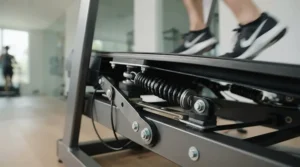
This is the machine on the list that takes a genuinely different engineering approach, and if your budget stretches far enough, it’s worth understanding why. Instead of relying only on deck-surface cushioning, the Pro Runner X builds shock absorption into the hardware itself: an Ortho Flex Shock™ suspension system, a thicker orthopedic-grade belt, and larger two-inch rollers working together from foot-strike through push-off.
What that means in practice is a two-layer defense against impact — the thicker belt absorbs the initial shock before it even reaches the deck, and the suspension underneath handles what’s left. This is the same layered principle used in commercial gym equipment that costs multiples more, which is precisely why physical therapy clinics and serious rehab buyers gravitate toward this brand. The larger rollers also reduce the subtle vibration that smaller rollers transmit up through the belt — a detail most shoppers never think to check, but one that adds up over a 30-minute session.
Who it’s for: buyers who’ve been specifically advised toward low-impact cardio for a disc injury and have the budget to prioritize suspension-grade cushioning over console bells and whistles.
Pros:
- ✅ Dual-layer shock absorption (belt plus suspension)
- ✅ Commercial-grade components rarely seen at consumer level
- ✅ Larger rollers reduce transmitted vibration
Cons:
- ❌ Highest price point on this list
- ❌ Fewer interactive/streaming features than NordicTrack
Priced around $3,000–$3,600, the 3G Cardio Pro Runner X isn’t for everyone’s budget, but it’s arguably the most clinically credible option here.
Benefits vs. Traditional Treadmills & Equipment
| Factor | Shock-Absorbing Treadmill | Standard Flat-Deck Treadmill | Outdoor Running |
|---|---|---|---|
| Impact on joints/spine | Reduced via deck/suspension engineering | Minimal cushioning, harder landings | Highest impact, variable surfaces |
| Consistency of surface | Fixed, predictable, no potholes or camber | Fixed, predictable | Uneven, weather-dependent |
| Best For | Disc issues, joint sensitivity, rehab | General fitness, budget buyers | Runners without injury concerns |
The predictability argument doesn’t get enough credit in these conversations. A Horizon 7.0 AT or SOLE F80 gives you the same cushioned surface every single session, whereas outdoor routes throw cracked pavement, sloped shoulders, and unexpected curbs into the mix — all things that can aggravate a sensitive disc without warning. Standard flat-deck treadmills split the difference: they remove the terrain variability of the outdoors but keep more of the impact than a purpose-built cushioned model. For anyone managing a spinal disc herniation specifically, that combination of consistency and cushioning is why treadmill walking gets recommended so often over outdoor routes during early recovery phases.
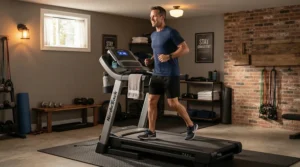
Setting Up Your Disc-Friendly Treadmill Routine
Getting the machine is the easy part. Getting your setup right is where people either build a sustainable habit or end up right back on the couch nursing a flare-up.
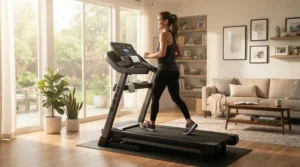
Start with incline, not speed. A slight 1-2% incline actually encourages a more upright posture and shorter stride, both of which reduce the jarring heel-strike that aggravates disc pain — counterintuitively, dead-flat walking often produces a harder landing than a gentle incline does. Keep your first few sessions to 10-15 minutes regardless of how good you feel; disc tissue responds to cumulative load, not just single-session intensity, so the temptation to “push through” on a good day is exactly what causes setbacks two days later.
Check your posture every few minutes rather than setting it once and forgetting it. Shoulders back, core gently braced, eyes forward instead of down at the console — looking down for extended periods rounds your upper back and shifts load through your lower spine in ways that undo some of what the cushioned deck is doing for you. Most people drift into bad posture within five minutes without realizing it.
Common early mistakes: increasing speed before increasing duration (do the opposite — get comfortable at 15 minutes before you get faster), holding the handrails so tightly your gait becomes unnatural, and skipping the incline entirely because it “feels harder.” Harder isn’t the same as worse here — a slight incline is doing protective work, not just burning more calories.
Real-World Scenarios: Matching the Right Treadmill to Your Situation
The desk-job walker in her 40s, recently diagnosed, cleared for light activity: This is the classic case for the Sunny Health & Fitness Ultra T10 or XTERRA TR150 — low financial risk while she figures out whether treadmill walking agrees with her, guided programs to keep intensity honest, and a small footprint for an apartment or condo.
The former runner in his 30s trying to stay active without setbacks: Someone who used to log serious mileage and now needs a gentler alternative benefits most from adaptive cushioning like the Horizon 7.0 AT — a machine that can flex between brisk walking and light jogging as tolerance improves week by week, without needing to buy a second treadmill later.
The retiree managing a long-term disc issue with physical therapy support: Here, budget is less of a constraint than long-term reliability and genuine rehab-grade cushioning, which points toward the SOLE F80 or the 3G Cardio Pro Runner X — machines built to hold their cushioning quality over years of consistent, careful use rather than occasional bursts of activity.
How to Choose a Treadmill With Shock Absorption for a Herniated Disc
- Get your doctor or physical therapist’s activity guidance first. Cushioning helps, but it doesn’t override medical clearance for your specific herniation location and severity.
- Prioritize deck/suspension engineering over console features. A touchscreen doesn’t protect your spine; the cushioning system underneath it does.
- Check the weight capacity against your actual body weight, with margin. Cushioning quality drops fast when a deck operates near its rated limit.
- Look for zone-based or variable cushioning if your symptoms fluctuate. Fixed-firmness decks work fine for stable, predictable activity levels — less so for the up-and-down nature of disc recovery.
- Factor in belt thickness, not just deck padding. A thicker orthopedic-style belt (like on the 3G Cardio) absorbs impact before it even reaches the deck.
- Budget for any required subscriptions separately. Interactive machines like the NordicTrack line often gate their best features behind a monthly fee.
- Test incline range and motor responsiveness. Slight inclines protect your spine, and a motor that lags on speed changes undermines interval-style rehab walking.
Disc-Friendly Treadmill Cushioning: Features That Actually Matter (And Those That Don’t)
What actually matters: multi-zone or multi-layer cushioning systems, belt thickness, roller size, frame rigidity, and weight capacity relative to your own body weight. These are the factors doing the physical work of reducing impact transmission through your joints and spine.
What doesn’t matter nearly as much as marketing suggests: touchscreen size, the number of preset workout programs, and Bluetooth speaker quality. None of that changes how your spine experiences each footstrike. A common trap is buyers comparing machines primarily on screen size and app ecosystem, then discovering later that the actual cushioning underneath was mediocre. The spec sheet won’t tell you this, but a smaller screen paired with genuinely engineered suspension — think the 3G Cardio Pro Runner X — will do more for a disc-friendly treadmill cushioning setup than a giant display sitting on a flat, unremarkable deck.
Low-Impact Treadmill for Spinal Disc Issues vs. High-Impact Cardio
The comparison here isn’t really treadmill vs. treadmill — it’s low-impact vs. high-impact activity in general, with the treadmill representing one of the more accessible low-impact options available. Running outdoors, jump-based HIIT classes, and court sports all deliver repeated ground-reaction forces multiple times higher than walking, and that force travels straight up through the kinetic chain into the spine.
A low-impact treadmill for spinal disc issues effectively splits the difference: you get cardiovascular benefit and the mental win of “doing something,” without the ground-reaction spikes of running or jumping. It’s not a magic fix — walking at 5 mph on a flat deck still produces measurable impact — but a genuinely cushioned deck meaningfully softens that impact compared to concrete, asphalt, or a bare gym floor. For most people navigating a disc herniation, that difference is exactly what separates “sustainable exercise habit” from “another thing that flares up my back.”
Common Mistakes When Buying a Treadmill for a Bad Back
The biggest one: buying based on price alone and assuming “cushioned” on the box means the same thing across every brand. It doesn’t — a $400 treadmill claiming shock absorption often uses a thin layer of basic foam that compresses flat within months, while machines like the SOLE F63 or Horizon 7.0 AT use engineered, tested cushioning systems built to hold their properties over years of use.
The second: ignoring weight capacity math. Buying a treadmill rated barely above your own body weight all but guarantees the cushioning will feel firmer and less protective than advertised, because the system is operating near its structural limit rather than with room to spare.
The third, and probably the sneakiest: skipping the return policy and warranty fine print. Cushioning systems are mechanical parts that can wear unevenly, and a treadmill with only a 90-day warranty on parts is telling you something about how long the manufacturer expects that cushioning to genuinely perform.
Impact-Reducing Footwear: The Piece Most Buyers Forget
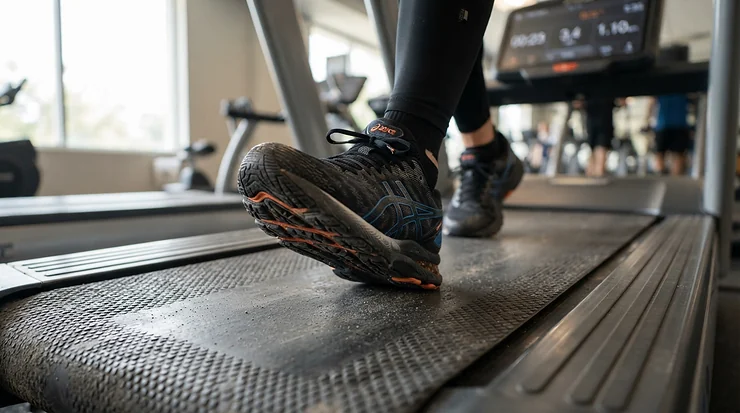
Here’s a detail that gets buried under all the treadmill spec talk: your shoes are doing roughly half the shock-absorption work, whether you’ve accounted for that or not. Impact-reducing footwear pairs with a cushioned deck rather than competing with it — think of the treadmill as the first layer of defense and your shoes as the second.
Look for a thick, EVA-foam or gel-cushioned midsole, since that’s the material actually compressing to absorb your foot-strike force before it reaches your joints. Shoes built with a rocker-sole design are also worth considering, since they encourage a more natural forward roll through the stride rather than an abrupt heel-to-toe slam. Models frequently mentioned for maximal cushioning in this category include options from Hoka’s Clifton line, which reviewers commonly point to when discussing serious impact protection for sensitive joints. Whatever you choose, replace treadmill shoes roughly every 300-500 miles — cushioning foam compresses permanently over time, and a “dead” midsole quietly stops doing its job long before the shoe looks worn out.
What to Expect: Real-World Performance Week to Week
Week one typically feels almost anticlimactic — short sessions, low speed, and a nagging feeling you should be doing more. Resist that instinct. Weeks two through four are usually where people notice the actual difference a cushioned deck makes, particularly compared to whatever hard-surface walking they were doing before; less next-day stiffness is a common, quietly encouraging sign. By week six or so, most consistent walkers can comfortably extend session length before they need to increase speed or incline, which is exactly the progression order that protects a healing disc.
Expect good days and frustrating days to alternate rather than a clean, linear improvement — that’s normal for disc recovery generally, not a sign your treadmill choice was wrong.
Long-Term Cost & Maintenance for Cushioned Treadmills
Cushioning components do wear over time, and budgeting for that upfront avoids surprises later. Belts typically need replacement every 1-3 years depending on use frequency, and deck cushioning pads on entry-level machines can compress and lose effectiveness faster than on mid-range or premium models — part of why the XTERRA TR150 and Sunny Health & Fitness Ultra T10 are priced where they are.
Factor in the iFit subscription if you’re eyeing the NordicTrack Commercial 1750 — that’s a recurring cost on top of the machine itself, and it’s worth calculating the annual total before comparing sticker prices against subscription-free options like the 3G Cardio Pro Runner X. Basic maintenance — belt lubrication, deck cleaning, and periodic belt-tension checks — extends cushioning life significantly across every model on this list, and it’s genuinely one of those five-minutes-a-month habits that pays for itself.
Safety, Red Flags & When to Talk to Your Doctor
Treadmill walking is widely regarded as a reasonable low-impact activity for many people managing a herniated disc, but “widely regarded as reasonable” is not the same as “cleared for you specifically.” Get sign-off from your doctor or physical therapist before starting, especially in the early weeks after diagnosis, and describe the exact activity you’re planning so they can weigh in on speed, incline, and duration limits.
Stop immediately and check in with a professional if you notice new numbness, tingling, or weakness in your legs, sharp pain that wasn’t there before you started, or pain that lingers well beyond the session rather than settling within a day. The American Academy of Orthopaedic Surgeons notes that most people improve substantially with nonsurgical treatment over weeks to months, but that timeline assumes activity is introduced sensibly rather than pushed through pain. A broader look at the research backs this up — a systematic review of exercise and chronic low back pain found aerobic activity like walking genuinely supports healing by improving blood flow and reducing stiffness, which is a fairly strong endorsement of getting on a cushioned treadmill consistently rather than avoiding movement out of fear.
Frequently Asked Questions
❓ Can a herniated disc be aggravated by treadmill walking?
❓ What's the best incline for a herniated disc on a treadmill?
❓ Do cushioned treadmills really reduce impact compared to regular ones?
❓ How long should I walk on a treadmill with a herniated disc?
❓ Is walking or swimming better for a herniated disc?
Conclusion
A herniated disc doesn’t have to mean giving up on movement — it means getting pickier about how you move. The right treadmill with shock absorption for herniated disc concerns gives you a consistent, controllable surface that’s kinder to your spine than concrete sidewalks or a bare gym floor, and the right pairing of cushioned deck, sensible incline, and genuinely impact-reducing footwear does more collective work than any single fancy feature.
Whether you land on the budget-friendly Sunny Health & Fitness Ultra T10 or invest in the suspension-grade 3G Cardio Pro Runner X, the underlying principle stays the same: start slow, prioritize real engineering over flashy screens, and let your body’s response guide your progression, not the calendar. Recovery isn’t a straight line, but consistent, well-cushioned movement is one of the more reliable tools you have for getting back to feeling like yourself.
Recommended for You
- Treadmill For Lower Back Pain: 7 Real Picks That Actually Help (2026)
- 7 Best Slow-Paced Treadmills For Joint Pain Relief (2026)
- Treadmill For Seniors With Hip Arthritis: 7 Best Picks (2026)
Disclaimer: This article contains affiliate links. As an Amazon Associate, I earn from qualifying purchases. If you purchase products through these links, we may earn a small commission at no additional cost to you. This content is for informational purposes only and is not a substitute for professional medical advice — please consult your doctor or physical therapist before starting any new exercise program.
✨ Found this helpful? Share it with your friends! 💬🤗
