In This Article
A treadmill under $600 for back pain is a home cardio machine priced below $600 that uses a cushioned or shock-absorbing deck to reduce spinal loading during walking or light jogging, making it gentler on a sore lower back than concrete, asphalt, or a bargain-bin treadmill with a stiff plywood deck. It won’t cure a disc problem or replace a physical therapist. What it can do is give you a controlled, flat, joint-friendlier surface to build the kind of consistent walking habit that researchers at Macquarie University found nearly doubled the pain-free period for adults recovering from low back pain, in a trial that tracked 701 people for one to three years.
Here’s the thing nobody tells you when you’re Googling this at 11 p.m. with a heating pad on your lower back: the price tag and the back-friendliness of a treadmill are almost completely unrelated. I’ve dug through spec sheets on machines costing $150 and machines costing $1,300, and some of the cheapest decks out there absorb shock better than treadmills three times their price. It comes down to cushioning engineering, belt thickness, and deck construction — not the brand name stitched onto the console.
That’s really what this guide is for. You’re not shopping for the fanciest treadmill. You’re shopping for the one that lets you rack up steps today without paying for it in your lower back tomorrow — all while keeping your wallet closed after the checkout page.
Quick Comparison Table
| Treadmill | Price Range | Deck Cushioning | Best For |
|---|---|---|---|
| Sunny Health & Fitness SF-T4400 | Under $450 | Basic shock absorption | Absolute beginners, tight budgets |
| NordicTrack T 6.5 S | $500–$600 range | FlexSelect adjustable cushioning | Best all-around back-friendly pick |
| Echelon Stride 10 Sport | $300–$400 range | Impact-absorbing cushioned deck | Small apartments, quiet operation |
| WalkingPad C2 | Around $600 | Light cushioning, foldable pad | Under-desk walking, tiny spaces |
| Goplus SuperFit 2-in-1 | Under $300 | 5-layer shock-absorbing belt | Ultra-tight budgets, first-timers |
| UREVO 2-in-1 Folding | $350–$400 range | Double shock absorption | Home office walkers |
| Sunny Health & Fitness SF-T1407M | Under $450 | Comparable shock absorption to SF-T4400 | Buyers who want a proven backup option |
Looking at this lineup, there’s no single “best” machine — there’s a best machine for your back and your square footage. The NordicTrack T 6.5 S earns its spot because it’s the only one here with adjustable cushioning you can dial between soft and firm, which matters more than people realize once your back starts dictating terms. Budget shoppers should notice that the Goplus SuperFit 2-in-1 delivers real shock absorption at roughly a third of the price of the pricier options, while anyone tight on floor space will get more mileage out of the WalkingPad C2 or UREVO 2-in-1 than out of a full-length deck they’ll resent moving around.
💬 Found a favorite already? Bookmark this page so you can compare specs again before you check out.
Top 7 Budget-Friendly Treadmills for Back Pain: Expert Analysis
1. Sunny Health & Fitness SF-T4400 — best true beginner walking machine
The SF-T4400 has become something of a cult classic in the budget treadmill world, and the standout feature here is how unapologetically it commits to being a walking machine rather than trying to be everything to everyone. Under the hood sits a 2.2 HP peak motor with a speed range of 0.5 to 9 mph and a 49-inch by 15.5-inch running deck, and that combination tells you exactly who this is for: someone rebuilding a walking habit, not someone training for a 10K. Based on the spec comparison, the shorter deck length is the real trade-off — it measures 49 inches long by 15.5 inches wide, which is noticeably tighter than most full-size treadmills, so taller walkers with a long stride may feel cramped at higher speeds.
Where it earns its place on a back-pain list is the built-in shock absorption technology on the tread, paired with three manual incline settings that let you vary the load on your lower back without cranking up speed. What most buyers overlook is that manual incline, while less flashy than a powered version, actually forces you to be deliberate about how hard you’re pushing — which is exactly the kind of self-monitoring a bad back rewards. Reviewers consistently note that this machine folds down small and rolls easily into a closet, a genuinely useful trait if you’re sharing a small apartment and don’t want a treadmill staring at you from the living room every day.
Pros:
- ✅ Genuine shock absorption at an entry-level price point
- ✅ Compact folded footprint fits small apartments easily
- ✅ Simple LCD display with 9 built-in programs for variety
Cons:
- ❌ 220-lb weight capacity limits who can use it comfortably
- ❌ Top speed of 9 mph rules out serious running goals
Price sits comfortably under $450 at the time of research, and the value verdict is straightforward: for pure back-friendly walking on a tight budget, this is close to the floor of what actually works.
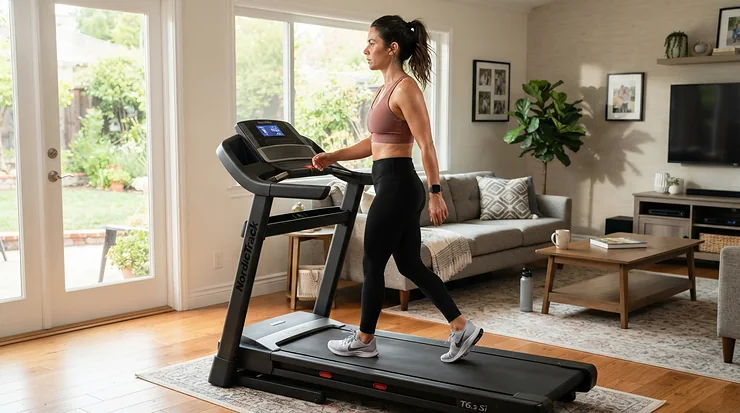
2. NordicTrack T 6.5 S — most adjustable cushioning for the money
This is the treadmill I’d point a friend toward if they asked me just one question: “which one should I actually buy?” The NordicTrack T 6.5 S was discontinued as NordicTrack shifted toward its EXP series, but it’s still widely available through retailers and refurbished channels, and the standout feature is its FlexSelect cushioning system — four orange dampeners positioned under the deck that let you toggle cushioning on or off depending on whether you want joint protection or a firmer, road-like feel. That’s a level of customization you almost never see below the $1,000 mark.
Here’s what the spec sheet won’t tell you outright: adjustable cushioning matters enormously for back pain because your tolerance for impact can change day to day, sometimes hour to hour. A softer setting on a flare-up day, a firmer setting when you’re feeling strong — that flexibility is rare at this price. The machine runs on a 2.6 continuous horsepower motor with speeds from 0.5 to 10 mph and incline up to 10 degrees, on a 22-inch by 55-inch running deck, which is a genuinely roomy surface for the price bracket. Weight capacity sits at 300 pounds, well above the entry-level competition.
Aggregated reviewer sentiment does flag one consistent complaint: customers report the T 6.5 S runs noisy, so if you’re in an apartment with thin floors, plan your workout times accordingly, or budget for a treadmill mat. Reviewers also note the motor doesn’t support sustained running, so treat this as a walking-and-light-jogging machine, not a marathon trainer.
Pros:
- ✅ Adjustable cushioning toggles between soft and firm
- ✅ Roomy 55-inch deck for the price bracket
- ✅ 300-lb weight capacity, above most budget rivals
Cons:
- ❌ Reviewers consistently mention noticeable motor noise
- ❌ Not built for sustained running or high mileage
At a price that lands right at the edge of our $600 ceiling, this is the pick for anyone who wants the closest thing to a “real” treadmill experience without real-treadmill pricing.
3. Echelon Stride 10 Sport — best cushioned deck for tight apartments
The Echelon Stride line built its reputation on one thing: a deck that actually feels different underfoot than the concrete-hard boards found on some competitors. The standout feature on the Sport model is its 16-inch by 47-inch impact-absorbing running deck, built specifically for smaller spaces, paired with speeds up to 10 mph and a 5-inch backlit LCD display. What most buyers overlook is that “impact-absorbing” isn’t just marketing language here — Echelon’s larger Stride models use the same cushioning philosophy that reviewers elsewhere in the lineup describe as feeling “cushioned and springy,” which lessens impact on the joints and avoids noisy pounding, and the Sport carries that same DNA into a smaller, cheaper frame.
Based on the spec comparison, this is genuinely one of the best-value cushioned decks under $400, especially since it doesn’t lock its core walking and jogging function behind a subscription — it includes 15 pre-programmed workout routines and 3 custom user modes out of the box. If you want Echelon’s live-class ecosystem, that’s an optional add-on, not a requirement to use the treadmill for its primary purpose: gentle, cushioned cardio.
The trade-off is deck length. At 47 inches, taller runners or people with a longer natural stride will feel the edges at higher speeds, which is precisely why this machine is positioned as a walker’s tool rather than a running platform.
Pros:
- ✅ Purpose-built impact-absorbing deck for smaller spaces
- ✅ No subscription required for core walking programs
- ✅ Compact enough to tuck away in an apartment closet
Cons:
- ❌ 47-inch deck feels short for taller users at speed
- ❌ App connectivity features require your own tablet
Price ranges from roughly $300 to $400 depending on retailer promotions, making this one of the strongest value plays in this entire roundup for anyone prioritizing cushioning over raw speed.
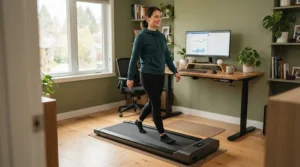
4. WalkingPad C2 — best under-desk option for constant, gentle movement
Sometimes the best thing for a cranky lower back isn’t a hard 30-minute workout — it’s simply not sitting still for eight hours straight. That’s the entire philosophy behind the WalkingPad C2, a slim folding walking pad priced around $600 that’s compact enough to fit under a desk and portable enough to move between rooms. The standout feature is how it disappears into your day rather than demanding a dedicated workout block.
Here’s what the spec sheet won’t tell you, but reviewers note: gentle, frequent walking throughout the day may do more for a stiff back than one intense session, since prolonged static sitting is itself a major contributor to lower back tightness. The C2’s top speed of 3.7 mph reflects that design intent — this is built for walking meetings and background movement, not sprint intervals. It folds in half for storage and weighs about 55 pounds, light enough for most adults to reposition without straining anything.
Reviewers who’ve lived with the C2 report it holds up well to regular weekly use tucked under a desk or bed, though it was docked points for lacking handles, which makes it slightly more awkward to carry between rooms than competitors with built-in grips.
Pros:
- ✅ Slides under a desk for movement during work hours
- ✅ Folds flat and stores in a closet or under furniture
- ✅ Lightweight at roughly 55 lbs for easy repositioning
Cons:
- ❌ Top speed of 3.7 mph limits it to walking pace only
- ❌ No side handles, making transport slightly awkward
Priced right at the $600 ceiling, this is the pick for anyone whose back pain is aggravated as much by sitting all day as by any specific workout.
5. Goplus SuperFit 2-in-1 — best ultra-budget shock-absorbing pick
If your first thought reading this whole article was “I don’t want to spend anywhere near $600,” this is your machine. The Goplus SuperFit 2-in-1 regularly sells for well under $300, sometimes dipping toward $150–200 during sales events, and its standout feature is a 5-layer non-slip, shock-absorbing running belt that punches well above its price class for impact reduction. It runs two modes — a compact under-desk walking mode and a taller running mode with a handrail attached — giving you flexibility that pricier single-purpose treadmills don’t offer.
What most buyers overlook is that the “budget” label here doesn’t mean flimsy. Based on the spec comparison, it packs a 2.25 HP ultra-quiet motor with a 265-lb weight capacity, competitive with machines costing twice as much. Aggregated review sentiment is genuinely strong for the price point — outdoorgearlab’s testing labeled it the smallest treadmill in their comparison set, with the best-in-class storability thanks to its lightweight frame and small collapsed footprint.
The honest trade-off is exercise capacity: the smaller belt and lighter-duty motor mean this is strictly a walking-and-light-jogging tool, not something to grow into as a serious runner.
Pros:
- ✅ 5-layer shock-absorbing belt at a rock-bottom price
- ✅ Smallest, most storable frame in this entire roundup
- ✅ Dual walking and running modes in one unit
Cons:
- ❌ Smaller running surface limits stride length options
- ❌ No incline adjustment on the base model
At well under $300, this is the pick for anyone testing whether a treadmill routine even fits their life before committing more money.
6. UREVO 2-in-1 Folding Treadmill — best lesser-known alternative for home offices
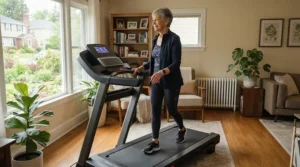
UREVO doesn’t have the brand recognition of NordicTrack or Echelon, but that’s exactly why it belongs on this list — it’s a genuinely capable, lesser-known option that a lot of buyers skip simply because they haven’t heard of it. The standout feature is its double shock absorption system, combining 5 layers of anti-slip belt material with 8 silicone shock absorbers and 2 soft rubber pads to cut down on joint and spine impact — a more layered cushioning approach than several pricier competitors use.
Based on the spec comparison, it runs a 2.25 HP motor with a 265-lb weight capacity and dual modes: 0.6–6.2 mph in open running mode and 0.6–4 mph in folded walking mode. What most buyers overlook here is the app integration — it connects to the UREVO Sport App, letting you actually track whether your walking volume is climbing over time, which matters if you’re trying to build toward that meaningful walking-volume threshold researchers associate with lower back pain risk.
Reviewer sentiment on this line is notably positive for daily reliability: one verified buyer reported walking about 3 miles a day on it and having it hold up well for almost a year of regular use, describing it as easy to set up and sturdy for everyday reliability.
Pros:
- ✅ Layered double shock absorption beyond typical budget decks
- ✅ Dual walking/running modes plus companion tracking app
- ✅ Reviewers report strong durability under daily use
Cons:
- ❌ No incline adjustment available on this model
- ❌ Deck length is tight for users over 6 feet tall
Priced in the $350–$400 range at the time of research, this is a smart pick for home-office walkers who want cushioning depth without paying for a big-name badge.
7. Sunny Health & Fitness SF-T1407M — best proven backup to the T4400
Rounding out this list is the SF-T1407M, which is essentially the SF-T4400’s close cousin, and its standout feature is offering nearly identical core performance at a comparably approachable price — useful if the T4400 happens to be out of stock or you simply want to comparison-shop within the same trusted product family. Reviewers describe the SF-T1407M as a close contender to the SF-T4400, noting the two treadmills are nearly identical in running deck length, motor power, and top speeds.
Based on the spec comparison, that near-identical DNA means you’re getting the same fundamental value proposition: a compact, shock-absorbing deck built for walking-first routines rather than serious mileage. What most buyers overlook when comparing near-twin products like this is that stock availability and small pricing fluctuations, not major spec differences, often decide which one makes more sense on a given week — so it’s worth checking current price and availability on both before deciding.
Honest analysis here has to acknowledge the limits: this isn’t a machine built to be pushed hard, and reviewers of the sister model note the same 220-lb-class weight capacity ceiling that limits who it comfortably serves.
Pros:
- ✅ Nearly identical proven performance to the popular T4400
- ✅ Compact folding frame for small living spaces
- ✅ Trusted brand with widely available replacement parts
Cons:
- ❌ Shares the same modest weight capacity as its sibling
- ❌ Limited to walking and light jogging speeds
Price sits under $450 at the time of research, and the value verdict mirrors its sibling: a safe, well-documented budget choice backed by a brand with a long track record in this category.
Top 7 Products: Full Spec Comparison
| Treadmill | Motor | Deck Size | Top Speed | Weight Capacity | Best For |
|---|---|---|---|---|---|
| Sunny SF-T4400 | 2.2 HP | 49″ x 15.5″ | 9 mph | 220 lbs | Beginners on a tight budget |
| NordicTrack T 6.5 S | 2.6 CHP | 55″ x 22″ | 10 mph | 300 lbs | Adjustable cushioning needs |
| Echelon Stride 10 Sport | N/A | 47″ x 16″ | 10 mph | Standard | Small apartments |
| WalkingPad C2 | N/A | Compact pad | 3.7 mph | Standard | Under-desk movement |
| Goplus SuperFit 2-in-1 | 2.25 HP | 40″ x 16″ | ~7.5 mph | 265 lbs | Ultra-low budget |
| UREVO 2-in-1 | 2.25 HP | 40″ x 15″ | 6.2 mph | 265 lbs | Home-office walkers |
| Sunny SF-T1407M | ~2.2 HP | ~49″ x 15.5″ | ~9 mph | ~220 lbs | Backup to SF-T4400 |
Scanning this table, weight capacity and deck size track together more than people expect: the machines with the roomiest decks, like the NordicTrack T 6.5 S, also tend to support heavier users, while the most compact under-desk options like the WalkingPad C2 and Goplus SuperFit 2-in-1 trade surface area for portability. If back pain has you moving cautiously and slowly, that trade-off usually favors the compact options; if you need room to find a natural, unrestricted stride, lean toward the roomier decks even if it costs a bit more storage space.
Benefits vs. Traditional Alternatives
| Option | Upfront Cost | Convenience | Back-Pain Suitability |
|---|---|---|---|
| Budget treadmill under $600 | One-time $150–$600 | High — home, any time | Good, with cushioned models |
| Gym membership | $30–$80/month ongoing | Low — travel required | Variable, depends on equipment |
| Outdoor walking | Free | High, weather-dependent | Good, but uneven terrain risk |
| Physical therapy sessions | $75–$150/visit | Low — scheduled appointments | Excellent, but not for daily cardio |
A home treadmill wins on convenience and long-term cost compared to a gym membership, since a home walking program has been shown in controlled comparisons to be just as effective as a supervised strengthening-exercise program for improving back pain outcomes, without the recurring monthly bill or the friction of driving somewhere. Outdoor walking is free and just as legitimate, but uneven sidewalks and unpredictable weather make a flat, cushioned indoor surface more consistent for someone actively managing pain. Physical therapy remains essential for diagnosis and targeted rehab work — a treadmill isn’t a replacement for that relationship, but rather the at-home cardio complement your therapist will likely encourage anyway.
Practical Usage Guide: Setting Up Your Treadmill for a Healthy Back
Getting the machine into your house is the easy part. Getting your form right is what actually protects your spine.
First 30 days — start conservative. Resist the urge to jump straight to 30-minute sessions at a brisk pace. Begin with 10–15 minutes at a comfortable walking speed, focusing entirely on posture rather than distance covered.
Posture checkpoints. Keep your shoulders back and down, avoid leaning forward onto the handrails (a common habit that quietly rounds the lower back), and let your arms swing naturally rather than gripping the rails white-knuckled.
Incline strategy. A slight incline of 1–2% can actually reduce impact compared to flat-ground walking by encouraging a more natural forward lean and gait pattern — but skip steep inclines entirely until your back has adapted to flat walking first.
Maintenance that protects your investment. Lubricate the belt roughly every 3 months (check your manual — some budget models need it more often), keep the deck free of dust buildup, and re-tighten any loose bolts after the first few weeks of use, since folding treadmills tend to loosen slightly during initial break-in.
Common first-month mistake. The single biggest error is treating day one like day thirty. Building consistency at an easy pace beats one heroic session followed by a week of recovery.
Real-World Scenario: Who Should Buy Which Treadmill
The desk-bound remote worker, budget around $300, small home office. This person’s back pain is driven mostly by sitting, not by an injury. The UREVO 2-in-1 or Goplus SuperFit 2-in-1 fits perfectly here — both slide under a desk, both offer genuine shock absorption, and both let this person accumulate steps throughout an 8-hour workday instead of trying to cram everything into one session.
The recovering exerciser, budget up to $600, moderate space available. Someone easing back into cardio after a back flare-up needs adjustable cushioning more than raw speed. The NordicTrack T 6.5 S is the clear match, since the ability to toggle cushioning firmness day-to-day accommodates the reality that pain tolerance fluctuates.
The apartment dweller, budget under $400, limited storage. Someone in a studio or one-bedroom needs a machine that disappears when not in use. The Echelon Stride 10 Sport or Sunny SF-T4400 both fold compactly and won’t dominate a small living room.
How to Choose a Treadmill for Back Pain
- Prioritize deck cushioning over top speed. A treadmill you’ll never run above 6 mph doesn’t need a 12 mph motor — it needs a deck that absorbs shock at walking pace.
- Check the deck length against your height. If you’re over 6 feet tall, a 40–47 inch deck will feel cramped; look toward the 55-inch options instead.
- Confirm the weight capacity honestly. Buying a machine rated for your exact body weight sets you up for premature wear; leave margin.
- Look for adjustable or multi-layer cushioning. Single-layer foam pads are the minimum; multi-layer or toggle-based systems like FlexSelect give you more control.
- Factor in noise if you live in an apartment. Reviewer feedback flags certain models as consistently loud — check this before buying if thin floors are a concern.
- Decide if incline matters to your routine. A slight incline can ease impact, but it’s not essential for a back-pain-focused walking routine.
- Read the folding mechanism reviews, not just the spec sheet. Some folding designs require removing screws or fighting a stiff hinge daily — annoying if you’re already dealing with limited mobility.
Common Mistakes When Buying a Budget Treadmill for Back Pain
People chasing a “treadmill under $600 for back pain” tend to make the same handful of errors. The first is assuming price correlates directly with cushioning quality — as this list shows, a $280 Goplus can out-cushion machines costing twice as much. The second is ignoring deck length entirely and regretting it the first week, especially for taller buyers. The third is buying the cheapest possible option without checking weight capacity, which leads to premature motor strain and a squeaky, unstable ride within months. The fourth, and probably the most common, is buying a treadmill and immediately trying to use it like a gym-grade machine — sprint intervals on day three of a new back-pain routine is a fast way to end up right back where you started.
What to Expect: Real-World Performance
Specs on paper translate to a specific lived experience once you’re actually on the belt. A 2.2–2.6 HP motor, which describes most of this list, means smooth, quiet performance at walking speeds but a noticeable strain if you try to sustain jogging for long stretches — that’s simply outside these machines’ design intent. A cushioned deck like the NordicTrack’s FlexSelect system or the UREVO’s double shock absorption translates into a noticeably softer landing on your heel and, by extension, less jarring transmitted up through your hips and lower back compared to a stiff, bargain-basement deck. Folding mechanisms that sound convenient in a product description can, in daily practice, range from a genuinely effortless one-step fold to an annoying multi-step process — worth checking recent buyer reviews on this specific point before committing.
Long-Term Cost & Maintenance
A $300–$600 treadmill isn’t a “buy once, done forever” purchase — budget for occasional belt lubricant (usually under $15 a bottle, needed every few months), and factor in that lower-cost motors may need replacement parts sooner than commercial-grade units. Even so, running the math over three years of regular use, a $500 treadmill amortizes to under $14 a month — meaningfully cheaper than most gym memberships, and available at 6 a.m. or midnight without getting in the car. If you already invest in chiropractic care, physical therapy, or over-the-counter pain relief for back flare-ups, a modest one-time equipment cost that reduces recurrence frequency can offset itself within a year or two.
Safety and Setup Considerations for Back Pain
Before starting any new exercise routine for back pain, it’s worth checking in with a doctor or physical therapist, particularly if you have a diagnosed disc issue, recent injury, or radiating leg pain — these can signal something a treadmill program alone won’t fix. Once cleared, place the treadmill on a stable, level surface, use the safety clip every session (it matters more than it feels like it does), and start slow enough that soreness the next day is mild, not alarming. Federal guidelines note that adults should aim for at least 150 minutes of moderate-intensity aerobic activity like walking each week for substantial health benefits, and that target works just as well broken into short daily sessions on a home treadmill as it does at a gym.
Frequently Asked Questions
❓ Is a treadmill actually good for lower back pain?
❓ What treadmill feature matters most for back pain?
❓ Can a cheap treadmill under $300 still help with back pain?
❓ How long should I walk on a treadmill if I have back pain?
❓ Should I use incline on a treadmill if my back hurts?
Conclusion
Finding a treadmill under $600 for back pain doesn’t mean settling for a flimsy machine that falls apart in six months. As this roundup shows, cushioning quality and thoughtful design show up at every price point in this list — from the ultra-budget Goplus SuperFit 2-in-1 to the adjustable-cushioning NordicTrack T 6.5 S. The right pick genuinely depends on your space, your body, and how your back responds day to day, not on which brand has the flashiest marketing.
What matters most is starting slow, prioritizing a cushioned deck over top speed, and treating consistency as the real goal rather than intensity. The research is genuinely encouraging here: regular walking has repeatedly shown up in clinical literature as one of the most accessible, lowest-cost tools for managing recurring back pain, and a home treadmill simply removes the weather, the commute, and the excuses that get in the way of doing it consistently.
Recommended for You
- 7 Best Cushioned Treadmills For Spinal Health In 2026
- Treadmill With Shock Absorption For Herniated Disc: 7 Top Picks 2026
- Treadmill For Lower Back Pain: 7 Real Picks That Actually Help (2026)
Disclaimer: This article contains affiliate links. As an Amazon Associate, I earn from qualifying purchases. If you purchase products through these links, we may earn a small commission at no additional cost to you.
✨ Found this helpful? Share it with your friends! 💬🤗
