
In This Article
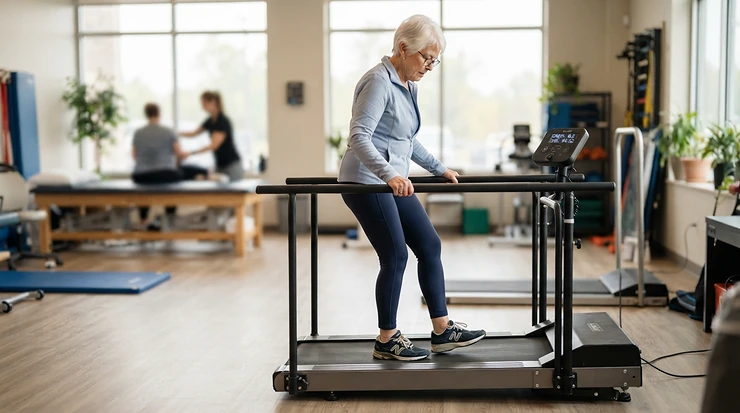
Let’s be honest about something nobody puts in the marketing copy: buying a treadmill for seniors with hip arthritis is a completely different exercise than buying one for a marathoner. You’re not shopping for top speed. You’re shopping for confidence — the kind that comes from knowing the belt won’t lurch out from under you and the deck won’t turn every step into a small negotiation with your joints. A treadmill for seniors with hip arthritis is a walking-focused machine built around cushioned decking, a very slow starting speed, and sturdy handrails so older adults with joint pain can move safely without jarring the hip. That’s the whole job description, and it’s a surprisingly hard one for most “regular” treadmills to fill.
Hip osteoarthritis doesn’t announce itself politely — it shows up as stiffness that eases once you get moving, then flares again if you push too hard on a punishing surface. And here’s the frustrating irony: staying still is often the worse choice. Federal researchers analyzing national health data found that among adults with arthritis who exercised, walking was by far the most common activity, reported by roughly seven in ten of them, according to a CDC analysis of physical activity patterns. The trick isn’t whether to walk. It’s how to walk without turning every session into damage control for your hips.
That’s where the right machine earns its keep. Below, we’ve dug into seven real, currently sold treadmills spanning budget rehab-style walkers up through premium cushioned decks, sorted them by who actually benefits from each, and explained the spec sheet in plain English — because “3-Zone Variable Response Cushioning” means nothing until someone tells you what it feels like at 7 a.m. with a stiff hip.
Quick Comparison Table
| Treadmill | Best For | Starting Speed | Price Range |
|---|---|---|---|
| Sole F63 | Best all-around cushioned deck | 0.5 mph | $1,100–$1,400 range |
| Horizon T101 | Best value walking treadmill | 0.5 mph | $650–$800 range |
| NordicTrack T Series 16 | Adjustable soft-to-firm cushioning | 0.5 mph | $1,300–$1,900 range |
| Echelon Stride-50 RCX Pro | Guided workouts on a big screen | 0.5 mph | $950–$1,300 range |
| UREVO Strol 2S Pro | Most compact for small spaces | 0.6 mph | $400–$550 range |
| REDLIRO Walking Treadmill with Long Handrails | Lowest start speed for rehab | 0.3 mph | $300–$450 range |
| Sunny Health & Fitness SF-T722062 | Budget pick with extended handrails | 0.5 mph | $400–$550 range |
Looking at the table, the split really comes down to floor space and ambition. If you have a dedicated workout corner and want incline programs that gently build hip strength over months, the NordicTrack T Series 16 or Sole F63 justify the higher price tag. If you mostly need a safe, flat walking surface near a chair or a desk, the REDLIRO Walking Treadmill with Long Handrails and Sunny Health & Fitness SF-T722062 deliver most of the safety benefit for a third of the cost. The UREVO Strol 2S Pro splits the difference nicely for apartments where a bulky frame simply isn’t an option.
💬 Just one click — help another walker find a safer routine too! 😊
Top 7 Treadmills for Seniors With Hip Arthritis: Expert Analysis
Coverage here spans budget, mid-range, and premium tiers, plus a couple of compact and lesser-known picks that don’t show up on every “best treadmill” roundup but genuinely earn their spot for this particular audience.
1. Sole F63 — best all-around cushioned deck for daily walking
The 2026 Sole F63 leans on its CushionFlex 2.0 deck as its calling card, and that’s not just branding fluff — it’s the reason this treadmill shows up on so many senior-focused lists. Under the hood sits a 3.0 HP brushless motor driving a spacious 20″ x 60″ deck, with 15 levels of incline and a 325-pound weight capacity that gives the frame real stability underfoot.
Based on the spec comparison, that generous deck length matters more than it sounds: a longer belt means less risk of your back foot clipping the rear rail mid-stride, which is exactly the kind of stumble a stiff hip can’t recover from gracefully. The 8″ step-up height is on the taller side, so pair it with a step stool if balance is a concern.
Reviewers consistently note that the F63 shakes slightly at faster paces, but at the slow, deliberate walking speeds this audience actually uses, that’s rarely an issue in practice. It also carries a lifetime frame and motor warranty, which says something about how the manufacturer expects it to hold up over years of gentle, daily use rather than sporadic sprints.
Pros:
- ✅ Cushioned 20″x60″ deck reduces joint impact noticeably
- ✅ Lifetime motor and frame warranty for peace of mind
- ✅ Hydraulic folding cuts footprint by about a third
Cons:
- ❌ 8-inch step-up height is taller than some rivals
- ❌ Some wobble reported at higher speeds and inclines
Expect to pay somewhere in the $1,100–$1,400 range depending on current promotions, and given the deck quality and warranty, that’s solid value for a machine built to be used almost every day for years.
2. Horizon T101 — gentlest 0.5 mph start speed for beginners
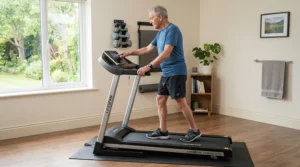
The Horizon T101 doesn’t try to dazzle you with a touchscreen or a subscription app — it just does the fundamentals correctly, starting at a crawling 0.5 mph so you can find your footing before the belt ever demands a real stride. The 2.5 HP motor drives a 20″ x 55″ deck with 3-Zone Variable Response Cushioning across a 0–10% incline range, and the whole unit tops out around 300 pounds of user capacity.
Here’s what most buyers overlook about this model: the step-up height is just over 7 inches, and the one-step hydraulic fold means you’re not wrestling a heavy deck into place every time you want to tuck it away. For someone managing hip osteoarthritis, that lower daily friction — easy fold, easy step-on — often decides whether the machine gets used five days a week or gathers dust after month one.
User reports on this model are largely positive on ease of setup, though several buyers note that Horizon’s customer service response time varies depending on the issue. It’s not built for runners, and Horizon says as much themselves, but for recreational walkers this is close to the sweet spot of price and function.
Pros:
- ✅ Ultra-low 0.5 mph starting speed for cautious first steps
- ✅ One-step hydraulic fold requires minimal effort
- ✅ Lifetime frame and motor warranty included
Cons:
- ❌ 55-inch deck feels short for taller walkers
- ❌ No touchscreen or guided workout programming
Priced in the $650–$800 range, the T101 is arguably the best-value entry point on this list for anyone who just wants a reliable, low-impact walking surface without paying for features they’ll never touch.
3. NordicTrack T Series 16 — adjustable cushioning from soft to firm
What sets the NordicTrack T Series 16 apart from nearly everything else here is that its SelectFlex deck isn’t fixed — you manually dial the six shock absorbers softer for recovery days or firmer when you want a surface that feels closer to pavement. On paper this means one treadmill can flex between “gentle rehab walk” and “steady cardio session” depending on how your hip feels that morning, which is a genuinely useful bit of engineering for a condition that fluctuates day to day.
The 3 HP motor supports up to 12% incline and a roughly 326-pound weight capacity, and the 16-inch tiltable touchscreen pairs with iFIT for trainer-led walking programs, though the machine also works fine without an active subscription for manual sessions.
The spec sheet won’t tell you this, but user reports suggest the SmartAdjust feature — which auto-tunes speed and incline to a trainer’s cues — can feel like too much handholding for people who just want a quiet, self-paced walk, so it’s worth trying manual mode first. Buyers researching this model should also budget for the optional iFIT membership if guided content is the draw.
Pros:
- ✅ Adjustable SelectFlex cushioning tunes deck softness
- ✅ 12% incline range supports gradual hip-strengthening
- ✅ Hydraulic fold with wheels for easy repositioning
Cons:
- ❌ iFIT subscription needed to unlock full feature set
- ❌ Higher price point than most senior-focused rivals
At roughly $1,300–$1,900 depending on sales, this is the premium pick here — worth it mainly for people who want cushioning control and structured incline progression as their hip strength improves over time.
4. Echelon Stride-50 RCX Pro — spacious DuroFlex deck for guided workouts
The Echelon Stride-50 RCX Pro brings a commercial-width 22″ x 57″ DuroFlex cushioned deck and pairs it with a 22-inch display built for streaming live and on-demand walking classes. Reviewers consistently point to the DuroFlex system as noticeably softer underfoot than budget alternatives, which lines up with what the brand claims about its impact-absorbing suspension.
Based on the spec comparison, the wider-than-average deck (22 inches versus the 20-inch standard) gives a bit more lateral margin for anyone whose gait has shifted slightly to protect a sore hip, and that margin for error matters more than it sounds on a features list. Safety-wise, it uses a magnetic pull-cord safety key that immediately cuts power if you stumble backward, a detail senior-focused reviewers flag as genuinely reassuring rather than a checkbox feature.
Speed tops out at 12.5 mph with 15 incline levels, though most walkers in this audience will never approach either ceiling — the value here is deck quality and screen size, not top-end performance. An Echelon Fit membership unlocks the full class library, though the console still functions for manual walking without one.
Pros:
- ✅ Wide 22-inch DuroFlex deck softens every footfall
- ✅ Magnetic safety key stops the belt instantly if you stumble
- ✅ Large 22-inch display supports guided walking classes
Cons:
- ❌ Full content library requires an ongoing membership
- ❌ Bulkier footprint than compact walking-pad alternatives
Typically found in the $950–$1,300 range, this model earns its price through deck width and screen size for anyone who wants a more immersive, class-led walking routine.
5. UREVO Strol 2S Pro — most compact 2-in-1 for tight spaces
For apartments, condos, or anyone who simply doesn’t have room for a full-size deck, the UREVO Strol 2S Pro solves a real problem: it’s a walking pad with a raisable handlebar, so it converts between a low-profile under-desk pad and a supported walking treadmill depending on whether you need the handrail. The 2.5 HP motor covers a 0.6–4.0 mph walking mode and up to 7.6 mph in running mode, with 9-level auto incline reaching 9% and a magnetic safety key for quick stops.
Here’s what most buyers overlook about this model: raising the handlebar isn’t just about convenience, it’s the difference between a device you’d hand to someone managing hip pain and one you wouldn’t — the extra stability point changes the safety calculus considerably. Reviewers consistently mention the SwiftFold mechanism as genuinely fast to deploy and stow, which matters if the treadmill needs to disappear under a bed or sofa between uses.
It’s not going to replace a full-size cushioned deck for serious daily mileage, but as a low-commitment way to add gentle movement to a small living space, it punches well above its size.
Pros:
- ✅ Folds flat and slides under furniture in seconds
- ✅ Raisable handlebar adds stability when needed
- ✅ Magnetic safety key stops the belt automatically
Cons:
- ❌ Shorter belt length limits natural stride for taller users
- ❌ 265-pound weight capacity is lower than full-size decks
At around $400–$550, this is a smart pick specifically for space-constrained homes rather than a like-for-like substitute for the bigger machines on this list.

6. REDLIRO Walking Treadmill with Long Handrails — lowest 0.3 mph start for rehab
Nothing else on this list starts as slowly as the REDLIRO Walking Treadmill with Long Handrails, which idles down to a genuinely crawling 0.3 mph — an increment that matters enormously for anyone easing back into activity after a flare-up or a hip procedure. The 2.5-peak-horsepower motor supports up to 300 pounds across a 300 lb-rated frame, and the extended handrails run along the top, middle, and end of the low-profile deck, so there’s a grip point within reach at essentially every phase of a stride.
What most buyers overlook about this model is the safety key mechanism: if you fall or lean back too far, the key drops free and cuts power immediately, which is a genuinely different safety proposition than a simple stop button you’d have to reach for mid-stumble. Aggregated customer sentiment on this model runs positive, with an average rating around 4.4 out of 5 across thousands of reviews, and buyers frequently cite quiet operation and straightforward assembly as standout points.
The tradeoff is speed ceiling and incline — this is a purpose-built rehab and daily-walking machine, not a fitness cross-trainer, and it shows in the modest top speed and near-flat incline range.
Pros:
- ✅ Ultra-low 0.3 mph start ideal for rehab pacing
- ✅ Multi-grip handrails run the length of the deck
- ✅ Safety key disconnects power instantly on a fall
Cons:
- ❌ Very limited incline range compared to full-size decks
- ❌ Smaller running surface than standard treadmills
At a budget-friendly $300–$450, this is the treadmill we’d point to first for anyone whose doctor or physical therapist has specifically flagged fall risk as a concern.
7. Sunny Health & Fitness SF-T722062 — budget pick with extended handrails
Rounding out the list, the Sunny Health & Fitness SF-T722062 takes the extended-handrail concept and pairs it with a slightly wider 18.9-inch deck than some rivals in its price bracket, plus Bluetooth connectivity through the SunnyFit app for tracking sessions over time. Based on the spec comparison, the wider deck combined with shock-absorption technology in the frame gives a bit more forgiving footing than bare-bones budget treadmills that skip cushioning entirely to hit a lower price point.
The handrails extend generously along the sides, offering a consistent grip whether you’re stepping on, mid-stride, or stepping off — arguably the three moments where a hip-arthritis walker is most vulnerable to an off-balance moment. Reviewer sentiment for this model runs strongly positive, sitting around 4.8 out of 5 stars across dozens of reviews, with buyers frequently citing the handrail design and quiet motor as the standout features.
It won’t compete with the Sole or NordicTrack decks on cushioning sophistication, but for the price, it delivers the two features that matter most for this exact use case: stability and a soft-enough landing.
Pros:
- ✅ Extended handrails support every phase of a stride
- ✅ Wide 18.9-inch deck with shock-absorption technology
- ✅ SunnyFit app tracks progress via Bluetooth
Cons:
- ❌ Fewer incline options than premium competitors
- ❌ Display is basic compared to touchscreen rivals
Priced around $400–$550, this is a genuinely strong budget contender that punches above its price bracket specifically on the safety-hardware side of the equation.
Practical Usage Guide: Setting Up Your Treadmill for Safe Hip-Friendly Walking
Getting the machine into your house is the easy part — setting it up so it actually protects your hip takes a bit more thought. First, placement matters more than people expect: give yourself at least two feet of clearance behind the belt and position the console within easy reach so you’re not twisting your torso (and by extension, your hip) to hit the controls. Second, start every single session — even ones you’ve done a hundred times — at the treadmill’s absolute lowest speed for the first 60 to 90 seconds. This isn’t overcaution; it lets the joint capsule warm up gradually rather than being asked to bear weight at pace immediately, which is exactly the kind of jolt that triggers flare-ups.
Maintenance-wise, most cushioned decks need belt lubrication every 100 to 150 miles (check your specific manual, since intervals vary), and skipping this step lets friction build that transmits as extra vibration up through the deck and into your joints. In the first 30 days, the single most common mistake is treating incline like a badge of honor — cranking it up before your hip has adapted to flat walking is a fast track to soreness. Keep incline at zero for at least the first two weeks, and add it in small 1–2% increments only once flat walking feels easy. Finally, wipe down handrails and check bolts monthly; a wobbly handrail defeats the entire purpose of buying one in the first place.

Real-World Scenarios: Matching Your Situation to the Right Treadmill
Picture Margaret, 71, recently cleared by her orthopedist to start walking again after a hip flare, living in a two-bedroom condo with limited storage. For her, the REDLIRO Walking Treadmill with Long Handrails is close to ideal — the 0.3 mph start speed matches exactly where her rehab program wants her, and the compact footprint tucks under a bed when she’s done.
Now consider Frank, 68, whose hip arthritis is mild and mostly a morning-stiffness issue, and who wants a longer-term investment with room to grow into incline training as his strength improves. The NordicTrack T Series 16 or Sole F63 make more sense here — both offer incline ranges and cushioning depth that reward someone planning to use the machine for years, not just months.
Then there’s Diane, 74, in a studio apartment with almost no spare floor space, whose main goal is simply hitting a daily step count without leaving her living room. The UREVO Strol 2S Pro‘s under-furniture storage and quick-fold design solve her actual constraint — space — better than any amount of extra cushioning would.
Buyer’s Decision Framework: If This, Choose That
If fall risk is your primary concern, choose a model with full-length multi-grip handrails and a 0.3–0.5 mph start, because stability hardware matters more than horsepower at these speeds. If you’re managing daily stiffness but have decent balance, choose a model with adjustable or thick cushioning like the NordicTrack or Sole, because deck quality is what determines how your joints feel after twenty minutes. If space is your binding constraint, choose a compact folding walking pad over a full-size deck, because a treadmill you can’t store is a treadmill you’ll stop using. And if budget is tight, prioritize handrails and starting speed over incline range and touchscreens — those two features do the most protective work for the least money.
How to Choose a Senior Hip Arthritis Treadmill
- Check the starting speed first. Anything above 0.5 mph as a floor makes it hard to ease in; look for machines that start at 0.3–0.5 mph.
- Prioritize handrail length and placement. Short “pulse grip” bars near the console don’t help mid-stride — look for rails that run alongside where you actually walk.
- Confirm the step-up height. Lower decks (around 3–7 inches) are easier to mount safely than taller commercial-style frames.
- Look for genuine deck cushioning, not just a marketing name — named systems like SelectFlex, CushionFlex, or DuroFlex generally indicate real shock-absorbing engineering underneath.
- Match weight capacity with a margin, not a ceiling — a machine rated close to your exact weight will feel less stable than one with 50–75 pounds of headroom.
- Consider a safety key or pull-cord, which cuts power instantly during a stumble, a feature not every budget model includes.
- Weigh incline against your current mobility — flat or low-incline machines suit early-stage rehab, while adjustable incline suits longer-term strength building.
Common Mistakes When Buying a Senior Hip Arthritis Treadmill
The single most common mistake is chasing top speed and horsepower specs that a walker will never use, while ignoring starting speed and step-up height — the two numbers that actually determine day-one safety. A close second is skipping the return policy: cushioning that feels fine in a showroom can feel different after a week of real use, and a narrow return window leaves you stuck. Buyers also frequently underestimate deck length, assuming any 55-inch belt is “long enough,” when a taller walker with a longer natural stride may need the extra room a 57- or 60-inch deck provides to avoid clipping the rear rail. Finally, many people buy based on brand recognition alone and skip checking whether handrails run the deck’s full length — a small detail on a spec sheet that makes an enormous difference in daily use.
Gentle Walking Treadmill for Hip Issues vs Traditional Treadmills
| Feature | Gentle Walking Treadmill | Traditional Treadmill |
|---|---|---|
| Starting speed | 0.3–0.6 mph | Typically 1–2 mph minimum |
| Handrails | Full-length, multi-grip | Short console-side grips only |
| Deck cushioning | Purpose-tuned for low impact | Optimized for running performance |
| Step-up height | Often 3–7 inches | Commonly 8–9 inches |
| Safety cutoff | Magnetic key or drop-clip | Basic stop button only |
A gentle walking treadmill for hip issues isn’t just a slower version of a regular treadmill — it’s engineered around an entirely different failure mode. Traditional treadmills are built to reward speed and stride length; a gentle walking model like the REDLIRO Walking Treadmill with Long Handrails or Sunny Health & Fitness SF-T722062 is built to reward stability at low speed, which is a different design problem entirely. What most buyers overlook about this until they’ve tried both is that the handrail geometry, not the motor, is usually the deciding factor in which category actually feels safer underfoot.
What to Expect: Real-World Performance for Hip Osteoarthritis Walkers
On paper, spec sheets promise “impact reduction,” but what does that translate to in a real living room? Reviewers and physical trainers alike describe well-cushioned decks as feeling closer to a rubberized track than pavement — a noticeably softer landing under the heel that reduces the jolt transmitted up through the hip with every step. That said, cushioning alone doesn’t eliminate discomfort if form is poor: leaning on the handrails too heavily changes your gait mechanics and can actually load the hip awkwardly, so use rails for balance confidence rather than as a constant crutch. The Arthritis Foundation’s guidance on exercise for osteoarthritis notes that regular movement helps maintain joint function and can reduce pain over time, which lines up with what most physical therapists tell patients about consistency mattering more than intensity. Expect the first two to three weeks to feel like an adjustment period — mild post-walk stiffness is common and typically fades as surrounding muscles strengthen, but sharp or worsening pain is a signal to slow down and check in with your doctor.
Best Treadmills for Senior Mobility Programs and Geriatric Fitness
Community and in-home senior mobility programs increasingly lean on treadmill walking as a core component, precisely because it’s measurable, low-impact, and easy to progress gradually. For geriatric fitness settings — whether that’s a physical therapist’s office, an assisted living common room, or a home-based program supervised by a caregiver — the priorities shift slightly from individual buying decisions. Durability under repeated daily use across multiple users becomes more important than any single feature, which is why models like the Sole F63 and NordicTrack T Series 16, both backed by lifetime frame and motor warranties, tend to show up in more structured settings. For a single-user home mobility program, though, a simpler and cheaper machine like the Horizon T101 or REDLIRO Walking Treadmill with Long Handrails typically covers everything a therapist would actually prescribe: flat or gently inclined walking at a controlled, slow pace with reliable support rails. Whichever machine you choose, coordinating incline and duration increases with a physical therapist — rather than guessing — tends to produce steadier, safer progress over months rather than weeks.
Safety, Regulations & Hip Osteoarthritis Exercise Guidance
Home fitness equipment in the U.S. isn’t subject to the same premarket testing rigor as medical devices, so the safety burden largely falls on smart purchasing and sensible use rather than regulatory guarantees. That makes features like magnetic safety keys and full-length handrails less “nice-to-have” and more genuinely load-bearing for this audience. Beyond the equipment itself, the University of Washington’s orthopaedic overview of hip arthritis explains that osteoarthritis symptoms typically respond well to activity modification and low-impact exercise, though it also notes that severe cases may eventually need surgical evaluation — a good reminder that a treadmill supports a management plan, it doesn’t replace one. Before starting any new walking program, especially after a flare-up, injury, or joint procedure, a quick check-in with a doctor or physical therapist helps set safe starting parameters. The National Institute on Aging’s tips for staying motivated with exercise also point out that consistency in small, manageable sessions tends to outperform occasional intense ones for older adults — which, conveniently, is exactly what a slow-starting home treadmill is built to support.
✨ Ready to walk safer, starting today? 🚶♀️ Take a closer look at the models above and check current pricing and availability before they shift — your hips will thank you for choosing cushioning over compromise!
Frequently Asked Questions
❓ What is the best treadmill for seniors with hip arthritis in 2026?
❓ How slow should a treadmill start for someone with hip arthritis?
❓ Are cushioned treadmills actually better for arthritic hips?
❓ Do I need a treadmill with handrails if I have hip arthritis?
❓ How much should I expect to pay for a good senior hip arthritis treadmill?
Conclusion
Choosing a treadmill for seniors with hip arthritis really comes down to matching three things honestly: your current mobility level, your available space, and how much you’re willing to spend on cushioning and safety hardware versus screens and subscriptions. The REDLIRO Walking Treadmill with Long Handrails and Sunny Health & Fitness SF-T722062 cover the essentials — slow starts and strong handrails — at a genuinely accessible price. The Sole F63 and NordicTrack T Series 16 reward a bigger investment with cushioning depth and incline range that can grow alongside your strength over months and years. And for tight living spaces, the UREVO Strol 2S Pro proves that compact doesn’t have to mean unsafe. Whichever you choose, start slow, keep incline flat for the first couple of weeks, and treat consistency — not intensity — as the real goal. Your hip will notice the difference long before the scale or the calendar does.
Recommended for You
- Low Impact Treadmill For Hip Pain: 7 Real Picks for 2026
- Treadmill Under $800 for Arthritis: 7 Best Picks for 2026
- Treadmill for Arthritis Sufferers: 7 Joint-Safe Picks (2026)
Disclaimer: This article contains affiliate links. As an Amazon Associate, I earn from qualifying purchases. If you purchase products through these links, we may earn a small commission at no additional cost to you.
✨ Found this helpful? Share it with your friends! 💬🤗
