In This Article
Somewhere between the third snow day of the week and the fortieth “I’m bored” of the afternoon, a lot of parents start eyeing a treadmill for kids under 12 the way other people eye a lottery ticket — as a small, hopeful bet against a long winter. It’s not a crazy idea. Kids need about an hour of movement most days, and a treadmill tucked into a playroom or basement can turn five spare minutes into a genuine burst of activity instead of another round of scrolling. But “treadmill” covers a lot of ground, from tiny manual units built for toddlers to compact family treadmills that a supervised nine-year-old can hop on for a walk.
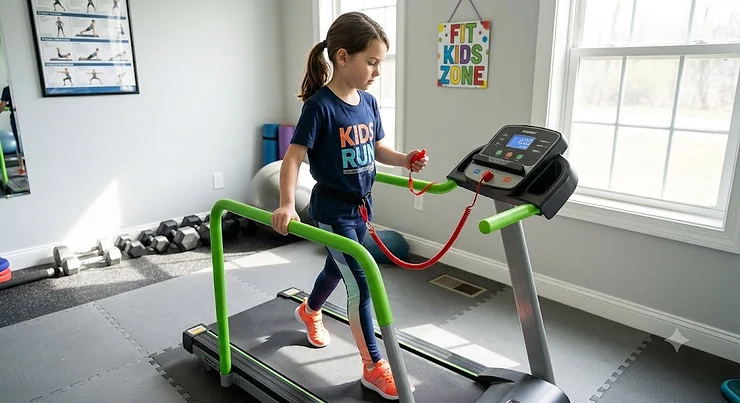
A treadmill for kids under 12 is generally either a purpose-built manual (non-motorized) unit designed for younger children, or a compact, low-speed family treadmill used strictly under adult supervision for elementary-age kids. Neither category is a toy, and neither replaces outdoor play — but used correctly, both can be a genuinely useful piece of the family fitness puzzle.
This guide walks through seven real, currently available options — including a couple of manual treadmills genuinely designed for kids, plus a handful of compact family treadmills that work for supervised use with elementary-age kids — and it’s honest about where the line between “kid-appropriate” and “adults-only” actually sits. We’ll also get into safety standards, what the research says about childhood obesity prevention, and how to build family fitness routines that don’t collapse by February. Prices shift constantly on Amazon, so every figure here is a range based on research at the time of writing — always check the current price before buying.
Quick Comparison Table
Here’s the shortest possible version of this whole article, for anyone skimming on a lunch break.
| Product | Type | Weight Capacity | Best For |
|---|---|---|---|
| Redmon Fun & Fitness for Kids Manual Treadmill | Manual, kid-specific | 100 lbs | Ages 3-7, dedicated kids’ unit |
| Kids Treadmill Workout Equipment (Indoor Toddler Gym) | Manual, kid-specific | ~110 lbs | Toddlers, gift-friendly budget pick |
| AKLUER RJ401 Non-Motorized Treadmill | Manual, family | 330 lbs | Elementary-age kids + parents sharing one unit |
| Sunny Health & Fitness Smart Manual Walking Treadmill | Manual, family | 300 lbs | Trusted-brand pick for the whole household |
| HevGlrm Walking Pad Treadmill with Incline | Motorized walking pad | 350 lbs | Budget-conscious families wanting low speeds |
| UREVO Strol 2E Smart 2-in-1 Folding Treadmill | Motorized, app-connected | ~265 lbs | Tech-savvy families tracking activity together |
| Goplus 2-in-1 Folding Treadmill 2.25HP Superfit | Motorized, family | 265 lbs | All-around premium family treadmill |
Looking at the spread, the real split isn’t “cheap versus expensive” — it’s manual versus motorized. The manual units, including the Redmon Fun & Fitness for Kids Manual Treadmill and the AKLUER RJ401 Non-Motorized Treadmill, only move when a child’s own legs are moving them, which removes the single biggest risk factor in kid treadmill safety: an unexpected belt speed. The motorized options, like the UREVO Strol 2E Smart 2-in-1 Folding Treadmill and Goplus 2-in-1 Folding Treadmill 2.25HP Superfit, are genuinely family equipment rather than kids’ toys, and they belong on this list only because, at low speeds and under direct supervision, they’re a reasonable way for an elementary-age kid to join a parent’s workout.
💬 Bookmark this table now — you’ll want to compare it against the deep dives below before you buy.
Top 7 Treadmill for Kids Under 12 Picks: Expert Analysis
1. Redmon Fun & Fitness for Kids Manual Treadmill — best dedicated manual pick for younger kids
The standout here is right in the name: this is one of the only treadmills on the market actually engineered and marketed for children, not a family unit repurposed for smaller feet. It’s a self-propelled, non-motorized belt that only moves when a child is walking or running on it, which is a meaningfully different safety profile than anything with a plug.
Specs-wise, it’s a steel-and-plastic frame rated to 100 pounds, with a battery-powered monitor that tracks time and shuts off automatically after ten minutes of inactivity. What that 100-pound rating means in practice: this is built for the 3-to-7 age bracket, not a 90-pound ten-year-old, so treat the “under 12” framing loosely and check your child’s weight against the spec sheet before buying. The auto-off monitor is a nice touch for parents who don’t want to police battery drain, though it’s cosmetic rather than a true safety stop.
Reviewers consistently describe the frame as sturdier than expected for the price, with a few noting that assembly is straightforward with the included tools. A recurring theme in aggregated feedback is that younger kids treat it like a novelty for the first week and then use it in short, sporadic bursts — which, frankly, tracks with how most kids use any home fitness equipment.
Pros:
- ✅ Purpose-built for young kids, not a scaled-down adult machine
- ✅ Non-motorized design removes unexpected-speed risk entirely
- ✅ Sturdy steel frame that reviewers say outlasts expectations
Cons:
- ❌ 100-lb capacity means it ages out fast for bigger elementary kids
- ❌ Auto-off timer needs batteries and isn’t a true safety lock
Price sits in the low-to-mid $100s range at most retailers, occasionally dipping toward $130 during sales. For the 3-7 crowd specifically, it’s one of the more honest value plays on this list — you’re paying for a real kids’ product, not a marketing label slapped on an adult treadmill.
2. Kids Treadmill Workout Equipment (Indoor Toddler Gym) — sturdiest budget build for active toddlers
This one’s standout feature is resistance calibrated for small legs — several buyers specifically mention that a strong preschooler can move the belt easily while a smaller toddler may need help getting started, which is actually the honest trade-off of manual kid treadmills in general.
It’s a steel-frame, non-motorized unit similar in spirit to the Redmon model, built around a roughly 100-to-110-pound capacity and a compact footprint that fits in a playroom corner without dominating the space. The real-world meaning of “manual resistance” here is that a wiry, high-energy kid will get more workout value than a smaller sibling — something worth testing in person or reading reviews carefully for before buying as a surprise gift.
Aggregated reviewer sentiment is mixed but leans positive: several buyers report it’s a hit with active 3-to-5-year-olds and note it’s well-built for the price, while a handful of one-star reviews cite missing parts on arrival or difficulty for smaller children to get the belt moving at all. That split is worth taking seriously — it’s not a universal win for every toddler.
Pros:
- ✅ Compact footprint fits small playrooms and shared spaces
- ✅ Manual belt engages large muscle groups during active play
- ✅ Priced accessibly for a first “big kid” fitness gift
Cons:
- ❌ Some reviewers report smaller toddlers can’t move the belt easily
- ❌ A subset of buyers reported damaged or incomplete units on arrival
At around $150-$190, it competes directly with the Redmon model, and the choice mostly comes down to which one is in stock and which reviews resonate with your specific kid’s size and energy level.
3. AKLUER RJ401 Non-Motorized Treadmill — highest-capacity manual option for growing kids
The standout feature is capacity: at 330 pounds, this manual treadmill isn’t sized for toddlers, it’s sized for a family to share — which matters enormously once you’re talking about elementary-age or tween kids who’ve outgrown the 100-pound toddler units above.
It runs a fixed 5% incline with three adjustable resistance levels, an anti-slip belt, and an LED console showing time, distance, and calories — all mechanical, with zero electrical components to fail or overheat. What that incline and multi-level resistance actually buys you is a machine that can flex from “gentle walk for an 8-year-old” to “real cardio session for a parent” without needing two separate treadmills in the house.
Because this is a general compact manual treadmill rather than a marketed kids’ product, verified customer-review data specific to child use is limited; most available reviews focus on adult walkers using it as a compact home unit. That’s a meaningful distinction worth being upfront about — buy it as a shared family treadmill an elementary-age kid can use under supervision, not as a dedicated kids’ product with kid-specific safety testing behind it.
Pros:
- ✅ 330-lb capacity means it works for the whole family long-term
- ✅ No motor means no unexpected belt-speed changes
- ✅ Adjustable incline and resistance scale from kid-gentle to adult-hard
Cons:
- ❌ Marketed as a general compact treadmill, not a kids’ product specifically
- ❌ Fixed incline can’t be lowered further for very small or unsteady kids
Expect a price in the $140-$180 range. Given the honest analysis above, this is best framed as “a family treadmill an elementary-age kid can use with you nearby,” not a standalone kids’ purchase.
4. Sunny Health & Fitness Smart Manual Walking Treadmill (SF-T1407SMART) — most trusted brand name in this lineup
The standout here is brand reputation: Sunny Health & Fitness has built its name on home fitness gear for over a decade, and that track record shows up in build consistency more than any single flashy feature.
It’s a non-electric, fixed-incline manual treadmill rated to 300 pounds, foldable for storage, with a digital monitor and Bluetooth connectivity to the SunnyFit app for logging sessions. In practical terms, the app integration means a parent can actually track how many minutes a kid logged during the week — useful ammunition for hitting that federal 60-minutes-a-day activity target without relying on memory.
Reviewer sentiment aggregated across major retailers is notably consistent: buyers repeatedly cite smooth folding, a compact stored footprint, and reliable customer support as reasons for the brand’s loyal following. A recurring gripe is that, like all manual treadmills, it requires real leg effort to get the belt moving — some buyers expected an easier walk than a fixed-incline manual unit delivers.
Pros:
- ✅ Established brand with a long history of reliable home fitness gear
- ✅ App connectivity makes tracking a child’s activity minutes simple
- ✅ Folds compactly, which matters in shared family spaces
Cons:
- ❌ Fixed incline demands more leg effort than some kids expect
- ❌ Not marketed specifically for children, so supervision is on the parent
Pricing typically lands in the high-$100s to low-$200s range. For families who want one well-known name behind the purchase, this is the safest brand bet on the list.
5. HevGlrm Walking Pad Treadmill with Incline — best budget motorized walking pad
The standout feature is price-to-speed-range ratio: a 0.6-to-7.6 mph range on a motorized unit for a genuinely budget price point, which matters because the low end of that range is what makes supervised elementary-age use plausible at all.
It’s a 3.0HP compact walking pad with an incline setting and a removable handle bar, built for under-desk or small-space use. The real-world takeaway on the 0.6 mph floor: that’s a slow amble, not a jog, which is exactly the speed zone where a parent standing next to a supervised nine- or ten-year-old has time to react if something goes wrong.
Aggregated reviews are solid for the price tier, with buyers frequently praising the compact folded size and quiet motor for apartment use; a common critique is that the handle bar, while removable, feels less sturdy than pricier units when a kid leans on it for balance.
Pros:
- ✅ Very low starting speed makes supervised elementary-age use realistic
- ✅ Compact and quiet enough for shared living spaces
- ✅ Budget price point relative to other motorized options here
Cons:
- ❌ Handle bar feels less rigid than higher-priced competitors
- ❌ As a motorized unit, it requires constant, undistracted adult supervision
Price generally falls in the $130-$180 range depending on sales. This is a reasonable “family walking pad, occasionally shared with a supervised tween” pick, never a stand-alone kids’ machine.
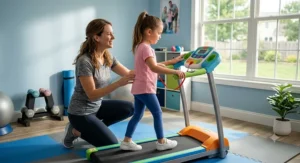
6. UREVO Strol 2E Smart 2-in-1 Folding Treadmill — smartest app-connected pick for tracking family activity
The standout feature is the safety handle bar paired with app-based activity tracking — a combination that lets a parent both physically supervise and digitally log a kid’s session in one setup.
This is a motorized 2-in-1 folding treadmill with a smart app offering workout insights and remote or app-based speed control, so a parent can adjust or halt the belt from a phone rather than reaching for a console. In practice, that remote-stop capability is one of the more genuinely useful safety features on this list for supervised elementary-age use, since it removes any fumbling at the console during an unexpected moment.
Real customer sentiment on this specific model is still building as newer stock circulates retailers, so treat aggregate review volume as thinner than the more established names here; early buyer feedback highlights the quiet motor and app setup as strong points, while a few reviewers note the companion app has a learning curve on first use.
Pros:
- ✅ Remote or app-based control adds a genuine supervision safety net
- ✅ Quiet motor works well in shared or open-plan living spaces
- ✅ Activity tracking supports building consistent family fitness routines
Cons:
- ❌ Companion app has a reported learning curve for first-time users
- ❌ Review volume is thinner than more established competing brands
Expect a price in the $250-$350 range. For families who like data — steps, minutes, streaks — this is the pick that turns a treadmill into an actual habit-tracking tool.
7. Goplus 2-in-1 Folding Treadmill 2.25HP Superfit — best all-around premium family treadmill
The standout feature is the combination of Bluetooth speaker, app control, and remote control in one under-desk-capable frame, making this the most fully equipped family unit on the list.
It runs a 2.25HP motor with LED display, installation-free setup, and dual control via app or physical remote — the kind of spec sheet built for a parent who wants one serious treadmill that occasionally, briefly, hosts a supervised kid’s walk rather than a machine bought specifically for children. What that dual-control setup means in real terms: you can start it, adjust it, and stop it without your child ever touching the console directly, which is exactly the kind of access control pediatric safety guidance recommends.
Reviewer sentiment aggregated from Goplus’s broader treadmill line is generally strong on ease of setup and quiet operation, with the installation-free claim frequently confirmed by buyers; the more common complaint across this line involves belt alignment needing occasional adjustment after heavy use, which is a maintenance item rather than a safety flaw.
Pros:
- ✅ Full remote and app control keeps a child off the physical console
- ✅ Installation-free setup confirmed by multiple independent reviewers
- ✅ Strong feature density (speaker, app, remote) for the price tier
Cons:
- ❌ Belt alignment reportedly needs occasional manual adjustment over time
- ❌ Premium features push it to the higher end of this list’s price range
Price typically lands in the $300-$400 range depending on promotions. If you want one treadmill the whole family can use — with the kid portion always parent-controlled — this is the strongest all-rounder here.
Practical Usage Guide: Setting Up a Treadmill for Kids Under 12 Safely
Getting a treadmill for kids under 12 into the house is the easy part; getting the setup right is where most of the actual safety work happens. Start with placement: face the machine toward the room’s entrance, not away from it, so whoever’s supervising can see the door and the belt at the same time. That single adjustment addresses one of the more common incident patterns pediatric researchers describe, where a child enters a room behind an adult who’s mid-workout and reaches for the moving belt unseen.
For the first thirty days, treat every session as supervised, full stop — even on the manual units where there’s no motor to misbehave. Kids test equipment in ways manuals don’t anticipate: leaning on handrails that aren’t designed for body weight, trying to hop on sideways, or racing a sibling to see who can go faster. None of that is really “misuse” so much as normal kid behavior meeting a machine that wasn’t built with it in mind.
A simple maintenance habit worth adopting from week one: wipe down the belt monthly, check bolts for looseness after the first few weeks of use (kids are harder on hardware than the average adult user), and, for motorized units, unplug or lock the console when not in active use. Common early mistakes include letting a child operate speed or incline controls independently, skipping the safety clip or key on motorized models, and assuming a “kids'” label means zero supervision is required — it never does, on any of the seven products above.
Real-World Family Scenarios: Matching the Right Treadmill to Your Household
Picture the Ramirez family: two kids, ages 5 and 9, a two-bedroom apartment, and a budget under $200. The 5-year-old gets far more out of the Kids Treadmill Workout Equipment (Indoor Toddler Gym), sized and priced for exactly that age band, while the 9-year-old is really better served joining a parent on the AKLUER RJ401 Non-Motorized Treadmill during short, supervised sessions — one purchase, two kids, honest fit for both.
Now consider a single parent with one 11-year-old, a home office, and a genuine need to model movement during the workday. The UREVO Strol 2E Smart 2-in-1 Folding Treadmill fits that household well: it tucks under a desk, tracks minutes automatically, and its app-based control means the parent can supervise a short after-school session from across the room without hovering over a console.
A third scenario: a family of four with kids at 4 and 10, decent space, and a bit more budget flexibility. Here, splitting the investment makes more sense than trying to force one machine to serve both ages — the Redmon Fun & Fitness for Kids Manual Treadmill for the younger sibling, paired with the Goplus 2-in-1 Folding Treadmill 2.25HP Superfit as the shared family unit the 10-year-old uses under direct supervision, covers both ends of the age range honestly rather than compromising on either.
Buyer’s Decision Framework: A Quick-Pick Guide
If your child is under 7 and you want a genuinely kid-specific product, choose a manual, dedicated kids’ treadmill like the Redmon Fun & Fitness for Kids Manual Treadmill, because it’s actually built and rated for that age and weight range rather than borrowed from adult equipment.
If your child is 8-12 and you want them to occasionally join your workout under supervision, choose a compact family manual treadmill like the AKLUER RJ401 Non-Motorized Treadmill or Sunny Health & Fitness Smart Manual Walking Treadmill, because the absence of a motor removes the single biggest risk factor for that age group.
If you want to track activity data and prefer a motorized option for slow, supervised walking sessions, choose an app-connected pick like the UREVO Strol 2E Smart 2-in-1 Folding Treadmill, because remote control keeps kids off the physical console entirely.
If budget is the primary constraint and you need one machine the whole household can eventually grow into, choose the AKLUER RJ401 Non-Motorized Treadmill for its 330-lb capacity, because it won’t be outgrown the way a 100-lb toddler unit will.
How to Choose a Treadmill for Kids Under 12
Cutting through the marketing, here’s the actual decision checklist, in order of importance:
- Check the age and weight rating against your specific child — not the “under 12” marketing framing, but the manufacturer’s actual number, since a 100-lb rating and a 90-lb ten-year-old don’t leave much margin.
- Prioritize manual over motorized for younger kids — a non-motorized belt physically cannot surprise a child with a sudden speed change, which the CDC’s guidance on youth physical activity treats as safe, low-barrier movement regardless of mechanism.
- Look for a genuine safety stop, not just an auto-off timer — a battery-powered ten-minute shutoff is a convenience feature, not an emergency stop.
- Confirm the footprint fits your actual space — a treadmill jammed into a hallway gets used less and creates its own tripping and collision risks.
- Weigh app and remote control features on motorized units as safety tools first, gimmicks second — the ability to stop a belt from across the room matters more than the workout-tracking dashboard.
- Read aggregated reviews specifically for durability under kid use — adult-treadmill reviews rarely reflect how a machine holds up to jumping on and off repeatedly.
- Budget for supervision time, not just the machine — every product on this list requires an adult present, which is really the biggest “cost” of the whole category.
Treadmill for Elementary-Age Kids: What Changes as They Grow
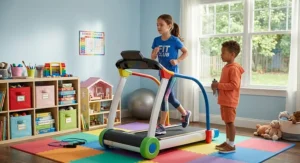
A treadmill for elementary-age kids looks meaningfully different from one built for toddlers, and it’s worth being honest that the market hasn’t fully caught up to that gap. Toddler-focused manual units like the Redmon Fun & Fitness for Kids Manual Treadmill cap out around 100 pounds, which a typical 3-to-7-year-old fits comfortably, but a growing 9-or-10-year-old often exceeds that rating well before they age out of wanting to use the thing.
That’s exactly why higher-capacity manual options like the AKLUER RJ401 Non-Motorized Treadmill and Sunny Health & Fitness Smart Manual Walking Treadmill end up doing double duty for this age bracket — not because they’re marketed at kids specifically, but because their 300-plus-pound ratings and lack of a motor make them a defensible fit for elementary-age use under supervision. Based on the spec comparison across all seven products, the honest recommendation for the 8-12 range consistently points toward these general compact treadmills over anything explicitly labeled “kids’,” since the labeled products simply aren’t built to that weight range.
What most buyers overlook is that elementary-age kids also want more autonomy than toddlers — they want to set their own pace, see a number climb on a display, maybe race a sibling’s time. Products with a visible console, like the UREVO Strol 2E Smart 2-in-1 Folding Treadmill, tend to hold a tween’s interest longer than a bare manual belt, even if the underlying safety profile favors the simpler machine.
Common Mistakes When Buying a Treadmill for Kids Under 12
The single most common mistake is buying based on the word “kids” in a product title without checking the actual weight rating — several genuinely excellent family treadmills on this list, including the Goplus 2-in-1 Folding Treadmill 2.25HP Superfit, aren’t marketed as kids’ products at all, while some products that do use “kids” in the name cap out at 100 pounds and won’t fit an average 10-year-old.
A second frequent misstep is assuming a motorized treadmill is inherently more advanced or better than a manual one for this use case. Reviewers and safety literature alike consistently point the other direction: for children specifically, the manual mechanism is the safety feature, not a budget compromise.
Third, many parents skip reading reviews for durability specifically under repeated kid use, focusing instead on general star ratings that reflect adult walkers. A treadmill that holds up fine for a 160-pound adult walking three times a week may wear differently under a kid jumping on and off ten times in an afternoon.
Finally, buyers frequently underestimate the ongoing supervision commitment, treating the purchase as a one-time decision rather than an ongoing household routine — every product reviewed here, without exception, requires active adult presence during use.
Kid-Sized Treadmill Review: What to Expect in Real-World Performance
On paper, spec sheets promise smooth belts, quiet motors, and sturdy frames. In an actual living room, a kid-sized treadmill review looks different: expect noise levels that spike when a child runs rather than walks, expect the belt or resistance mechanism to get more abuse in month one than an adult unit sees in a year, and expect genuine enthusiasm that fades within a few weeks unless the treadmill is tied to something — a show they only watch while walking, a step-count competition with a sibling, a parent using it alongside them.
Reviewers across the manual units, including the Kids Treadmill Workout Equipment (Indoor Toddler Gym), repeatedly note that engagement correlates more with how the treadmill is framed by parents than with any single feature. A treadmill introduced as “your special exercise machine” tends to get more voluntary use than one introduced as “this will help you lose weight” — the latter framing risks attaching shame to a child’s body rather than encouraging genuine enjoyment of movement.
What the spec sheet won’t tell you, but aggregated user reports suggest, is that the app-connected options like the UREVO Strol 2E Smart 2-in-1 Folding Treadmill hold interest longest specifically because kids like watching a number change in real time — the psychological hook matters as much as the mechanical one.
Childhood Obesity Prevention Starts at Home
The scale of the issue is genuinely striking: roughly one in five U.S. children and adolescents now has obesity, according to the CDC’s most recent childhood obesity data, a figure that has climbed steadily for decades and now sits at record highs. That statistic isn’t meant to alarm any individual parent reading a treadmill review — it’s meant to frame why a modest piece of home equipment, used consistently, can matter more than it seems.
A treadmill for kids under 12 isn’t a childhood obesity prevention solution on its own; no single product is. But it can lower the barrier to movement on the days when outdoor play isn’t practical — bad weather, early sunsets, a packed homework schedule. Based on the research above, the honest framing is that consistency matters more than intensity: five supervised minutes on a manual treadmill most days beats an occasional thirty-minute session that fizzles out by the second week.
It’s also worth being direct about what this article isn’t recommending: using a treadmill as a punishment, a response to a child’s weight, or a substitute for pediatric guidance. If weight is a genuine concern, that conversation belongs with a child’s doctor, not a blog post about exercise equipment. What this guide can honestly offer is a lower-friction way to help a kid hit recommended activity levels on an ordinary Tuesday.
Building Family Fitness Routines That Actually Stick
The treadmills that get used months later, based on aggregated review patterns across this whole list, share one trait: they’re built into an existing family routine rather than treated as a standalone chore. That might mean five minutes on the AKLUER RJ401 Non-Motorized Treadmill right after homework, before screen time starts, or a shared “who can log the most minutes this week” tracker using the app on the UREVO Strol 2E Smart 2-in-1 Folding Treadmill.
Family fitness routines that survive past the first month tend to involve the whole household, not just the kid. A parent walking alongside a child on the Goplus 2-in-1 Folding Treadmill 2.25HP Superfit, even briefly, does more for long-term habit formation than sending a child to use a treadmill alone in another room — both because it’s more fun and because it keeps supervision where it needs to be.
Small, boring consistency beats ambitious plans that collapse under their own weight. A repeatable ten-minute after-dinner walk, five days a week, will do more for a family’s actual activity levels over a year than an elaborate schedule nobody sticks to past week two.
Safety, Regulations & Compliance Guide
Treadmill injuries involving children are a documented, ongoing concern rather than a rare fluke. Pediatric burns specialists have described home treadmill injuries as an emerging problem, with published clinical research on the topic noting that most injured children were hurt when a hand or forearm made contact with the belt while an adult was using the machine — not while a child was operating it alone. That single finding reshapes how supervision should actually work: the risk exists even when a parent is right there exercising, not just when a child sneaks onto an unattended machine.
Practical takeaways from that research and from consumer safety data: always face the machine toward the room’s entry point, use a safety key or passcode lock on any motorized unit, and never assume a child standing nearby during your own workout is automatically safe. For manual units like the Sunny Health & Fitness Smart Manual Walking Treadmill, the risk profile is lower but not zero — moving belts and folding mechanisms can still pinch fingers.
There’s no federal regulation specifically governing “kids’ treadmills” as a labeled category, which means marketing claims aren’t independently verified the way, say, car seats are. Buyers should treat “for kids” language on a product listing as a starting point for research, not a safety guarantee.
✨ Ready to compare real options for your family? Check current pricing and availability on the picks above before the next sale cycle ends.
Long-Term Cost & Maintenance
The manual units on this list, including the Redmon Fun & Fitness for Kids Manual Treadmill and AKLUER RJ401 Non-Motorized Treadmill, have a real cost advantage over years of ownership: no motor to replace, no electrical components to fail, and minimal maintenance beyond periodic bolt checks and belt lubrication. Total cost of ownership over three to five years for a manual unit typically stays close to the sticker price, plus maybe a lubricant purchase or two.
Motorized picks like the UREVO Strol 2E Smart 2-in-1 Folding Treadmill and Goplus 2-in-1 Folding Treadmill 2.25HP Superfit carry a higher long-term cost profile — motors wear, belts need occasional realignment, and app-connected features sometimes require firmware updates or, eventually, replacement of a discontinued app. That’s not a reason to avoid them, but it’s worth budgeting an extra $20-$40 a year in incidental upkeep versus a manual machine.
Value-per-use is genuinely hard to calculate for kids’ equipment, since usage patterns swing wildly — a treadmill used daily for a school year returns far more value than one used twice and abandoned. The honest advice: buy toward the lower end of your budget range for the first purchase, see how it actually gets used, and upgrade later if the habit sticks.
Features That Actually Matter (And Those That Don’t)
Genuinely worth paying for: a low starting speed on motorized units (anything under 1 mph matters more than top speed), remote or app-based stop control, and a wide, stable footprint that resists tipping when a kid leans on the rails.
Genuinely overrated for this specific use case: built-in speakers, elaborate preset workout programs, and touchscreen consoles. Kids rarely use programmed workouts, and a speaker is a nice-to-have that adds cost without addressing safety or engagement in any meaningful way.
A middle-ground feature worth real consideration: incline. A fixed or adjustable incline, like the one on the AKLUER RJ401 Non-Motorized Treadmill, increases calorie burn modestly but also increases physical effort required, which for younger or smaller kids can turn a fun walk into a frustrating slog. Match incline expectations to your specific child rather than assuming more challenge is automatically better.
Frequently Asked Questions
❓ Is a treadmill for kids under 12 actually safe to buy?
❓ What age is appropriate for a kid-sized treadmill review pick like the ones on this list?
❓ Can a treadmill for elementary-age kids replace outdoor play?
❓ How does a treadmill fit into childhood obesity prevention efforts at home?
❓ What's the best way to build family fitness routines around a new treadmill?
Conclusion
There’s no single best treadmill for kids under 12, and honestly, anyone claiming otherwise is skipping the most important variable: your kid’s actual age, weight, and personality. For younger children, a dedicated manual unit like the Redmon Fun & Fitness for Kids Manual Treadmill is the more honest, purpose-built choice. For elementary-age and tween kids, the safer, more defensible pick is almost always a compact family manual treadmill like the AKLUER RJ401 Non-Motorized Treadmill or Sunny Health & Fitness Smart Manual Walking Treadmill, used together rather than solo.
Motorized options like the UREVO Strol 2E Smart 2-in-1 Folding Treadmill, HevGlrm Walking Pad Treadmill with Incline, and Goplus 2-in-1 Folding Treadmill 2.25HP Superfit absolutely have a place in this list, but they’re family equipment first, kid-adjacent second — supervision isn’t optional on any of them. Whatever you choose, pair it with a genuine routine, realistic expectations, and the understanding that consistency, not intensity, is what actually moves the needle on a growing kid’s activity levels.
Recommended for You
- Safe Treadmill For Kids With Auto Shut-off: 7 Trusted Picks for 2026
- 7 Best Youth Treadmill With Speed Limiter Picks for 2026
- 7 Best Treadmills for Elderly Under $600 in 2026
Disclaimer: This article contains affiliate links. As an Amazon Associate, I earn from qualifying purchases. If you purchase products through these links, we may earn a small commission at no additional cost to you.
✨ Found this helpful? Share it with your friends! 💬🤗
