In This Article
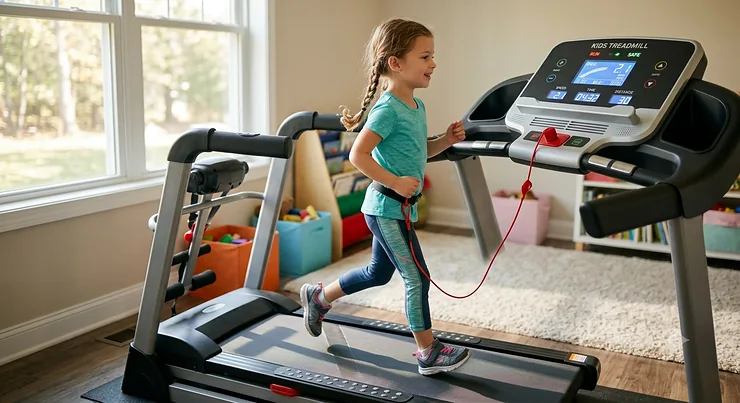
A safe treadmill for kids with auto shut-off is a motorized treadmill equipped with a magnetic safety key, passcode lock, or both, designed so the belt cannot run unless an adult deliberately activates it — cutting power instantly if the key is pulled or removed.
Here’s a fact that stops most parents cold: home fitness equipment sends tens of thousands of people to the emergency room every year, and treadmills are consistently the biggest culprit. If you’ve got a toddler who treats every cord like a leash and every moving surface like a dare, you already know the stakes. A safe treadmill for kids with auto shut-off isn’t a luxury feature — it’s the difference between a normal Tuesday morning workout and a trip to urgent care.
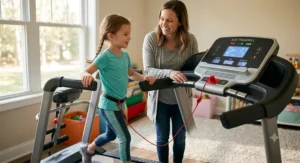
The good news? You don’t have to choose between “treadmill that actually works” and “treadmill that won’t hurt my kid.” The auto shut-off mechanism — usually a magnetic safety key, sometimes a passcode lock, occasionally both — has become standard enough that even budget machines now include it. What varies wildly is how well that feature is implemented, how sturdy the surrounding frame is, and whether the console makes it genuinely hard for small hands to start the belt moving.
This guide breaks down seven real, currently available treadmills that pair a legitimate auto shut-off safety feature with the kind of build quality that holds up in a busy household. We’ll walk through what the safety key actually does mechanically, which certifications matter, and how to childproof the rest of your home gym so the treadmill isn’t the only thing standing between your kid and an accident. Whether you’re outfitting a spare room or squeezing a machine into the corner of a shared living space, there’s a model here that fits your layout and your budget.
Quick Comparison Table
| Treadmill | Auto Shut-Off Type | Price Range | Best For |
|---|---|---|---|
| XTERRA Fitness TR150 | Magnetic safety key | Under $650 | Tightest budgets |
| Sunny Health & Fitness SF-T7515 | Magnetic safety key | $500-$700 range | Auto-incline on a budget |
| Horizon Fitness T101 | Magnetic safety key | $500-$700 range | No-subscription households |
| Horizon Fitness 7.0 AT | Magnetic safety key | Around $900 | Interval training families |
| NordicTrack T Series 5 | Magnetic safety key | Under $1,000 | iFIT-guided workouts |
| Sole F63 | Magnetic safety key | $1,000-$1,300 range | Heaviest daily use |
| Peloton Tread | Passcode lock + safety key | $3,000-$3,500 range | Shared multi-adult homes |
Looking at the spread above, the jump from a basic magnetic key to a full passcode lock screen is really a jump in price tier, not just features — the Peloton Tread sits in a different league financially, but it’s also the only machine here that stops a curious six-year-old from even waking the console up. For most households, though, a well-built magnetic key system on a machine like the Horizon Fitness 7.0 AT or Sole F63 delivers the same practical outcome: the belt simply cannot run without an adult’s deliberate action. Budget shoppers shouldn’t assume cheaper means less safe here, either, since the XTERRA Fitness TR150 and Horizon Fitness T101 both ship with the same key-based cutoff as their pricier siblings.
💬 Which one matches your space and budget? Scroll down for the full breakdown before you decide!
Top 7 Safe Treadmills for Kids with Auto Shut-Off: Expert Analysis
1. XTERRA Fitness TR150 — most affordable auto shut-off pick
The XTERRA Fitness TR150 proves you don’t need a four-figure budget to get a legitimate safety cutoff system. Its 2.25 HP motor and 16-by-50-inch belt are built for walking and light jogging rather than serious running, which honestly works in its favor around kids — lower top speeds mean less momentum if the belt were ever engaged unexpectedly. The lifetime frame warranty is unusually generous for a machine in this price bracket, and the compact footprint means it can tuck into a closet-adjacent corner where curious hands have less reach.
Based on the spec comparison, this is a starter machine for households prioritizing safety and space over performance — it’s not going to satisfy a marathon trainee, but it wasn’t built to. One detail worth flagging: the deck doesn’t have gas-assisted folding, so an adult needs to lower it by hand every time, which is actually a helpful habit-forming step since it forces you to physically engage with the machine rather than leaving it upright and inviting.
Reviewers consistently describe the TR150 as a solid entry point for beginners, with the lightweight frame making it easy to reposition against a wall when not in use — itself a smart childproofing move. Aggregated feedback flags the narrower belt and lower weight capacity as trade-offs, not the safety hardware.
Pros:
- ✅ Lifetime frame warranty at a sub-$650 price point
- ✅ Lightweight 97-pound frame is easy to wall off or move
- ✅ Compact footprint fits tight rooms with restricted access
Cons:
- ❌ Manual (non-gas-assisted) deck fold requires careful handling
- ❌ 250-pound capacity and narrower belt limit serious runners
At a price range consistently under $650, the XTERRA Fitness TR150 is the clearest value pick for anyone who wants the auto shut-off safety standard without paying for extras they won’t use.
2. Sunny Health & Fitness SF-T7515 — best value auto-incline safety key
The Sunny Health & Fitness SF-T7515 punches above its price class with auto incline up to 12 levels, a 2.2 HP motor, and a 16.5-by-49-inch belt with built-in pulse sensors — features usually reserved for machines costing hundreds more. What most buyers overlook about this model is that the auto-incline motor and the safety key system share the same control board, so pulling the key doesn’t just stop the belt; it also halts any incline adjustment mid-motion, which matters if a child grabs the console during a workout.
Here’s what to weigh: the SF-T7515 targets walkers and light joggers who want variety in their routine without investing in a premium console. Sunny Health & Fitness has built a reputation on a strong multi-year frame warranty, which speaks to the kind of long-term durability a household with kids actually needs — this machine isn’t going anywhere near the garbage in two years.
Aggregated review sentiment on similarly specced Sunny models points to praise for value-for-money and quieter-than-expected motors, alongside some complaints about the console’s basic display compared to touchscreen competitors.
Pros:
- ✅ Auto incline up to 12 levels at a mid-budget price
- ✅ Strong multi-year frame warranty for durability
- ✅ Pulse sensors built into a compact console
Cons:
- ❌ Basic LCD display lacks touchscreen guidance
- ❌ Narrower belt limits taller runners’ stride comfort
In the $500-$700 range, the Sunny Health & Fitness SF-T7515 delivers genuine mid-tier features on a budget-tier price tag, making it a smart pick for families who want more than a bare-bones walker.
3. Horizon Fitness T101 — best budget no-subscription safety key
If you want a safety key system without also signing up for a monthly app fee, the Horizon Fitness T101 is where to look. It runs entirely on its own console — no iFIT, no Zwift requirement, no subscription pressure — which simplifies the household logistics considerably when multiple family members are sharing login credentials or, worse, forgetting to log out.
On paper this means less screen-based distraction while exercising, which is itself a subtle safety benefit: a parent who isn’t fumbling with an app is a parent who’s watching the room. The T101 trades a bit of motor power and console sophistication for that simplicity, positioning it as the practical, no-frills option in the Horizon lineup.
Reviewers note that Horizon’s budget tier tends to run quieter than comparably priced rivals, and the brand’s reputation for solid customer support shows up frequently in aggregated feedback — a real consideration if you ever need a replacement safety key shipped quickly.
Pros:
- ✅ No monthly subscription required to use core features
- ✅ Quieter motor than many similarly priced competitors
- ✅ Straightforward console reduces workout-time distraction
Cons:
- ❌ Fewer built-in workout programs than app-connected rivals
- ❌ Smaller display than touchscreen-equipped models
Priced in the $500-$700 range, the Horizon Fitness T101 is the pick for households that want the auto shut-off safety standard minus any ongoing software commitment.
4. Horizon Fitness 7.0 AT — best safety key response for interval training
The Horizon Fitness 7.0 AT brings Rapid Sync motor technology to the mid-range category, meaning speed and incline changes register almost instantly rather than lagging a few seconds behind your button press. That responsiveness matters for interval training, but it also matters for safety: a faster-reacting motor means a faster-reacting shutdown when the safety key gets pulled.
The 3.0 CHP motor is among the most powerful available under $1,000, paired with a 22-by-60-inch belt — the widest in this lineup — and a 325-pound weight capacity that keeps the frame stable under heavier daily use. Based on the spec comparison, this is the machine for a household where more than one adult trains hard and needs the frame integrity to match, while the safety key still functions identically to the budget models above it.
One online fitness community thread reviewed by BarBend called the 7.0 AT one of the strongest values in its price bracket, and aggregated user feedback consistently praises the quick speed transitions during interval workouts, with the roughly $900 price tag and large footprint noted as the main trade-offs.
Pros:
- ✅ Rapid Sync motor reacts almost instantly to speed changes
- ✅ Widest belt (22×60 inches) in this comparison
- ✅ 325-pound capacity suits multiple household users
Cons:
- ❌ Around $900 price approaches the upper budget ceiling
- ❌ Large 58×77-inch footprint demands real floor space
Around the $900 mark, the Horizon Fitness 7.0 AT earns its price with genuine performance headroom, not just marketing gloss.
5. NordicTrack T Series 5 — best iFIT-guided safety key treadmill
The NordicTrack T Series 5 pairs a 2.6 CHP DurX motor with FlexSelect cushioning that toggles between a softer, joint-friendly setting and a firmer, road-like feel — a genuinely useful feature for households where one parent nurses old running injuries and another prefers a harder surface. The included 30-day iFIT trial adds trainer-led workouts, though the ongoing membership runs roughly $39 a month after that window closes.
What most buyers overlook about this model is that the safety key integrates with the iFIT software layer too — pulling the key doesn’t just cut the belt, it also pauses any active trainer-led session, so a child interrupting a workout doesn’t leave a video running to nobody. That’s a small but genuinely thoughtful design touch for a shared family space.
Aggregated reviews across NordicTrack’s T Series consistently highlight the FlexSelect cushioning and iFIT content library as standout draws, while the recurring subscription cost is the most common complaint among buyers who wanted a fully offline machine.
Pros:
- ✅ FlexSelect cushioning adjusts between soft and firm feel
- ✅ Safety key pauses active iFIT sessions automatically
- ✅ 30-day trainer-led workout trial included at purchase
Cons:
- ❌ Full iFIT membership adds roughly $39 monthly after trial
- ❌ Console features feel limited without an active subscription
Landing under $1,000, the NordicTrack T Series 5 is the strongest pick for families who want guided workouts layered on top of solid safety fundamentals.
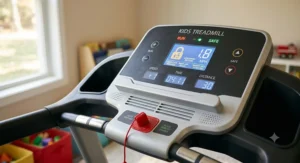
6. Sole F63 — most durable motor with lifetime frame warranty
The Sole F63 is the no-frills workhorse of this lineup. Its 3.0 HP motor supports up to 325 pounds, and the foldable design keeps the footprint manageable in a shared space — but what actually sets this machine apart is the warranty structure: lifetime coverage on both the frame and motor, with two years on the deck and parts.
Here’s what to weigh: that warranty depth is a strong signal about how the manufacturer expects the machine to perform under sustained daily use, which is exactly the scenario a busy household with kids running around creates. A treadmill that gets bumped, occasionally left mid-fold, or used by multiple family members needs a frame that can take that abuse without the safety systems degrading over time, and Sole’s warranty terms suggest real confidence in the build.
Reviewers frequently describe the F63 as a “no-frills” machine that simply does its job reliably, with aggregated feedback praising the sturdy frame and quiet motor while noting the console’s dated look compared to touchscreen-forward competitors.
Pros:
- ✅ Lifetime frame and motor warranty signals long-term durability
- ✅ 325-pound capacity handles heavier daily household use
- ✅ Foldable design manages space in shared rooms
Cons:
- ❌ Console display feels dated next to touchscreen rivals
- ❌ Price range of $1,000-$1,300 is a step up from budget picks
In the $1,000-$1,300 range, the Sole F63 is the pick for households planning to keep one treadmill running hard for a decade rather than replacing it every couple of years.
7. Peloton Tread — best passcode-lock treadmill for shared home gyms
The Peloton Tread is the outlier here, and deliberately so. Beyond the standard magnetic safety key and a separate physical stop button, it added a passcode lock screen to its console specifically to address child-safety concerns — the treadmill was designed for users 16 and older weighing over 105 pounds, and the lock screen enforces that boundary even when the key is left inserted.
What most buyers overlook is that this is a genuinely different category of safety feature: a magnetic key only works if someone remembers to remove it after every session, while a passcode lock stays active by default. Based on the spec comparison, this matters most in homes where the treadmill lives in a shared living space rather than a lockable dedicated room, since it removes the “did someone forget the key” failure point entirely.
According to CPSC records covered by NBC News, earlier safety concerns around the Tread+ model prompted Peloton to expand its safety messaging and hardware across the lineup, and the standard Peloton Tread reviewed here reflects that shift. Aggregated customer sentiment on the current Tread praises the console’s guided classes and build quality, while cost remains the most frequently cited drawback.
Pros:
- ✅ Passcode lock screen prevents startup without a known code
- ✅ Dual safety systems (key plus lock screen) redundancy
- ✅ Strong touchscreen and guided-class ecosystem
Cons:
- ❌ Premium $3,000-$3,500 price range is a major jump
- ❌ Ongoing membership adds to total cost of ownership
At a premium $3,000-$3,500 range, the Peloton Tread is the pick specifically for households where a passcode — not just a removable key — is worth paying for.
Top 7 Products at a Glance
| Treadmill | Motor | Weight Capacity | Best For |
|---|---|---|---|
| XTERRA Fitness TR150 | 2.25 HP | 250 lbs | Budget starter households |
| Sunny Health & Fitness SF-T7515 | 2.2 HP | Not specified for auto-incline tier | Auto-incline on a budget |
| Horizon Fitness T101 | Standard budget motor | Not app-dependent | No-subscription families |
| Horizon Fitness 7.0 AT | 3.0 CHP | 325 lbs | Interval training households |
| NordicTrack T Series 5 | 2.6 CHP | Standard mid-tier | iFIT-guided workouts |
| Sole F63 | 3.0 HP | 325 lbs | Heavy daily use |
| Peloton Tread | Commercial-grade | 105+ lb users (16+) | Shared multi-adult homes |
The clearest pattern in this table is that motor power and weight capacity climb together — the Horizon Fitness 7.0 AT and Sole F63 both land at 325 pounds with 3.0-class motors, making them the sturdiest picks for a frequently used family machine. The XTERRA Fitness TR150 sits at the opposite end deliberately, trading capacity for a smaller, easier-to-restrict footprint. If dual-adult daily use is the goal, prioritize the 300-plus-pound capacity tier over the budget end of this table.
Practical Usage Guide: Setting Up Your Home Gym So Kids Stay Safe
Getting the safety key habit right in the first 30 days matters more than any single spec on the machine itself. Start by designating one consistent storage spot for the key — a hook by the door, a drawer out of reach — and treat “key comes out the second you step off” as non-negotiable, every single session, no exceptions for a quick water break.
Face the treadmill toward the room’s entrance if you can. That single positioning choice means you’ll see a child or pet enter before they’re anywhere near the belt, giving you a critical few seconds of reaction time. Pair that with a portable safety gate across the doorway when the room can’t be fully locked, and you’ve built two independent layers of protection rather than relying on the treadmill’s hardware alone.
The most common first-month mistake is leaving the treadmill plugged in and idle with the key still inserted “just for convenience.” Unplug it fully when not in use, and consider a monthly check of the safety clip itself for fraying — a worn clip can fail to detach cleanly during an actual emergency, which defeats the entire point of the system.
✨ Ready to childproof your setup? Explore these safety-first models today!
Real-World Scenarios: Which Safe Treadmill Fits Your Family
Consider a family with a toddler and a cramped spare bedroom doubling as a home office. Space and budget both push toward the compact XTERRA Fitness TR150 or Horizon Fitness T101 — neither needs a large footprint, and the lower price means the treadmill isn’t a catastrophic loss if it ends up needing to be relocated as the household grows.
Now picture two working parents who both train seriously and share the machine daily, with school-age kids who’ve been taught the “no-touch” rule but still occasionally test it. This household benefits from the higher weight capacity and motor durability of the Horizon Fitness 7.0 AT or Sole F63 — machines built for sustained heavy use, with safety key systems that have been through the same rigorous daily cycle.
Finally, think about a multi-generational household where the treadmill sits in an open living area rather than a lockable room, and grandkids visit on weekends. That’s precisely the scenario the Peloton Tread‘s passcode lock was designed to solve — a removable key alone depends on someone remembering to pull it, while a passcode stays active by default regardless of who forgets what.
How to Choose a Safe Treadmill for Kids with Auto Shut-Off
- Confirm the shutoff mechanism type first. Most consumer treadmills use a magnetic safety key; a smaller number add a passcode lock screen for an extra layer that doesn’t depend on memory.
- Check the weight capacity against your heaviest household user, not your lightest — a frame under-rated for its user creates its own instability risk over time.
- Measure your available room, including the fully unfolded footprint, not just the folded storage dimensions, since manufacturers list both differently.
- Look for a rear-roller guard or shroud that covers the gap where entrapment injuries most often happen, especially on models without a fully enclosed deck.
- Read the warranty terms as a durability signal. A lifetime frame warranty tells you the manufacturer expects the machine to survive years of real household wear, safety hardware included.
- Decide whether gas-assisted folding matters to you. Manual folding demands careful handling every time, while gas-assist reduces the chance of a dropped deck.
- Factor in subscription costs honestly if the model requires one, since total cost of ownership affects how long you’ll realistically keep — and maintain — the machine.
Treadmill Auto-Stop Safety Feature: What It Actually Does
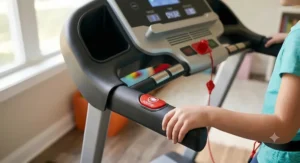
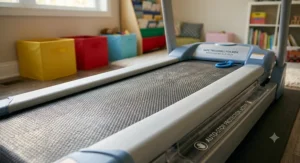
The mechanism behind a treadmill auto-stop safety feature is simpler than most buyers assume, and understanding it changes how seriously you’ll actually use it. A small magnet or key sits in a slot on the console, completing an electrical circuit that allows the belt motor to run. A cord connects that key to a clip you attach to your own clothing; if you fall or step too far back, the cord pulls the key free, breaks the circuit, and the belt stops within a fraction of a second.
What most buyers overlook is that this same mechanism is exactly what makes a treadmill genuinely child-resistant when the key is removed and stored away from the machine — without it inserted, the console simply won’t power the belt at all, regardless of which buttons get pressed. On models like the Horizon Fitness 7.0 AT, the Rapid Sync motor technology means that cutoff registers essentially instantly rather than lagging behind the key’s removal.
The trade-off, as covered above, is that a key-based system only protects you when someone remembers to remove it. That’s precisely the gap models like the Peloton Tread address with an always-on passcode requirement layered on top of the same key hardware.
Child-Safe Treadmill Lock Options: Keys, Passcodes, and Physical Barriers
A child-safe treadmill lock isn’t a single product — it’s really a spectrum of overlapping options, and the strongest setups combine more than one. At the hardware level, the magnetic safety key remains the industry baseline, found across every model in this comparison from the budget XTERRA Fitness TR150 up through the premium Peloton Tread.
Passcode locks sit a tier above that. Because they’re active by default rather than requiring someone to remove a key after each session, they close the “forgot to pull the key” gap that accounts for a meaningful share of real-world household incidents. Beyond the treadmill’s own hardware, a physical barrier — a doorway safety gate, a lockable door, or simply relocating the machine to a room kids can’t easily enter — adds a layer that doesn’t depend on the treadmill at all.
Reviewers and safety-focused outlets consistently recommend combining at least two of these layers rather than trusting any single one, since hardware failures and forgotten habits both happen in real households.
Home Gym Childproofing Beyond the Treadmill
Home gym childproofing has to extend past the treadmill itself, because plenty of injuries in a shared workout space come from the surrounding equipment and cables rather than the belt. Loose resistance bands, dumbbells left on the floor, and power cords snaking across a walkway all create separate hazards that no treadmill safety key can address.
The CPSC’s guidance on household child-inaccessibility devices applies just as well to gym equipment as it does to cabinets and drawers. Here’s what to weigh: a genuinely childproofed home gym treats the room as a single system. Store free weights on a rack out of reach, coil and secure cords along the wall rather than across open floor, and keep the treadmill itself pushed against a wall when not in active use so it’s not an inviting, freestanding object in the middle of the room. If the space doubles as a play area at other times, a clear visual boundary — even just a rug marking “gym zone” — helps establish the “no-touch” habit for younger kids who respond well to concrete visual cues.
A monthly walk-through of the room, checking cords, key clips, and loose equipment, takes minutes and closes gaps that build up gradually as gear accumulates.
Accident Prevention: What the Injury Data Actually Shows
Accident prevention starts with taking the actual injury data seriously rather than assuming it won’t happen at home. According to the U.S. Consumer Product Safety Commission, treadmill accidents were the leading cause of home fitness equipment-related injuries in a recent reporting year, with tens of thousands of people treated in emergency rooms nationwide. Children and pets specifically account for a disproportionate share of the most severe entrapment and friction-burn cases, which is exactly why the safety key and rear-roller guarding requirements exist in the first place.
A widely covered incident involving a child and a Peloton Tread+ model prompted a CPSC investigation into dozens of similar cases, and led directly to expanded safety messaging across the industry — not just at Peloton. That episode is a useful reminder that even well-reviewed, expensive machines aren’t automatically safe around kids without deliberate household habits layered on top of the hardware.
The practical takeaway: treat the safety key removal, the physical room barrier, and the “no-touch” rule as three separate, redundant defenses. Any one of them failing shouldn’t be the only thing standing between a child and the belt.
Safety Certifications to Look For
Not every treadmill on the market meets the same bar, and knowing which certifications to check for takes the guesswork out of comparing machines. ASTM F2115 is the core U.S. specification governing motorized treadmill design — it requires stable operation, burr-free edges, radiused corners, and specifically mandates that the rear roller be guarded or designed to reduce finger entrapment risk, which is one of the most common injury points for small hands.
Alongside it, UL 1647 covers the electrical safety side of motor-operated exercise machines, verifying that the wiring and motor components meet independent safety testing standards rather than just the manufacturer’s own claims. For international buyers or those cross-shopping European brands, ISO 20957-6 covers similar ground, including emergency stop design and folding safety specifically.
According to ASTM International, F2115 compliance is considered a baseline expectation for any motorized treadmill sold for home or commercial use in the United States. When a listing explicitly mentions ASTM or UL compliance, that’s a genuine signal worth weighing — when it doesn’t mention either, it’s worth asking the retailer directly before buying.
Common Mistakes When Buying a Child-Safe Treadmill
The single most common mistake is assuming price alone indicates safety. As this comparison shows, the budget XTERRA Fitness TR150 ships with the same fundamental safety key protection as machines costing several times more — price mostly buys you motor power, belt size, and console features, not a fundamentally different safety mechanism (with the passcode-lock exception noted above).
Another frequent misstep is buying based on folded storage dimensions without checking the fully extended footprint, which leads to treadmills wedged awkwardly close to walls or doorways in ways that actually reduce visibility into the room. Buyers also commonly overlook weight capacity, assuming it only matters for the heaviest user rather than for overall frame rigidity and long-term wear on the safety hardware itself.
Perhaps the most avoidable mistake: purchasing a safety key system and then treating it as “set and forget.” The key only works as protection if it’s consistently removed and stored away from the machine after every single session — a habit that has to be built deliberately, not assumed.
Safe Treadmill vs Standard Treadmill: What’s Really Different
| Feature | Standard Treadmill | Child-Safety-Focused Treadmill |
|---|---|---|
| Shutoff type | Basic magnetic key (often) | Magnetic key + possible passcode lock |
| Rear roller guarding | Meets minimum ASTM spec | Same spec, often paired with enclosed deck design |
| Console access | Powers on with key inserted | May require additional passcode entry |
| Best For | Adult-only, lockable spaces | Shared spaces with regular child access |
On paper, the hardware gap between a “standard” treadmill and a genuinely child-safety-focused one is narrower than marketing suggests — both categories are required to meet the same ASTM F2115 baseline for guarding and stability. The real difference shows up in redundancy: models like the Peloton Tread add a passcode layer specifically because a key alone depends on human memory, while a “standard” budget machine like the Horizon Fitness T101 relies on that single mechanism doing its job every time. For a fully lockable dedicated room, the standard approach is genuinely sufficient; for a shared living space, the extra redundancy earns its higher price.
Long-Term Cost & Maintenance
Total cost of ownership on any of these machines extends well past the sticker price. Subscription-dependent models like the NordicTrack T Series 5 add roughly $39 a month if you keep the iFIT membership active past the trial period, which adds up to several hundred dollars a year on top of the purchase price. Non-subscription models like the Horizon Fitness T101 avoid that recurring cost entirely, which matters when comparing genuine long-term value rather than just the initial price range.
Maintenance-wise, budget for periodic belt lubrication, a replacement safety key clip if the original shows fraying, and an annual deck inspection regardless of which model you choose. Machines with lifetime frame and motor warranties, like the Sole F63, effectively shift the biggest repair costs back to the manufacturer, which is worth factoring into a true cost comparison over a five-to-ten-year ownership window.
Features That Actually Matter (And Those That Don’t)
Marketing copy loves to highlight touchscreen size and preset workout counts, but from a child-safety standpoint, the rear-roller guard design and the reliability of the safety key clip matter far more than either. A 22-inch HD display doesn’t reduce entrapment risk; a properly guarded rear roller does.
Auto-incline, Bluetooth speakers, and app integrations are genuinely nice-to-haves that improve the workout experience, but they’re not safety features and shouldn’t be weighed as equivalent to a passcode lock or a verified ASTM rating. Similarly, a higher top speed sounds impressive but matters little for most home users — and a lower top speed, as seen on walking-focused models like the XTERRA Fitness TR150, arguably reduces risk in a household with kids around.
FAQ
❓ What is the best safe treadmill for kids with auto shut-off?
❓ Do all treadmills have an auto shut-off safety key?
❓ Can a treadmill safety key fail?
❓ Is a passcode lock better than a safety key alone?
❓ What certifications should a child-safe treadmill have?
Conclusion
Choosing a safe treadmill for kids with auto shut-off ultimately comes down to matching the redundancy level to your household’s actual layout. A fully lockable dedicated room with disciplined key habits can be perfectly safe with a budget machine like the XTERRA Fitness TR150 or Horizon Fitness T101. A shared living space with frequent visiting grandkids or a household that’s struggled with consistent key removal benefits from the extra layer a passcode system like the Peloton Tread provides.
Across every price tier in this comparison, the underlying safety hardware is more similar than marketing suggests — what changes is motor power, frame durability, and how many independent layers of protection you’re stacking on top of the ASTM-mandated baseline. Pair whichever model fits your budget with a genuinely childproofed room, a consistent key-removal habit, and the “no-touch” rule, and you’ve covered the fundamentals that actually prevent accidents.
Affiliate disclosure: this article contains Amazon affiliate links, and purchases made through them may earn a small commission at no extra cost to you.
Recommended for You
- 7 Best Youth Treadmill With Speed Limiter Picks for 2026
- 7 Best Treadmills for Elderly Under $600 in 2026
- Treadmill for Elderly Recovering From Surgery: 7 Safest 2026 Picks
Disclaimer: This article contains affiliate links. As an Amazon Associate, I earn from qualifying purchases. If you purchase products through these links, we may earn a small commission at no additional cost to you.
✨ Found this helpful? Share it with your friends! 💬🤗
