In This Article
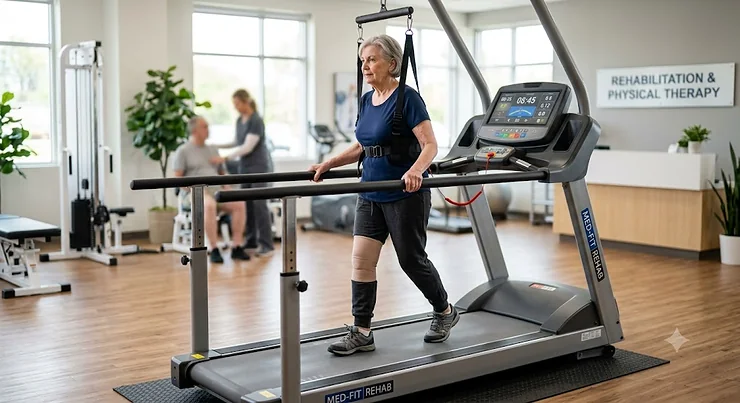
Here’s a scene that plays out in living rooms all over the country: a hospital discharge folder sits on the kitchen table, a walker leans against the couch, and somewhere in the fine print is a line that says “resume light activity as tolerated.” Nobody hands you a manual for what that actually looks like at home. A treadmill for elderly recovering from surgery is, in plain terms, a slow-moving, handrail-equipped walking machine built to let someone regain strength and confidence at a pace their healing body can actually handle — not a machine for burning calories or training for a 5K. The good ones start at a genuine crawl, sometimes as low as 0.1 mph, and lean on full-length rails rather than the stubby 18-inch grips you’d find on a standard gym treadmill.
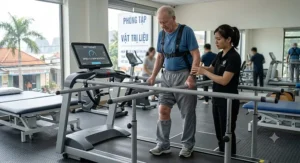
We dug through real product listings, manufacturer specs, and aggregated buyer feedback to find seven machines that actually deliver on that promise, from a $300 folding unit that fits beside a couch to a clinic-grade rehab treadmill built for physical therapists. Along the way, we’ll walk through what a realistic post-op walking treadmill routine looks like, how recovery timelines for hip and knee replacement typically unfold, and where a home machine fits into the physical therapy protocols your surgeon’s team will actually hand you. If you’re shopping for a parent, a spouse, or yourself, this guide is built to save you the trial and error.
Quick Comparison Table
Before we dig into full reviews, here’s the fast version. If you only read one table on this page, make it this one — it maps each machine to the situation it solves best, so you can jump straight to the section that matches your recovery stage and budget.
| Treadmill | Best For | Starting Speed | Price Range |
|---|---|---|---|
| Exerpeutic TF2000 | Full-length handrail support | 0.2 mph | $300-$400 range |
| Redliro 400 lb Senior Walking Treadmill | Ultra-slow, budget-friendly start | 0.3 mph | $300-$400 range |
| Body-Solid Endurance T50 | Clinic-grade rehab structure | 0.1 mph | $1,400-$1,600 range |
The pattern that jumps out immediately is that price doesn’t track neatly with safety here. A $350 machine with a 0.2 mph start and 49-inch rails can be a better fit for someone six weeks post-surgery than a $2,000 smart treadmill with a touchscreen and no minimum-speed advantage at all. Speed range and handrail length matter more for this specific use case than horsepower or incline, which is the opposite of how most treadmill shopping guides are written. Keep that in mind as price tags climb in the full comparison below — you’re not always paying for more safety, sometimes you’re paying for more entertainment.
💬 Found a pick you like already? Scroll down to see it ranked against all seven — just one click and you’ll know exactly why it made the list.
Top 7 Treadmills for Elderly Recovering From Surgery: Expert Analysis
We picked these seven specifically to cover the real range of what recovery looks like: someone three weeks out of a hip replacement, someone six months into knee rehab and building endurance, and everyone whose budget and living room fall somewhere in between. Each entry below breaks down the spec sheet in plain English, because a number like “0.1-5 mph in 0.1 mph increments” means nothing until you picture what it feels like to actually step on the belt.
1. Body-Solid Endurance T50 — clinic-grade rehab structure
The Body-Solid Endurance T50 opens at a genuinely startling 0.1 mph, which sounds almost comically slow until you’re the one stepping onto a moving belt three weeks after a hip replacement. That first-step vulnerability is exactly what this machine was engineered around. Its 1.5 HP motor isn’t built for speed — it’s built for control, holding steady in 0.1 mph increments all the way up to 5 mph, so nobody has to lurch between “too slow to feel safe” and “too fast to keep up.”
What genuinely sets this apart is the rear-entry ramp paired with 2-inch-thick handrails that run the entire 53-inch length of the deck, rather than stopping at the console like most consumer treadmills. Physical therapists and rehab clinics have leaned on this design for years, which tells you something about how it holds up under repeated, cautious use rather than occasional weekend jogging. Reviewers who bought it specifically for post-surgical walking consistently mention the confidence the full rail gives them during the wobbly first few sessions, while a common thread in aggregated feedback is that the machine feels underpowered if anyone in the household later wants to jog on it — which, frankly, isn’t what it’s for.
Pros:
- ✅ Full-length 2-inch rails extend the entire deck
- ✅ True 0.1 mph start speed for gradual reintroduction
- ✅ Rear-entry ramp removes any step-up hazard
Cons:
- ❌ Underpowered for anyone who later wants to jog
- ❌ Premium price for relatively basic electronics
Price sits in the $1,400-$1,600 range at the time of research, and given that this is the closest thing to clinic equipment you can put in a spare room, the value verdict comes down to whether you want the rehab-specific engineering badly enough to pay a real premium for it.
2. NordicTrack T Series 16 — guided walking with real incline range
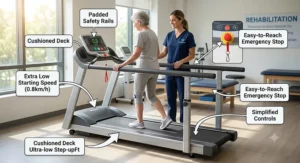
The NordicTrack T Series 16 takes a different approach entirely: instead of stripping features down to bare-bones safety, it leans into structured, trainer-guided sessions that can actually make daily walking feel less like a chore during a long recovery. Its 16-inch tilting touchscreen runs iFIT programs that auto-adjust speed and incline in real time, which matters more than it sounds for someone whose physical therapist has prescribed a specific walking cadence — the machine can hold that pace automatically instead of relying on shaky manual button presses.
Here’s what most spec sheets gloss over: the 8.3-inch step-up height is genuinely low for a folding treadmill in this class, and the SelectFlex cushioned deck lets you dial cushioning toward “soft” specifically for lower-impact walking, which is a real advantage over fixed-deck competitors. On paper, this means less jarring impact traveling up through healing joints with every step. Reviewers consistently praise the deck’s stability at walking pace and the surprisingly compact folded footprint, while a recurring complaint is that an iFIT Pro subscription is effectively required to unlock the coaching features that justify the price tag in the first place.
Pros:
- ✅ Low 8.3-inch step-up height for easier mounting
- ✅ SelectFlex deck adjusts specifically toward low-impact
- ✅ Auto-adjusting incline matches PT-prescribed pacing
Cons:
- ❌ iFIT Pro subscription essentially required for full value
- ❌ No true ultra-slow start speed like dedicated rehab models
Expect to pay in the $1,400-$2,000 range depending on promotional pricing, making this the pick for households that want a genuinely modern, connected experience layered on top of adequate — not extreme — safety features.
3. Exerpeutic TF2000 — full-length handrail specialist
The Exerpeutic TF2000, sometimes sold under the newer Model 4003 branding, was purpose-built around one idea: the handrail is the whole point. Its 49-inch rails run the complete length of the 50-by-16-inch belt and can even be reverse-installed for a narrower grip, which is a small detail that makes an outsized difference for someone with a smaller frame or limited shoulder mobility post-surgery.
What most listings underplay is the 5-inch step-up height, among the lowest in this category, paired with 10 shock-absorbing deck cushions that noticeably soften each footfall. Based on the spec comparison against similarly priced machines, the 1.5 HP “Quiet Drive” motor trades top-end speed (capped around 4-5 mph) for consistent low-end torque, which is exactly the trade a recovering walker wants. Aggregated reviewer sentiment repeatedly highlights how secure the extended rail feels during the shaky first weeks of use, with one long-time owner describing the assembly manual as clear enough for an 85-year-old to complete solo. The recurring downside: because the rails don’t fold, the frame stays fairly large and permanent in a room.
Pros:
- ✅ 49-inch rails span the entire belt length
- ✅ Low 5-inch step-up height eases mounting
- ✅ 10-point cushioned deck reduces joint impact
Cons:
- ❌ Non-folding design takes up permanent floor space
- ❌ Top speed capped around 4-5 mph limits future growth
Pricing lands in the $300-$400 range, putting it near the top of the budget tier while offering handrail coverage that rivals machines costing four times as much.
4. Redliro 400 lb Senior Walking Treadmill — ultra-slow budget start
The Redliro 400 lb Senior Walking Treadmill earns its spot with a 0.3 mph starting speed and a genuinely impressive 400-pound weight capacity for its price bracket, undercutting most rehab-labeled competitors by hundreds of dollars. The 47.6-inch belt paired with front-and-side handrails means a user gets support from two directions during the vulnerable moment of stepping on, not just a single side rail.
Here’s what the spec sheet doesn’t say outright: the 0-2% manual incline is deliberately modest by design rather than a limitation, since a flat or barely-inclined surface is exactly what most surgeons recommend in the earliest recovery weeks before progressing to any grade at all. What most buyers overlook is the auto-lubrication port, a small maintenance feature that matters more than it seems when the alternative is asking someone with limited mobility to crouch down and oil a belt by hand. Reviewer sentiment aggregated across major retailers is largely positive on ease of assembly and the confidence the dual handrails provide, while a smaller but consistent complaint concerns the LED display being harder to read in bright rooms.
Pros:
- ✅ 400 lb weight capacity at a budget price point
- ✅ Front-and-side handrails offer dual-direction support
- ✅ Auto-lubrication reduces hands-on maintenance
Cons:
- ❌ LED display can be hard to read in bright light
- ❌ Incline capped at 2%, limiting long-term progression
Price sits in the $300-$400 range, making it one of the strongest dollar-for-dollar picks on this list for a household prioritizing capacity and dual-rail support over tech features.
5. Sunny Health & Fitness SF-T7515 Smart Treadmill — connected value pick
The Sunny Health & Fitness SF-T7515 Smart Treadmill occupies a genuinely useful middle ground: real auto-incline (0-12%, adjustable via quick buttons) and Bluetooth app connectivity at a price that undercuts most “smart” competitors by hundreds of dollars. The double-deck cushioning system with integrated shock absorption is specifically engineered to soften impact, which on paper translates to noticeably less jarring feedback through the knees and hips during a slow, deliberate walking session.
What reviewers consistently note is that the handlebar-mounted speed and pulse controls, while convenient, occupy the entire length of the grip — meaning someone who wants a stable hand position for balance may find their palm bumping a button mid-stride. That’s a real trade-off worth weighing against the SunnyFit app’s genuinely useful library of over 1,000 guided workouts and 10,000 virtual routes, features that can make a monotonous recovery walk feel less like a chore. Based on the spec comparison, the 2.2 peak HP motor is on the lighter side for this price bracket, which is a non-issue for walking-pace recovery but worth knowing if fitness goals evolve later.
Pros:
- ✅ 0-12% auto incline via simple quick buttons
- ✅ Double-deck cushioning noticeably softens impact
- ✅ SunnyFit app adds guided routes and workouts
Cons:
- ❌ Handlebar controls can crowd out a stable grip
- ❌ 2.2 peak HP motor is modest for the price tier
Expect a $400-$600 range depending on current promotions, with a 3-year frame warranty backing up the investment.
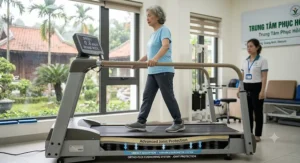
6. FYC Foldable Treadmill for Seniors Fitness Recovery — compact apartment pick
The FYC Foldable Treadmill for Seniors Fitness Recovery solves a problem the other six machines mostly ignore: what happens when there’s no spare room to dedicate to a permanent walking rig. Its 2-in-1 foldable frame with side rails collapses down small enough for a closet or a corner behind a couch, without sacrificing the extended handrail support that matters most in early recovery.
What most compact treadmills get wrong is treating “small” and “flimsy” as the same thing, but the 300-pound capacity here holds up reasonably well against non-folding competitors nearly double the price. The speed range tops out around 6-7.5 mph depending on the specific model variant, which is more than enough headroom for anyone progressing from a cautious shuffle toward a brisker daily walk over several months. Aggregated buyer feedback is largely positive on ease of assembly, with one recurring caveat: the handrails themselves don’t fold flush with the deck, so the “compact” footprint is more modest than dramatic once assembled.
Pros:
- ✅ Genuinely space-saving 2-in-1 folding frame
- ✅ 300 lb capacity rivals pricier non-folding models
- ✅ Long handrails preserved despite compact design
Cons:
- ❌ Handrails don’t fold flat, limiting true compactness
- ❌ Return shipping costs can surprise first-time buyers
Price runs in the $280-$350 range, making it the strongest pick specifically for apartment dwellers or anyone recovering in a shared or small-footprint home.
7. XTERRA Fitness TR150 — budget pick with standout warranty
The XTERRA Fitness TR150 rounds out this list as the pick for someone who wants a straightforward, no-frills walking treadmill backed by a warranty that punches well above its price class. Its lifetime frame warranty is genuinely unusual at this price point, a detail that matters when you’re buying equipment you hope to still be using for years of ongoing maintenance walking after the acute recovery period ends.
The 2.25 HP motor and 16-by-50-inch belt are tuned for walking and light jogging rather than serious running, which fits this use case perfectly — nobody recovering from surgery needs treadmill horsepower built for sprint intervals. What the spec sheet doesn’t advertise clearly is that the manual, three-position incline requires stepping off to adjust, a real inconvenience compared to the auto-incline machines above, and there’s no gas-assisted fold, meaning the deck must be lowered by hand with some care. Reviewer sentiment is consistently positive on value and build quality for the price, with the recurring criticism centering on the short 90-day parts-and-labor warranty window standing in contrast to that excellent lifetime frame coverage.
Pros:
- ✅ Lifetime frame warranty rare at this price tier
- ✅ 16-inch belt width suits steady walking gaits
- ✅ Compact folded footprint for small spaces
Cons:
- ❌ Manual incline requires stepping off to adjust
- ❌ No gas-assisted fold for the deck
Price typically falls in the $400-$650 range depending on retailer promotions, positioning it as a dependable long-term walking companion once the most delicate recovery weeks are behind you.
Top 7 Products: Full Spec Comparison
| Treadmill | Starting Speed | Weight Capacity | Best For |
|---|---|---|---|
| Body-Solid Endurance T50 | 0.1 mph | 310 lbs | Structured clinical rehab |
| NordicTrack T Series 16 | 0.5 mph (typical) | 325 lbs | Guided, connected walking |
| Exerpeutic TF2000 | 0.2 mph | 300 lbs | Maximum handrail coverage |
| Redliro 400 lb Senior Treadmill | 0.3 mph | 400 lbs | Budget dual-rail support |
| Sunny Health & Fitness SF-T7515 | 1 mph (typical) | 265 lbs | Value with auto incline |
| FYC Foldable Treadmill for Seniors | 0.5 mph | 300 lbs | Small apartments |
| XTERRA Fitness TR150 | 0.5 mph (typical) | 250 lbs | Long-term budget walking |
Looking at the table above, the Body-Solid Endurance T50 stands alone on true minimum speed, which matters most in the first two to three weeks after surgery when even 0.5 mph can feel unnervingly fast. Weight capacity swings widely across this lineup, so anyone shopping for a larger-framed user should lead with the Redliro 400 lb Senior Walking Treadmill rather than assuming all “senior” treadmills are built the same. Notice, too, that raw speed range barely matters here — every single pick on this list caps out well under 12 mph, because top speed was never the point of buying a recovery-focused machine in the first place.
Benefits vs. Traditional Alternatives
| Factor | Home Treadmill | Outdoor Walking | Clinic PT Sessions Only |
|---|---|---|---|
| Weather Independence | Full control | Weather-dependent | Full control |
| Session Frequency | Multiple daily | Limited by conditions | 2-3x weekly typical |
| Best For | Daily consistency | Fresh air, terrain variety | Professional supervision |
The clearest takeaway from this comparison is that a home treadmill and a clinic aren’t competing options so much as complementary ones — the equipment covers the daily reps your physical therapy protocols call for, while your actual therapist covers the professional gait assessment and hands-on correction a machine simply can’t replicate. Outdoor walking still earns its place for uneven-terrain practice and the mental lift of fresh air, but weather, ice, and uneven sidewalks make it a poor daily default during the first vulnerable weeks. For most recovering walkers, the realistic answer is all three working together rather than any single option standing alone.
✨ Don’t Miss These Exclusive Deals!
🔍 Take your recovery routine to the next level with these carefully selected treadmills. Click on any highlighted pick above to check current pricing and availability, because these machines can help build back the safe, confident daily walk your recovery genuinely deserves.
Post-Op Walking Treadmill: Your First 30 Days
Setting up a post-op walking treadmill correctly in the first month matters more than most people expect, because bad habits formed in week one tend to stick. Start by positioning the machine somewhere with a stable chair or countertop within arm’s reach, not just relying on the handrails alone — early sessions sometimes end with a need to sit down quickly. In the first week, most surgeons and physical therapists want nothing more than 5 to 10 minutes at the machine’s absolute lowest speed, done two or three times daily rather than one long session; short and frequent genuinely beats long and rare here.
A common early mistake is cranking the speed up the moment walking starts to feel comfortable. Resist that instinct for at least the first two weeks — comfort at a given pace is the signal to add duration, not necessarily speed. Around week two, most people can extend individual sessions toward 10 to 15 minutes if their surgeon hasn’t flagged any concerns. By week three or four, a light manual incline (if the machine offers a true 0% baseline first) can be reintroduced, but only after checking with your physical therapist, since incline changes the load on a healing hip or knee joint in ways flat walking doesn’t. One optimization trick that rarely makes it into owner’s manuals: wipe down and lubricate the belt on whatever schedule the manufacturer recommends, since a sticky belt creates subtle drag that can throw off gait timing during a stage when consistent footfall really matters.
Real-World Recovery Scenarios
Picture Diane, 71, three weeks removed from a total knee replacement, living alone in a two-bedroom condo. Her physical therapist wants short, frequent walking sessions, and she’s nervous about balance on her own. For her, the Exerpeutic TF2000‘s full-length rails and 0.2 mph start make sense specifically because she can grip continuously through an entire lap without ever losing rail contact — the exact reassurance a solo recovering walker needs most.
Now picture Robert, 68, six months past a hip replacement, cleared for more vigorous activity but still cautious about outdoor ice in a Midwest winter. He’s past the “any speed feels scary” stage and wants something that keeps him engaged daily. The NordicTrack T Series 16‘s guided iFIT sessions and adjustable incline fit his situation better, since his recovery has shifted from raw safety toward sustained motivation and gradually rebuilding endurance.
Finally, consider the Alvarez family, caring for an 84-year-old parent recovering from spinal surgery in a small one-bedroom apartment with no room for permanent equipment. The FYC Foldable Treadmill for Seniors Fitness Recovery solves their specific constraint — not because it’s the safest machine on this list in absolute terms, but because a treadmill that gets folded away and forgotten helps nobody, and this is the one that actually fits their space.
Gentle Rehab Treadmill for Elderly: Problem → Solution Guide
Problem: Fear of falling stops someone from using the treadmill at all. The solution here isn’t a faster machine, it’s the opposite — pick a gentle rehab treadmill for elderly users with a true sub-0.5 mph starting speed like the Body-Solid Endurance T50 or Exerpeutic TF2000, and position it with a chair nearby for the first two weeks so getting off feels as safe as getting on.
Problem: Joint pain flares up after every session. This usually traces back to deck cushioning rather than duration. Machines with layered shock-absorbing cushions, such as the Exerpeutic TF2000‘s 10-point deck or the NordicTrack T Series 16‘s SelectFlex system, meaningfully reduce the jarring feedback that a bare, unpadded deck sends straight up through a healing joint.
Problem: Sessions feel monotonous and get skipped. Boredom is a legitimate recovery risk, not a minor inconvenience, since skipped sessions slow measurable progress. The Sunny Health & Fitness SF-T7515‘s app-guided routes or the NordicTrack T Series 16‘s trainer-led programs directly address this by giving the mind something to follow besides a blank wall.
Problem: The treadmill takes up space nobody has to spare. The FYC Foldable Treadmill for Seniors Fitness Recovery exists precisely for this scenario, folding down small enough to tuck beside furniture between sessions.
Problem: A larger-framed user needs more capacity than typical “senior” treadmills advertise. The Redliro 400 lb Senior Walking Treadmill‘s 400-pound rating solves this directly, avoiding the false economy of buying a machine that technically supports someone’s weight but with zero safety margin.
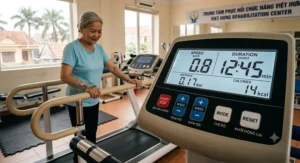
How to Choose a Treadmill for Elderly Recovering From Surgery
Choosing the right treadmill for elderly recovering from surgery comes down to matching seven concrete criteria against a person’s current recovery stage, not chasing the highest-rated machine in the abstract. Here’s the order that actually matters:
- Confirm minimum starting speed first. Anything above 0.5 mph is too fast for the first two to three weeks after most joint surgeries — this single number eliminates more unsuitable machines than any other spec.
- Check handrail length, not just presence. A 49-inch rail spanning the full deck offers continuous support; an 18-inch console-mounted grip does not, regardless of what marketing copy implies.
- Verify weight capacity with real margin. Choose a rating at least 50 pounds above actual body weight, since a frame running near its limit flexes and feels less stable underfoot.
- Measure the step-up height. Under 6 inches is genuinely easier for someone with limited hip flexion or knee bend; anything above 8 inches turns mounting into its own small hazard.
- Decide whether folding matters for your space. A permanent frame is typically sturdier, but a folding design may be the only realistic option in a small home.
- Weigh deck cushioning against personal joint sensitivity. Multi-layer shock absorption matters more for someone managing arthritis alongside surgical recovery than for a generally healthy patient.
- Only then compare price and extra features. Incline, touchscreens, and app connectivity are genuine quality-of-life additions, but they should be the last filter applied, not the first.
Physical Therapy Protocols and Your Home Treadmill
Physical therapy protocols following hip or knee replacement typically begin within 24 hours of surgery, often with a therapist walking the patient a short distance using a walker before discharge. A multicenter study of post-op physical therapy usage found that structured PT following hospital discharge meaningfully supports recovery, and that patients using longer-term physical therapy — generally defined as 12 weeks or more — often report better functional outcomes on standard hip and knee assessment scales. That’s a useful data point for anyone wondering whether stopping formal PT early and relying solely on a home treadmill is a reasonable substitute; the research suggests continued professional guidance alongside home equipment tends to outperform either approach alone.
A home treadmill’s role within this framework is straightforward: it gives patients a controlled, repeatable environment to log the daily walking minutes their therapist prescribes, without needing a clinic visit for every single session. What it can’t replace is a trained eye watching for compensation patterns — a slight limp favoring the non-surgical leg, for instance, that can become a hard habit to unlearn if it goes uncorrected for weeks. The AAOS OrthoInfo exercise guide for total hip replacement explicitly names treadmill walking as a safe option when outdoor terrain feels risky, starting with 5 to 10 minute sessions several times daily and building toward 20 to 30 minutes as strength returns — timing that lines up closely with what we outlined in the first-30-days section above.
Recovery Timelines: What to Expect Week by Week
Recovery timelines vary by surgery type, but hip and knee replacement follow broadly similar shapes. In the first week, most patients are walking short distances with a walker the same day or the day after surgery, focused purely on getting up and moving rather than covering distance. By weeks two to three, many transition from a walker to a cane, and this is typically when a home treadmill at its lowest setting starts making real sense as a supplement to clinic visits.
Weeks four through six usually bring the shift away from assistive devices entirely for many patients, with walking sessions extending toward 10 to 15 continuous minutes and driving often becoming possible once off narcotic pain medication. Somewhere in the two-to-three-month range, most people report walking without a limp for short indoor distances, and by three to six months, outdoor walking on uneven terrain starts feeling natural again rather than effortful. Full recovery, including the last stretches of strength and endurance, commonly takes six months to a full year — a timeline that surprises people who expected to feel “done” the moment they stopped using a cane.
Hip/Knee Replacement Recovery: Treadmill-Specific Guidance
Hip and knee replacement recovery share a lot of common ground, but the treadmill guidance diverges slightly depending on which joint is involved. For hip replacement patients, the priority in early weeks is usually just accumulating walking time safely, since range of motion typically isn’t the limiting factor the way it is after knee surgery — a slow, steady treadmill session genuinely counts as meaningful therapy from day one. Patients following a posterior surgical approach are often given specific hip precautions, like avoiding flexion past 90 degrees, which makes handrail height and step-up height doubly important on any treadmill they use.
For knee replacement patients, the treadmill’s job shifts slightly toward supporting the range-of-motion work happening in parallel physical therapy sessions, since the biggest early priority is regaining full extension and bending past 90 degrees. According to Johns Hopkins Medicine, most hip replacement patients can begin walking the same day as surgery, with pain levels generally dropping to a 1 or 2 out of 10 by around twelve weeks post-op — a useful benchmark for judging whether your own recovery, or a loved one’s, is tracking normally or deserves a call to the surgeon’s office.
Common Mistakes When Buying a Treadmill for Elderly Recovering From Surgery
The single most common mistake is prioritizing brand recognition over minimum speed and rail length — a well-known fitness brand’s entry-level treadmill often starts at 1 mph or higher, which is genuinely too fast for someone two weeks post-surgery, regardless of how trusted the name is. A close second is underestimating weight capacity margin; buying a machine rated exactly at someone’s current weight, rather than 50-plus pounds above it, sacrifices the stability margin that matters most during unsteady early sessions.
Buyers also frequently skip measuring their actual space before ordering a non-folding model, only to discover the 30-by-77-inch footprint of something like the Body-Solid Endurance T50 doesn’t clear a hallway or doorway. Another recurring error is assuming higher price automatically means more appropriate safety features — as the comparison tables above show, a $300 machine can outperform a $2,000 one on the specific metrics that matter for post-surgical walking. Finally, many buyers forget to confirm return policies before purchase; several budget models carry return-shipping costs that catch buyers off guard if the machine doesn’t fit their space or needs as expected.
Features That Actually Matter (And Those That Don’t)
Handrail length and starting speed matter enormously — they’re the two specs most directly tied to fall prevention during the exact window when fall risk is highest. Step-up height matters nearly as much, since a high deck turns every mount and dismount into its own small hazard. Deck cushioning genuinely matters for anyone managing joint pain alongside their surgical recovery, cutting down the repetitive impact that a bare deck sends upward with every step.
What doesn’t matter nearly as much as marketing suggests: top speed above 6 mph, since virtually nobody recovering from surgery needs to run on this equipment in the first year, if ever. Touchscreen size is a genuine nice-to-have rather than a functional necessity — a basic LED display showing time, speed, and distance covers the actual clinical need. Bluetooth speakers and music integration are pleasant but irrelevant to recovery outcomes. And motor horsepower above roughly 2.5 HP is largely wasted on walking-pace use, since it’s built for running loads this equipment will likely never see.
Long-Term Cost & Maintenance
Thinking beyond the sticker price matters here, since a cheaper machine that needs belt replacement within a year can end up costing more than a pricier one built to last. Budget models in the $300-$400 range typically carry shorter parts-and-labor warranties, often just 90 days, meaning any mechanical issue after that window becomes an out-of-pocket repair. Mid-range and premium options, like the NordicTrack T Series 16 or Body-Solid Endurance T50, generally carry frame warranties running several years to lifetime, which matters if the plan is to keep using the equipment well past acute recovery for ongoing daily maintenance walking.
Routine maintenance costs are modest across this entire category — belt lubrication a few times a year, occasional belt alignment checks, and eventually a replacement belt every few years of regular use. The real long-term value calculation isn’t about the machine at all, though; it’s about avoiding the far larger cost of a fall-related re-injury during recovery, which the CDC reports results in roughly a million hospitalizations among older adults annually. Measured against that backdrop, even a premium rehab treadmill is a modest investment.
Safety, Regulations, and Fall Prevention
Every treadmill on this list includes a magnetic safety key or clip designed to cut power instantly if a user drifts back too far or loses balance — a feature nobody should consider optional for this use case. Beyond the equipment itself, positioning matters: place any treadmill away from sharp furniture edges, ensure adequate lighting, and keep a phone or emergency call device within reach during early sessions when a fall risk, however small, still exists.
There’s no federal regulation specifically governing “senior” or “rehab” treadmill labeling, so those terms are marketing language rather than a certified safety standard — this is exactly why checking the underlying specs (speed, rail length, step-up height) matters more than trusting a product name. Given that falls remain the leading cause of injury among adults 65 and older, treating a home treadmill purchase as a genuine safety decision, not just a fitness purchase, is the right frame of mind to bring into this whole process.
Frequently Asked Questions
❓ What speed should a treadmill for elderly recovering from surgery start at?
❓ Can walking on a treadmill replace physical therapy after knee surgery?
❓ How soon after hip replacement can someone use a treadmill at home?
❓ What handrail length is actually safe for a post-op walking treadmill?
❓ Do gentle rehab treadmills for elderly users need an incline feature?
Conclusion
Choosing the right treadmill for elderly recovering from surgery really comes down to matching the machine to the actual moment someone is in, not the machine with the flashiest spec sheet. Someone three weeks past a knee replacement needs a genuinely slow start speed and full-length rails far more than they need a touchscreen, while someone six months into recovery and building endurance has very different priorities. The seven options here span that entire range honestly, from the $300 Redliro 400 lb Senior Walking Treadmill to the clinic-grade Body-Solid Endurance T50, and every one of them was chosen because the underlying specs actually hold up under the safety-first standard this use case demands.
Recovery is rarely a straight line, and neither is finding the right equipment for it. Take the time to match starting speed, rail length, and step-up height to where you or your loved one actually stands today, and revisit that match as recovery progresses over the following months. The right treadmill won’t rush anyone’s healing, but it can absolutely remove one of the biggest daily obstacles standing between a recovering walker and the confident, steady steps that get them back to the life they had before.
Recommended for You
- Walking Treadmill for Elderly: 7 Safest Picks for 2026
- 7 Best Treadmills With Emergency Stop Button for Elderly (2026)
- 7 Best Treadmill With Extra Side Rails for Elderly Picks (2026)
This post contains affiliate links. As an Amazon Associate, we earn from qualifying purchases at no additional cost to you.
✨ Found this helpful? Share it with your friends! 💬🤗
