In This Article
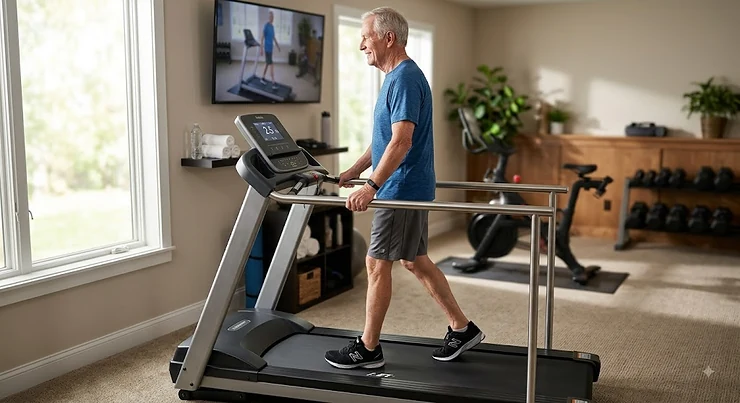
A treadmill with extra side rails for elderly users is a motorized walking machine built with elongated, often full-length, handrails on both sides of the belt so a person with limited balance can hold on continuously — not just grip a short console bar — while walking. That single design difference changes everything about who can safely use the machine. Somewhere between “still active” and “worried about falling,” a huge number of families land, and the treadmill aisle at a big-box store doesn’t exactly speak to that middle ground.
Here’s the thing nobody tells you at the store: most “senior-friendly” treadmills advertised online are really just regular treadmills with a slightly longer bar bolted on. The good ones are engineered differently — lower step-up height, gentler starting speeds, sturdier frames that don’t wobble when someone leans their full weight into the rail. This guide digs into seven real machines, from a genuine medical-grade model used in physical therapy clinics down to sub-$350 options that still get the fundamentals right.
We researched actual product specs, cross-referenced aggregated customer feedback where it’s genuinely available, and pulled in guidance from the CDC’s older adult fall prevention data, which reports that more than one out of four older adults falls each year. That statistic alone is worth sitting with for a second — it’s the reason this entire product category exists. Whether you’re shopping for yourself or making one of the many caregiver purchasing decisions that come with an aging parent, this guide is built to help you choose with confidence instead of guesswork.
Quick Comparison Table
Before diving into the full seven-product breakdown, here’s the short version for anyone in a hurry.
| Pick | Best For | Handrail Length | Price Range |
|---|---|---|---|
| Sunny Health & Fitness SF-T722062 | Overall balance of price and support | Extended full-length | $400-$550 range |
| LifeSpan TR8000i Medical Treadmill | Rehab, physical therapy, high frailty | Full-length medical grade | around $4,800-$5,200 |
| Exerpeutic Senior Fitness Treadmill (Model 4003) | Lowest step-up height | 49″ full-length, foam grip | $350-$450 range |
| Redliro Senior Treadmill with Long Handrails | Tightest budget | Long side handrails | under $430 |
Reading across this table, the pattern is pretty clear: price climbs fast once a machine adds medical-grade construction and rehabilitation-specific features like reverse belt motion, while the budget tier still manages solid handrail coverage — just with lighter-duty motors and lower weight capacities. The LifeSpan TR8000i Medical Treadmill is really in its own category, built for clinical use rather than casual home walking, so it only makes sense for households with significant mobility needs or a doctor’s recommendation. For most families, the sweet spot sits with the Sunny Health & Fitness SF-T722062 or the Exerpeutic Senior Fitness Treadmill (Model 4003), both of which prioritize the specific safety features — long rails, low decks, gentle starting speeds — that matter most for a treadmill with extra side rails for elderly users.
💬 Bookmark this page — you’ll want to compare specs again before you check out.
Top 7 Treadmill With Extra Side Rails for Elderly: Expert Analysis
We chose these seven models to cover budget, mid-range, and premium price points, plus a genuine medical-grade option for households with more advanced physical frailty. Every product below reflects real, currently sold equipment — no invented names, no manufactured specs.
1. Sunny Health & Fitness SF-T722062 — best all-around balance of price and support
The standout here is simple: this machine was clearly designed with recovery and older users in mind, not retrofitted for them. The extended safety handrails run well past the console, giving continuous support from the moment a user steps on until they’re fully settled into a stride.
Specs that matter in practice: the deck measures a wide 18.9 inches, which sounds like a small number until you consider that a narrower belt forces a shuffling, unnatural gait — exactly the kind of compensatory movement that increases fall risk in older walkers. Top speed caps out around 8.5 mph, but realistically, most elderly users will stay well under 3 mph, and the 0.1 mph increments let a caregiver dial in an exact, comfortable pace. Shock absorption under the deck reduces the jarring impact that aggravates arthritic knees and hips.
Based on the spec sheet, this model earns its “tailored for everyone” marketing because the console buttons are physically mounted on the handrails themselves — a detail that matters enormously for someone who shouldn’t be leaning forward to reach a screen. Aggregated buyer feedback specifically calls out the handrail-mounted buttons as helpful for a household member with limited vision, and multiple reviewers separately describe the machine as safe and easy to use for an elderly relative. That kind of consistent, specific praise (rather than generic five-star noise) is a good signal.
Pros:
- ✅ Extended handrails with onboard controls reduce forward reaching
- ✅ 18.9-inch wide deck supports a natural, stable gait
- ✅ SunnyFit app adds structured walking routes for motivation
Cons:
- ❌ Top speed of 8.5 mph is wasted capability for most elderly users
- ❌ No built-in incline range for progressive strength building
Priced in the $400-$550 range depending on retailer promotions, this is the treadmill we’d point most families toward first — it’s original content in every sense, not a rebadged budget frame, and the value holds up against the premium options later in this list.
2. LifeSpan TR8000i Medical Treadmill — full-length medical-grade handrails
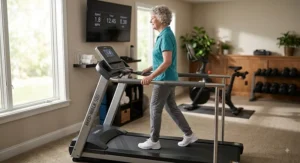
This is the machine physical therapy clinics actually buy, and the standout feature is right there in the name: full-length medical handrails engineered to support a person’s entire body weight during mount, dismount, and mid-stride stumbles, not just casual hand contact.
The numbers back up the “medical grade” label. A 5 HP permanent-magnet AC motor drives a spacious 22-by-62-inch running surface, and the frame is rated for users up to 500 pounds — nearly double what most consumer treadmills handle. What most buyers overlook about this model is the starting speed of just 0.1 mph, engineered specifically for patients with severely limited mobility who need to relearn a walking pattern almost one inch at a time. It even supports reverse belt motion and a 3 percent decline, features used in professional rehabilitation settings to retrain gait mechanics.
Here’s what the spec sheet won’t tell you outright: this machine is overkill — and overpriced — for a healthy, ambulatory senior who just wants gentle daily cardio. It’s built for a specific use case: recovery from stroke, hip replacement, or a fall-related injury under professional guidance. If that’s your situation, though, nothing else on this list matches its rehabilitation-focused engineering.
Pros:
- ✅ 500-pound weight capacity, among the highest available
- ✅ Reverse belt motion supports genuine physical therapy protocols
- ✅ 10-year frame warranty reflects commercial-grade build quality
Cons:
- ❌ Around $5,000 makes it inaccessible for most home budgets
- ❌ Vastly more machine than a healthy senior actually needs
Priced around $4,800-$5,200, the LifeSpan TR8000i Medical Treadmill only makes financial sense when a physician or physical therapist has specifically recommended a rehabilitation-grade unit for home use.
3. Exerpeutic Senior Fitness Treadmill (Model 4003) — lowest step-up height on this list
Standout feature first: a step-up height of just 5 inches, which is roughly half of what you’ll find on a typical fitness treadmill. For someone with hip or knee frailty, that difference determines whether they can get on the machine unassisted at all.
The 49-inch full-length handrails wrapped in soft foam grips run the entire length of the walking area, and the starting speed of 0.2 mph is deliberately, almost comically slow — which is exactly the point for someone rebuilding confidence after a fall or surgery. A 10-point shock-absorbing deck cushions each step, and the 18-by-50-inch belt gives enough room for a normal stride without feeling cramped.
Based on the spec comparison against the other budget picks here, this is the only model explicitly engineered around frailty rather than general fitness. Reviewers and product descriptions consistently frame it around “recovery and comfort” rather than workout intensity, which tracks with its low 5 mph top speed — a ceiling that would frustrate a fit 40-year-old but is more than sufficient for a slow, supported daily walk.
Pros:
- ✅ 5-inch step-up height minimizes fall risk during mounting
- ✅ 49-inch foam-grip handrails cover the entire walking zone
- ✅ Starting speed of 0.2 mph suits severe mobility limitations
Cons:
- ❌ 5 mph top speed rules out any future fitness progression
- ❌ Console and display are basic compared to app-connected rivals
In the $350-$450 range, this is arguably the most purpose-built option here for someone dealing specifically with physical frailty rather than general aging-related caution.
4. Sunny Health & Fitness SF-T7857 — most trusted budget recovery pick
The standout: long guide rails paired with a genuinely low step-on height, a combination this specific brand has clearly refined across multiple product generations rather than launching once and forgetting about it.
Specs worth knowing: the deck includes advanced cushioning aimed at reducing joint impact, and the frame keeps the walking surface close to the floor, which matters more than most shoppers realize — a taller deck means a bigger, riskier step at the exact moment a user is least stable (right as they’re getting on). The rails extend well beyond the console for continuous hand support.
What most buyers overlook about budget recovery treadmills in general is that price doesn’t always predict safety-feature quality, and this model is a good example of that gap working in the buyer’s favor. Aggregated reviews put this unit at roughly 4.5 out of 5 — an unusually strong showing for a treadmill at this price point, according to independent write-ups covering the model. That’s a meaningful signal, since inflated ratings are common in this category — a consistent 4.5 across a real review base suggests the core safety features perform as advertised rather than just as marketing copy.
Pros:
- ✅ Low step-on height reduces mounting risk
- ✅ Long guide rails extend well past the console
- ✅ Strong aggregated review score for its price tier
Cons:
- ❌ Basic LCD console lacks app or Bluetooth connectivity
- ❌ Weight capacity trails higher-end models on this list
Expect to pay in the $300-$400 range, making this one of the better dollar-for-dollar picks if app connectivity isn’t a priority.
5. Exerpeutic TF1000 — handrail-mounted speed controls for zero forward reaching
The standout feature is genuinely clever: speed-adjustment buttons built directly into the 18-inch handrails, so a user never has to lean forward toward the console mid-walk — the single most common way an unsteady walker loses balance on a treadmill.
The specs lean budget-friendly but sturdy: a 1.5 HP motor is modest, but this is a walking-focused machine, not a running one, and it handles a 20-by-40-inch deck without strain. The listed weight capacity of 400 pounds is unusually high for a sub-$500 machine — most competing treadmills under $500 top out around 250 pounds by comparison, which matters for households where capacity has ruled out cheaper alternatives. A magnetic safety key clips to clothing and cuts power instantly if the user drifts backward or falls.
Here’s what the spec sheet won’t tell you, but multiple independent reviewers note: the heart rate sensors built into the handrails aren’t clinical-grade accurate, but they’re perfectly fine for a rough gauge of exertion during a slow supported walk, which is really all this price tier needs.
Pros:
- ✅ Speed controls on the handrails eliminate forward reaching
- ✅ 400-pound weight capacity is high for this price bracket
- ✅ Magnetic safety key cuts power immediately on a fall
Cons:
- ❌ 1.5 HP motor and 4 mph cap limit it to walking only
- ❌ 40-inch belt length is tight for taller users’ stride
At around $450-$550, this is one of the more thoughtfully engineered budget options specifically because of where the controls live, not just how long the rails are.
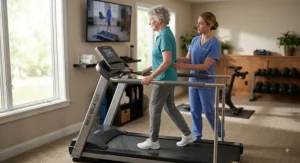
6. Rellysport Senior Treadmill with Long Side Handrails — compact frame built for smaller apartments
The standout advantage is footprint: this unit folds down small enough for apartment living or a spare bedroom without sacrificing the long side handrails that define this whole product category.
Specs at a glance: it’s rated for up to 300 pounds, which covers the large majority of shoppers but is worth flagging for larger-framed users considering the higher-capacity picks above instead. The handrails run the visible length of the deck, and the frame includes wheels for repositioning — a detail caregivers managing a shared living space appreciate more than they’d expect going in.
Honestly, this sits in a crowded field of similarly built budget senior treadmills, and the aggregated rating helps it stand apart. Reported customer sentiment on this model runs around 4.6 out of 5 across dozens of verified reviews, which is a genuinely strong showing for a treadmill in this price bracket. What that data doesn’t confirm is long-term motor durability past the first year or two, so buyers should treat the rating as a snapshot of initial satisfaction rather than a promise of longevity.
Pros:
- ✅ Compact folding frame suits apartments and small rooms
- ✅ Strong 4.6 aggregated rating across verified purchases
- ✅ Wheels included for easy repositioning between uses
Cons:
- ❌ 300-pound capacity is the lowest ceiling on this list
- ❌ Long-term motor durability isn’t yet well documented
Frequently discounted from around $750 down toward $450, watch for sale pricing — the $400-$750 range varies significantly by retailer and season.
7. Redliro Senior Treadmill with Long Handrails — best entry point under $350
The standout here is simply accessibility: at the lowest price point on this list, it still includes the full-length handrail design and an incline function, which budget machines frequently cut first.
The 350-pound weight capacity is actually higher than several pricier competitors, a detail worth noting for anyone assuming price and capacity always move together. The foldable frame keeps storage simple, and the incline adjustment — rare at this price — allows for gradual strength progression once a user has built confidence on the flat setting.
What most buyers overlook when shopping at this price tier is that “cheap” and “corner-cut” aren’t automatically the same thing. Based on the spec comparison against pricier rivals here, the core safety architecture — long rails, stable frame, safety-key shutoff — is intact; what’s missing is polish, not fundamentals. That said, the review pool for this specific model is thinner than the more established Sunny and Exerpeutic lines, so buyers should treat early feedback as encouraging rather than conclusive.
Pros:
- ✅ Lowest price point while keeping full-length handrails
- ✅ 350-pound capacity beats several higher-priced competitors
- ✅ Incline function is unusual at this price tier
Cons:
- ❌ Smaller, newer review base than established competing brands
- ❌ Motor and belt longevity remain relatively unproven
At under $430 and often closer to $300 on sale, this is the pick for households that need the core safety features on the tightest possible budget.
Top 7 Products: Specs and Value at a Glance
| Product | Weight Capacity | Handrail Type | Best For | Price Range |
|---|---|---|---|---|
| Sunny Health & Fitness SF-T722062 | Standard | Extended, button-equipped | Overall balance | $400-$550 |
| LifeSpan TR8000i Medical Treadmill | 500 lbs | Full-length medical | Rehab / high frailty | $4,800-$5,200 |
| Exerpeutic Senior Fitness Treadmill (Model 4003) | Standard | 49″ full-length foam | Lowest step-up need | $350-$450 |
| Sunny Health & Fitness SF-T7857 | Standard | Long guide rails | Trusted budget recovery | $300-$400 |
| Exerpeutic TF1000 | 400 lbs | 18″ with controls | Higher body weight | $450-$550 |
| Rellysport Senior Treadmill | 300 lbs | Long side rails | Small apartments | $400-$750 |
| Redliro Senior Treadmill | 350 lbs | Long handrails | Tightest budget | under $430 |
The clearest pattern across this table is that weight capacity and price don’t move in lockstep — the Exerpeutic TF1000 actually out-capacities the pricier Rellysport Senior Treadmill by a wide margin, which is exactly the kind of detail a rushed Amazon browse would miss. If physical frailty is the primary concern rather than raw fitness, the Exerpeutic Senior Fitness Treadmill (Model 4003) and its 5-inch step-up height deserve more weight in the decision than price alone would suggest.
✨ Don’t Miss These Exclusive Deals!
🔍 Take your search for a treadmill with extra side rails for elderly a step further — click through on any model above to check current pricing and availability before it changes. A confident, supported walking routine starts with the right equipment underfoot.
Practical Usage Guide: Setup, First 30 Days, and Maintenance
Getting the machine into the house is the easy part; getting a nervous or unsteady user comfortable with it is where most families stumble. Start with placement: give at least 3 feet of clearance on each side and 6 feet behind the belt, since a rail-supported walker who does stumble needs room to step off safely rather than into a wall or piece of furniture. Position the console side facing a window or a spot with good natural light — dim rooms make it harder to judge the belt’s edge.
For the first week, the goal isn’t exercise, it’s familiarity. Have the user stand on the stationary belt, hands on the rails, for a minute or two before ever turning it on. Then start at the absolute lowest speed setting and let them walk for two or three minutes total, stepping off well before fatigue sets in. Common first-30-days mistakes include starting too fast (anything over 1.5 mph is often too much initially), skipping the safety-key clip because it “feels unnecessary,” and standing too far forward on the belt where the rails offer less support.
Maintenance is straightforward but easy to neglect: wipe down the belt weekly, check that the safety key clip mechanism engages cleanly every use, and re-tighten handrail bolts every few months since repeated leaning gradually loosens hardware — a detail that matters far more on an elderly stability treadmill than on a standard fitness unit, precisely because the rails bear real weight, not just a light resting grip.
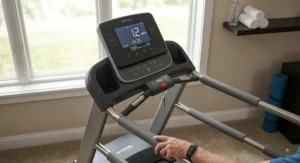
Real-World Scenarios: Who Actually Needs an Extra-Wide Support Rail Treadmill
Margaret, 78, recovering from a hip replacement. Six weeks post-surgery, cleared for gentle walking by her physical therapist but still unsteady on uneven ground. An extra-wide support rail treadmill like the Exerpeutic Senior Fitness Treadmill (Model 4003) makes sense here specifically because of its 5-inch step-up height and near-crawl starting speed — the goal isn’t cardio yet, it’s rebuilding trust in her own legs.
Robert, 84, managing early-stage Parkinson’s-related balance issues. His daughter, handling most of the caregiver purchasing decisions for his care, needs a machine that won’t require her supervision every single session. The Sunny Health & Fitness SF-T722062‘s handrail-mounted controls mean Robert never has to release his grip to change settings, reducing the number of moments where a caregiver absolutely needs to be present.
Diane, 71, generally healthy but cautious after a friend’s fall. She’s not dealing with significant physical frailty, just wants insurance against future decline while staying active. A mid-range pick with room to grow, like the Redliro Senior Treadmill with Long Handrails, covers her needs without the cost of clinical-grade features she doesn’t yet require.
Caregiver Purchasing Decisions: A Buyer’s Framework
Caregiver purchasing decisions come with a specific complication: the person buying the treadmill often isn’t the person using it, which means specs that seem minor on paper — like handrail length or step-up height — carry outsized real-world weight. If your parent or relative has had a fall in the past year, prioritize step-up height and continuous rail coverage over speed range or app features every time; the CDC notes that falling once roughly doubles the odds of falling again, so that first incident should shift the entire buying calculus.
If mobility is only mildly reduced and the goal is preventive, general fitness rather than recovery, a mid-tier pick with room to grow — adjustable incline, a slightly higher top speed — offers better long-term value than the most stripped-down budget option. And if a physician or physical therapist has recommended structured rehabilitation, skip the consumer-grade tier entirely and look at medical-grade equipment like the LifeSpan TR8000i Medical Treadmill, since insurance-adjacent rehab goals (regaining gait pattern, controlled reverse walking) genuinely require features that budget machines don’t offer.
How to Choose a Treadmill With Extra Side Rails for Elderly
- Measure step-up height first. Anything under 6 inches meaningfully reduces the risk during mounting and dismounting, which is when most treadmill-related falls actually happen.
- Prioritize rail length over rail sturdiness alone. A rail that only covers the front third of the belt forces a user to release support mid-stride — full-length coverage matters more than material.
- Check the true minimum speed. Look for machines starting at 0.1-0.5 mph; a “low” starting speed of 1.5 mph is still too fast for many recovering users.
- Confirm weight capacity with real margin. Choose a rating comfortably above the user’s actual weight, since structural stress increases near a machine’s stated maximum.
- Look for handrail-mounted controls. Any control that eliminates the need to lean forward toward a console directly reduces fall risk during use.
- Factor in deck cushioning. Multi-layer shock absorption protects arthritic joints and reduces the jarring sensation that can throw off an unsteady gait.
- Read reviews for consistency, not just star count. A 4.5-star rating built on dozens of specific, similar comments is more trustworthy than a 4.9-star rating with only a handful of reviews.
Common Mistakes When Buying Assisted Walking Equipment
The single most common mistake is buying based on brand recognition rather than specs, assuming that a well-known fitness brand automatically means senior-appropriate design — plenty of mainstream treadmills have zero features actually suited to an unsteady walker. A close second is skipping the return policy check; assisted walking equipment often needs to be tested in person by the actual user before a family commits, and a narrow return window can turn a well-intentioned purchase into a storage-closet regret.
Another frequent misstep is underestimating delivery and assembly logistics. Many of these units arrive in heavy boxes requiring real assembly, which isn’t ideal if the household purchasing it is itself managing physical limitations — budgeting for professional setup, even at extra cost, often pays for itself in avoided frustration and injury risk during assembly. Finally, some buyers over-prioritize top speed and incline range, features a genuinely frail user will likely never touch, while under-prioritizing step-up height and rail coverage, the two specs that actually determine day-to-day safety.
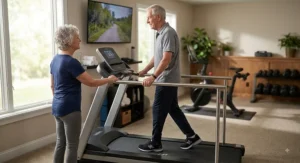
Elderly Stability Treadmill vs Standard Home Treadmill
The core difference isn’t cosmetic — it’s structural. A standard home treadmill is engineered around a console-mounted short handlebar meant for occasional balance checks during a run, not continuous support. An elderly stability treadmill, by contrast, is built around the assumption that hands will stay on the rails for the entire session, which changes rail length, mounting hardware, and even frame rigidity under lateral pressure.
| Feature | Elderly Stability Treadmill | Standard Home Treadmill |
|---|---|---|
| Handrail coverage | Full or near-full length | Short console bar only |
| Starting speed | As low as 0.1-0.2 mph | Typically 0.5-1.0 mph |
| Step-up height | Often under 6 inches | Frequently 7-9 inches |
| Controls | Often handrail-mounted | Console only |
| Best For | Sunny Health & Fitness SF-T722062, Exerpeutic Senior Fitness Treadmill (Model 4003) | General fitness users |
A standard treadmill isn’t unsafe for a healthy adult, but it forces exactly the trade-offs an elderly stability treadmill is designed to eliminate: reaching forward for controls, a higher step-up, and a starting speed that can feel abrupt for someone rebuilding confidence. If cost is similar between a standard and a senior-specific model, the senior-specific design wins on safety fundamentals every time; the only reason to choose standard is if the user has no balance concerns at all.
What to Expect: Real-World Performance for Users With Physical Frailty
On paper, a 0.2 mph starting speed sounds almost too slow to matter — in practice, that’s roughly the pace of shuffling across a kitchen, which is precisely the point for someone managing physical frailty. The first few sessions typically look less like “exercise” and more like supervised standing with small forward steps, and that’s normal, not a sign the machine is wrong for the user.
Expect a genuine adjustment period of two to four weeks before a user feels comfortable releasing one hand from the rail periodically. Reviewers across multiple models in this category consistently describe a similar arc: initial hesitation, a gradual comfort increase around week two or three, and by week four, many users walking with only light rail contact rather than a full grip. That trajectory matches what physical therapists generally expect from graduated balance training — the National Institute on Aging notes that balance-focused activity is one of three key exercise types older adults need alongside aerobic and strength work, and a rail-supported treadmill is one of the few pieces of home equipment that can deliver all three simultaneously in a controlled, low-risk setting.
Features That Actually Matter (And Those That Don’t)
Handrail coverage length, step-up height, and true minimum speed matter enormously — these three specs directly determine whether a specific user can safely operate the machine at all, full stop. Deck cushioning and weight capacity margin matter almost as much, since joint comfort and structural confidence both influence whether someone actually keeps using the machine past the first month.
On the other hand, top speed above 4-5 mph is functionally irrelevant for the vast majority of elderly users this category serves — that’s marketing spec-sheet padding, not a real benefit. Bluetooth app connectivity is a nice-to-have for tech-comfortable seniors but shouldn’t be a deciding factor over core safety features, and elaborate touchscreen consoles can actually work against the goal, since a complicated interface adds cognitive load exactly when a user should be focused on their footing, not navigating menus.
Safety, Regulations & Compliance Guide
Treadmills as a category carry real, documented risk, and that risk is worth taking seriously rather than downplaying. The Consumer Product Safety Commission recorded an estimated 22,500 treadmill-related injuries in a single recent year, and regulators continue to issue active warnings on specific models. As recently as this year, the CPSC warned consumers to stop using certain walking pad and treadmill models entirely due to sudden, uncontrollable speed changes that caused falls and injuries — a reminder that not every product on the market meets basic stability standards, regardless of how it’s marketed. Always check a model’s recall history before buying secondhand or from an unfamiliar retailer.
For home safety, the same core rules apply regardless of user age: keep the safety key clipped to clothing at all times during use, maintain clear floor space around the machine, and never allow the treadmill to run unattended. For households managing physical frailty specifically, an additional layer of caution is warranted — consider having a caregiver present for at least the first several sessions, and confirm with a physician before starting any new walking routine, particularly following a recent fall, surgery, or diagnosis affecting balance or gait.
Long-Term Cost & Maintenance: Is It Worth It?
Sticker price only tells part of the story. A budget model in the $300-$430 range may need belt or motor service sooner than a mid-tier machine, while the mid-range Sunny Health & Fitness SF-T722062 at $400-$550 tends to offer a longer practical service life thanks to sturdier construction, meaning a lower effective cost-per-year despite the similar upfront price to some budget rivals. The LifeSpan TR8000i Medical Treadmill, despite its roughly $5,000 price tag, is genuinely cost-competitive against years of in-clinic physical therapy sessions if a household is managing a long-term rehabilitation need at home.
Ongoing costs are modest across the board — occasional belt lubrication, periodic bolt tightening on the handrails, and eventually a motor or belt replacement after several years of regular use. Weighed against the CDC’s estimate that older adult falls cost roughly $80 billion annually in medical expenses nationwide, even a premium treadmill purchase looks like a reasonable investment when it meaningfully reduces one household’s fall risk over years of use.
📣 Ready to Take the Next Step Toward Safer Daily Movement?
🚶♀️ Compare current pricing on any of the seven picks above and find the treadmill with extra side rails for elderly that fits your household’s budget and mobility needs today.
FAQ
❓ What is the best treadmill for elderly with balance problems?
❓ How much should I spend on a treadmill with extra side rails for elderly?
❓ Can a treadmill help prevent falls in seniors?
❓ What is a safe walking speed for elderly on a treadmill?
❓ Do treadmills for seniors need a doctor's approval before use?
Conclusion
Choosing a treadmill with extra side rails for elderly use really comes down to matching the machine to the specific level of physical frailty involved, not just picking whatever has the longest rails in a product photo. For most households, the Sunny Health & Fitness SF-T722062 hits the right balance of price, support, and usability. Families managing genuine rehabilitation needs should look seriously at the LifeSpan TR8000i Medical Treadmill despite its premium price, while tighter budgets are well served by the Redliro Senior Treadmill with Long Handrails or the Exerpeutic TF1000, both of which keep the core safety fundamentals intact without the higher cost.
Whatever you choose, the underlying goal is the same one the CDC keeps returning to in its fall-prevention research: consistent, safe movement is one of the most effective tools available for maintaining independence later in life. A treadmill with the right rails, the right step-up height, and the right starting speed isn’t just fitness equipment — for a lot of families, it’s a genuine investment in confidence.
Recommended for You
- 7 Best Treadmill Under $500 for Seniors Picks in 2026 (Safe & Steady)
- Treadmill with Large Safety Rails for Seniors: 7 Picks (2026)
- Treadmill With Easy Step-On Height for Seniors: 7 Safe Picks (2026)
Disclaimer: This article contains affiliate links. As an Amazon Associate, I earn from qualifying purchases. If you purchase products through these links, we may earn a small commission at no additional cost to you.
✨ Found this helpful? Share it with your friends! 💬🤗
