
In This Article
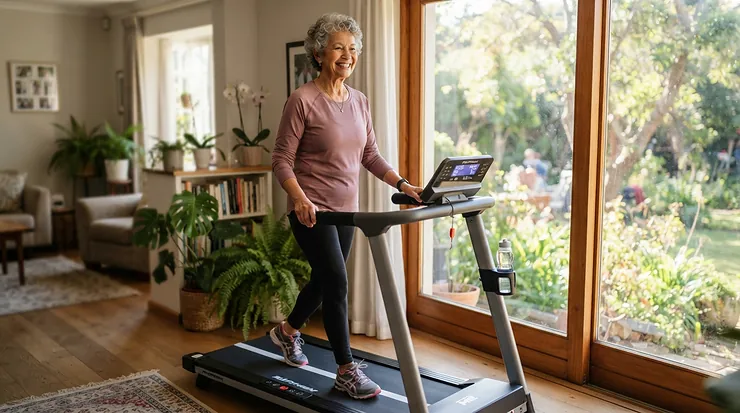
A small treadmill for seniors with limited space is a compact, motorized walking machine built around stability rather than speed. It has a low step-up deck, sturdy handrails, a gentle starting pace, a magnetic safety key, and a footprint that fits a corner of the living room instead of swallowing a spare bedroom.
Now picture a rainy Tuesday in November. The sidewalk is slick, the light fades by 4:30, and your doctor’s voice is still in your head about keeping active. Indoors, a good walking machine turns that excuse into a non-event.
The stakes are real. The CDC’s guidelines for adults 65 and older call for at least 150 minutes of moderate aerobic activity a week, plus activities that improve balance. That’s about 30 minutes, five days a week. The catch is that the machine has to be safe for the person using it and small enough for the home it lives in.
Most treadmill reviews chase runners: top speeds, 15% inclines, giant decks. Seniors need something else. The useful questions are how low the deck sits, how the handrails are positioned, how slowly the belt starts, and whether a safety key stops the machine if you slip.
This guide covers seven real machines, from rehab-style walkers to a premium folder. It is built from published spec sheets, manufacturer pages, independent lab testing, and aggregated reviewer commentary, not hands-on testing. Read every verdict as analysis, not a lab report. Prices are ranges only, so check current pricing before you buy.
Quick Comparison: Small Treadmill for Seniors With Limited Space at a Glance
Here is the whole field on one screen. The speed, deck and step-up columns matter most for seniors.
| Product | Walking Speed Range | Deck (L × W) | Step-Up / Deck Height | Best For |
|---|---|---|---|---|
| Exerpeutic TF2000 | 0.2–5 mph | 50″ × 16″ (listings vary) | About 5″ | Balance-first walkers, recovery |
| Sunny Health & Fitness SF-T7857 | Up to 5 mph | 44″ × 19.5″ | “Low-profile” deck | A wider belt without a bigger footprint |
| Redliro | Starts at 0.3 mph | 41″ × 16″ | Low deck (height not stated) | Tight budgets, removable rails |
| Exerpeutic 1010 | 0.4–4 mph | Check listing | Ground-level walking surface (retailer description) | Slow, simple, fold-away walking |
| XTERRA TR150 | 0.5–10 mph | 50″ × 16″ | Not published | Smallest folded footprint |
| Horizon T101 | 0.5–10 mph | 55″ × 20″ | About 7⅛” (spec) | Roomy belt, hydraulic fold |
| Sole F63 | 0.5–12 mph | 60″ × 20″ | About 8″ | Long-term durability, room to spare |
Look at the spread. The two Exerpeutic models start slowest and cap out lowest, which is what a cautious walker wants. The Horizon T101 and Sole F63 trade a taller step-up for a roomier belt. If hill-climbing isn’t on your list, the Sunny Health & Fitness SF-T7857 offers the widest belt in the low-deck group.
💬 Just one click — help others make better buying decisions too!😊
Top 7 Small Treadmills for Seniors With Limited Space: Expert Analysis
Each pick below follows the same logic. It states what the spec means in practice, who it suits, and what reviewers and testers flag as trade-offs. Where research couldn’t verify a large pool of reviews, the text says so instead of guessing.
1. Exerpeutic TF2000 Recovery Fitness Walking Treadmill — rehab-clinic ergonomics for home
The standout is a deck about 5 inches off the floor paired with 49-inch foam-padded handrails that run nearly the full length of the belt. That combination is rare at this size.
The belt starts at 0.2 mph and climbs in 0.1 mph steps to 5 mph. It rides on ten reinforced cushions, with four adjustable stabilizers for uneven floors. A 0.2 mph start means you can step on while the belt is barely moving. The 5 mph ceiling removes any temptation to turn a recovery session into a sprint. The 1.5 HP motor is modest, but walking is a low-demand job.
Based on the spec comparison, this is the closest thing to a physical-therapy-clinic design on the list. It is also a true compact treadmill for walking only, with no apps and no incline in the specs found. It suits anyone whose top worry is balance.
Research did not surface a large, consistent pool of aggregated reviews for this exact model. Its reputation is mostly editorial, since several independent roundups single it out as a recovery pick. Check current reviews, and confirm belt width, because listings show both 16 and 18 inches.
Pros:
- ✅ Roughly 5-inch deck for easy mounting
- ✅ Near-full-length padded handrails
- ✅ 0.2 mph start, 0.1 mph increments
Cons:
- ❌ No incline in listed specs
- ❌ 5 mph cap limits progression
Price range: roughly $550–$650 at the time of research. The value is fair if safety ergonomics are the priority, since you’re paying for the geometry, not the electronics.
2. Sunny Health & Fitness SF-T7857 Recovery Walking Treadmill — widest belt in the low-deck class
The hook here is a 44 × 19.5-inch low-profile deck. That is noticeably roomier than the 16-inch belts on most compact walkers. Multi-grip handrails sit along the top, middle and sides, and an emergency stop clip is included.
A 19.5-inch belt gives you lateral margin. If your stride wanders or you shift your feet, you aren’t riding the edge. The motor is listed at 2.5 HP, the top speed is 5 mph, and capacity is 295 lbs. Shock-absorbing deck technology and front transport wheels round it out. There is no incline, which for this audience is a feature, not a flaw.
On paper this is the best fit for someone who wants a small treadmill with safety key support and a wide walking surface. The trade-off is footprint. The listed dimensions of about 53 inches deep, 29 wide and 56 high mean it needs a permanent spot.
On sentiment, the manufacturer’s own product page showed a high rating on a small base of roughly 40 reviews at the time of research. That is encouraging but not conclusive, and a vendor-hosted score deserves a grain of salt.
Pros:
- ✅ 19.5-inch belt feels secure
- ✅ Handrails at multiple grip heights
- ✅ Emergency stop clip included
Cons:
- ❌ No incline for progression
- ❌ Not a fold-flat design
Price range: check current price; mid-range for the category. Verdict: strong value if belt width is your safety priority.
3. Redliro Walking Treadmill With Long Handrails — 0.3 mph start and detachable rails
The standout feature is a 0.3 mph minimum speed combined with handrails at top, middle and end positions. Roundups also note the rails come off in minutes when a younger family member wants to use the machine.
The listing specs show a 41 × 16-inch deck, 300 lb capacity, wheels and auto-lubrication. Roundups cite a 0–2% manual incline and a pulse sensor. Starting at 0.3 mph matters for anyone who finds a 1.0 mph jump abrupt. Multi-height rails let you shift hand position as fatigue builds.
This is a sensible pick for tight budgets and tight rooms. It is also a good compact treadmill for walking only if you’d rather not pay for features you won’t touch.
Independent roundups repeat the same caveats. The incline range is limited, and the compact size may feel small for taller users or long strides. Research did not find a verifiable large review sample, so lean on those editorial notes.
Pros:
- ✅ Gentle 0.3 mph starting speed
- ✅ Rails at three grip positions
- ✅ Foldable with removable handrails
Cons:
- ❌ 16-inch belt feels tight for tall users
- ❌ Incline limited to about 2%
Price range: budget tier; check current price. Verdict: high value on paper, so verify the exact variant and capacity before ordering.
4. Exerpeutic 1010 Fitness Walking Treadmill With Extra-Long Safety Handles — folds away, speeds stay gentle
The standout feature is its modest ambition. The retailer description says the walking surface sits level with the ground and pairs with wide side rails, which should make stepping on and off easier. The speed range is 0.4–4 mph, the frame handles up to 350 lbs, and the whole unit folds for storage.
A 4 mph ceiling is plenty for any senior walking pace. Brisk walking for this age group lands well below that, as the speed section below shows. The LCD covers time, distance, calories and speed, and nothing else. That minimalism is a hidden benefit if tech intimidates you.
Analytically, this is the pick when the room is the constraint and the fold-away matters more than a wide belt. Deck dimensions weren’t confirmed in the sources found, so measure against the listing.
Retail reviewers across Exerpeutic’s walking line frequently mention quiet operation and no-frills simplicity. A few describe the fold as the feature that made a small apartment work. These are retailer-page impressions, not lab data.
Pros:
- ✅ Ground-level walking surface, per retailer
- ✅ Extra-long side rails and safety handles
- ✅ 350 lb capacity with fold-away storage
Cons:
- ❌ 4 mph cap and 0.4 mph start
- ❌ Basic display, no pulse reading listed
Price range: listings found varied widely, up to the mid-to-high $600s at one warehouse club, so compare retailers. Verdict: fair value if you need a heavier capacity.
5. XTERRA Fitness TR150 Folding Treadmill — smallest folded footprint here
The hook is how small it becomes. Folded, it measures about 32 inches long, which is genuinely closet-friendly. In use it measures about 63 × 29 inches with a 50 × 16-inch deck, 2.25 HP and a 0.5–10 mph range.
For seniors, the first number to notice is the 0.5 mph minimum. It’s fine for most walkers but not as gentle as the 0.2 and 0.3 mph starts above. Three manual incline levels add some progression. Capacity is 250 lbs, and the frame weighs about 97 lbs, which matters when you’re moving it.
Independent testing flagged the fold. The deck lacks a gas shock, so it can drop hard when lowered. That’s a real concern if lifting is difficult. The same tester called the cushioning minimal.
Handled carefully, it works well as a budget walker for a younger, steadier senior. If a family member can do the folding, the small footprint wins.
Pros:
- ✅ Very small folded footprint
- ✅ 50-inch deck for natural strides
- ✅ Three manual incline levels
Cons:
- ❌ Deck can drop hard when unfolded
- ❌ Minimal cushioning, narrow 16-inch belt
Price range: mid-$300s to mid-$400s. Verdict: good value if someone else handles the fold.
6. Horizon Fitness T101 — roomy 20-inch belt with hydraulic fold
The standout is a 20 × 55-inch three-zone cushioned deck. That is more usable space than any other machine here, apart from the Sole F63. A one-step hydraulic fold lowers the deck gently, and twist dials adjust speed and incline.
Spec sheets list a 7⅛-inch step-up height, but Consumer Reports measured 8.5 inches on the T101-05 model. Treat manufacturer step-up numbers as a starting point and measure the machine yourself. Speed runs from 0.5 to 10 mph, with 0–10% incline.
That Consumer Reports page also notes an October 2022 recall of T101-05 units that could change speed or stop without warning. If you buy new, confirm the current model carries the fix. On retailer pages, a few buyers report speed surges while others praise it as quiet. Mixed feedback is a reason to inspect, not to panic.
It suits an active, balanced senior who wants a gentler fold than most budget treadmills offer.
Pros:
- ✅ Wide 20-inch belt feels secure
- ✅ Hydraulic fold is easy on the back
- ✅ Incline available for progression
Cons:
- ❌ Taller step-up than rehab models
- ❌ Past speed-change recall history
Price range: roughly $600–$700. Verdict: solid mid-range value, provided you’ve checked the recall status.
7. Sole F63 — premium durability with room to grow
The hook is a 20 × 60-inch cushioned deck on a frame rated to 325 lbs. The 2026 model adds a brushless motor and Bluetooth with the SOLE+ app. Speed runs from 0.5 to 12 mph, with 15 incline levels.
Be honest about the space. In use it measures about 82 inches long, which is the largest footprint on this list. Folded, it still stands about 47 × 35 × 72 inches. The step-up is around 8 inches, which independent testers called easy to step on and off, though one reviewer flagged it as a possible issue for limited mobility. At around 224 lbs it moves on wheels, but it needs two people for setup.
It earns its place if you have the room and want a machine you won’t outgrow. A younger senior who plans to add incline walking may appreciate that. If your priority is a small footprint, look at the picks above.
Pros:
- ✅ Long, wide cushioned deck
- ✅ Durable frame, 325 lb capacity
- ✅ Wide incline range for progression
Cons:
- ❌ Largest footprint on this list
- ❌ Heavier and costlier than the walkers
Price range: low-to-mid $1,000s. Verdict: worth it for the long haul, overbuilt for a tiny apartment.
✨ Ready to Walk Safely at Home?
🔍 Take your daily walks indoors with these carefully selected machines.Click on any highlighted item to check current pricing and availability. Pick the one whose rails, deck and speed range match your home and your confidence.
Your First 30 Days: A Setup and Practice Guide
A treadmill is only as safe as the habits around it. Amazon listings won’t tell you this part, so here is a practical month-one plan.
Week 1: Set up for safety. Place the machine on a hard, level floor and use the stabilizers or leveling feet if it rocks. Keep the area clear and the power cord out of the walking path. If it needs lubrication before first use, as some do, follow the manual.
Week 1: Practice without moving. Stand on the belt with the power off. Hold both rails, take the safety key in your hand, and practice clipping it to your waistband. Do this several times before you ever start the belt.
Week 2: Start slow. Hold the rails, start at the lowest speed, and walk for five minutes. Then step off and rest. Add a minute or two every few days if you feel steady.
Week 3: Find your pace. Raise the speed in small steps until you can talk comfortably. That’s roughly the moderate effort the CDC describes. Don’t watch the screen the whole time. Look ahead.
Week 4: Build the routine. Aim for short sessions most days. Check the belt for drift, listen for new noises, and wipe the deck and rails.
Common first-month mistakes: letting go of the rails to adjust the console, skipping the safety key, and ramping speed too fast. If you’ve had surgery, balance trouble or a heart condition, check with your clinician before starting.
Real-World Scenarios: Three Seniors, Three Spaces
These profiles are illustrative composites, not real case studies. They show how the same buying logic leads to different machines.
Scenario A: The apartment walker. A 74-year-old lives in a one-bedroom apartment with limited closet space and a modest budget. She uses a cane outdoors and wants a gentle pace. The fold-away Exerpeutic 1010 or the Redliro fits the room and the budget. Either gives slow starts and rails, and neither dominates the floor plan. The deciding factor is storage, so she should measure the folded footprint first.
Scenario B: The couple with a spare room. A 68-year-old couple has a spare bedroom and both want to walk daily. They’ll share one machine, one of them wants light incline work, and neither has balance concerns. The Horizon T101 or Sole F63 suits them, with a wider belt and incline for progression. They should check the Horizon T101 recall status and weigh whether the Sole F63‘s size is worth it.
Scenario C: The post-surgery recovery. An 80-year-old is recovering from knee surgery and has been cleared by a clinician to walk indoors. Balance and low step-up come first. The Exerpeutic TF2000 or the Sunny Health & Fitness SF-T7857 is the logical shortlist. The first has the lower deck and slower start, and the second has the wider belt.
Notice the pattern. Space decides the first cut, balance decides the second, and budget decides the third.
Problem → Solution Guide: Fixing the Everyday Snags
Problem: “I feel wobbly stepping on.” Hold both rails before you press start, and step on only when the belt is stopped or barely moving. If the step-up still feels high, a lower-deck model like the Exerpeutic TF2000 is the better fit.
Problem: “The machine shakes or walks across the floor.” Check that it sits level, and use the stabilizers if your model has them, as the Exerpeutic TF2000 does. A rubber mat under the frame helps on hard floors.
Problem: “The belt feels like it pulls me to one side.” Belt drift is common and usually fixable with the adjustment steps in your manual. Stop using it if it keeps drifting, and call the manufacturer.
Problem: “The console confuses me.” Choose a simple console. The Exerpeutic 1010 shows only the basics, which removes decision fatigue. Practice the speed buttons while holding the rails.
Problem: “I can’t lift the deck to fold it.” This is a real limitation with heavy folders like the XTERRA TR150. Pick a gas-shock or hydraulic model like the Horizon T101, or leave a non-folding walker in place.
Problem: “I feel dizzy or short of breath.” Stop, hold the rails, and step off when the belt stops. Check with your clinician before continuing.
How to Choose a Small Treadmill for Seniors With Limited Space
Start with the answer, then the reasoning. Work through these seven steps in order.
- Measure your space first. Note the usable length, width and ceiling height, plus a clear safety zone around the machine. The folded and in-use dimensions often differ by 30 inches or more.
- Check the step-up height. Under roughly 6 inches is ideal for seniors, and under 8 inches is acceptable for steadier users.
- Inspect the handrails. Look for rails that reach the middle of the belt and let you walk upright without leaning.
- Confirm the walking speed range. A start of 0.5 mph or lower, with 0.1 mph steps, keeps control in your hands.
- Look for a safety key. Magnetic keys that clip to clothing stop the belt if you slip.
- Compare belt width. Twenty inches gives more margin than 16, though it costs floor space.
- Check the fold and the weight. If you can’t lift or lower the deck safely, skip the fold or choose a hydraulic assist.
Skip the app connectivity, preset programs and giant screens unless you really want them. They add cost and complexity without adding safety.
Handrail Height and Grip Zones: Getting the Ergonomics Right
Handrail height decides whether the rails help or fight you. A widely used ergonomic rule of thumb is that rails near hip-to-waist height let your elbows bend comfortably with relaxed shoulders. Rails that are too high make you shrug, and rails that are too low make you lean. Neither is stable.
Independent buying guides add a second test. The rails should reach at least the middle of the belt, and they should let you walk upright without leaning forward. Leaning transfers weight to your wrists and shoulders and changes your gait.
Grip variety matters too. The Exerpeutic TF2000 runs 49-inch foam-padded rails nearly the length of the belt. The Sunny Health & Fitness SF-T7857 offers multi-grip rails along the top, middle and sides. The Redliro puts grips at top, middle and end positions. More grip zones mean you can shift hands as fatigue builds.
One more thing. If you plan to share the machine with a younger family member, removable rails on the Redliro are a handy bonus. But for you, rails that stay put are the safer default.
Why a Low Step-Up Deck Matters More Than Horsepower
Here is a useful analogy. A typical household stair riser runs around 7 to 7¾ inches. A treadmill with a 7⅛-inch step-up asks you to climb one stair every time you mount the belt, and to descend one every time you leave. That’s trivial when you’re fresh and awkward when you’re tired.
A low step-up deck cuts that risk. The Exerpeutic TF2000 lists roughly 5 inches. The Horizon T101 lists about 7⅛ inches, though Consumer Reports measured 8.5 inches on a related model. The Sole F63 sits near 8 inches. Different testers measure differently, so measure the real machine against your own stairs.
Folding treadmills tend to have lower profiles than fixed-frame commercial units, though the folding latches need inspection before each use. Horsepower, by contrast, barely matters for walking. A modest motor is fine at 2 to 3 mph.
Guidance from reviewers varies on the ideal number. Some say under 6 inches, others under 8. Both camps agree that lower is safer.
Walking Speed Range: What Numbers Does a Senior Actually Need?
Let’s translate the research into treadmill settings. A cross-sectional study of 120 older adults found an average preferred walking speed of about 1.19 m/s, roughly 2.7 mph, for people in their 70s. Another study found healthy, active 80-year-olds preferred about 1.16 m/s, closer to 2.6 mph, while active 65-year-olds averaged about 1.38 m/s, or 3.1 mph.
Speeds drop with age and health. Clinical references treat anything below about 0.7 m/s, roughly 1.6 mph, as a risk flag. One study of people 90 and older found average speeds near 0.58 m/s, about 1.3 mph, and about 0.38 m/s, roughly 0.85 mph, for those using assistive devices.
What this means for buying: a walking speed range of 0.2 to 4 or 5 mph covers nearly everyone. A 10 or 12 mph ceiling is irrelevant. What matters is a slow start and fine steps. The Exerpeutic TF2000 starts at 0.2 mph, the Redliro at 0.3, and the Exerpeutic 1010 at 0.4.
One more finding is useful. The same study showed more people walk slowly when also doing a mental task. So avoid fast speeds while chatting or watching a gripping show.
Small Treadmill With Safety Key: The Tether That Earns Its Keep
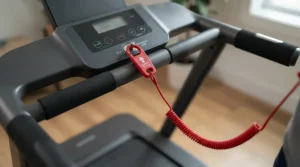
A small treadmill with safety key support is worth insisting on. The key is a tether with a magnet on one end and a clip on the other. The magnet sits in the console, and a sensor inside lets power flow to the motor only while it’s in place. Pull it out, and the belt stops.
Wikipedia’s treadmill entry notes that treadmill safety standards exist (IEC EN 957) and that a fall-stop device is a standard safety feature. In practice, the usual form is a clip you attach to your clothing.
For seniors, three tips apply. Clip it at the waistband, not on a loose sleeve. Practice pulling it with the power off, because arthritic hands may need a stronger or larger clip. And never bypass it with a household magnet. Console sensors are calibrated to a specific magnetic pull, and a wrong magnet can fail unpredictably.
Keys vary by brand. Sunny Health & Fitness uses three different key styles across its models, so a lost key needs a model-specific replacement. Keep a spare.
The key stops the belt. It doesn’t catch you. That’s what the rails are for.
Compact Treadmill for Walking Only vs. Full-Size Folding Treadmill
A compact treadmill for walking only gives up top speed, incline and big decks in exchange for low starts, simple controls and a smaller footprint. For most seniors, that’s the right trade. A full-size folder gives you room to grow and a more cushioned platform, at the cost of floor space and weight.
| Option | Footprint | Starting Speed | Stability Aids | Best For |
|---|---|---|---|---|
| Walking-only treadmill | Small to medium | 0.2–0.4 mph | Long rails, low deck | Exerpeutic TF2000, Sunny Health & Fitness SF-T7857 |
| Full-size folding treadmill | Medium to large | About 0.5 mph | Rails, wider belt | Horizon T101, Sole F63 |
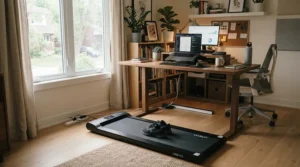
| Under-desk walking pad | Very small | About 0.6 mph | Little or no rails | Steady walkers with a desk setup |
| Outdoor walking | None | Self-paced | Weather, terrain | Good weather, secure footing |
The table shows why walking-only machines win for balance concerns: their slow starts and rails are built for support. Full-size folders win on comfort and long-term headroom. Under-desk pads, like the UREVO Strol 2E with a 15 × 40-inch belt, trade stability for space, and one tester called the deck short and skinny.
The practical rule is to choose the smallest machine whose rails and deck you’d still trust on a tired day.
Common Mistakes When Buying a Small Treadmill for Seniors With Limited Space
Buying for top speed. A 10 or 12 mph ceiling is a runner’s spec. Seniors need a gentle start, not a fast finish.
Ignoring the deck size. One tester warned that an exceptionally small deck, on a different model, was a poor fit for a senior with balance issues. A belt that is too short or narrow forces cramped steps.
Skipping the measurement. Folded and in-use dimensions differ, and a heavy machine like the Sole F63 also needs a path through your doors.
Forgetting the lift. The XTERRA TR150 weighs about 97 lbs, and a fold without a gas shock needs strength and care.
Trusting a step-up number blindly. Measure the real deck against a stair you know.
Skipping the recall check. The Horizon T101-05 recall is a reminder to search the model and serial number before buying.
Choosing a walking pad for balance concerns. Pads like the UREVO Strol 2E shine at a desk, but they usually offer limited handrail support.
Skipping the clinician. If you have balance, heart or joint concerns, ask before you start.
Long-Term Cost and Maintenance: What Your Treadmill Really Costs
The sticker price is only the opening bid. A machine in the $500 range used for 30 minutes, five days a week, for five years works out to roughly 1,300 sessions, or about 40 cents each. That’s cheap by any health-spending standard.
Ongoing costs are small but real. Belts need occasional lubrication, though the Redliro lists auto-lubrication and others require it before first use. Warranties differ: the XTERRA TR150 lists a lifetime frame warranty with shorter coverage on the motor and deck.
Repairs can be the sting. One retail reviewer of the Horizon T101 reported a console repair quote close to the machine’s purchase price. That’s one report, not a verdict, but it’s a reminder to read the warranty before you buy.
| Tier | Typical Price Range | Examples | What You Get | Best For |
|---|---|---|---|---|
| Budget | Mid-$300s to mid-$400s | XTERRA TR150, Redliro | Fold, basic cushioning | Small spaces, tight budgets |
| Mid-range | Roughly $550–$700 | Exerpeutic TF2000, Exerpeutic 1010, Horizon T101 | Safety-first or wide belts | Balance-first walkers |
| Premium | Low-to-mid $1,000s | Sole F63 | Durability, long deck | Long-term ownership |
Tier placement is approximate, so check current prices. The pattern holds, though: the cheapest machines give up cushioning or fold quality, mid-range models buy safety geometry, and premium models buy longevity. Pay for the features you’ll use every day, such as rails, step-up height and starting speed, and skip the ones you won’t.
FAQ
❓ How much floor space does a small treadmill for seniors with limited space really need?
❓ Are folding treadmills safe for seniors?
❓ How many minutes a week should a senior walk on a treadmill?
❓ Do you have to wear the safety key every time?
❓ Is an under-desk walking pad a good choice for seniors with balance concerns?
Conclusion
The best small treadmill for seniors with limited space is the one you’ll trust on your tiredest day. That means a low step-up deck, a handrail height that keeps you upright, a gentle walking speed range, and a safety key you actually wear.
If balance comes first, start with the Exerpeutic TF2000 or the Sunny Health & Fitness SF-T7857. If the closet is the constraint, look at the Exerpeutic 1010, the Redliro, or the fold-flat XTERRA TR150, ideally with someone else doing the lifting. If you have room and want a machine for the long haul, the Horizon T101 and Sole F63 offer more belt and more headroom, as long as you’ve checked the recall status and the step-up.
Whatever you choose, take the same approach: measure the space, measure the step-up, practice with the power off, and start slow. Aim for the CDC’s 150-minute weekly target in small, comfortable pieces, and ask your clinician before you begin if you have any health concerns.
✨ Take the First Step Today!
🔍 Compare the picks above, click any highlighted item to check current pricing and availability, and choose the machine that fits your home and your confidence. Your best walking weather is whatever the forecast says, because indoors it’s always dry. 🚶♀️
Recommended for You
- Ultra Compact Treadmill For Small Bedroom: 7 Best Picks 2026
- Mini Treadmill That Fits Under A Standing Desk: 7 Best Picks (2026)
- Compact Treadmill For Studio Apartment Walking: 7 Best Picks 2026
Disclaimer: This article contains affiliate links. As an Amazon Associate, I earn from qualifying purchases. If you purchase products through these links, we may earn a small commission at no additional cost to you.
✨ Found this helpful? Share it with your friends! 💬🤗
