In This Article
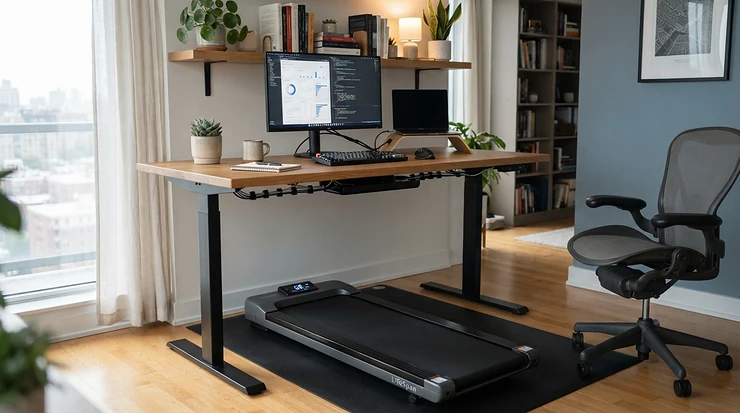
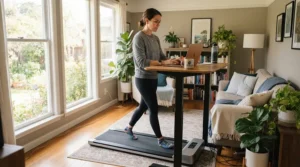
A mini treadmill that fits under a standing desk is a slim, motorized walking belt, typically 4 to 7 inches tall and 20 to 23 inches wide. It slides beneath a raised desk so you can walk at roughly 1 to 3 mph while you type, take calls, or read. Most weigh 45 to 60 pounds, roll on built-in wheels, and run from a handheld remote.
Here’s the catch: shopping for a mini treadmill that fits under a standing desk is nothing like shopping for a gym treadmill. Horsepower and fancy programs barely matter. What matters is whether the machine physically clears your desk legs, whether your desk can rise high enough to compensate for the deck, and whether the belt is long enough for your stride at a slow shuffle.
The idea isn’t new. Mayo Clinic obesity researcher James Levine popularized walking while working under the banner of non-exercise activity thermogenesis, or NEAT. The theory is simple: lots of low-intensity movement beats long stretches of stillness punctuated by one heroic workout.
This guide compares seven real, currently sold models using published specs, independent testing notes, and aggregated review sentiment. You’ll also get the measurements that decide fit, the speed range that actually suits desk work, and a plan for the first 30 days. Prices below are ranges at the time of research (October 2026), so check current listings.
Quick Comparison: 7 Mini Treadmills That Fit Under a Standing Desk at a Glance
| Model | Speed range | Max user weight | Height (as listed) | Price range | Best For |
|---|---|---|---|---|---|
| WalkingPad Z1 | 1–4 mph | 242 lb | 4.1 in. | Around $300 | Wide belt, quiet walking |
| WalkingPad C2 | 0.5–3.7 mph | 220 lb | About 5 in. | Around $400 | Tiny folded footprint, auto-speed |
| UREVO Strol 2E | 0.6–4 mph (walk), up to 6.2 mph (run) | 265 lb | Low, handle folds flat | Under $400 | Walk by day, jog at night |
| Sunny Health & Fitness Walkstation Slim | 0.5–3.7 mph | 220 lb | 6.5 in. | Under $300 | Budget buyers wanting a long warranty |
| Egofit Walker Pro M1 | 0.62–3.11 mph | 220 lb | 6.9 in. | Around $400 | Closets and very tight spaces |
| Sperax Q1 Pro | 0.2–3.8 mph | 265–320 lb (listed) | 4.7 in. | Under $200 | Lowest entry price |
| GoPlus 2-in-1 Folding Treadmill | About 0.6–7.5 mph | 265 lb | About 5 in. (handrail folded) | Under $400 | Hybrid walkers who also jog |
Looking at the table, the WalkingPad Z1 and Sperax Q1 Pro are the lowest-profile options, which matters if your desk tops out low. The UREVO Strol 2E and GoPlus 2-in-1 Folding Treadmill are the only ones with a real running mode, but that versatility costs extra weight and a slightly more complicated setup. If you need a higher weight capacity, the Sperax Q1 Pro‘s listed number looks generous, but independent testers urged caution, as you’ll see below.
💬 Just one click — help others make better buying decisions too!😊
Top 7 Mini Treadmills That Fit Under a Standing Desk: Expert Analysis
Each entry below blends published specs, independent reviewer findings, and aggregated customer sentiment. None of this is hands-on testing by the author, so treat the “what it means” notes as analysis rather than lab results.
1. WalkingPad Z1 — widest belt among the no-handlebar pads
The WalkingPad Z1 unfolds to 56.1 × 22 × 4.1 inches, a deck height low enough that it barely raises your keyboard requirements. It runs 1–4 mph, supports 242 pounds, weighs about 51 pounds, and is controlled by remote or app.
A 4.1-inch deck means you only need to lift your desk about four inches above your normal standing height. One roundup measured its belt at 17.3 inches wide, the widest in its under-$400, no-handlebar class, and rated it quieter than 40 dB. That extra width is forgiving if you drift sideways while typing.
The 1 mph floor is worth noting. You can’t creep along at a half-mile pace for a tricky spreadsheet, so you’ll stop the belt for deep-focus work.
Reviewers and testers consistently praise its simplicity and low profile. Tom’s Guide names it its best WalkingPad pick but advises caution on thick carpet.
Pros:
- ✅ Widest belt in its no-handlebar class
- ✅ Only 4.1 inches tall unfolded
- ✅ Quiet operation reported below 40 dB
Cons:
- ❌ Top speed stops at 4 mph
- ❌ No handrail or incline option
Price range: around $300, which is solid value for a wide belt and low deck.
2. WalkingPad C2 — smallest folded footprint with step-sensing speed
The WalkingPad C2 folds in half, from 57 × 20 × 5 inches unfolded to 32 × 20 × 5.5 inches folded, with a 1 HP brushless motor, a 47.2 × 15.8-inch belt, and a 0.5–3.7 mph range. It supports 220 pounds and weighs 55.
Its signature feature is foot-sense control. Step toward the front of the deck to speed up, drift back to slow down. In principle that lets your pace follow your workflow without reaching for the remote.
In practice, Garage Gym Reviews flagged the auto-speed as sometimes glitchy, and testers called the deck narrow. The 220-pound cap is “decent but not great,” in the publication’s words. If you’re near that limit, look at the WalkingPad Z1 or UREVO Strol 2E instead.
Another tester noted a faintly noticeable fold hinge underfoot, which most people stop noticing quickly.
Pros:
- ✅ Folds to roughly 32 inches long
- ✅ Foot-sense control plus remote and app
- ✅ Quiet 1 HP brushless motor
Cons:
- ❌ Auto-speed can be inconsistent
- ❌ 220 lb capacity and narrow deck
Price range: around $400, a premium for compactness that pays off mainly in small apartments.
3. UREVO Strol 2E — hybrid with a handle that folds away
The UREVO Strol 2E is a 2-in-1 with a 2.25 HP motor (a brushed design, according to a spec database) and a 15 × 40.2-inch track. Lower the handle for desk mode at 0.6–4 mph, or raise it for a jogging mode up to 6.2 mph. It supports 265 pounds.
Think of it as a walking pad with a gym-lite escape hatch. At the desk, the handle folds out of the way, and in the evening you can light-jog without buying a second machine.
Garage Gym Reviews scored it 4.08 and called it inexpensive and easy to store, but noted the short, narrow deck isn’t ideal for serious running and there’s no incline. Aggregated retailer ratings sit around 4.3 out of 5 across roughly 6,000 reviews.
One policy change matters: as of March 2026, the extended 180-day warranty requires registering through the app.
Pros:
- ✅ Handle folds flat for desk use
- ✅ 265 lb weight capacity
- ✅ Strong aggregated rating across thousands of reviews
Cons:
- ❌ Deck feels short for real running
- ❌ Extended warranty needs app registration
Price range: under $400, which is excellent value if you’ll use both modes.
4. Sunny Health & Fitness Walkstation Slim — budget pick with a long warranty
The Sunny Health & Fitness Walkstation Slim (model SF-T7945) measures roughly 50 × 21.5 × 6.5 inches and weighs 55 pounds. It offers a 0.5–3.7 mph range, a 39 × 14-inch deck, and a 1.5 HP motor, and it supports 220 pounds. It isn’t foldable.
Its safety logic is thoughtful. Active-use detection pauses the belt if you step off for about five seconds, which is handy for the “wait, door!” moment. The manufacturer also recommends using it beside a stable object for balance, so the desk itself becomes your handrail.
Garage Gym Reviews scored it 3.94, praising its stability, assembled delivery, and 3-year warranty, while noting the short deck and 220-pound cap. The brand’s own site shows roughly a 4.9-star average across about 70 reviews, though brand-hosted ratings skew positive.
At 6.5 inches tall, it needs about two inches more desk headroom than the WalkingPad Z1.
Pros:
- ✅ 3-year manufacturer warranty
- ✅ Auto-pause when no user is detected
- ✅ Stable, planted feel in testing
Cons:
- ❌ 14-inch-wide deck feels tight
- ❌ Doesn’t fold for storage
Price range: under $300, one of the better warranty-to-price ratios here.
5. Egofit Walker Pro M1 — tiniest footprint, with a fixed 5% incline
The Egofit Walker Pro M1 is built for tight spots. It measures about 38.4 × 21.9 × 6.9 inches, weighs 48.5 pounds, and has a 34.25 × 16.54-inch deck. Speed runs 0.62–3.11 mph, and capacity is 220 pounds. A fixed 5% incline sits under the belt.
BarBend notes it occupies under six square feet, about a third of a twin bed. That makes it the best fit on this list for a closet or corner. The incline also raises calorie burn at slow speeds without increasing pace.
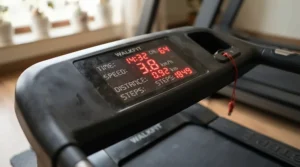
Feedback is divided, though. A review at Work While Walking criticized the short belt and a floor-level display that’s hard to see under a desk. Another reviewer called it a solid, affordable option as long as you accept the permanent incline, and noted you can’t swing your arms freely while working. Amazon-side ratings are around 4.4 out of 5 across roughly 900 reviews.
Taller walkers with long strides should look at the UREVO Strol 2E or GoPlus 2-in-1 Folding Treadmill instead.
Pros:
- ✅ Under six square feet of floor space
- ✅ 5% incline boosts effort at slow speeds
- ✅ Wheels make rolling it out easy
Cons:
- ❌ 34-inch belt is short for long strides
- ❌ Incline can’t be turned off
Price range: around $400, which is fair if footprint is your top priority.
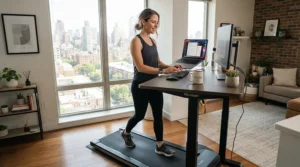
6. Sperax Q1 Pro — slimline budget pad that stores upright
The Sperax Q1 Pro is listed at about 45.3 × 19.7 × 4.7 inches and 46 pounds. OutdoorGearLab’s review of a Sperax walking pad measured speed adjustment in 0.2 mph steps up to 3.8 mph, controlled by remote.
That fine-grained adjustment is a genuine plus for desk work. The 0.2 mph steps let you dial in 1.4 or 1.6 mph, rather than leaping between presets. The pad also stands on end for storage, at about 48 inches tall.
The caution: while the listing claims a 320-pound capacity, OutdoorGearLab said it wouldn’t recommend the machine for anyone above 220 pounds. Its testers also reported kicking the side rails because the pad is narrow when you’re absorbed in work.
Reviewers broadly describe it as adequate for casual walkers who want quiet, space-saving movement. Choose the WalkingPad Z1 if you want a wider belt for a bit more money.
Pros:
- ✅ Lowest entry price on this list
- ✅ 0.2 mph speed increments
- ✅ Stands upright for storage
Cons:
- ❌ Narrow pad invites rail-kicking
- ❌ Real-world weight limit looks closer to 220 lb
Price range: under $200, an easy first-time buy if you’re under the weight caution.
7. GoPlus 2-in-1 Folding Treadmill — walk during the day, jog in the evening
The GoPlus 2-in-1 Folding Treadmill pairs a 2.25 HP motor with a 40 × 16-inch deck, supports 265 pounds, and folds to about 52 × 27 × 5 inches. Listings cite a top speed between 7.5 and 8 mph depending on the version. At 69.5 pounds, it’s the heaviest pick here.
The detachable or foldable handrail is what sets it apart. Remove it for desk walking, then reinstall it for brisk evening jogs. One roundup rated it best overall after reviewing more than 7,000 owner reviews, and noted it feels best at desk speeds under 3 mph.
Garage Gym Reviews called it a strong value for walkers and casual joggers but not built for sustained or fast running. The fixed handrail height of roughly 3.5 feet is awkward for tall users, and another roundup recommended it for buyers under 5’10”. At 265 pounds, capacity beats the other flat walking pads here.
Pros:
- ✅ Handrail removes for desk walking
- ✅ 265 lb capacity
- ✅ Thousands of owner reviews to read
Cons:
- ❌ Heaviest unit at nearly 70 pounds
- ❌ Handrail height is poor for tall users
Price range: under $400, strong value for a true hybrid.
✨ Ready to Walk While You Work?
🔍 Tap any bolded model name above to check current pricing and availability. The right pad is the one that clears your desk legs and gets used every day.
How to Choose a Mini Treadmill That Fits Under a Standing Desk
Picking a mini treadmill that fits under a standing desk comes down to six checks, in this order:
- Measure your desk first. Record the gap between desk legs and your desk’s maximum height. Everything else is moot if the machine doesn’t physically fit.
- Match deck height to your desk range. Add the deck’s height (4 to 7 inches) to your standing elbow height to see how high the desk must go.
- Check belt length against your stride. Taller walkers need at least 40 inches. Shorter belts, like the 34-inch Egofit Walker Pro M1, force you to shorten your steps.
- Confirm capacity with margin. Choose a rated capacity at least 30 to 40 pounds above your weight, since independent testers advise caution on some inflated ratings.
- Decide whether you’ll jog. If yes, pick a 2-in-1 such as the UREVO Strol 2E or GoPlus 2-in-1 Folding Treadmill. If not, a walking-only pad is lighter and simpler.
- Plan storage. Folding, standing upright, or sliding under a couch each demand different clearance numbers.
If two models tie, choose the one with the better warranty. Terms range from the Sunny Health & Fitness Walkstation Slim‘s 3 years to roughly 1 to 1.5 years on others.
Under Desk Clearance: The Measurements That Decide Everything
Under desk clearance is more than “does it slide under.” Three separate measurements all have to work.
Width between desk legs. Listed widths cluster around 20 to 23 inches. The WalkingPad C2 is about 20.4 inches wide, the Sunny Health & Fitness Walkstation Slim about 21.5, and the WalkingPad Z1 22. If your desk has a crossbar or wide feet, measure the actual floor gap, not the frame.
Height your desk must reach. A treadmill raises you, so your elbows rise by the deck height. If your elbow sits at 42 inches while standing on the floor, a 5-inch deck puts it at 47. That matters because some standing desks max out around 46.5 inches. One brand’s compatible desk, for example, lists a 28.3–46.5-inch range, which would feel marginal for a tall walker on any deck above four inches.
Room to roll out. You’ll want to park the pad when you sit. Reviewers note that wheels and a rail grip make rotating and “parallel parking” easier, but that’s a real extra step in your daily routine.
Based on the spec comparison, the WalkingPad Z1 at 4.1 inches and the Sperax Q1 Pro at 4.7 inches are the safest bets when desk height is tight.
Desk Treadmill Speed Range: What You’ll Actually Use
Treadmill spec sheets love shouting about top speed, but desk work happens at the bottom of the dial. Here’s how the field compares:
| Model | Speed range | Belt/deck | Realistic desk use | Best For |
|---|---|---|---|---|
| WalkingPad Z1 | 1–4 mph | About 17.3 in. wide | 1–2 mph | Steady typing |
| WalkingPad C2 | 0.5–3.7 mph | 47.2 × 15.8 in. | 0.5–2 mph | Slow meetings |
| UREVO Strol 2E | 0.6–4 / 6.2 mph | 40.2 × 15 in. | 1–2 mph, jogging later | Dual use |
| Sunny Health & Fitness Walkstation Slim | 0.5–3.7 mph | 39 × 14 in. | 1–2 mph | Budget desk walking |
| Egofit Walker Pro M1 | 0.62–3.11 mph | 34.25 × 16.54 in. | 1–2 mph | Incline fans |
| Sperax Q1 Pro | 0.2–3.8 mph | Not verified | 1–2 mph | Fine-tuned pace |
| GoPlus 2-in-1 Folding Treadmill | About 0.6–7.5 mph | 40 × 16 in. | Under 3 mph | Walk-and-jog |
The pattern is clear: nearly every pad covers the 1–2 mph band that desk-walking advocates favor. One industry source cautions that going above about 2 mph defeats the NEAT purpose, since you start sweating and typing gets harder. What separates models is the floor speed and fine adjustment. The Sperax Q1 Pro‘s 0.2 mph steps and the WalkingPad C2‘s 0.5 mph floor are friendlier to slow, focused work than the 1 mph minimum on the WalkingPad Z1.
As for payoff, a small Mayo Clinic pilot with 15 obese participants found average energy use rose from 72 to 191 kcal per hour when walking while working versus sitting. The study was short, tiny, and didn’t prove long-term weight loss, so treat it as directional.
Low Profile Walking Treadmill for Tiny Home Office: Where Height Wins
A low profile walking treadmill for tiny home office use is about the vertical budget as much as the floor. Every inch of deck height has to be matched by a higher desk, and tiny offices often use compact desks with limited range.
Ranked by listed height, from lowest to highest:
- WalkingPad Z1: 4.1 inches
- Sperax Q1 Pro: 4.7 inches
- WalkingPad C2: about 5 inches
- GoPlus 2-in-1 Folding Treadmill: about 5 inches with handrail folded
- Sunny Health & Fitness Walkstation Slim: 6.5 inches
- Egofit Walker Pro M1: 6.9 inches
The difference between 4 and 7 inches sounds trivial until you remember that an elbow-height shift forces a taller, pricier desk. A low pad also looks less like gym equipment, which counts for something in a space that doubles as a bedroom or living room.
Floors matter too. Tom’s Guide cautions that very low pads can struggle with thick carpet, so consider a hard surface or a mat. For tight apartments where the machine lives under a couch, the WalkingPad C2 and WalkingPad Z1 both fold to under 6 inches thick, and the UREVO Strol 2E folds flat as well.
Small Treadmill for Walking in a Closet Corner: A Real-World Scenario
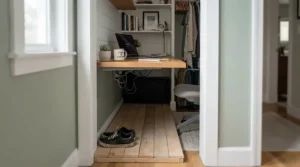
Picture a renter with a converted closet office roughly 3 by 5 feet, a standing desk shelf, and an outlet near the floor. A small treadmill for walking in a closet corner has to clear three constraints: length, door swing, and heat.
Profile 1: the true closet. Budget around $400, working eight hours a day. The Egofit Walker Pro M1‘s 38-inch length is the shortest here, and its under-six-square-feet footprint leaves room for a chair. The trade-off is a 34-inch belt, so a short-stride walker is ideal.
Profile 2: the corner nook, one tall user. Budget under $400. A longer belt matters more, so the UREVO Strol 2E at 40.2 inches is a better fit. Pair it with a desk that tops 47 inches.
Profile 3: the stow-away. Budget under $200, only 90 minutes of walking daily. The Sperax Q1 Pro stands upright at about 48 inches tall and just under 20 inches wide, tucking behind the door.
Practical closet tips: keep the motor end away from stacked fabric, leave a few inches of breathing room, and run the power cord where it can’t snag a foot.
Your First 30 Days: Setup, Break-In, and Maintenance
Most under-desk walkers quit in the first two weeks. This schedule is designed to prevent that, and it’s reasoned guidance rather than lab data.
Day 1–3: install and calibrate. Place the pad on a hard, level surface, plug it in directly, and set your desk to the correct elbow height. Walk 10 to 15 minutes at 1 mph before touching your keyboard.
Week 1: build the habit. Aim for 30 to 45 minutes daily at 1–1.5 mph. Choose shoes with thin, flat soles, and keep the remote on the desk edge. Some remotes, like the UREVO Strol 2E‘s, have magnetic storage.
Week 2–3: add task matching. Walk during calls, email, and reading. Pause for fine detail work.
Week 4: maintain. Check belt alignment, wipe the deck, and follow your manual’s lubrication guidance. Skipped maintenance is a common cause of premature motor wear.
Common mistakes in the first 30 days: walking too fast, ignoring belt drift, using thick-soled shoes, and forgetting to shut the belt off before sitting.
Common Problems and Simple Solutions
Problem: the belt drifts to one side. Fix: follow the manual’s belt-centering steps, and confirm the floor is level. Sloped floors worsen drift.
Problem: the auto-speed feature misbehaves. The WalkingPad C2 earned this complaint from testers. Fix: switch to manual or remote mode for important calls.
Problem: you keep kicking the rails. OutdoorGearLab reported this on a Sperax pad. Fix: practice with a mirror or a floor marker, or choose a wider belt like the WalkingPad Z1.
Problem: you can’t see the display. Reviewers noted this on the Egofit Walker Pro M1. Fix: rely on remote or app feedback.
Problem: you can’t sit down. Fix: roll the pad out once at the end of the day rather than every break. Reviewers described rotating and “parallel parking” a roughly 50-pound pad beneath a desk, which is easier than lifting it.
Problem: noise on video calls. Fix: mat underneath, slower speeds, and a closer mic.
Mini Treadmill vs. Other Ways to Move at Your Desk
| Option | Footprint | Typing comfort | Storage | Best For |
|---|---|---|---|---|
| Mini walking pad | Small | High at 1–2 mph | Slides under desk or couch | Steady, low-intensity movement |
| Full-size treadmill | Large | Poor | Hard | Dedicated cardio |
| Under-desk bike | Small | Medium | Easy | Seated pedaling |
| Standing only | None | High | None | Posture breaks |
Looking at the comparison, a mini walking pad delivers the most movement per square foot without wrecking your typing. A full-size treadmill is overkill and hard to store, while a bike keeps you seated, so it can’t match walking for step counts. If you only want to break up sitting, a standing desk alone is the cheapest option.
Work While Walking’s NEAT explainer frames desk treadmills as a complement to real exercise rather than a substitute. Treat a walking pad as a way to raise your baseline movement, then keep any dedicated workouts.
Long-Term Cost and Value: What You Really Pay Per Walk
Price tiers at the time of research:
| Tier | Models | Price range | Best For |
|---|---|---|---|
| Entry | Sperax Q1 Pro | Under $200 | Testing the habit |
| Mid | Sunny Health & Fitness Walkstation Slim, UREVO Strol 2E, GoPlus 2-in-1 Folding Treadmill | $300–$400 range | Most users |
| Premium | WalkingPad C2, Egofit Walker Pro M1, WalkingPad Z1 | Around $300–$400 | Compactness, design |
A rough value formula: price divided by days used. A pad costing around $300 and used for three years works out to roughly 30 cents a day. A model that quits at month 14 is much more expensive.
Longevity signals worth weighing:
- Warranty: the Sunny Health & Fitness Walkstation Slim has 3 years, while the UREVO Strol 2E offers 1 year plus 180 days with registration.
- Motor type: the WalkingPad C2 uses a brushless motor, while the UREVO Strol 2E is brushed, per a spec database.
- Weight margin: staying well under the rated capacity reduces wear.
The total cost of ownership also includes a possible taller desk or anti-fatigue mat. Budget a small extra for both.
Features That Actually Matter (And Those That Don’t)
Features worth paying for:
- Belt width and length. A wider belt like the WalkingPad Z1‘s 17.3 inches reduces rail-kicking.
- Low height. Every inch saved loosens your desk requirements.
- A usable remote. You’ll adjust speed constantly without bending down.
- Auto-pause. Safety features like the Sunny Health & Fitness Walkstation Slim‘s five-second detection are genuinely useful.
- A real warranty.
Features that matter less:
- Peak horsepower. Marketing HP figures are often peak, not continuous. At 1–2 mph, it hardly matters.
- Top speed. Unless you plan to jog, a 7+ mph ceiling is irrelevant.
- App libraries and global routes. Nice, but you’ll use the remote.
- Vibration or massage modes. Some Sperax variants offer them, but they’re a bonus, not a reason to buy.
The spec sheet won’t tell you this, but the best feature is the one that keeps the machine in use.
Safety and Health: What to Expect From Desk Walking
Desk walking is low impact, but it isn’t risk-free. Keep these basics in mind:
- Balance: Sunny Health & Fitness recommends using its pad under a desk or beside a stable object. The same logic applies to most handrail-free models.
- Footwear: thin, flat soles with good grip.
- Pacing: start at 1 mph and build slowly.
- Medical advice: if you have balance, heart, or joint concerns, ask your doctor first.
On benefits, expect modest but real gains. Garage Gym Reviews’ treadmill desk benefits guide notes there’s limited data specific to under-desk treadmills, but cites a 2023 study in which treadmill-desk users perceived mental health benefits and higher step counts. In other words, you’re buying more movement and less sitting, not a miracle.
Finally, check your building and workplace policies on equipment noise, and confirm your electrical setup supports a dedicated outlet.
FAQ
❓ Can a mini treadmill sit on carpet?
❓ How loud is an under desk treadmill on a video call?
❓ Do I need a handrail on a walking pad?
❓ Is a 220 lb weight limit enough?
❓ Can I use a mini treadmill with a hand-crank desk?
Conclusion
The best mini treadmill that fits under a standing desk is the one that clears your desk, matches your stride, and survives your schedule. For most people, the WalkingPad Z1 offers the best blend of low height, belt width, and quiet. If space is brutally tight, the Egofit Walker Pro M1 and WalkingPad C2 are the compact picks. Budget shoppers should look at the Sunny Health & Fitness Walkstation Slim for its warranty or the Sperax Q1 Pro for its price, while hybrid users will prefer the UREVO Strol 2E or GoPlus 2-in-1 Folding Treadmill.
Before buying, measure three things: leg-to-leg width, maximum desk height minus deck height, and the floor length you can spare. Then pick a speed range that fits slow, steady 1–2 mph walking, because that’s where desk work lives. Treat your pad as a daily movement tool, not a replacement for real exercise.
Recommended for You
- Compact Treadmill For Studio Apartment Walking: 7 Best Picks 2026
- Treadmill For Renters With Storage Constraints: 7 Best Picks 2026
- Treadmill For Apartments With Thin Walls: 7 Proven Quiet Picks (2026)
Disclaimer: This article contains affiliate links. As an Amazon Associate, I earn from qualifying purchases. If you purchase products through these links, we may earn a small commission at no additional cost to you.
✨ Found this helpful? Share it with your friends! 💬🤗
