
In This Article
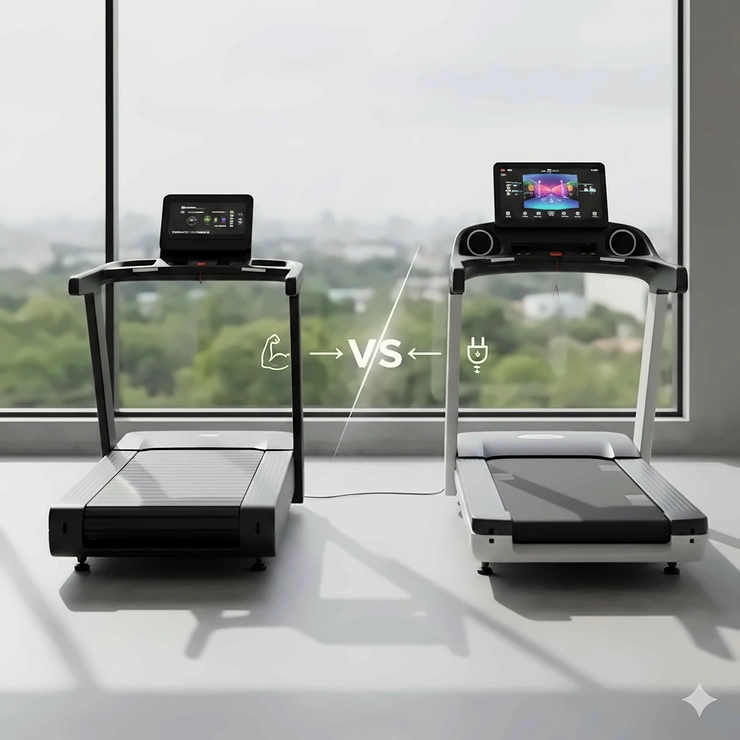
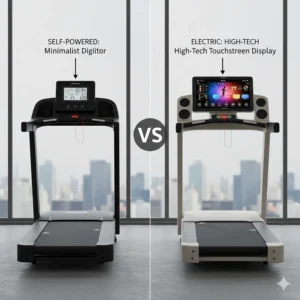
Standing in front of two treadmills at the gym, you might wonder why one requires you to plug it in while the other just sits there, quietly waiting for your energy to power it up. I’ve been there myself, and after spending months researching and testing both types, I can tell you the difference goes way deeper than just electricity bills.
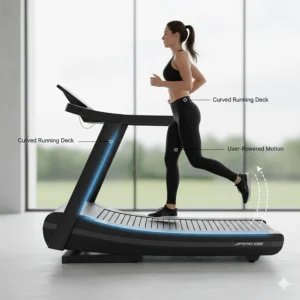
The self powered treadmill vs electric debate isn’t just about saving a few bucks on your power bill (though that’s definitely a perk!). It’s about understanding your fitness goals, workout style, and what you’re willing to invest both financially and physically. Manual treadmills, or self powered options as they’re often called, make you the engine – literally. Your legs power the belt, creating a more intense workout that research from Harvard Health suggests can target key muscle groups like quadriceps, calves, and glutes more effectively than motorized versions.
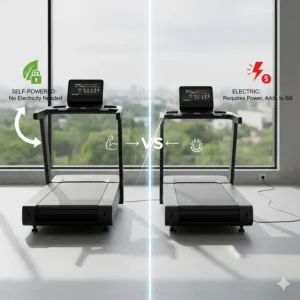
On the flip side, electric treadmills offer convenience, preset programs, and the ability to maintain consistent speeds without the extra effort. They’re the go-to choice for marathon trainers and those who want precise control over their workouts. But here’s the kicker: the “better” option completely depends on YOU. Your fitness level, budget, space constraints, and workout preferences all play crucial roles in this decision.
In this comprehensive guide, I’ll walk you through everything you need to know about manual vs motorized treadmill comparison, breaking down the pros and cons, operating costs, workout intensity differences, and showing you seven real products currently available on Amazon in 2026. Let’s dive in!
Quick Comparison Table: Self Powered vs Electric Treadmills
| Feature | Self Powered Treadmill | Electric Treadmill |
|---|---|---|
| Power Source | Your legs (no electricity) | AC motor (plugged in) |
| Price Range | $120 – $3,500 | $400 – $6,700 |
| Calorie Burn | 30% higher per session | Standard cardio burn |
| Operating Cost | $0/month | $5-15/month electricity |
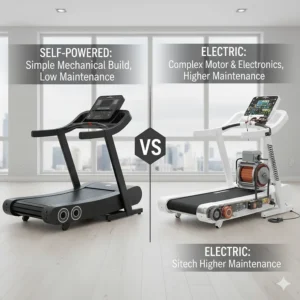
| Maintenance | Minimal (belt lubrication) | Motor servicing required |
| Workout Intensity | High (you control resistance) | Adjustable via settings |
| Best For | HIIT, weight loss, small spaces | Long runs, consistent pace training |
💬 Just one click – help others make better buying decisions too!😊
Top 7 Self Powered and Electric Treadmills: Expert Analysis
1. Sunny Health & Fitness SF-T1407M Manual Walking Treadmill
If you’re dipping your toes into the manual treadmill world, the Sunny Health & Fitness SF-T1407M is where most people start – and for good reason. At around $200-220, it’s the budget-friendly entry point that doesn’t feel like a total compromise.
Key Specifications:
- Running surface: 42″ L x 13″ W
- Weight capacity: 220 lbs
- Fixed incline: 13.5 degrees
- LCD display tracking: time, speed, distance, calories
This compact machine folds down to just 20″ L x 23″ W x 50″ H, making it perfect for apartment dwellers. The fixed incline is both a blessing and a curse – it helps the belt move smoothly and gives you a natural uphill walking experience, but you can’t adjust it for varied workouts.
Customer feedback reveals this is ideal for light to moderate walking routines. One verified buyer mentioned, “I use it for 30-minute walks while watching TV, and it’s perfect for that purpose. Just don’t expect to run sprints on it.”
✅ Pros:
- Extremely affordable price point
- Super compact when folded
- No assembly nightmares
❌ Cons:
- Fixed incline can be steep for beginners
- Narrow belt not ideal for running
Price: $200-220 | Best For: Budget-conscious walkers, small apartments
2. AssaultRunner Pro Curved Treadmill
Now we’re talking serious business. The AssaultRunner Pro represents the gold standard in self powered curved treadmills, sitting at around $2,999 – a price that might make you wince until you understand what you’re getting.
Key Specifications:
- Curved slat belt design
- Weight capacity: 350 lbs
- Console metrics: watts, HR, speed, RPM, distance, time, calories
- Bluetooth and ANT+ connectivity
- 150,000-mile belt warranty (yes, you read that right)
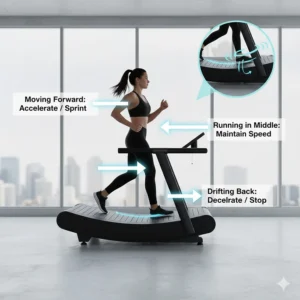
The curved design isn’t just for show. It forces you into proper running form while letting you control speed naturally by moving forward or backward on the belt. CrossFit enthusiasts and HIIT fanatics swear by this machine because it can burn up to 30% more calories than traditional motorized treadmills.
Customer experiences highlight a learning curve. “It took me about three sessions to really get the hang of it,” shared one reviewer, “but now I can’t imagine going back to electric. The control you have over your workout is unmatched.”
✅ Pros:
- Commercial-grade durability
- Incredible calorie burn potential
- Zero electricity costs
❌ Cons:
- Steep learning curve for beginners
- Takes up considerable space
Price: $2,999 | Best For: Serious athletes, CrossFit training, HIIT workouts
3. NordicTrack T Series 5 Treadmill
Switching gears to electric options, the NordicTrack T Series 5 has been making waves in 2026 with its impressive balance of affordability and features. Currently on sale for $479 (regularly $599), it’s the electric treadmill that doesn’t require a second mortgage.
Key Specifications:
- Motor: 2.5 CHP
- Running deck: 20″ W x 55″ L
- Speed range: 0-10 mph
- Incline: 0-10% adjustable
- 5-inch LCD display
- iFIT compatibility (30-day trial included)
The cushioned deck protects your joints – a huge advantage over manual treadmills on concrete-feeling belts. The iFIT integration means access to thousands of trainer-led workouts, though you’ll need a $15/month subscription after the trial.
Customers rave about the assembly process and overall value. One buyer noted, “I bought this for my wife, now she can’t get me off it. I look forward to walking on it twice a day. This treadmill has helped me strengthen my core and back muscles significantly.”
✅ Pros:
- Great price-to-feature ratio
- Joint-friendly cushioning
- Folds for storage
❌ Cons:
- Smaller screen than premium models
- iFIT subscription adds ongoing cost
Price: $479-599 | Best For: Home fitness beginners, consistent walkers/joggers
4. Stamina InMotion T900 Manual Treadmill
The Stamina InMotion T900 is the ultra-budget option that proves you don’t need to break the bank to start moving. At just $120-130, it’s cheaper than three months of most gym memberships.
Key Specifications:
- Running surface: 41″ L x 12.5″ W
- Weight capacity: 225 lbs
- Two incline positions: 8° and 10°
- Dual weighted flywheels
- Battery-operated LCD monitor
This lightweight treadmill (just 50 lbs) is ridiculously portable with built-in wheels. The dual flywheels help smooth out the walking motion, though don’t expect it to feel like gliding on clouds.
Real-world feedback is mixed but honest. “It’s perfect for light exercise when the weather’s bad,” one reviewer explained. “I walk for 20-30 minutes and it does the job. Just remember to lubricate the belt regularly.”
✅ Pros:
- Incredibly affordable
- Easy to move and store
- Zero electricity usage
❌ Cons:
- Very narrow belt
- Requires frequent belt maintenance
- Not suitable for running or heavy users
Price: $120-130 | Best For: Backup cardio option, very light use
5. Peloton Tread
Stepping into premium territory, the Peloton Tread at $3,295 represents the connected fitness revolution. This isn’t just a treadmill – it’s a gateway to an entire fitness ecosystem.
Key Specifications:
- Running deck: 59″ L x 20″ W
- Speed range: 0-12.5 mph
- Incline: 0-12.5% (auto-adjustable)
- 21.5″ Full HD swivel touchscreen
- Premium speaker system
- Precision speed and incline knobs
The swivel screen is genius for transitioning from running to floor-based strength workouts. The All-Access Membership ($49.99/month required) gives your entire household access to thousands of live and on-demand classes across multiple workout types.
User experiences highlight the motivation factor. “The instructors are so engaging that I actually look forward to my treadmill sessions,” shared a verified buyer. “The swivel screen makes it perfect for bootcamps and stretches.”
✅ Pros:
- World-class instructor-led classes
- Exceptional build quality
- Versatile workout options beyond running
❌ Cons:
- Expensive initial investment
- Mandatory monthly membership
- Requires significant space
Price: $3,295 | Best For: Motivation-driven fitness enthusiasts, variety seekers
6. NordicTrack T 6.5 S Treadmill
The NordicTrack T 6.5 S bridges the gap between entry-level and mid-range electric treadmills. Priced at $799-899, it offers just enough features without overwhelming beginners.
Key Specifications:
- Motor: 2.6 CHP
- Running deck: 20″ W x 55″ L
- Speed range: 0-10 mph
- Incline: 0-10%
- 5-inch display
- Bluetooth-enabled
- AutoBreeze fan included
The built-in handlebar sensors monitor heart rate, while the foldable design saves precious floor space. The 55″ belt length is adequate for most joggers, though serious runners might want the 60″ option from higher-end models.
Customer feedback emphasizes reliability. “Perfect for those who want NordicTrack features but aren’t sure about paying fees for iFIT,” one reviewer noted. “The machine works great in manual mode without the subscription.”
✅ Pros:
- Solid motor for the price
- Works without subscription
- Quiet operation
❌ Cons:
- Shorter belt than premium models
- Basic display compared to touchscreen models
Price: $799-899 | Best For: Regular joggers, iFIT-curious users
7. Peloton Tread+
The crown jewel of electric treadmills, the Peloton Tread+ at $6,695 is what happens when engineering meets luxury. This beast features a slat-belt design rarely seen in consumer treadmills.
Key Specifications:
- Running deck: 67″ L (rubberized slat belt)
- Speed range: 0-12.5 mph (plus manual mode!)
- Incline: 0-15% (auto-adjustable)
- 23.8″ Full HD touchscreen
- Sonos-tuned speaker system
- Integrated 3-speed fan
- Powered by Peloton IQ for form correction
Here’s the wild part: you can actually turn OFF the motor and use it as a manual treadmill, powered entirely by your muscles. The rubberized slat belt provides incredible cushioning and energy return that makes running feel almost effortless (until you check your heart rate).
Users consistently praise the premium feel. “After having the Bike+ for years, I finally got the Tread+ and it’s been a game changer,” one customer shared. “The movement tracker with real-time form correction is worth the price alone.”
✅ Pros:
- Dual functionality (motorized and manual)
- Exceptional cushioning for joint protection
- Best-in-class technology and features
❌ Cons:
- Eye-watering price tag
- $299 mandatory assembly fee
- Massive footprint requires dedicated space
Price: $6,695 | Best For: Premium fitness enthusiasts, hybrid workout preferences
Manual vs Motorized Treadmill Comparison: The Real Differences
Workout Intensity Difference: Feel the Burn
Let’s get real about sweat equity. When you’re on a self powered treadmill, YOU are the engine. Every stride requires you to actively push the belt backward, engaging your hamstrings, glutes, and calves in ways electric treadmills simply don’t match.
Studies have shown that curved manual treadmills can increase calorie burn by up to 30% compared to motorized versions at similar perceived exertion levels. Your heart rate climbs faster, your muscles work harder, and you’re essentially combining cardio with resistance training.
Electric treadmills, however, let you maintain steady-state cardio for longer periods. That consistency is crucial for marathon training or when you’re following specific heart rate zones. You can set it to 6 mph and zone out to your favorite podcast without worrying about the belt slowing down if you lose focus.
The verdict? Manual treadmills win for maximum intensity and calorie burn. Electric treadmills excel for endurance training and consistent pacing.
Energy Consumption Comparison: Following the Money
Here’s where math becomes your friend. According to energy consumption research, the average electric treadmill uses between 600-700 watts during operation. If you use it for one hour daily, that’s approximately 18-21 kWh per month.
At the average U.S. electricity rate of $0.14 per kWh in 2026, you’re looking at $2.52-2.94 monthly, or roughly $30-35 annually. Not exactly bank-breaking, but it adds up over a decade.
Manual treadmills? Zero. Zilch. Nada. Your energy consumption is measured in calories burned, not kilowatt-hours consumed.
The hidden costs:
- Electric treadmills need occasional motor servicing ($100-300 every few years)
- Belt replacement for electric models: $150-250
- Manual treadmill belt lubrication: $10-15 annually
Over a 10-year ownership period, an electric treadmill might cost you $300-500 more in operating expenses than a manual option.
Operating Cost Analysis: Total Cost of Ownership
Let’s break down the real numbers for a 5-year ownership period:
Budget Manual Treadmill (e.g., Sunny SF-T1407M):
- Initial cost: $220
- Maintenance (belt lube, adjustments): $50
- Electricity: $0
- Total: $270
Premium Manual Treadmill (e.g., AssaultRunner Pro):
- Initial cost: $2,999
- Maintenance: $100
- Electricity: $0
- Total: $3,099
Mid-Range Electric Treadmill (e.g., NordicTrack T 6.5 S):
- Initial cost: $850
- Electricity (5 years): $175
- Maintenance/servicing: $200
- iFIT subscription (optional): $900
- Total: $2,125 (or $1,225 without subscription)
Premium Electric Treadmill (e.g., Peloton Tread):
- Initial cost: $3,295
- Electricity (5 years): $175
- Membership (required): $2,999
- Maintenance: $150
- Total: $6,619
The sweet spot? Mid-range electric treadmills without mandatory subscriptions offer the best value for most users.
Self Powered Treadmill Pros Cons: The Unfiltered Truth
Self Powered Treadmill Advantages
✅ Superior Calorie Burn You’re fighting gravity and friction with every step. Your body works approximately 30% harder compared to motorized treadmills, according to cardiovascular research published in PubMed.
✅ Zero Operating Costs No electricity bills. No motor replacement. No voltage surge worries during storms.
✅ Natural Running Mechanics Curved manual treadmills especially encourage proper form. Your body naturally finds the optimal strike pattern without the belt dictating your rhythm.
✅ Environmentally Friendly Your carbon footprint = zero for exercise equipment. Mother Earth gives you a high-five.
✅ Portability Most manual treadmills are lighter and easier to move. No need to worry about proximity to outlets.
Self Powered Treadmill Drawbacks
❌ Learning Curve The first few sessions can feel awkward. Your muscles need time to adapt to the self-propulsion mechanics.
❌ Limited Long-Distance Running Maintaining a consistent pace for marathon training becomes exhausting. Electric treadmills win for endurance work.
❌ Can Be Harder on Joints Flat-belt manual treadmills especially can feel harsh without motor-assisted cushioning. Curved models are better but still more impactful than quality electric decks.
❌ No Preset Programs You can’t automatically follow speed or incline intervals without manually adjusting.
Electric vs Non Electric Treadmill: Who Wins?
The honest answer? It depends entirely on your fitness goals and priorities.
Choose SELF POWERED if you:
- Want maximum calorie burn in minimum time
- Enjoy HIIT and interval training
- Are environmentally conscious
- Have budget constraints (entry-level options)
- Prefer control over consistent automation
Choose ELECTRIC if you:
- Train for marathons or long-distance events
- Value entertainment and coaching integration
- Need precise speed control for specific workouts
- Have joint concerns requiring extra cushioning
- Want varied automated workout programs
Many serious fitness enthusiasts actually own BOTH. They use manual treadmills for intense 20-minute HIIT sessions and electric models for steady-state cardio or recovery runs.
Should I Buy Self Powered Treadmill? Decision Framework
Ask yourself these five critical questions:
1. What’s your primary fitness goal?
- Weight loss → Manual (higher calorie burn)
- Marathon training → Electric (consistent pacing)
- General fitness → Either works
2. What’s your realistic budget?
- Under $300 → Manual (budget options available)
- $500-1,500 → Electric (best value range)
- $2,000+ → Either (premium choices in both)
3. How much space do you have?
- Limited → Manual (typically more compact)
- Dedicated gym room → Electric (worth the space)
4. What’s your workout style?
- Short, intense sessions → Manual
- Long, steady workouts → Electric
- Mix of both → Consider your primary use
5. Are you motivated by technology?
- Yes → Electric with app integration
- No → Manual keeps it simple
If you answered mostly favoring manual features, the Sunny Health & Fitness SF-T1407M (budget) or AssaultRunner Pro (premium) are your best bets. Leaning electric? Start with the NordicTrack T Series 5 for value or Peloton Tread for the complete experience.
Comparison Table: Top Products Side-by-Side
| Model | Type | Price | Weight Capacity | Best Feature | Warranty |
|---|---|---|---|---|---|
| Sunny SF-T1407M | Manual | $220 | 220 lbs | Compact foldable design | 3yr frame/90 day parts |
| Stamina InMotion T900 | Manual | $130 | 225 lbs | Ultra-affordable | 1yr frame/90 day parts |
| AssaultRunner Pro | Manual | $2,999 | 350 lbs | 150,000-mile belt warranty | Lifetime frame/10yr parts |
| NordicTrack T Series 5 | Electric | $479 | 300 lbs | Best value with iFIT | 10yr frame/2yr parts |
| NordicTrack T 6.5 S | Electric | $850 | 300 lbs | Works without subscription | 10yr frame/2yr parts |
| Peloton Tread | Electric | $3,295 | 300 lbs | World-class instructor content | 12mo limited |
| Peloton Tread+ | Electric/Hybrid | $6,695 | 300 lbs | Slat belt + manual mode | 12mo limited |
✨ Don’t Miss These Exclusive Deals!
🔍 Take your cardio training to the next level with these carefully selected treadmills. Click on any highlighted model above to check current pricing and availability on Amazon. Whether you choose manual or electric, these proven options will help you achieve your fitness goals without wasting money on features you don’t need!
Frequently Asked Questions
❓ Can you run on a self powered treadmill effectively?
❓ How much electricity does an electric treadmill use per month?
❓ Are manual treadmills better for weight loss than electric?
❓ What maintenance does a manual treadmill require?
❓ Can electric treadmills work without being plugged in?
Conclusion: Your Perfect Treadmill Awaits
After dissecting the self powered treadmill vs electric debate from every angle, here’s the bottom line: there’s no universally “better” option. What matters is finding the right match for YOUR specific needs, goals, and circumstances.
If you’re chasing maximum calorie burn, prioritizing budget-consciousness, or limited on space, manual treadmills deliver exceptional value. The Sunny Health & Fitness SF-T1407M at $220 represents the perfect entry point, while the AssaultRunner Pro at $2,999 satisfies serious athletes demanding commercial-grade durability.
For those prioritizing convenience, entertainment integration, and consistent pacing for long-distance training, electric treadmills justify the higher operating costs. The NordicTrack T Series 5 at $479 offers incredible bang-for-buck, while the Peloton Tread creates an immersive fitness experience that keeps you motivated long-term.
My personal take? If I could only own one, I’d choose a mid-range electric treadmill like the NordicTrack T 6.5 S for its versatility. But the real magic happens when you combine both types – manual for intense 20-minute HIIT blasts, electric for recovery runs and Netflix-binge walks.
Whatever you choose, remember that the best treadmill is the one you’ll actually use consistently. Start with your budget, be honest about your workout habits, and invest in quality that matches your commitment level. Your future self (and your cardiovascular health) will thank you.
Ready to make your choice? Amazon’s current 2026 inventory offers competitive pricing across all categories, with free shipping on most models. Don’t let analysis paralysis stop you from taking that first step toward your fitness goals!
Recommended for You
- 7 Best Self Powered Treadmill Reviews 2026: Eco-Friendly Guide
- 7 Best Manual Treadmill for Seniors 2026 – Safe Walking Guide
- Best Manual Treadmill Under $200 in 2026: Top 7 Budget Picks
Disclaimer: This article contains affiliate links. If you purchase products through these links, we may earn a small commission at no additional cost to you.
✨ Found this helpful? Share it with your friends! 💬🤗
