In This Article
Let’s be honest: most treadmills are built for joggers. They’re designed for the person who hops on at 5.5 mph, stares at the wall for 45 minutes, and calls it a workout. Good machines for that. Terrible machines for you — because you’re here for HIIT.
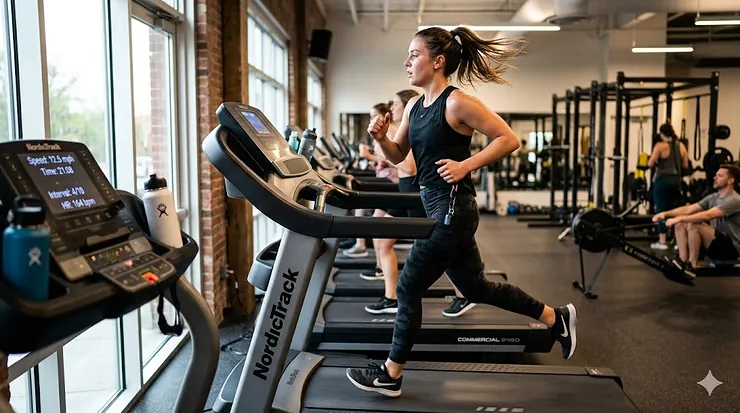
High-Intensity Interval Training is a fundamentally different animal. You’re not looking for a steady cruise; you’re demanding explosive acceleration, instant incline jumps, and a belt that doesn’t shudder when you hit 10 mph out of nowhere. The best treadmill for HIIT workouts needs to behave less like a gentle conveyor belt and more like a responsive, obedient training partner.
And the science backs the urgency. Research published in the Journal of Strength and Conditioning Research found that HIIT burns 25–30% more calories than traditional steady-state cardio — not because of the workout alone, but thanks to Excess Post-Exercise Oxygen Consumption (EPOC), the so-called “afterburn effect.” Your metabolism stays elevated for hours after you step off the belt. That’s the kind of ROI that makes a quality machine worth every penny.
But here’s what nobody tells you upfront: a slow-responding treadmill can completely destroy the science behind your HIIT protocol. Some budget models take 15–27 seconds to change speed or incline, essentially turning your sharp intervals into a blurry smear of mediocre effort. If you’ve ever tried to sprint and felt the belt lazily catching up to your legs, you know exactly how maddening — and ineffective — that is.
So what makes a treadmill actually good for a treadmill for HIIT workouts? Quick-touch speed buttons or thumb dials that respond in under two seconds. A motor robust enough to handle repeated surges without overheating. An incline motor that moves fast enough to matter within a 20-second work interval. And preset HIIT programs that do the heavy lifting for you on days when you’d rather not program your own torture.
In this guide, I’ve tested and researched the seven best machines currently available on Amazon — from budget-friendly workhorses to premium connected behemoths — so you can find the exact right fit for your training style, your space, and your wallet.
Quick Comparison: Top 7 HIIT Treadmills at a Glance
| Treadmill | Motor | Max Speed | Incline Range | Weight Capacity | Price Range | Best For |
|---|---|---|---|---|---|---|
| NordicTrack Commercial 1750 | 4.25 CHP | 12 mph | -3% to 12% | 300 lbs | $2,200–$2,500 | Tech-forward HIIT enthusiasts |
| Bowflex T10 | 4.0 CHP | 12 mph | -5% to 15% | 400 lbs | $1,400–$1,800 | Heavy users, decline intervals |
| Peloton Cross Training Tread | N/A | 12.5 mph | 0–12.5% | 300 lbs | $3,000–$3,500 | Class-driven, community athletes |
| SOLE F85 | 4.0 HP | 12 mph | Incline/Decline (15 levels) | 375 lbs | $2,200–$2,500 | Durability-first buyers |
| Horizon 7.4 AT | 3.5 CHP | 12 mph | 0–15% | 350 lbs | $1,700–$1,900 | Rotary-dial speed freaks |
| ProForm Carbon Pro 9000 | 3.6 CHP | 12 mph | 0–12% | 300 lbs | $1,400–$1,600 | iFIT fans on a budget |
| Echelon Stride Auto-Incline | 2.75 CHP | 12 mph | Motorized incline | 300 lbs | $800–$1,100 | Space-conscious beginners |
The standout pattern here? The machines that dominate for interval training aren’t necessarily the most expensive — they’re the ones with the fastest response controls. Notice that the Horizon 7.4 AT’s rotary dial and Bowflex T10’s QuickDial system both give you almost instant feedback, which is what separates a true HIIT machine from a jog-machine in disguise. Budget shoppers should note that the Echelon Stride sacrifices motor power for portability, which works fine for moderate intervals but may strain during heavy back-to-back sprint sessions.
💬 Just one click — help others make better buying decisions too! 😊
✨ Don’t Miss These Exclusive Deals!
🔍 Take your interval training to the next level with these carefully selected treadmills. Click on any highlighted product to check current pricing and availability on Amazon. These machines will help you crush your cardio goals every single session!
Top 7 Treadmills for HIIT Workouts: Expert Analysis
1. NordicTrack Commercial 1750 — Best Overall HIIT Treadmill
If the treadmill world has a crown jewel right now, the NordicTrack Commercial 1750 is wearing it. This machine runs on a 4.25 CHP motor — the strongest in its price class — which means those rapid-fire speed changes during sprint intervals don’t make it hesitate for even a beat. The -3% to 12% incline range is paired with SmartAdjust technology, which automatically shifts speed and grade to match your iFIT trainer’s commands in real time. In practice, this translates to a workout that flows the way interval training is supposed to: sharp, reactive, and completely distraction-free.
The 16-inch swiveling HD touchscreen now supports Netflix and Spotify alongside iFIT’s 10,000+ workout library, and the RunFlex™ cushioning absorbs the punishment of repeated hard landings in a way that budget treadmills simply can’t replicate. What most buyers overlook is the AutoBreeze fan that automatically ramps up with your workout intensity — a small touch that matters enormously when you’re 15 minutes into a brutal sprint session. The 22″ x 60″ running deck is wide enough to give you confidence during all-out sprints without feeling like you’re running on a balance beam.
This is the machine for the serious HIIT athlete who wants a connected, data-rich training experience and doesn’t want to outgrow their equipment in two years.
Customers say: Users rave about the iFIT integration and the near-silent motor at high speeds. The most common complaint is the mandatory subscription cost post-trial.
✅ 4.25 CHP motor handles sustained sprint intervals without heat buildup
✅ SmartAdjust auto-responds to trainer commands in real time
✅ Netflix/Spotify streaming keeps long sessions engaging
❌ iFIT subscription ($39/month) is essentially required for full value
❌ 300 lb weight limit is lower than some competitors
Price range: $2,200–$2,500 | Excellent long-term value for connected HIIT training
2. Bowflex T10 Treadmill — Best for Decline Interval Training
If you’ve never done downhill sprint intervals, the Bowflex T10 will change your fitness life. The -5% decline capability sounds like a minor spec — it absolutely isn’t. Downhill HIIT engages your quads and anterior tibialis in ways flat-belt training never touches, and the T10 is one of the very few treadmills under $2,000 that takes you there. The 4.0 CHP motor drives a -5% to 15% incline range with genuine speed, meaning incline transitions that take 10+ seconds on budget machines happen in roughly 2–3 seconds here.
The 10-inch HD touchscreen runs JRNY — Bowflex’s fitness platform — which includes personalized adaptive workouts that honestly feel like having a coach who knows when to push and when to pull back. The 22″ x 60″ running path on a 400 lb weight capacity frame is the most generous combination you’ll find in this price range. The ComfortTech deck cushioning is notably firm, which is the right choice for HIIT: too much softness robs you of ground-reaction energy during explosive efforts.
The T10 is the machine for larger-framed athletes, anyone serious about decline interval training, and buyers who want premium warranty coverage — the 15-year frame warranty here beats nearly every competitor in its class.
Customers say: Owners consistently praise the quiet, solid feel during high-speed intervals. Some note that the JRNY app, while good, has a slightly smaller content library than iFIT.
✅ -5% decline for unique downhill interval training
✅ 400 lb capacity — most generous in the mid-range segment
✅ Industry-best 15-year frame / 5-year parts warranty
❌ 10″ screen feels modest compared to NordicTrack’s 16″
❌ JRNY content library narrower than iFIT’s 10,000+ workouts
Price range: $1,400–$1,800 | Best value per pound of capacity in this list
3. Peloton Cross Training Tread — Best for Class-Driven HIIT
There’s a reason Peloton’s cult following is still growing in 2026: the Peloton Cross Training Tread doesn’t just give you a treadmill — it gives you accountability. The precision rotary knobs allow you to change speed and incline in fractions of a second without fumbling for buttons mid-sprint, which is exactly what interval training demands. With a top speed of 12.5 mph and a 0–12.5% incline range, the machine handles everything from moderate Fartlek sessions to all-out 30-second sprints without flinching.
What truly sets this machine apart is the instructor ecosystem. Peloton’s live and on-demand HIIT classes feature some of the most motivating coaches in the fitness industry, and the 21.5-inch Full HD swivel screen makes following along feel almost cinematic. The auto-incline feature responds to instructor cues automatically, so you’re not touching controls when your lungs are already screaming. The 59-inch running surface is slightly compact, which feels fine for average-height runners but may cramp the stride of anyone over 6’2″.
The honest trade-off: the Peloton requires an All-Access Membership ($49.99/month) to unlock essentially all its features. For solo athletes or budget-conscious buyers, that’s a significant long-term cost. For households where two or more people will use it, the value equation shifts dramatically.
Customers say: HIIT class quality and instructor motivation receive near-universal praise. The price point and mandatory subscription are the most cited downsides.
✅ Instant-response precision knobs built for interval transitions
✅ Auto-incline follows instructor cues without manual input
✅ 360° swivel screen enables off-treadmill strength and yoga work
❌ Premium price point is the highest on this list
❌ Full functionality locked behind $49.99/month membership
Price range: $3,000–$3,500 | Premium investment for community-driven fitness athletes
4. SOLE F85 Treadmill — Best for Durability and Heavy Users
The SOLE F85 is what happens when an engineer builds a treadmill instead of a marketer. No gimmicks, no flashy subscription ecosystem — just a relentlessly solid 4.0 HP motor, a 22″ x 60″ deck rated for 375 lbs, and 2.75-inch rollers that are significantly larger than the 1.9-inch rollers found on most mid-range machines. Why do rollers matter for HIIT? Larger rollers mean the belt flexes less violently during speed changes, which reduces wear dramatically and makes the ride smoother during hard sprint intervals.
The 15 incline levels with 6 decline settings give you impressive gradient variety for interval programming, and the 12 pre-loaded workout programs include structured HIIT protocols you can activate with a single button press. The Cushion Flex whisper deck absorbs impact quietly — SOLE rates it at noise levels that won’t disturb a sleeping baby in the next room, a bold claim that many users actually verify. The console is no-nonsense: a clear, bright display with direct-access number buttons for instant speed changes during intervals.
What most buyers overlook about the F85 is the lifetime motor and frame warranty. Most treadmills in this price range offer 10 years on the frame; SOLE doubles that. For anyone planning to use this machine hard for a decade, that warranty alone justifies much of the price premium.
Customers say: Users consistently mention the rock-solid build quality and the ease of speed changes. A minority note the interface feels dated compared to touchscreen competitors.
✅ Lifetime motor and frame warranty — best-in-class coverage
✅ 2.75″ rollers for smooth, quiet high-speed interval transitions
✅ 375 lb capacity handles virtually any user
❌ Console looks dated compared to touchscreen-equipped rivals
❌ Heavier than most (around 280 lbs), limiting portability
Price range: $2,200–$2,500 | The “buy once, cry once” choice for serious long-term athletes
5. Horizon 7.4 AT Treadmill — Best for Instant Speed Response
Here’s the machine that serious interval athletes keep discovering and never stop talking about. The Horizon 7.4 AT features a rotary dial speed control that gives you completely analog, lightning-fast speed and incline adjustments — turn the dial, it responds. No button mashing, no 3-second lag, no watching your sprint window disappear while the belt slowly catches up. For interval training specifically, this is genuinely transformative. A 3.5 CHP motor drives a 0–15% incline range, and that incline motor is notably faster than most competitors — reaching near maximum grade in just a few seconds.
The built-in Sprint 8 training program is a legitimate gem that most buyers don’t fully appreciate until they try it. Sprint 8 is a scientifically designed HIIT protocol (8 rounds of 30-second all-out efforts with 90-second recoveries) that has been shown in clinical research to produce significant improvements in both aerobic and anaerobic capacity. Having it baked into the console means zero setup — one button, and the machine programs itself. The 22″ x 60″ running surface and 350 lb capacity sit in solid mid-range territory.
The trade-off is the screen: the 7.4 AT’s basic display is functional but feels Spartan next to the touchscreen machines. If you’re a data minimalist who wants to work hard and go home, that’s actually a feature, not a bug.
Customers say: The dial controls and build quality receive exceptional praise. Users who are accustomed to touchscreen treadmills sometimes find the interface adjustment takes a session or two.
✅ Rotary dial = fastest speed response of any machine on this list
✅ Sprint 8 pre-loaded HIIT protocol requires zero programming
✅ Reaches 14.7% incline in seconds — perfect for hill interval work
❌ Basic console screen, no built-in streaming capability
❌ Heavy frame (318 lbs) makes repositioning inconvenient
Price range: $1,700–$1,900 | The interval trainer’s secret weapon in the mid-range segment
6. ProForm Carbon Pro 9000 Treadmill — Best Budget-Friendly iFIT Option
Think of the ProForm Carbon Pro 9000 as the NordicTrack Commercial 1750’s more affordable younger sibling — because it literally is. Both ProForm and NordicTrack are owned by iFIT Health & Fitness, which means the Carbon Pro 9000 runs the same platform with a slightly smaller motor (3.6 CHP vs. 4.25 CHP) and a marginally more compact build. For most HIIT practitioners, this difference is barely perceptible during typical interval sessions. Where you’ll feel it is in extended back-to-back sprint cycles at maximum speed — the smaller motor can generate more heat over longer periods.
The 16-inch HD touchscreen is the same size as the 1750’s and runs iFIT’s full 10,000+ workout library, including live and on-demand HIIT classes. The 0–12% incline range handles most programming needs handily, though the lack of a decline setting is a legitimate gap compared to the Bowflex T10. Direct-access number buttons allow for quick interval speed changes, and the ProShox cushioning provides a forgiving landing surface that’s friendlier on joints during repeated high-impact sprint landings.
This is the machine for the iFIT devotee who wants the full connected-training experience without paying the 1750’s premium. If you’re already subscribed to iFIT for another piece of equipment in your home, the Carbon Pro 9000 makes exceptional economic sense.
Customers say: Users love the iFIT integration and the price-to-feature ratio. The most common note is that the motor can feel more strained during extended max-speed sessions compared to higher-powered competitors.
✅ Full iFIT platform access at a significantly lower price than the 1750
✅ 16-inch touchscreen — same size as the premium NordicTrack
✅ Direct-access number buttons for clean interval control
❌ 3.6 CHP motor shows strain during very long high-intensity sessions
❌ No decline capability
Price range: $1,400–$1,600 | The smartest way into the iFIT ecosystem without the flagship price
7. Echelon Stride Auto-Incline Smart Treadmill — Best for Beginners and Small Spaces
The Echelon Stride Auto-Incline is the machine that proves you don’t need to spend $2,000 to get started with interval training on a treadmill. The 2.75 CHP motor and motorized incline system support speeds up to 12 mph, which covers the full sprint range for most recreational HIIT athletes. The Air Cushioning deck absorbs impact quietly, and the compact foldable design stores in a space roughly the size of a large carry-on suitcase — an absolute lifesaver for apartment dwellers or anyone running a dual-purpose home gym setup.
What makes the Echelon Stride genuinely interesting for HIIT beginners is the 30-day free Echelon membership included with purchase, which features instructor-led interval classes that teach proper HIIT pacing to newcomers who might otherwise push too hard or too easy. The USB charging port is a thoughtful touch that keeps your phone ready for playlist control during intervals. The 300 lb weight capacity is standard, and the console gives you direct speed access for rapid adjustments.
The honest limitation: the 2.75 CHP motor will feel resistance under very heavy sustained sprint loads, and the step-up from beginner HIIT to advanced protocols may eventually push you toward an upgrade. Think of the Echelon Stride less as a forever treadmill and more as the machine that gets you genuinely fit over your first 12–18 months, at which point you’ll know exactly what you need next.
Customers say: Buyers love the compact footprint and the smooth folding mechanism. Some report wanting more power after 6+ months of consistent HIIT use.
✅ Folds flat — among the most compact full-feature HIIT treadmills available
✅ Budget-friendly entry point with real interval training capability
✅ 30-day class membership helps beginners learn proper HIIT pacing
❌ 2.75 CHP motor may feel strained during advanced sprint protocols
❌ Smaller screen and simpler console than mid-range competitors
Price range: $800–$1,100 | The best first HIIT treadmill for budget-conscious beginners
How to Actually Use Your HIIT Treadmill: A First-30-Days Survival Guide
Buying the right treadmill for HIIT workouts is step one. Using it correctly — without injuring yourself or burning out in week two — is where most people quietly fail. Here’s what the instruction manual won’t tell you.
Week 1: Respect the warm-up, always. Your HIIT machine is capable of launching you into maximum effort in seconds. Your tendons and ligaments are not ready for that out of bed on a Monday morning. Spend five minutes at 3–4 mph, then two minutes at 60–70% of your target sprint speed before your first work interval. The American College of Sports Medicine recommends a full warm-up protocol precisely because cold connective tissue tears, and torn tissue doesn’t care how expensive your machine was.
Week 2: Learn your “recovery walk” speed. During HIIT, your recovery intervals are just as important as your sprints. Most beginners set recovery pace too slow — so slow that heart rate drops completely and the metabolic stimulus disappears. Your recovery pace should keep your heart rate at roughly 50–60% of max. For most people, that’s 3.0–3.8 mph. Program this into your quick-touch buttons on day one.
Weeks 3–4: Start layering incline into your sprints. Flat-belt HIIT is excellent. Incline HIIT is extraordinary. Once your base fitness has improved over the first two weeks, introduce 4–6% incline during work intervals. This dramatically increases calorie burn and engages your posterior chain — glutes, hamstrings, and calves — in ways that flat sprinting never does. A 2022 study showed that regular HIIT workouts incorporating incline changes helped decrease body fat mass percentage significantly more than flat-only protocols.
Common mistakes to avoid in the first month:
- Starting with 5 days per week of HIIT. Three sessions maximum, with recovery days between. HIIT creates genuine muscular micro-damage; that damage is the adaptation catalyst, but only if you give it 48 hours to repair.
- Jumping off and back on while the belt is running full speed. This is how people get thrown. Use the quick-stop button or let the belt slow during recovery intervals.
- Ignoring belt lubrication. Most manufacturers recommend lubricating the deck every 150 miles of use. Skip this, and you’ll burn out the motor in 18 months.
The Perfect HIIT Treadmill: A Buyer’s Decision Framework
Not every machine in this list is right for every person. Here’s how to match yourself to your machine without regret.
If you’re a beginner just starting HIIT: The Echelon Stride Auto-Incline gives you everything you need without overwhelming your current fitness level or your budget. You’ll grow into it.
If you’re intermediate and want maximum HIIT responsiveness on a mid-range budget: The Horizon 7.4 AT is your machine, full stop. The rotary dial and Sprint 8 protocol are specifically designed for the interval athlete who wants zero friction between intention and execution.
If you have a large body frame or plan on training heavy for years: The Bowflex T10’s 400 lb capacity and 15-year warranty make it the obvious choice. The decline functionality is a bonus that becomes addictive.
If you’re already in the iFIT ecosystem and want a budget entry: The ProForm Carbon Pro 9000 saves you significant money versus the NordicTrack 1750 while delivering 90% of the same connected experience.
If you want the absolute best connected HIIT experience money can buy: The NordicTrack Commercial 1750 is the machine that will outlast your fitness goals, grow with your training, and feel like an upgrade compared to anything you’ve used before.
If community and live classes are your primary training motivator: The Peloton Cross Training Tread is worth the premium. The instructor quality and accountability ecosystem are genuinely unmatched.
If you’re tight on space and budget but serious about progress: The Echelon Stride. Always fold it back up when you’re done.
Treadmill HIIT vs. Outdoor Sprint Training: The Honest Comparison
| Factor | Treadmill HIIT | Outdoor Sprint Training |
|---|---|---|
| Speed precision | ✅ Exact mph control | ❌ Estimated effort |
| Incline control | ✅ Adjustable, precise | ⚠️ Weather-dependent |
| Joint impact | ✅ Cushioned deck | ❌ Hard pavement |
| Year-round availability | ✅ Always available | ❌ Weather-dependent |
| Cost | ❌ Equipment investment | ✅ Free |
| EPOC / afterburn effect | ✅ Equal | ✅ Equal |
| Natural terrain stimulus | ❌ Simulated | ✅ Real |
The comparison above makes an important case for treadmills that’s often missed in the outdoor-running community: cushioned decks reduce joint stress during repeated high-impact sprints dramatically. Running on asphalt sends impact force of 2–3x your body weight through your knees with every stride. A quality treadmill deck cuts that by 15–40%, which compounds significantly across a training year of repeated sprint intervals. For long-term HIIT practitioners, the joint preservation argument is as compelling as the weather argument.
That said, outdoor sprint training has genuine value in proprioceptive development and terrain variation that treadmills can’t replicate. The smart athlete uses both.
Features That Actually Matter for HIIT (And Those That Don’t)
After years of testing treadmills for high-intensity use, the line between genuine performance features and marketing noise becomes very clear. Let me save you from expensive spec-sheet seduction.
What Genuinely Matters:
Motor size (CHP, not HP). Continuous Horsepower is the honest metric. Brands that advertise “Peak HP” are showing you the momentary maximum before the motor overheats. For HIIT, 3.5 CHP is the minimum; 4.0+ CHP is where sprint intervals feel truly effortless.
Speed change response time. This is almost never published, but it’s the most important HIIT-specific specification. Rotary dials (Horizon) and QuickDial systems (Bowflex) respond fastest. Standard up/down arrow buttons vary widely — test before you commit.
Roller diameter. 2.5 inches or larger means smoother high-speed transitions and significantly less belt wear. The cheap 1.9-inch rollers on entry-level machines will wear belts out in under 500 miles of HIIT use.
Incline motor speed. Look for machines advertised as reaching maximum incline in “seconds.” Some budget models take 30+ seconds to travel from 0% to maximum, which is essentially useless during a 30-second work interval.
What Doesn’t Matter as Much as You Think:
Massive touchscreens. A 10-inch screen versus a 22-inch screen doesn’t improve your VO2 max. If connected training features aren’t your priority, don’t pay the premium.
“Peak” horsepower ratings. As mentioned — pure marketing. Ignore them entirely.
Excessive cushioning claims. There’s a sweet spot. A deck that’s too soft (common in budget machines marketed as “joint-friendly”) actually robs energy return during explosive sprint intervals and reduces training efficiency.
What to Expect: Real-World HIIT Performance Across Fitness Levels
🟢 Beginners (0–3 months of consistent training)
A realistic beginner HIIT session on any of these machines looks like: 5-minute warm-up at 3 mph, then 8–10 rounds of 30 seconds at 6–7 mph / 60 seconds at 3.0 mph recovery. This is roughly a 20-minute total workout. Don’t let the short duration fool you — studies confirm that 20-minute HIIT sessions can burn the same calories as 50-minute steady-state runs thanks to EPOC. The Echelon Stride or ProForm Carbon Pro 9000 handles this protocol easily.
🟡 Intermediate (3–12 months)
At this level, you’re running 8–10 mph during work intervals, incorporating 4–8% inclines, and potentially doing 6–8 rounds of 45 seconds on / 60 seconds off. The Horizon 7.4 AT’s Sprint 8 protocol is practically designed for this fitness band and provides an excellent structured progression path.
🔴 Advanced (12+ months, competitive athletes)
Advanced HIIT athletes are pushing 10–12 mph work intervals with 8–15% incline, often doing Tabata-style 20-second/10-second protocols repeated 8 times. At this level, motor quality becomes non-negotiable — you want the NordicTrack 1750, Bowflex T10, or SOLE F85. Their motors don’t break a sweat during protocols that would cook a budget machine’s components.
Long-Term Cost and Maintenance: The Total Cost of Ownership Nobody Calculates
The sticker price is the beginning of the conversation, not the end. Here’s what actually determines whether a treadmill for HIIT workouts represents good value over five years.
Belt replacement: A quality belt lasts 3,000–5,000 miles with proper maintenance. On a budget machine with poor rollers, you’re replacing the belt at 800–1,200 miles. Belt replacements cost $80–$200 plus installation time. Run the math across five years of daily HIIT and the “cheap” machine starts looking very expensive.
Subscriptions: iFIT ($39/month = $468/year), Peloton All-Access ($49.99/month = $599.88/year), JRNY ($15/month = $180/year). Over five years, iFIT adds $2,340 to your total cost; Peloton adds nearly $3,000. The Horizon 7.4 AT and SOLE F85, meanwhile, offer robust built-in programs with zero mandatory subscription.
Motor warranties as quality signals: A brand that offers a lifetime motor warranty (SOLE) or 15-year frame warranty (Bowflex) is telling you something that marketing language can’t fake — they expect their machines to survive. A 1-year motor warranty is a confession.
Lubrication and belt tension: Bi-annual deck lubrication (a $10 bottle of silicone lubricant does the job) and monthly belt tension checks take about 20 minutes per year. Skip these, and you’ll be replacing parts years ahead of schedule.
FAQ
❓ What is the best treadmill for HIIT workouts for a beginner?
❓ Do I need quick-touch speed buttons for interval training treadmill reviews?
❓ What motor size do I need for the best treadmill for sprint intervals?
❓ Do preset HIIT programs on treadmills actually work?
❓ How important is recovery time tracking on a HIIT treadmill?
Conclusion: The Right HIIT Treadmill Will Change the Way You Train
Here’s the bottom line — buying a treadmill for HIIT workouts isn’t the same decision as buying a treadmill for jogging. The machines are doing fundamentally different jobs. A jogging treadmill needs to be steady and comfortable. A HIIT treadmill needs to be fast, reactive, durable under repeated stress, and honest about the performance gap between your current fitness and your potential.
Every machine on this list earns its place. The Echelon Stride brings real interval capability to a beginner’s budget. The Horizon 7.4 AT delivers the best pure response control in the mid-range. The Bowflex T10 serves the heavy athlete who demands durability and decline intervals. The SOLE F85 is simply built to last forever. The ProForm Carbon Pro 9000 opens the iFIT ecosystem at a sane price. The NordicTrack Commercial 1750 is as good as home HIIT treadmills get without entering commercial-grade pricing. And the Peloton Tread turns interval training into a social sport.
Pick the one that matches where you are right now — not where you hope to be in two years — and go use it. Consistently, smartly, and with proper recovery. The science is unambiguous: HIIT is among the most effective training modalities on the planet for cardiovascular health, fat loss, and metabolic improvement. Your only job is showing up.
✨ Don’t Miss These Exclusive Deals!
🔍 Ready to upgrade your interval training? Click on any highlighted product to check current pricing and deals on Amazon. Your next best sprint session is one purchase away!
Recommended for You
- Best High Speed Treadmill for Sprinters in 2026: 7 Top Picks
- 7 Best Low Speed Treadmill for Seniors in 2026 — Safe & Proven Picks
- 7 Best Portable Walking Treadmills That Transform Home Fitness 2026
Disclaimer: This article contains affiliate links. As an Amazon Associate, I earn from qualifying purchases. If you purchase products through these links, we may earn a small commission at no additional cost to you.
✨ Found this helpful? Share it with your friends! 💬🤗
