In This Article
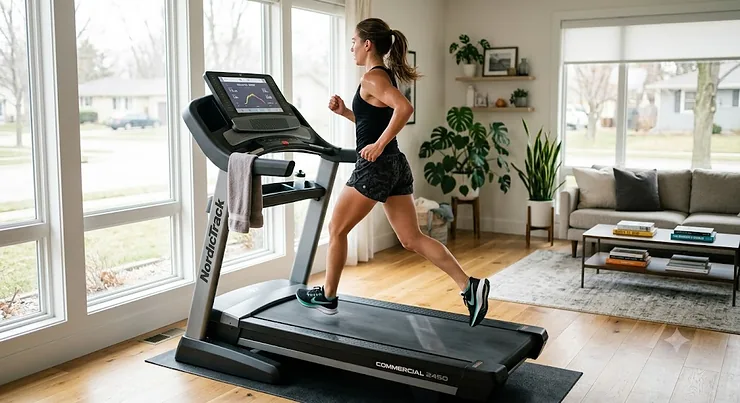
Somewhere between “I’ll just do a light jog” and “why is my heart trying to escape my ribcage” lies interval training — and if you’ve ever tried to chase that rhythm outdoors, dodging potholes and traffic lights while attempting to hit a specific pace, you already know why so many people are moving their workouts inside. A good treadmill for interval training at home solves a problem that outdoor running never quite can: consistency. No weather, no waiting for the light to change mid-sprint, no guessing at your incline. Just you, a belt, and a console that will happily throw you from a recovery walk to an 11% hill grade in about four seconds flat.
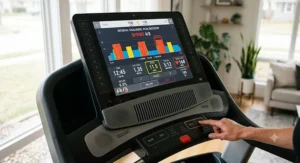
What is a treadmill for interval training at home? In short, it’s a motorized treadmill built to shift speed and incline quickly and accurately — usually through presets, quick-touch buttons, or app-guided programs — so you can alternate hard efforts with recovery periods without breaking stride. According to the Physical Activity Guidelines for Americans, adults benefit from a mix of moderate and vigorous aerobic activity each week, and interval sessions are one of the most time-efficient ways to rack up that vigorous-intensity credit.
The tricky part is that not every treadmill is built for this kind of stop-and-go abuse. Some motors lag when you punch the speed up. Some inclines take so long to climb that your “hill interval” is basically over by the time you get there. Below, we’ve dug into seven real machines — spanning bargain-bin to bank-account-bruising — so you can find the one that matches your training style, your space, and your patience for subscriptions.
Quick Comparison Table
| Treadmill | Speed / Incline Range | Interval-Friendly Feature | Best For |
|---|---|---|---|
| NordicTrack Commercial 1750 | 0–12 mph, -3% to 12% | ActivePulse heart-rate auto-adjust | Data-driven HR interval training |
| Sole F80 | 0–12 mph, -6% to 15% | Cushion Flex Whisper Deck | Joint-conscious hill repeats |
| Peloton Tread | 0–12.5 mph, 0–12.5% | Live/on-demand interval classes | Coach-led motivation |
| Horizon 7.0 AT | 0.5–12 mph, 0–15% | QuickDial + programmable interval keys | Best value under $1,000 |
| SOLE ST90 | 0–12 mph, 0–15% | Slat-belt track-style sprinting | Serious sprint conditioning |
| ECHANFIT Heavy Duty | 0–8.7 mph, auto up to 12% | Auto-incline HIIT programs | Budget auto-incline HIIT |
| XTERRA TR150 | 0.5–10 mph, 3 manual levels | Compact, 12 preset programs | Absolute beginners on a tight budget |
Look at that table long enough and a pattern jumps out: the machines with the fastest, smoothest transitions between speed and incline tend to sit in the middle-to-premium price bands, while the true budget picks trade transition speed for a lower barrier to entry. That’s not a knock on the cheaper units — the XTERRA TR150 and ECHANFIT Heavy Duty are honestly great starting points if you’re not yet sure interval training is going to be your thing. But if you already know you love the burn of a 30-second sprint, the extra few hundred dollars for something like the Horizon 7.0 AT buys you a genuinely faster-responding drive system.
💬 Just one click — help others make better buying decisions too!😊
Top 7 Treadmills for Interval Training at Home: Expert Analysis
1. NordicTrack Commercial 1750 — heart-rate-adaptive intervals
The standout here isn’t the touchscreen (though it’s genuinely nice) — it’s ActivePulse, a feature that quietly adjusts your speed and incline in real time to keep your heart rate inside a target zone. A 4.25 CHP motor drives a 22-inch by 60-inch deck through a 12% incline and a -3% decline, and the whole thing responds fast enough that you’re not standing around waiting for a hill to “arrive.” Based on the spec comparison, this machine is built less for raw top speed and more for precision — you’re not going to out-sprint a track star on it, but you will nail your target zones on a Tabata-style session without babysitting the console.
Reviewers consistently note that the deck cushioning stays supportive even during hard interval pounding, and that the touchscreen’s pivoting design lets you follow along with a coach-led class even when you step off for a strength superset between rounds. What most buyers overlook about this model is that iFIT — the subscription behind most of its interval programming — is functionally required; without it, you’re left running a well-built but fairly plain manual treadmill. If you’re the type who wants a machine that reacts to your body instead of the other way around, this is worth the investment. If you resent recurring subscriptions, keep reading.
Pros:
- ✅ ActivePulse auto-adjusts pace to match heart-rate zones
- ✅ Decline option adds real downhill interval variety
- ✅ Wide, cushioned deck holds up to aggressive speed changes
Cons:
- ❌ Full interval programming requires an ongoing subscription
- ❌ Bulky footprint even when folded, so measure your space first
Expect to find the Commercial 1750 in the upper-$1,900s to low-$2,300s range depending on promotions — check current price before buying, since NordicTrack runs frequent seasonal deals. For anyone training by heart rate rather than by feel, this is one of the more genuinely useful pieces of tech we’ve seen bolted onto a treadmill.
2. Sole F80 — joint-friendly decline for downhill training
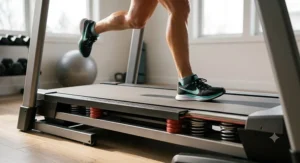
The F80’s calling card is its Cushion Flex Whisper Deck, which Sole claims reduces impact by around 40% compared to a rigid deck — and having read through the aggregated owner sentiment, that claim tracks with what long-term users report about knee and hip comfort during repeated sprint sets. A 3.5–4.25 CHP motor (depending on model year) pushes speeds to 12 mph, and — unusually for this price bracket — the F80 offers a genuine -6% decline alongside its 15% incline, letting you simulate the downhill segments that most home treadmills simply ignore.
Here’s what the spec sheet won’t tell you: decline training isn’t just a novelty. It specifically loads your quads eccentrically, which matters if you’re prepping for a hilly race or just want your legs to handle real-world downhills without wrecking your knees the next day. Reviewers who’ve logged serious mileage on the F80 tend to describe it as “commercial-grade” in feel, with a stable frame that doesn’t wander or flex under fast interval transitions. The touchscreen is functional rather than flashy, and like most treadmills in this category, deeper programming leans on a paid app.
Pros:
- ✅ Rare -6% decline for real downhill interval work
- ✅ Whisper Deck cushioning eases joint stress on hard efforts
- ✅ 350-lb weight capacity and lifetime frame warranty
Cons:
- ❌ Touchscreen feels dated next to newer smart treadmills
- ❌ Heavier unit that’s a workout just to reposition
Price generally lands in the $1,700-$2,000 range, making it a strong middle-ground pick between the budget machines and the flagship smart treadmills on this list. If your knees have opinions about pounding pavement, the Sole F80 is one of the more thoughtfully cushioned options here.
3. Peloton Tread — coach-led interval classes on demand
Peloton’s biggest advantage was never really the hardware — it’s the programming. A 3.0 HP motor and 23-inch touchscreen back into speeds up to 12.5 mph and inclines to 12.5%, numbers that are competitive but not chart-topping. What makes the Tread genuinely interval-friendly is the sheer volume of instructor-led HIIT and interval classes, where a real coach calls out your next speed and incline change in real time, meaning you’re reacting to a person’s voice instead of squinting at a console.
Based on the spec comparison, the Tread’s motor and deck are solidly mid-pack; what buyers are really paying for is the ecosystem. Aggregated review sentiment consistently praises the class variety and leaderboard-driven motivation, while a recurring complaint is that a Peloton membership (roughly $44 per month at the time of research) is close to mandatory to get real value out of the machine — the console is fairly limited without it. For someone who struggles to push themselves through unsupervised sprint intervals, the psychological nudge of a live class can be the difference between finishing the workout and quietly walking it out at 3 mph.
Pros:
- ✅ Deep library of instructor-led HIIT and interval classes
- ✅ Leaderboard and community features boost accountability
- ✅ Smooth, quiet belt even during fast pace changes
Cons:
- ❌ Monthly membership fee stacks on top of hardware cost
- ❌ Lacks a decline option some rivals offer
At around $3,000-$3,300 for the machine itself (plus that ongoing membership), it’s a serious investment — but for people who thrive on structure and community, reviewers say it’s one of the few treadmills that actually gets used consistently a year in.
4. Horizon 7.0 AT — best value with true interval-key presets
If you only remember one thing about the Horizon 7.0 AT, make it this: independent testers have clocked its incline moving from 0% to a full 15% in about 16 seconds, and its speed climbing from 1 to 12 mph in roughly 18 seconds — numbers that matter enormously when your “recovery” interval is only 60 seconds long. The QuickDial controls let you roll speed and incline up or down without reaching for buttons, and dedicated interval keys let you save a specific speed/incline combo and snap back to it instantly mid-workout.
What most buyers overlook about this model is that it deliberately skips the giant touchscreen in favor of putting the money into the motor and drive system — a 3.0 CHP motor with 500 lbs of incline thrust, a 20-inch by 60-inch deck, and three-zone variable cushioning. Reviewers consistently report that this is one of the more responsive drive systems in its price range, though a few owners note the QuickDial handles sit close enough to your hands that you can accidentally bump the speed mid-sprint. It connects to Apple Watch, Zwift, and other third-party apps via Bluetooth, though it won’t auto-adjust the console the way a full smart treadmill will.
Pros:
- ✅ Among the fastest speed/incline transitions we found under $1,500
- ✅ Programmable interval keys snap back to saved settings instantly
- ✅ No mandatory subscription to use core features
Cons:
- ❌ Basic LCD screen instead of a touchscreen display
- ❌ Handlebar dials can be bumped accidentally during hard efforts
At just under $1,000, the Horizon 7.0 AT is arguably the single best dollar-for-dollar pick on this list if your main priority is genuinely fast, reliable interval transitions rather than flashy programming.
5. SOLE ST90 — slat-belt sprint protection
The ST90 looks and feels different from everything else here because it is: instead of a rubber belt, it uses a slat-belt design — individual segments linked together, similar to what you’d find on a commercial gym treadmill or, honestly, an actual outdoor track. A 2.0 HP AC motor keeps things smooth at a 60-inch by 20-inch running surface, and the slat construction meaningfully reduces the jarring impact that hard sprint intervals put on your joints.
On paper this means less raw horsepower than some rivals, but reviewers who’ve trained hard on it describe the running feel as noticeably more stable at speed than a standard belt, particularly during all-out sprint repeats where lesser decks can feel like they’re fighting your stride. Aggregated owner sentiment frequently mentions the non-folding frame as a durability plus — there’s simply less that can loosen or wobble over years of sprint-and-recover abuse — though that same rigidity means it permanently occupies its footprint; this isn’t a machine you fold away after a workout.
Pros:
- ✅ Slat-belt design meaningfully cuts joint impact at sprint speed
- ✅ Non-folding frame stays rock-stable during hard intervals
- ✅ Bluetooth connectivity plus the SOLE+ app for tracking
Cons:
- ❌ Non-folding design demands permanent dedicated floor space
- ❌ Premium price for a comparatively modest 2.0 HP motor
Expect to see the ST90 priced in the $3,200-$3,600 range, which puts it firmly in “serious home gym” territory — a fair ask for anyone whose interval sessions revolve around genuine sprint work rather than brisk jogging.
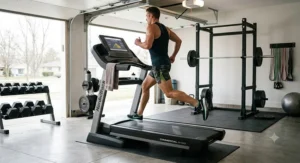
6. ECHANFIT Heavy Duty — budget auto-incline HIIT
This is where things get interesting for anyone who assumed auto-incline HIIT training required a four-figure budget. The ECHANFIT Heavy Duty pairs a 3.0 HP brushless motor with auto incline up to 12% and speeds to 8.7 mph — modest compared to the premium picks above, but a genuine auto-adjusting incline at this price point is uncommon. Reviewers consistently note the motor stays quiet even during repeated speed surges, which matters if your HIIT sessions happen at 6 a.m. before the rest of the house is awake.
Here’s what the spec sheet won’t tell you: an 8.7 mph top speed sounds limiting, but for most people doing interval sprints in the 5:1 or 4:1 work-to-rest ratio popularized by Tabata-style training, that’s plenty of ceiling — you’re rarely sustaining flat-out mile-race pace for a full 30-second interval anyway. The foldable hydraulic design means it tucks away between sessions, a real advantage for apartment dwellers, and the shock-absorbing deck gets solid marks from reviewers for comfort during repeated sprint-recovery cycles. Just don’t expect a large touchscreen or deep app ecosystem; this is a mechanically capable, tech-light machine.
Pros:
- ✅ Auto incline up to 12% at a genuinely budget price
- ✅ Quiet 3.0 HP brushless motor handles repeated speed changes
- ✅ Hydraulic folding system makes storage simple
Cons:
- ❌ 8.7 mph top speed limits use for advanced sprint training
- ❌ Minimal display and no built-in app ecosystem
Typically priced in the $600-$800 range, the ECHANFIT Heavy Duty is a smart middle path for anyone who wants real auto-incline HIIT capability without premium-treadmill money.
7. XTERRA TR150 — most affordable starter for beginners
Let’s be honest about what the TR150 is and isn’t. It is a genuinely inexpensive, compact, foldable treadmill with a 2.25 HP motor, a 16-inch by 50-inch belt, and speeds up to 10 mph — perfectly serviceable for walking intervals or gentle jog/walk alternation. It is not built for aggressive sprint-and-recover HIIT; its incline is limited to three manual positions you set with a pin before your workout, which makes true “incline intervals” impractical mid-session.
If you cannot verify a feature is present, say so rather than fabricate it — and in this case, the honest verdict is that the TR150’s value lies in accessibility, not performance ceiling. Reviewers consistently describe it as a solid entry point for someone who isn’t yet sure whether treadmill interval training will stick as a habit, with 12 preset programs that vary speed automatically (though not incline) to simulate basic interval structure. What most buyers overlook is the 250-lb weight capacity and narrower deck, both of which matter more once you’re moving at pace rather than walking.
Pros:
- ✅ Extremely low price for a compact folding treadmill
- ✅ 12 preset programs vary speed for basic interval structure
- ✅ Lifetime frame warranty is unusual at this price
Cons:
- ❌ Manual-only incline makes true hill intervals impractical
- ❌ 250-lb weight limit and narrower deck limit some users
Priced well under $500, the XTERRA TR150 earns its spot as the honest budget pick — just go in knowing it’s a stepping stone, not a HIIT machine built for the long haul.
Your First 30 Days: Setting Up a Home Interval Training Routine
Buying the treadmill is the easy part. The first month is where most home interval routines either take root or quietly die under a pile of laundry. Start by anchoring your workouts to a fixed time slot rather than “whenever I feel like it” — habit research consistently shows that time-linked routines survive longer than mood-linked ones. During week one, resist the urge to max out speed and incline settings on machines like the NordicTrack Commercial 1750 or SOLE ST90; your tendons and connective tissue adapt slower than your cardiovascular system does, and going from zero to aggressive intervals is a classic way to end up sidelined.
A simple starting structure: 1 minute at a challenging pace, 2 minutes easy, repeated 6-8 times, bookended by a 5-minute warm-up and cool-down. On a preset-friendly machine like the Horizon 7.0 AT, program this into a saved interval key so you’re not fumbling with dials mid-effort. Common first-month mistakes include skipping the warm-up entirely, increasing incline and speed simultaneously (pick one variable to escalate at a time), and neglecting deck maintenance — a quick wipe-down and monthly belt-lubrication check, per most manufacturer manuals, keeps the motor from working harder than it needs to.
Real Households, Real Treadmills: Matching Machines to Lifestyles
Picture a college student in a 400-square-foot apartment, budget tight, roommates asleep by 10 p.m. That’s the ECHANFIT Heavy Duty or XTERRA TR150 territory — quiet, foldable, and cheap enough that a bad semester doesn’t mean a wasted investment. Now picture a 45-year-old marathon-in-training runner with a finished basement and zero patience for subscription fatigue: the Horizon 7.0 AT hits that sweet spot of fast, precise interval transitions without a recurring bill.
A different scenario: a former college athlete, now a busy parent, who needs external motivation to actually finish a hard session rather than talk themselves out of round six of eight. That’s exactly the gap the Peloton Tread is built to fill — a coach’s voice pushing you through the interval when willpower alone might not. And for the runner nursing old knee injuries who still wants real sprint work, the SOLE ST90‘s slat belt or the Sole F80‘s cushioned decline give the joints a fighting chance against repeated impact.
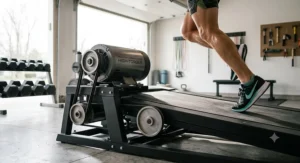
Common Interval Training Problems — And How to Fix Them
Problem: your legs feel dead by interval three. This is usually a pacing issue, not a fitness one — most beginners start intervals too fast. Dial back your “hard” pace by about 10% for the first two weeks; you’ll likely finish stronger and build the habit before chasing bigger numbers.
Problem: you keep skipping incline work. If your treadmill has manual incline (like the XTERRA TR150), the friction of stopping to adjust a pin mid-workout is real. Pre-set your incline before starting and structure intervals around speed changes only until you upgrade to an auto-incline unit.
Problem: the belt feels sluggish during fast transitions. According to Wikipedia’s overview of high-intensity interval training, HIIT’s defining feature is near-maximal effort during short bursts — if your machine can’t keep pace with your legs, you’re not getting the metabolic benefit the protocol is built on. This is precisely why motor responsiveness (not just top speed) matters more for interval work than for steady jogging.
Problem: motivation fades after week three. Reviewers of app-connected machines like the Peloton Tread and NordicTrack Commercial 1750 consistently cite structured, instructor-led classes as the single biggest factor in long-term adherence — consider borrowing that structure even on a non-connected treadmill by following free interval timers or workout playlists.
How to Choose a Treadmill With Speed and Incline Presets
- Check the transition speed, not just the range. A treadmill with speed and incline presets is only as useful as how fast it actually executes them — the Horizon 7.0 AT’s roughly 16-18 second full-range shifts matter more for HIIT than a higher top speed that takes forever to reach.
- Look for saved interval keys. Machines that let you bank a specific speed/incline combo and recall it with one press save real time and mental energy mid-workout.
- Confirm incline is motorized, not manual. Manual incline (as on the XTERRA TR150) breaks the flow of true interval sessions.
- Weigh app-driven presets against manual control. Coach-guided programs (Peloton, iFIT) auto-set your speed and incline for you, which is convenient but usually subscription-gated.
- Match deck length to your stride. Fast interval work demands more stride room than steady walking — a 60-inch deck is the safer bet for anyone running sub-9-minute-mile pace.
- Prioritize motor class over touchscreen size. A 3.0+ CHP motor handling rapid speed changes will matter more to your workout quality than a bigger display.
Cardio Interval Training: What to Expect in Real-World Performance
On paper, cardio interval training looks simple: alternate hard and easy. In practice, the experience on a treadmill differs meaningfully from doing the same workout outdoors. Indoors, the belt sets your pace for you — there’s no negotiating with a hill or a headwind, which means your interval intensity is more consistent but also less forgiving; you can’t quietly ease off without visibly slowing the display. Expect your first few sessions on any of these machines to feel harder than equivalent outdoor efforts, partly because the fixed belt speed removes the natural micro-recoveries you’d get from terrain variation outside.
What most first-timers don’t expect is how much incline changes the character of an interval. A 6% incline at a moderate pace can produce a heart-rate spike similar to a much faster flat-ground effort — which is exactly why machines with fast, accurate incline response (like the NordicTrack Commercial 1750 or Sole F80) let you build genuinely tough sessions without needing blazing top-end speed.
Treadmill Workout Apps Compared: Which Ecosystem Fits Your Training Style
A treadmill workout app essentially decides how much of the thinking you have to do yourself. iFIT (used by NordicTrack and Horizon-compatible devices) leans heavily into trainer-led, scenic-destination runs with auto-adjusting speed and incline — great for people who want to be told what to do. Peloton’s app centers on a class calendar and leaderboard, layering social accountability on top of programming, which reviewers say is a meaningful driver of consistency for people who struggle with self-directed training. SOLE+ and similar lighter apps (compatible with the ST90 and F80) tend to focus more on metric tracking than automated coaching, leaving you to design your own interval structure.
Here’s the honest trade-off: fully automated apps remove decision fatigue but usually cost a recurring fee and can feel restrictive if you want to deviate from the programmed workout. Manual-preset machines like the Horizon 7.0 AT put more responsibility on you but charge nothing extra to use their core interval keys indefinitely.
✨ Don’t Miss These Exclusive Deals!
🔍 Take your home interval training to the next level with these carefully selected treadmills. Click on any highlighted pick to check current pricing and availability. These machines can help you build the kind of consistent, joint-friendly cardio habit your future self will thank you for!
Heart Rate Monitor Treadmill Features That Actually Matter (And Those That Don’t)
A heart rate monitor treadmill lets you train by physiological response rather than guesswork, and for interval work this is genuinely useful — the whole point of an interval is hitting and recovering from a specific intensity, and heart rate is one of the more accessible proxies for that. Grip-sensor handlebar monitors (like the one on the Horizon 7.0 AT) are convenient but notoriously inconsistent mid-stride, since they require both hands stay still on the bars — not exactly compatible with an all-out sprint. Chest-strap and Bluetooth wrist-based monitors (compatible with most machines here via Apple Watch or similar) tend to be considerably more accurate during fast movement.
According to the American Council on Exercise’s heart rate training resources, gauging intensity by heart rate works best when paired with a secondary check like perceived exertion, since predicted maximum heart rate formulas carry real margin of error for many people. What actually matters, then, isn’t whether a treadmill has a fancy HR readout on the console — it’s whether it reliably connects to a chest strap or watch you trust, which the NordicTrack Commercial 1750‘s ActivePulse feature leans on directly to auto-adjust your workout in real time.
Common Mistakes When Buying a Treadmill for Interval Training
The single most common mistake is buying on top speed alone. A machine capable of 12.5 mph is irrelevant if it takes 30 seconds to actually get you there — by then your interval is half over. Shoppers also frequently underestimate deck length, assuming any treadmill will handle their stride at speed; taller runners or those with long strides genuinely need the 60-inch decks found on the Sole F80, NordicTrack Commercial 1750, and SOLE ST90 rather than the shorter 50-inch belts on entry-level machines like the XTERRA TR150.
Another frequent misstep: ignoring subscription costs when comparing sticker prices. A Peloton Tread at roughly $3,000-$3,300 plus a monthly membership can end up costing more over three years than a similarly capable non-subscription machine, even though the upfront price looks comparable to some smart NordicTrack models. Finally, plenty of buyers skip measuring their space entirely, only to discover the unfolded footprint of a 60-inch-deck treadmill doesn’t clear their ceiling fan or fit through a stairwell.
Long-Term Cost & Maintenance for Interval Training Treadmills
Interval training is objectively harder on a treadmill’s motor and belt than steady walking, thanks to the repeated acceleration and deceleration cycles. Budget for belt lubrication every 3-6 months (many owners handle this themselves with a basic silicone lubricant), and factor in that non-folding, heavier-duty frames like the SOLE ST90 tend to show less long-term wear specifically because they’re built to absorb sprint-level impact without frame flex.
On subscription-based ecosystems, the real total cost of ownership often eclipses the hardware price within two to three years. A NordicTrack Commercial 1750 at roughly $2,000 plus an iFIT membership near $39-$40 monthly adds up to well over $1,400 in subscription fees alone over three years — worth factoring in before you commit, especially against a subscription-free option like the Horizon 7.0 AT or ECHANFIT Heavy Duty.
Safety, Form, and Injury Prevention for High-Intensity Treadmill Training
Interval training’s stop-and-go intensity carries real injury risk if approached carelessly, particularly for beginners. A 2023 research perspective published via the National Center for Biotechnology Information notes that high-intensity interval protocols are generally characterized by effort performed above the heavy-intensity domain — meaning your body is working in a zone that demands proper warm-up and gradual progression rather than jumping straight into maximal efforts.
Always use the safety clip, especially during sprint intervals where a stumble is more likely at speed. Keep handrail use to a minimum during actual work intervals — gripping the rails while sprinting distorts your natural running mechanics and can mask early signs of a stability problem. Beginners should cap incline increases and speed increases separately rather than simultaneously, and anyone with a pre-existing heart condition or a long period of inactivity should check with a physician before starting a structured HIIT program, regardless of which treadmill they choose.
Frequently Asked Questions
❓ What's the best treadmill for interval training at home on a budget?
❓ Do I need a treadmill with speed and incline presets for HIIT?
❓ How accurate is a heart rate monitor treadmill?
❓ Is a treadmill workout app worth the subscription cost?
❓ How fast should treadmill incline and speed change for interval training?
Conclusion
There’s no single “best” treadmill for interval training at home — there’s only the best one for your budget, your space, and how much you want technology doing the thinking for you. If you want data-driven precision, the NordicTrack Commercial 1750‘s heart-rate-adaptive intervals are hard to beat. If you want the fastest transitions for the least money, the Horizon 7.0 AT remains a genuinely smart pick. And if you’re just testing whether this whole treadmill-interval thing is for you, there’s no shame in starting with the XTERRA TR150 or ECHANFIT Heavy Duty and upgrading once the habit sticks.
Whatever you choose, the real work happens in the consistency — the twelfth session, not the first. Build the routine, respect the recovery periods as much as the hard efforts, and let the machine do what it does best: remove every excuse standing between you and the workout.
Recommended for You
- 7 Best Mid-Range Treadmill Under $1000 Picks for 2026
- Easy To Use Treadmill For Seniors: 7 Best Picks (2026)
- 7 Best Entry Level Treadmill Under $500 Picks (2026 Guide)
Disclaimer: This article contains affiliate links. As an Amazon Associate, I earn from qualifying purchases. If you purchase products through these links, we may earn a small commission at no additional cost to you.
✨ Found this helpful? Share it with your friends! 💬🤗
