
In This Article
A quiet treadmill for upstairs apartment use is a machine whose motor, belt, and deck stay low in airborne sound (ideally around 45-55 dB at walking speed) and soft enough in footfall vibration that the people below can’t hear or feel it. Most are brushless-motor walking pads or well-cushioned folding models.
Here’s the uncomfortable truth, though: the motor is only half the story. A treadmill can hum like a refrigerator and still thump through your ceiling-floor assembly like a slow drum solo. Your neighbor downstairs doesn’t hear decibels. They hear rhythm, and rhythm travels through joists.
That’s why shopping for a quiet treadmill for upstairs apartment life takes more care than reading the biggest number on a product page. You’re juggling three noise sources at once: motor whine, belt-and-deck friction, and footstrike vibration. Manufacturers love to advertise the first. Reviewers tend to care about the second and third.
This guide sorts the signal from the sales copy. You’ll get seven real models across budget, mid-range, and premium tiers, plus plain-English explanations of decibel ratings, motor types, and the cheap maintenance habits that keep a machine hushed for years. One caveat up front: most noise figures below are manufacturer claims or single-source measurements. Take them as directional, not gospel.
Quick Comparison: Which Quiet Treadmill Fits Your Upstairs Apartment?
| Model | Motor | Reported Noise | Price Range | Best For |
|---|---|---|---|---|
| UREVO Strol 2E | 2.25 HP | Claimed ≤45 dB | $300-$450 | Under-desk walking |
| DeerRun Q2 Urban Plus | Brushless | Claimed <45 dB | Around $200 | Tight budgets |
| WalkingPad X21 | 1.25 HP brushless | ~65-75 dB at peak speed (sources differ) | Check current price | Compact storage and light jogging |
| Horizon 7.0 AT | Brushless | ~40-58 dB (sources differ) | $1,000-$1,300 | Runners who want a full-size deck |
| Echelon Stride-6S | 3.0 HP brushless | ~45-55 dB reported | Around $2,000 | Compact, fast, and foldable |
| SOLE F80 | ~3.25-3.5 HP brushless | ~46-54 dB walking | $1,500-$1,700 | Heavier users and daily runners |
| NordicTrack Commercial 1750 | Not verified | ~51 dB at 3 mph (belt only) | $2,000-$2,500 | iFIT-style guided workouts |
The table shows a clear split. Walking pads win the raw decibel contest, but they top out at walking or light-jog speeds. The full-size machines run louder in absolute terms, yet their heavier decks and better cushioning often dampen the footfall thud that actually bothers neighbors. Notice, too, that two sources disagree on the Horizon 7.0 AT and the WalkingPad X21, which is a good reminder to treat every dB claim with a raised eyebrow.
💬 Just one click — help others make better buying decisions too!😊
Top 7 Quiet Treadmills for Upstairs Apartment Living: Expert Analysis
A note on method. Everything below comes from published specs and aggregated reviewer commentary, not from owning these machines. Where I couldn’t verify real customer reviews for a model, I say so rather than papering over the gap.
1. UREVO Strol 2E — quietest budget pick for under-desk walking
The UREVO Strol 2E is a slim walking pad that slides under a bed or couch, which already helps with the number-one apartment complaint: where do you put the thing? Its 2.25 HP motor is advertised as ultra-quiet, with listings placing it at or below 45 dB.
In practice, 45 dB sits near a quiet library. A motor that soft won’t compete with your podcast or a video call. Walking-pad belts also ride lightly, so the footstrike is gentler than on a full runner, which matters more for the ceiling below you than the motor does.
Based on the spec sheet, this is for walkers, remote workers, and anyone who wants steady steps without a gym footprint. Heavy runners should look elsewhere, since speeds are capped for walking.
Reviewer roundups consistently place it among the quietest and best-value compact options. I couldn’t verify a large pool of individual buyer reviews, so weigh that cautiously.
Pros:
- ✅ Advertised ultra-quiet motor around 45 dB
- ✅ Slim profile stores easily under furniture
- ✅ Strong value for office-style walking
Cons:
- ❌ Not built for running speeds
- ❌ Dimensions leave little room for long strides
Priced roughly in the $300-$450 range, it’s the best value verdict for noise-first walkers.
2. DeerRun Q2 Urban Plus — ultra-cheap entry with a brushless motor
If your budget is tight, the DeerRun Q2 Urban Plus is where this list starts at the floor. It pairs a brushless motor (advertised below 45 dB) with a 0.6-3.8 mph speed range and a 300 lb capacity, according to one comparison guide. That guide also lists a 7% manual incline.
A manual incline means you adjust it by hand rather than by remote. For an upstairs unit, that’s a fair trade: fewer motors and actuators mean fewer places for a squeak to start. The tradeoff is convenience, since you have to hop off to change it.
This is a machine for slow, steady walking. Four miles per hour is a brisk stroll for some and a ceiling for others, so confirm it matches your pace.
One caveat worth stating plainly: the noise and spec figures come from a comparison published by a rival brand’s blog, so treat the numbers as claims. I couldn’t verify a robust set of independent buyer reviews.
Pros:
- ✅ Brushless motor at a very low price
- ✅ Folding design suits small rooms
- ✅ Generous 300 lb capacity for the class
Cons:
- ❌ Top speed too slow for jogging
- ❌ Incline must be adjusted by hand
At around $200, the value verdict is simple: cheapest sensible entry, with modest expectations.
3. WalkingPad X21 — double-fold design for the tiniest floor plans
The WalkingPad X21 folds twice, giving it an upright footprint near nine inches deep. Its 1.25 HP brushless motor drives an 18″ x 48″ belt rated for roughly 242 lbs, with speeds up to about 7.4 mph.
Here’s where it gets interesting. One review site says the X21 measures 75 dB at peak output, while another retailer-style guide says under 65 dB at max speed. Two numbers for one machine. The gap likely reflects test method, speed, and distance, and it’s exactly why you shouldn’t trust a single decibel figure.
On paper, the brushless motor keeps it hushed at walking pace, and reviewers call it underpowered for serious mileage. That matches the spec: 1.25 HP is a gentle motor. It’s a design piece first, a light-jogging tool second.
If you’d rather leave a treadmill in the corner than hide it, this is the model built to look okay doing so.
Pros:
- ✅ Double-fold storage with tiny upright footprint
- ✅ Brushless motor suited to quiet walking
- ✅ Clean, furniture-friendly design
Cons:
- ❌ Reported noise varies widely between sources
- ❌ Underpowered for high-mileage running
Check current price before buying; the value hinges on whether storage matters more than speed.
4. Horizon 7.0 AT — full-size deck that stays politely quiet
The Horizon 7.0 AT is the first machine here that behaves like a “real” treadmill: a 0-15% incline range, speeds up to 12 mph, and a belt around 20″ x 60″ (some listings say 22″). Noise claims vary a lot, from the low 40s to the high 50s in dB depending on the source.
Treat that range as the honest answer. Under 60 dB at walking speed is the common apartment-friendly target in the guides I reviewed, and this model lands inside it in every report. One guide credits its brushless motor and multi-zone cushioning for its low readings; another notes a lifetime warranty on frame and motor, though warranty terms deserve a check on the current listing.
Based on the spec comparison, this is the “I want to actually run, but I live upstairs” choice. A heavier, better-cushioned deck absorbs footfall energy that a thin walking pad can’t.
I couldn’t verify a clean set of individual customer reviews, so rely on the independent noise readings above instead.
Pros:
- ✅ Full-size deck with real running speeds
- ✅ Cushioning that tames footfall vibration
- ✅ Reported warranty coverage on frame and motor
Cons:
- ❌ Heavy and bulky for tiny apartments
- ❌ Published noise figures conflict between sources
In the $1,000-$1,300 range, it’s strong value for committed runners.
5. Echelon Stride-6S — fastest of the compact folders
The Echelon Stride-6S pairs a 3.0 HP brushless motor with a 20.5″ x 60″ impact-absorbing deck, a top speed around 12.5 mph, and 12 levels of incline. A 10-inch touchscreen and a 300 lb capacity round it out.
Why does that matter upstairs? Because a quiet motor on a big, cushioned deck is the rare combination that satisfies both the decibel meter and the ceiling below. Two guides describe the Echelon Stride-6S as built for apartments, with reported noise in the 45-55 dB band. The console and rails also fold flat onto the deck, and wheels let you roll it upright or horizontally, which shrinks the “where does it live” problem.
Judging by the specs, it suits runners who don’t have a spare room but do have strong opinions about interval training.
Published reviewers describe it as quiet and compact; I couldn’t verify a broad set of individual owner reviews.
Pros:
- ✅ Brushless motor with impact-absorbing deck
- ✅ Folds flat and rolls in two directions
- ✅ Full 60-inch running length
Cons:
- ❌ Premium price for the category
- ❌ Touchscreen ecosystem may add recurring costs
Around the $2,000 range, the value verdict is “excellent if you’ll run; overkill if you’ll walk.”
6. SOLE F80 — measured quiet with serious durability
The SOLE F80 has some of the better-documented noise data. One tester measured 46.3 dB at 3 mph with the belt running empty, and with a person on it the readings reportedly rose to roughly 53.5 dB at 3 mph, 61.0 dB at 6 mph, and 65.5 dB at 9 mph. A separate guide put walking-speed noise near 53.8 dB.
Read those numbers carefully. A walking-speed reading in the low 50s is genuinely apartment-friendly, but the jump to the 60s at running speed is the part to plan around. Different sources also list slightly different motor figures (roughly 3.25-3.5 HP), a 20″ or 22″ belt width, a 12 mph top speed, 15 incline levels, and a 350 lb capacity, so verify against the current listing.
This is the choice for heavier users and anyone who wants a machine that will outlast a lease or two. A cross-site caution applies: readings from different testers aren’t a controlled head-to-head.
Pros:
- ✅ Measured walking-speed noise in the low 50s
- ✅ High 350 lb capacity
- ✅ Cushioned deck suits daily runners
Cons:
- ❌ Louder at running speeds
- ❌ Large footprint even when folded
In the $1,500-$1,700 range, it’s a durable value pick.
7. NordicTrack Commercial 1750 — library-level quiet with guided workouts
The NordicTrack Commercial 1750 is the premium, subscription-friendly option. One published test recorded 50.8 dB at 3 mph with the belt moving and nobody on it. That’s a typical quiet office level, and a fair figure for a full-size machine.
Two honest cautions. First, that reading was taken without a user, so real-world numbers will run higher. Second, much of this model’s appeal comes from guided classes through an iFIT subscription, which is an ongoing cost you should price in before comparing it with a one-time-purchase walking pad.
Based on the spec comparison, it fits people who want coaching, auto-adjusting workouts, and a sturdy machine, and who have a floor plan generous enough to host it. Commentary reviewers keep returning to the same theme: quiet relative to its size class, not silent.
I couldn’t verify a full pool of buyer reviews, so use the published measurement as your anchor.
Pros:
- ✅ Measured around 51 dB at walking speed (belt only)
- ✅ Full-size deck and strong build
- ✅ Guided-workout ecosystem
Cons:
- ❌ Ongoing subscription cost for the best features
- ❌ Bulky storage footprint
At $2,000-$2,500, the value verdict depends on whether you’ll use the coaching.
How to Set Up a Quiet Treadmill for Upstairs Apartment Floors (Practical Guide)
Buying the right model gets you 60% of the way. Setup closes the gap.
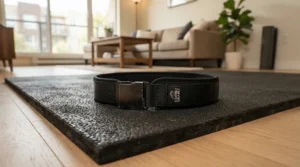
Start with the floor. A dense rubber mat under the machine is the single highest-impact accessory. Guides suggest mats can cut noise by roughly 20-40%, though results vary by building construction. Place the treadmill over the strongest part of the floor, near load-bearing walls rather than mid-span between them, because mid-span floors flex and amplify thumps.
Level it. A wobbling frame turns every stride into a knock. Adjust the feet until nothing rocks.
Center the belt before your first session. A drifting belt rubs the deck edge and squeals.
Time your workouts. Even a 50 dB machine is more noticeable at 6 a.m. than at 4 p.m. Treat quiet hours as part of the setup.
First-30-day mistakes to avoid:
- Skipping the first lubrication check (more on that next)
- Running at full speed before testing walking-speed noise
- Ignoring squeaks, which only get louder
Ask a neighbor to listen once. A thirty-second favor beats a month of guessing.
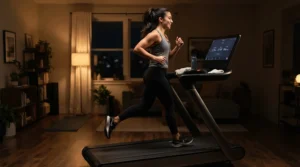
Belt Lubrication: The Cheapest Noise Fix You’ll Ever Make
Of everything in this guide, belt lubrication is the unsung hero. The belt runs directly on the deck, and without a thin film of silicone between them, friction rises, the motor works harder, and the squeak begins.
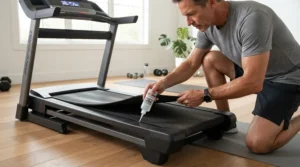
Which lubricant? Use 100% silicone made for treadmills. Several maintenance guides warn that generic hardware-store sprays can contain petroleum distillates that degrade belts and attract dust. Many manufacturers also say the wrong lube can affect warranties.
How often? Rules vary by brand. Some guidance suggests roughly every three months under normal use, others every few months or every 130 miles, and heavier use means more often. A reliable shortcut: reach under the belt. If it doesn’t feel slightly oily or waxy, it’s due.
How to apply: unplug the unit, wipe the underside clean, apply silicone along the deck on both sides, then run the belt slowly for a few minutes to spread it.
Don’t overdo it. Too much lube makes the belt slip, and people then over-tighten it, which makes everything worse. Also note that some machines claim to need no lubrication at all, so check your manual before you buy any product.
Real-World Scenarios: Which Quiet Treadmill Fits Your Life?
Specs mean nothing until they meet a lifestyle. Three profiles, matched by reasoning rather than anecdote:
The remote worker (second floor, hardwood, tight budget). She walks 90 minutes a day on calls. Pick the UREVO Strol 2E or DeerRun Q2 Urban Plus: low motor noise, gentle footfall, and easy storage. Add a thick mat and she’s done.
The commuter-turned-runner (third floor, concrete-slab building). He runs four mornings a week at 6-7 mph. The Echelon Stride-6S or Horizon 7.0 AT make sense, because heavier cushioned decks tame footfall, and slab construction transmits less thump than wood framing. Run before 7 a.m. only if your lease allows.
The heavier user with long-term plans (any floor). He needs a high capacity and a durable frame. The SOLE F80 (around 350 lb listed) fits, with a mat and scheduled belt lubrication.
If you live in a wood-framed building above bedrooms, prioritize cushioning and mat quality over raw dB. A 45 dB walking pad on a thin floor can still be heard as a rhythmic tick.
✨ Don’t Miss These Exclusive Deals!
🔍 Take your home workouts to the next level with these carefully selected treadmills. Click on any highlighted item to check current pricing and availability. These machines will help you build a quieter, more consistent routine your whole building will thank you for!
How to Choose a Quiet Treadmill for Upstairs Apartment Use
- Set a decibel target. Aim for roughly 45-55 dB at walking speed. Under 60 dB is the commonly cited apartment-friendly ceiling. Ask whether the figure was measured with a person on the belt.
- Choose the motor type. A brushless motor is generally quieter and smoother than a brushed one, so make it your default filter.
- Match speed to need. Walkers can choose a walking pad. Runners need a full-size deck and should expect louder footfall.
- Weigh cushioning. Deck design affects vibration more than motor noise does. Look for multi-zone or impact-absorbing decks.
- Check the folded footprint. A machine you can’t store becomes a noisy piece of furniture you resent.
- Verify weight capacity. Many compact units cap near 265 lb, so heavier users should look for 300+ lb ratings.
- Budget for extras. A mat, silicone lube, and possibly a subscription are part of the real price.
Decibel Rating Explained: What the Numbers Actually Mean for Your Ceiling
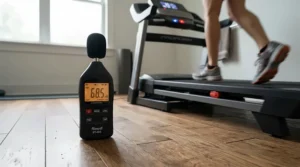
Every treadmill listing leans on a decibel rating, so it pays to know what you’re reading. Decibels are logarithmic: a 10 dB increase is perceived as roughly twice as loud, so 55 dB isn’t a little louder than 45 dB; it’s noticeably louder.
For reference, the American Academy of Audiology’s noise chart places a quiet library near 40 dB, moderate rainfall near 50 dB, and normal conversation and dishwashers near 60 dB. That scale makes treadmill claims easier to picture. A 45 dB machine sits between a library and light rain; a 65 dB one is closer to a conversation in the next room.
Three caveats matter. First, test conditions differ: belt-only readings run lower than readings with a user. Second, distance from the meter changes the result. Third, airborne decibels ignore structure-borne vibration, the thumping your neighbor feels.
So use the decibel rating as a filter, not a verdict. Then confirm cushioning and add a mat.
Brushless DC Motor vs Brushed: Why It Matters Upstairs
A brushless DC motor replaces the physical carbon brushes of older designs with electronic switching. As the Wikipedia overview of brushless DC motors explains, removing brush contact reduces friction, sparking, and wear, which is why these motors tend to run cooler and last longer.
For you, three practical effects follow. The motor produces less electromagnetic hum and brush noise. It runs smoothly at low speeds, which is what apartment walking looks like. And it needs less maintenance, because there are no brushes to wear down.
Guides consistently describe brushless motors as quieter than brushed equivalents, and nearly every model on this list uses one. But don’t stop there. A brushless motor can’t fix a hard deck or a loose belt. Think of it as the quiet orchestra pit beneath a loud stage: it helps, but the stage still matters.
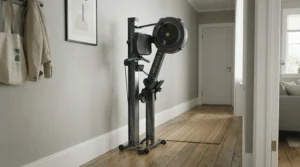
Silent Brushless Motor Treadmill for Apartments: Walking Pads vs Full-Size Folders
Shoppers searching for a silent brushless motor treadmill for apartments usually land in one of two camps, and the choice shapes everything else.
| Factor | Walking Pad | Full-Size Folding Treadmill |
|---|---|---|
| Typical noise | ~45-55 dB claims | ~50-60 dB measured |
| Speed range | Walking to light jog | Walking to 12 mph |
| Storage | Under bed or sofa | Upright or rolling fold |
| Footfall vibration | Light | Better cushioning, heavier impact |
| Best For | Remote workers and walkers | Runners and heavier users |
Walking pads win the quietest-motor contest and the storage contest. Full-size folders win on cushioning and speed, but the footfall at jogging pace still travels. If you walk, the pad is the clear choice; if you run, accept a bigger machine and invest more in mat and floor placement.
Under 50 Decibel Treadmill for Condo Living: Realistic or Marketing?
An under 50 decibel treadmill for condo life is achievable at walking speed, but only in certain categories. Walking pads regularly claim 45 dB or below. Full-size machines rarely stay under 50 dB once a person starts moving, with published readings typically in the low-to-mid 50s for walking and higher for running.
Condo living adds another wrinkle: shared walls, strict HOA noise rules, and often concrete floors that transmit less airborne sound but carry impact thumps. Check your building’s quiet-hours policy before choosing a machine, and consider asking the board whether there are decibel or hour restrictions.
The honest takeaway: if you need sub-50 dB across the whole workout, go with a walking pad and a mat. If you need running speeds, aim for the 50s at walking pace and schedule runs during daytime hours.
Common Mistakes When Buying a Quiet Treadmill for Upstairs Apartment Spaces
Trusting one decibel number. The WalkingPad X21 and Horizon 7.0 AT show how reports vary widely. Cross-check at least two sources.
Ignoring footfall. Airborne noise is easy to measure; vibration is what neighbors complain about. Cushioning and mats matter.
Overbuying power. Higher horsepower doesn’t mean louder, but it doesn’t mean quieter either. Match motor power to your real speeds.
Skipping the mat. It’s the cheapest upgrade with the biggest effect.
Forgetting hearing-safety context. Even loud workout music matters: CDC and NIOSH materials, such as this overview of work-related noise levels, note that sounds above 85 decibels can cause hearing loss, so don’t mask treadmill noise by cranking your headphones.
Neglecting lubrication. A dry belt gets louder over time, and the fix costs less than a pizza.
Price Range & Value Analysis: What You Actually Pay For Quiet
| Tier | Models | Price Range | Best For |
|---|---|---|---|
| Budget | DeerRun Q2 Urban Plus, UREVO Strol 2E | ~$200-$450 | Walkers and remote workers |
| Mid-range | Horizon 7.0 AT, SOLE F80 | ~$1,000-$1,700 | Committed runners |
| Premium | Echelon Stride-6S, NordicTrack Commercial 1750 | ~$2,000-$2,500 | Guided, tech-forward training |
The price ladder tracks speed and durability more than silence. The quietest motors sit at the bottom of the price range, while the premium tier buys cushioning, speed, and ecosystem features. If your priority is a quiet treadmill for upstairs apartment life and you only walk, the budget tier delivers most of the benefit.
Total cost of ownership matters too. Add a mat, a silicone lubricant, and any subscription, and a “$2,000” machine can quietly become a bigger commitment. A budget walking pad with a good mat can match a premium machine’s quiet at walking speed for a fraction of the price.
Frequently Asked Questions
❓ What is the quietest treadmill for upstairs apartment use?
❓ Is a decibel rating enough to judge a quiet treadmill?
❓ How often should I do belt lubrication on a quiet treadmill?
❓ Does a brushless DC motor really make a treadmill quieter?
❓ Can a treadmill for upstairs apartment use go under 50 dB at running speed?
Conclusion
The best quiet treadmill for upstairs apartment life isn’t the one with the smallest number on the box. It’s the one whose motor, deck, and your floor setup work together. Walkers should look at the UREVO Strol 2E or DeerRun Q2 Urban Plus. Design-minded renters with tight space might like the WalkingPad X21. Runners get the best balance from the Horizon 7.0 AT, Echelon Stride-6S, or SOLE F80, while NordicTrack Commercial 1750 fits those who want guided classes and can accept a subscription.
Remember the three habits that keep any of them neighbor-friendly: a dense mat, a level frame, and regular belt lubrication. They cost little and make a big difference.
Above all, treat decibel claims as directional, check the folded footprint, and be honest about whether you’ll walk or run. Pick for the workout you’ll actually do, and your downstairs neighbor may never know you own a treadmill.
✨ Ready to move more without moving the neighbors? Check current pricing on your favorite pick above, add a good mat, and start tonight! 🏃♂️💬
Recommended for You
- Small Treadmill For Seniors With Limited Space: 7 Safest Picks 2026
- Ultra Compact Treadmill For Small Bedroom: 7 Best Picks 2026
- Mini Treadmill That Fits Under A Standing Desk: 7 Best Picks (2026)
Disclaimer: This article contains affiliate links. As an Amazon Associate, I earn from qualifying purchases. If you purchase products through these links, we may earn a small commission at no additional cost to you.
✨ Found this helpful? Share it with your friends! 💬🤗
