
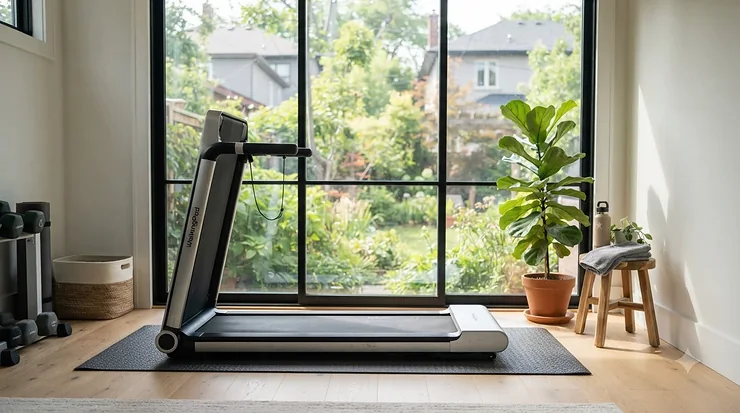
In This Article
Your knees have opinions about your cardio routine, and lately they’ve been vocal about it. If you’ve spent any time hunting for a low impact treadmill for knee pain, you already know the internet is stuffed with vague promises — “ultra cushioned,” “joint friendly,” “doctor recommended” — that rarely explain what’s actually happening underneath your feet. So let’s fix that. This guide breaks down seven real, currently available machines, the actual engineering behind their decks, and the honest trade-offs between them, so you’re not gambling a four-figure purchase on marketing copy alone.
A low impact treadmill for knee pain is a machine built around a cushioned or “soft-deck” running surface — usually layered elastomers, gel pads, or orthopedic belting — designed to absorb impact forces before they travel up through your ankles, knees, and hips. It won’t cure arthritis or rebuild cartilage, but the CDC notes that regular physical activity can help people with arthritis reduce joint pain and improve function, and a genuinely well-cushioned deck makes that activity a lot more tolerable. We’ll walk through seven products spanning budget walking pads to premium commercial-style decks, plus the buying logic, common mistakes, and real-world performance notes that Amazon listings conveniently leave out.
Quick Comparison Table
| Treadmill | Cushioning Type | Price Range | Best For |
|---|---|---|---|
| NordicTrack Commercial 1750 | Three-zone cushioning + decline | $1,900-$2,300 range | Overall knee-friendly all-rounder |
| Horizon 7.4 AT | 3-Zone Variable Response Cushioning | $1,500-$1,800 range | No-subscription mid-range buyers |
| Sole F63 | Cushion Flex Whisper Deck | $1,100-$1,400 range | Best value soft-deck option |
| NordicTrack T Series 16 | Adjustable SelectFlex deck | $1,400-$1,600 range | Buyers who want tunable firmness |
| 3G Cardio Pro Runner X | Ortho Flex Shock orthopedic belt | $2,100-$2,700 range | Lowest step-up, stiff or post-injury knees |
| WalkingPad P1 | 4-layer EVA foam cushioning | Under $500 range | Small apartments, walking-only routines |
| UREVO 2-in-1 Under Desk Treadmill | 5-layer shock-absorbing belt | Under $350 range | Tightest budgets |
Looking across the table, a clear pattern emerges: the more sophisticated the cushioning engineering (zoned elastomers, adjustable firmness, orthopedic belting), the higher the price climbs, but that doesn’t mean budget options are worthless. The WalkingPad P1 and UREVO 2-in-1 Under Desk Treadmill trade running capability for genuinely useful shock absorption at walking speeds, which is often exactly what knee pain sufferers need anyway. Meanwhile, the 3G Cardio Pro Runner X stands out for a detail spreadsheets miss entirely — a 6.5-inch step-up height that matters enormously if getting your leg up and over the frame is itself painful.
💬 Already have a favorite on this list? A quick share helps someone else with cranky knees find the right machine too!
Top 7 Low Impact Treadmills for Knee Pain: Expert Analysis
Below is the full spec breakdown for all seven machines side by side before we dig into each one individually.
| Model | Motor | Deck Size | Incline Range | Max Weight |
|---|---|---|---|---|
| NordicTrack Commercial 1750 | 3.75 CHP | 22″ x 60″ | -3% to 15% | 300 lbs |
| Horizon 7.4 AT | 3.5 CHP | 22″ x 60″ | 0.7% to 14.7% | 350 lbs |
| Sole F63 | 3.0 CHP | 20″ x 60″ | 0-15% | 325 lbs |
| NordicTrack T Series 16 | 3.6 CHP | 20″ x 60″ | 0-12% | 300 lbs |
| 3G Cardio Pro Runner X | 3.0 CHP | 20.5″ x 58″ | 0-15% | 350 lbs |
| WalkingPad P1 | Compact DC | ~16″ x 45″ | Fixed flat | 220 lbs |
| UREVO 2-in-1 Under Desk Treadmill | 2.25 CHP | ~17″ x 47″ | Fixed flat | 265 lbs |
A wider, longer deck generally means more room to land naturally without clipping the edges — which matters for knee alignment, since a cramped stride forces awkward foot placement that can twist the joint mid-stance. Notice that the two budget walking pads sacrifice incline entirely; that’s a reasonable trade if you’re walking for joint-safe cardio rather than training for hills, but it’s worth knowing before you buy. If decline training interests you (research suggests walking backward or downhill at a gentle grade can help some knee pain patients), the NordicTrack Commercial 1750 is the only unit here that goes negative.
1. NordicTrack Commercial 1750 — best all-around knee-friendly deck
The redesigned deck sits noticeably lower than earlier NordicTrack generations, which shaves a few inches off the step-up height and makes mounting and dismounting less of an ordeal on a bad day. Under the belt, the 3.75 CHP motor and three-zone cushioning distribute give differently across the landing, transition, and push-off phases of your stride, so your heel gets more compression than your toe does — mimicking what a good running shoe already tries to do. The 22-inch by 60-inch running surface is genuinely spacious, and the -3% to 15% incline range is unusual because it includes decline, letting you simulate downhill walking, which some physical therapists use specifically for knee rehab work.
Based on the spec comparison, this is the machine for someone who wants one treadmill to do everything — walking recovery days, jogging intervals, and incline hill work — without switching equipment. Reviewers consistently note the deck feels supportive rather than mushy, and several owners specifically mention using it post-injury or post-surgery under a doctor’s guidance. On the downside, the standout iFIT programming requires an ongoing subscription to unlock trainer-led workouts, so factor that into your real cost.
Pros:
- ✅ Three-zone cushioning tuned to each phase of your stride
- ✅ Rare decline capability for downhill knee rehab walking
- ✅ Spacious 22″x60″ commercial-style deck
Cons:
- ❌ Full iFIT programming requires a paid subscription
- ❌ Bulkier footprint than folding budget decks
At around $1,900-$2,300, the NordicTrack Commercial 1750 sits at the upper-mid tier, but for buyers who want maximum cushioning tech plus incline versatility in one box, it’s a legitimately strong value.
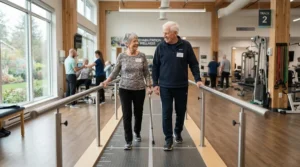
2. Horizon 7.4 AT — no-subscription workhorse with commercial cushioning
Horizon’s 3-Zone Variable Response Cushioning uses softer elastomers where your foot first strikes, a moderate zone through mid-stride, and firmer elastomers at push-off — essentially the same zoned-cushioning philosophy as pricier commercial decks, just without the connected-fitness ecosystem wrapped around it. The 3.5 CHP motor drives a full 22-inch by 60-inch deck, which Horizon calls “the commercial standard,” and in practice that width gives you real margin for error if your gait wanders slightly, which it often does when a knee is compensating for pain.
What most buyers overlook about this model is that it doesn’t lock you into any subscription at all — it pairs via Bluetooth FTMS to whatever free or paid app you already use, or you can simply run the built-in console programs. Aggregated owner feedback is notably consistent: multiple reviewers specifically credit the deck cushioning with making high-mileage walking or the Sprint 8 interval program “much less taxing” on knees and ankles than a standard flat treadmill. A few long-term owners note the cushioning firms up noticeably during hard sprint intervals, which is worth knowing if speed work is your goal rather than gentle walking.
Pros:
- ✅ Zoned cushioning without any required subscription
- ✅ Full commercial-size 22″x60″ running deck
- ✅ 500 lb thrust incline motor for quick, smooth grade changes
Cons:
- ❌ Console feels basic next to touchscreen competitors
- ❌ Cushioning firms up under hard sprint efforts, per owner reports
Expect to pay in the $1,500-$1,800 range, which puts the Horizon 7.4 AT solidly mid-pack — a strong value verdict for anyone who wants serious cushioning engineering without an app tether.
3. Sole F63 — best value soft-deck treadmill for knee pain
Sole’s Cushion Flex Whisper Deck is the headline feature here, and the company’s own testing claims it can cut joint impact by roughly 40 percent compared to running on pavement — a claim that, while company-sourced, lines up with independent reviewer impressions of a deck that’s firmer at the heel-strike zone and progressively softer under the forefoot. The 3.0 CHP motor and 20-inch by 60-inch belt aren’t the biggest numbers on this list, but they’re plenty for walking and moderate jogging, and the oversized 2.5-inch rollers plus 2-ply belt keep vibration noticeably low.
Here’s what the spec sheet won’t tell you: this is one of the most consistently recommended “knee-friendly” treadmills across independent review sites precisely because Sole has kept the formula stable for nearly a decade instead of chasing screen size. One owner review specifically described switching from a decade-old ProForm and finding the F63 “so much easier on my muscles and joints” during daily 2-mile walks — exactly the kind of aggregated sentiment worth paying attention to, even though individual results always vary by user and gait.
Pros:
- ✅ Cushion Flex Whisper Deck built specifically to cut joint impact
- ✅ Lifetime frame and motor warranty backs up long-term durability
- ✅ Quiet brushless motor suited to apartment living
Cons:
- ❌ 6.5″ LCD console is basic compared to touchscreen rivals
- ❌ A minority of testers find the deck firmer than expected for recovery-pace walking
Priced around $1,100-$1,400, the Sole F63 is arguably the best dollar-for-dollar cushioning value on this entire list.
4. NordicTrack T Series 16 — adjustable deck firmness on demand
Most cushioned decks give you one fixed level of give, but the NordicTrack T Series 16 builds in SelectFlex, letting you manually toggle between a softer, more forgiving deck feel and a firmer, more responsive one depending on how your knees feel that day. Paired with a 3.6 HP motor, a 60-inch by 20-inch belt, and a 16-inch touchscreen running iFIT-guided workouts, it’s positioned as a mid-range machine that doesn’t skimp on running specs to hit its price point.
On paper, this means you get flexibility that fixed-cushioning competitors simply can’t offer — softer for a recovery walk after a flare-up, firmer for a faster-paced session when your knees are cooperating. Based on the spec comparison against the Horizon 7.4 AT, the T Series 16 wins on adjustability and touchscreen size but concedes some incline range (0-12% versus Horizon’s nearly 15%). That’s a fair trade for buyers who prioritize daily comfort tuning over hill-training range.
Pros:
- ✅ SelectFlex lets you toggle deck firmness to match how you feel
- ✅ Strong 3.6 HP motor with a roomy 60″x20″ deck
- ✅ 16″ touchscreen with guided iFIT programming included
Cons:
- ❌ Full iFIT library requires an ongoing subscription
- ❌ Incline tops out lower than several competitors on this list
Typically listed in the $1,400-$1,600 range, the NordicTrack T Series 16 earns its spot for anyone whose knee pain fluctuates day to day and wants a deck that can fluctuate with it.
5. 3G Cardio Pro Runner X — lowest step-up, orthopedic-grade belt
If you’ve ever winced just lifting your leg over a treadmill frame, this is the machine built for that exact moment. The 3G Cardio Pro Runner X has a 6.5-inch step-up height at ground level — among the lowest of any folding treadmill on the market — which the manufacturer specifically markets to “users with mobility limitations or those recovering from injuries.” Underneath, the Ortho Flex Shock suspension system pairs with a thick 20.5-inch by 58-inch orthopedic belt and 2-inch rollers designed to blunt the initial foot-strike vibration before it reaches your joints.
What most buyers overlook about this niche brand is that 3G Cardio built its entire reputation around orthopedic belting years before “joint friendly” became a marketing buzzword every major brand slaps on a spec sheet. The BYOS (bring-your-own-screen) approach means no built-in touchscreen, but it also means no forced subscription — you FTMS-pair your own tablet to whatever app you like. Reviewers highlight the low step-up and shock-absorbing belt as standout features specifically for older adults and rehab-stage users, though the console itself feels sparse next to flashier commercial brands.
Pros:
- ✅ Industry-low 6.5″ step-up height for easier mounting
- ✅ Ortho Flex Shock suspension plus thick orthopedic belt
- ✅ Lifetime residential drive motor warranty
Cons:
- ❌ No built-in touchscreen — bring your own device
- ❌ Priced above most mainstream folding treadmills in its class
Expect a $2,100-$2,700 range depending on retailer promotions, making the 3G Cardio Pro Runner X a premium pick reserved for buyers whose primary pain point is literally getting on and off the machine.
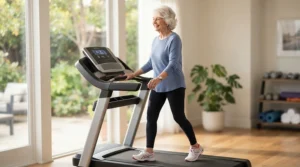
6. WalkingPad P1 — most compact for small apartments
Not everyone dealing with knee pain wants — or has room for — a full-size treadmill, and that’s where the WalkingPad P1 earns its spot. Its 4-layer EVA cushioning system sits inside a slim, foldable deck that collapses flat for under-bed or under-couch storage, and its signature party trick is automatic speed sensing: step toward the front of the deck and it speeds up, step back and it slows down, all without touching a control panel. That matters more than it sounds for knee pain specifically, since fumbling for buttons mid-stride can throw off your gait and create the exact kind of awkward footfall that aggravates a sore joint.
Reviewers consistently note that owners who’ve used the P1 daily across multiple seasons report it “still works fine” years in, which speaks to durability despite its budget-friendly price point. The honest trade-off: this is a walking-only machine capped around 3.7-4 mph, so it won’t support jogging or running workouts, and its weight capacity trails full-size treadmills. For someone whose knee pain means walking is the only comfortable cardio option anyway, that ceiling rarely matters in practice.
Pros:
- ✅ Auto speed-sensing means no fumbling for controls mid-stride
- ✅ Folds flat for genuinely tight apartment storage
- ✅ Proven multi-year durability in owner reports
Cons:
- ❌ Walking-only — capped around 3.7-4 mph, no running
- ❌ Lower weight capacity than full-size treadmill decks
Usually listed under $500, the WalkingPad P1 is the pick for anyone prioritizing space savings and gentle daily movement over training intensity.
7. UREVO 2-in-1 Under Desk Treadmill — most budget-friendly shock absorption
At the entry-level end of this list sits the UREVO 2-in-1 Under Desk Treadmill, which pairs a 2.25 CHP motor with a five-layer anti-slip, shock-absorbing belt and additional silicone shock absorbers built into the frame itself — a layered-defense approach to cushioning that’s unusually thorough for something priced under $350. The “2-in-1” branding refers to its dual-mode design: a low-profile walking-pad mode for use under a standing desk, and a handrail-equipped jogging mode for slightly faster-paced sessions.
Here’s what the spec sheet doesn’t advertise loudly: at up to roughly 6.2 mph, the UREVO holds one of the widest speed ranges among budget under-desk treadmills, meaning it flexes from a gentle rehab-pace shuffle up to a light jog without feeling maxed out. Aggregated reviewer sentiment consistently praises the shock absorption specifically for protecting joints during casual lunch-break walks and longer at-home sessions, though the overall build materials understandably feel less premium than name-brand, four-figure machines — a reasonable trade at this price point.
Pros:
- ✅ Five-layer shock-absorbing belt plus dedicated silicone shock absorbers
- ✅ Dual walking-pad and handrail jogging modes in one unit
- ✅ Unusually wide speed range for a budget under-desk treadmill
Cons:
- ❌ Handrail attachment adds footprint versus pure walking pads
- ❌ Build quality feels noticeably less premium than name-brand options
At under $350, the UREVO 2-in-1 Under Desk Treadmill is the entry point for anyone who wants genuine shock absorption without a four-figure commitment.
Setting Up Your Soft-Deck Treadmill for Knee-Safe Workouts
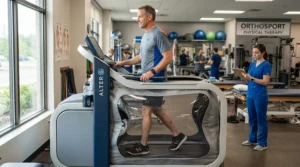
Getting the cushioning benefits you paid for starts before you ever take a step. Place your treadmill on a hard, level floor — carpet padding underneath can actually destabilize the deck and undercut the engineered cushioning zones. During your first 30 days, resist the urge to jump straight to your old running pace; even the softest deck can’t compensate for a body that hasn’t adapted to a new surface yet, and most knee flare-ups in week one come from doing too much, too fast, rather than from the equipment itself.
Lubricate the belt per the manufacturer’s schedule (usually every 3-6 months depending on mileage), because a dry, dragging belt forces the motor to work harder and transmits more vibration up through the deck exactly where you don’t want it. Keep incline low — mild grades between 2% and 5% are generally considered safe for bad knees and can help strengthen the supporting muscles, while grades above 8% increase stress on the joint for anyone dealing with patellofemoral or kneecap issues. A common first-month mistake is skipping the warm-up walk entirely; give yourself 3-5 minutes at an easy pace before ramping up, every single session, no exceptions.
Who Actually Benefits from a Gentle Cardio Treadmill for Knees
The Post-Injury Walker. Say you’re six weeks out from a meniscus procedure, cleared for low-impact activity but still guarded about every step. A machine with the lowest possible step-up height and a genuinely orthopedic belt — like the 3G Cardio Pro Runner X — removes the two biggest daily obstacles: painful mounting and harsh foot-strike.
The Budget-Conscious Apartment Dweller. A 26-year-old with early-onset patellofemoral pain, living in a 600-square-foot apartment, doesn’t need a 300-pound commercial deck. The WalkingPad P1 or UREVO 2-in-1 Under Desk Treadmill delivers real cushioning in a footprint that disappears under the bed between sessions.
The Fluctuating Chronic Pain Patient. Someone managing osteoarthritis whose knees feel different every single day benefits most from adjustable firmness. The NordicTrack T Series 16‘s SelectFlex deck lets that person soften the ride on flare-up days and firm it up when they’re feeling strong — a level of daily control fixed-cushioning decks simply don’t offer.
Problem → Solution: Fixing Common Knee-Pain Treadmill Issues
Problem: Sharp pain during incline walking. Solution — drop below 5% grade and rebuild tolerance gradually; steep inclines load the kneecap directly, and pain here usually means the joint needs more time before hills return to your routine.
Problem: Knee pain that worsens after 15-20 minutes. Solution — check your stride length first; overstriding forces a harder heel strike even on a cushioned deck like the Sole F63‘s. Shortening your stride slightly often resolves this faster than any equipment change.
Problem: Deck feels too firm despite “cushioned” marketing. Solution — verify you’re using proper footwear with adequate midsole cushioning; a soft deck paired with worn-out shoes still transmits significant impact, and no treadmill engineering fully compensates for dead shoe foam.
Problem: Pain when stepping on or off the machine. Solution — prioritize step-up height specifically; models like the 3G Cardio Pro Runner X with a sub-7-inch step-up remove this friction point entirely for stiff or post-surgical knees.
How to Choose a Low Impact Treadmill for Knee Pain
- Check the step-up height first. A tall deck forces a bigger, more jarring leg lift just to get on the machine — often more painful than the workout itself for stiff knees.
- Prioritize deck size over screen size. A cramped 18-inch-wide belt forces an unnatural, joint-twisting gait far more than a missing touchscreen ever will.
- Understand what “cushioning” actually means for that model. Zoned elastomer systems, adjustable decks, and orthopedic belting all behave differently — read past the marketing word to the mechanism.
- Match incline range to your rehab goals. If a decline feature matters to you, only the NordicTrack Commercial 1750 on this list offers it; most competitors go flat to positive incline only.
- Factor in ongoing subscription costs. iFIT-dependent machines look cheaper upfront but add a recurring bill; no-subscription models like the Horizon 7.4 AT avoid that entirely.
- Weigh footprint against your living space realistically. A full-size deck you resent unfolding gets used less than a compact walking pad you’ll actually step onto daily.
- Read aggregated review sentiment, not star averages alone. Look specifically for repeated mentions of knee or joint comfort across many reviewers, not a single five-star outlier.
Common Mistakes When Buying a Soft-Deck Treadmill for Knee Pain
The single most common mistake is buying based on motor horsepower alone. A powerful motor says nothing about how the deck absorbs impact — you can have a 4.0 HP motor sitting on top of a rock-hard belt. Reviewers consistently note that shoppers get seduced by touchscreen size and streaming integrations while barely researching the actual cushioning mechanism underneath, which is backwards priority for anyone buying specifically for joint pain.
A second frequent misstep: ignoring maximum incline range because “I only walk flat anyway,” then discovering months later that a physical therapist recommends gentle incline work for quad strengthening — and the budget walking pad they bought can’t do it. Finally, plenty of buyers skip step-up height entirely, only to find that mounting a tall deck is genuinely painful on bad days, undermining the whole point of the purchase before the belt even starts moving.
Low Impact Treadmills vs Traditional Treadmills and Other Low-Impact Cardio Alternatives
| Option | Impact Level | Joint Stress | Best For |
|---|---|---|---|
| Traditional flat-deck treadmill | Moderate-High | Direct, uncushioned | Healthy joints, general fitness |
| Cushioned/soft-deck treadmill | Low-Moderate | Absorbed by zoned elastomers or foam | Knee pain, arthritis, rehab |
| Elliptical machine | Very Low | Near-zero impact, fixed motion path | Severe joint pain, post-surgery |
| Swimming/water aerobics | Very Low | Buoyancy removes most load | Maximum joint protection |
| Stationary bike | Very Low | Seated, no weight-bearing impact | Knee pain with balance concerns |
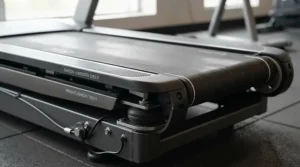
A cushioned treadmill sits in a genuinely useful middle ground: it preserves the weight-bearing, bone-density benefits of walking that non-impact alternatives like swimming or cycling simply can’t replicate, while meaningfully reducing the joint stress of a standard flat deck. Ellipticals and pools go even gentler, but they trade away some of the functional, real-world movement pattern that walking naturally reinforces. For most people managing knee pain rather than recovering from acute injury, a genuinely well-cushioned treadmill — not a bike or pool — tends to be the most sustainable daily habit, precisely because it mimics the activity people already do outside their front door.
✨ Don’t Miss These Exclusive Deals!
🔍 Take your search for a knee-friendly cardio routine to the next level with the cushioned picks above — click through to check current pricing and find the fit that gets you moving comfortably again!
What to Expect: Real-World Performance on a Gentle Cardio Treadmill for Knees
Specs on a page don’t tell you what a first session actually feels like, so here’s the translation. On a properly cushioned deck like the Horizon 7.4 AT or NordicTrack Commercial 1750, you should notice a subtle, springy give underfoot during walking — not a bouncy trampoline sensation, but a softening at the exact moment your heel lands. That’s the elastomer doing its job. What most buyers overlook is that this effect is far more noticeable at walking pace than during a hard run, since faster strides compress the cushioning material more fully and it firms up under greater force — which several 7.4 AT owners specifically flagged during sprint intervals.
On budget walking pads like the WalkingPad P1, the sensation is different: a flatter, foam-based softness rather than zoned engineering, which is entirely appropriate given the walking-only speed range. Reviewers consistently note that the real-world difference between a $300 cushioned deck and a $2,000 one is most obvious not at slow walking speeds — where both feel reasonably comfortable — but during longer sessions and faster paces, where premium zoned cushioning maintains support that budget foam gradually loses.
Cartilage Health: What the Research Actually Says About Treadmill Walking
There’s a persistent myth that any repetitive impact “wears down” cartilage the way tire tread wears down on pavement. The research tells a more nuanced story. A narrative review published in the Journal of Rheumatology found that consistent physical activity helps reduce pain and improve quality of life for people with knee and hip osteoarthritis, and may even slow the progression of joint damage — the opposite of the “just rest it” instinct many people follow. Moderate, regular loading actually appears to support cartilage health rather than degrade it, largely because cartilage relies on movement-driven fluid exchange to receive nutrients, since it has no direct blood supply of its own.
That said, the type of impact matters. A cushioned deck reduces peak ground-reaction forces at each footstrike compared to concrete or a hard flat belt, which is exactly the mechanism that makes a low impact treadmill for knee pain a reasonable long-term tool rather than a temporary workaround. What the spec sheet won’t tell you is that consistency matters more than any single cushioning technology — people living with knee osteoarthritis average only around 50 minutes of moderate-to-vigorous activity per week against national guidelines calling for well over 150, so the biggest cartilage-health win for most people isn’t finding the perfect deck — it’s finding a machine comfortable enough that they’ll actually use it regularly.
Features That Actually Matter (And Those That Don’t)
Matters: deck size, step-up height, cushioning mechanism, incline/decline range, and motor continuous horsepower rating (not peak horsepower, which is a marketing number that overstates real-world performance). Doesn’t matter nearly as much: touchscreen size, built-in speaker quality, and app ecosystem exclusivity — nice-to-haves that add cost without touching your knees at all.
Here’s what most buyers overlook: warranty length on the motor and frame specifically (not just “parts”) is a genuinely useful proxy for how seriously a brand engineered the product, since manufacturers rarely offer a lifetime motor warranty on components they expect to fail early. Between two similarly cushioned decks, the one with the longer motor warranty is usually the better-built machine, full stop.

Frequently Asked Questions
❓ Is a treadmill good for knee pain?
❓ What is the best incline for knee pain on a treadmill?
❓ Can walking on a treadmill damage cartilage?
❓ How much does a good cushioned treadmill cost?
❓ Are under-desk walking pads good for bad knees?
Conclusion
There’s no single “best” low impact treadmill for knee pain — there’s the best one for your knees, your budget, and your living room. If you want maximum cushioning technology and decline capability, the NordicTrack Commercial 1750 earns its price tag. If step-up height is your dealbreaker, nothing on this list beats the 3G Cardio Pro Runner X. And if you’re just trying to move more without dropping four figures, the WalkingPad P1 or UREVO 2-in-1 Under Desk Treadmill proves genuine shock absorption doesn’t require a commercial budget.
What matters more than any single spec is consistency — a soft-deck treadmill for knee pain only helps the knees that actually use it. Structured walking interventions, like the WalkOut study registered on ClinicalTrials.gov, are specifically being studied for their ability to improve pain and function in knee osteoarthritis — a research-backed reminder that showing up regularly, even at a gentle pace, does more for your joints long-term than any single piece of equipment ever could. Pick the machine that removes your specific friction point — whether that’s step height, price, or footprint — and then commit to using it.
Recommended for You
- 7 Best Treadmills for Bad Knees Under $700 in 2026
- 7 Best Treadmill for Teenagers Under $300 Picks (2026 Guide)
- Compact Treadmill for Children’s Bedroom: 7 Safe Picks (2026)
Disclaimer: This article contains affiliate links. As an Amazon Associate, I earn from qualifying purchases. If you purchase products through these links, we may earn a small commission at no additional cost to you.
✨ Found this helpful? Share it with your friends! 💬🤗
