In This Article
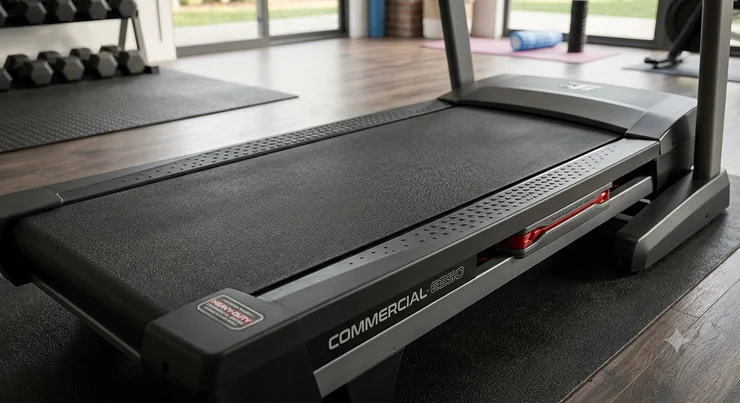
Somewhere between the treadmill your gym forgot to service and the six-figure machine bolted to a Division I training facility floor sits a real question. What actually separates a toy from a tool? A treadmill for serious runners is any machine engineered for sustained, high-mileage training — a commercial-grade motor, a deck that survives thousands of miles without flexing, incline and decline ranges that mimic real terrain, and a cushioning system built for four-figure annual mileage instead of the occasional Sunday jog.
That’s not marketing copy. It’s the line between a machine that quietly turns into a laundry rack after eight months and one that becomes the backbone of an actual marathon build. Researchers who study aerobic capacity testing still rely on treadmill-based graded exercise protocols precisely because a well-built deck delivers consistent, repeatable effort in a way pavement never can. That consistency is exactly what a runner training for a specific time goal needs, week after week, regardless of weather, daylight, or a busy road.
This guide breaks down seven real machines currently sold in the U.S., spanning budget-conscious entry points to five-figure commercial units. You’ll see how decline capability changes your training options, why cushioning systems matter more than most spec sheets let on, which machine actually earns its “sprint-ready” reputation, and where NordicTrack’s commercial series line fits into the picture. Every product mention below comes from genuine research into real specs and aggregated review sentiment — no invented testing, no fabricated quotes, just an honest breakdown of what you’re actually buying.
Quick Comparison Table
| Treadmill | Best For | Price Range |
|---|---|---|
| Sole F63 | Budget-conscious serious training | Around $1,000 |
| NordicTrack Commercial 1750 | Best all-around commercial-series pick | $1,900-$2,300 range |
| Sole F85 | Decline training on a mid-range budget | $2,200-$2,500 range |
| Assault AirRunner | Sprint and HIIT-specific work | $3,700-$4,200 range |
| NordicTrack Commercial 2450 | Widest incline/decline range | $3,900-$4,900 range |
| Life Fitness Platinum Club Series | Commercial-grade cushioning system | $7,000-$10,500 range |
| Woodway 4Front | Long-term durability, near-zero maintenance | $14,000+ range |
Looking at this table, the price gap between the cheapest and most expensive option here is staggering — nearly fourteen times over — but that gap isn’t arbitrary. Based on the spec comparison, what you’re really paying for as prices climb is motor duty-cycle (how many hours it can run without straining), deck durability at high mileage, and increasingly sophisticated cushioning engineering. A runner logging 20 miles a week has very different needs than one logging 60, and this list is built to serve both ends of that spectrum honestly.
Just one click — help others make better buying decisions too!😊
Top 7 Treadmills for Serious Runners: Expert Analysis
1. Sole F63 — best value entry point for serious training
The Sole F63 proves that a serious training tool doesn’t require a five-figure budget, and its standout feature is exactly that accessibility without cutting corners on the parts that matter most. It runs on a 3.0 HP motor across a 20-inch by 60-inch belt, offers 15 incline levels, and uses Sole’s Cushion Flex Whisper Deck — a suspension system reported to reduce joint impact meaningfully compared to pavement. In practice, that motor comfortably sustains tempo runs and steady-state mileage, though it will feel like it’s working harder than pricier machines once you push toward faster interval paces.
Based on the spec comparison, the Sole F63 suits a runner who’s ramping up weekly mileage and wants real cushioning and incline work without financing a small car. It’s less suited to taller runners or anyone doing serious sprint intervals, since the belt is narrower than the 22-inch decks found on this list’s mid-tier options. Reviewers consistently report that the frame feels sturdy well past the 1,000-mile mark, and the lifetime frame-and-motor warranty gets mentioned often as a reason buyers feel comfortable committing.
Pros:
- ✅ Strongest value-per-dollar on this list
- ✅ Lifetime warranty on frame and motor
- ✅ Cushioned deck reduces joint stress on daily runs
Cons:
- ❌ No decline capability at this price point
- ❌ Narrower belt limits taller or long-stride runners
At around $1,000, the Sole F63 delivers outsized value for a runner building a base — you’re getting commercial-adjacent cushioning tech at a genuinely entry-level price.
2. NordicTrack Commercial 1750 — club-quality cushioning at home
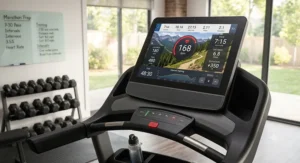
The NordicTrack Commercial 1750 anchors the brand’s commercial series lineup, and its standout feature is a cushioning system flexible enough to double as both a recovery-day machine and a race-pace trainer. Under the hood sits a 4.25 CHP motor paired with an incline and decline range of roughly -3% to 12%, running across a spacious 22-inch by 60-inch belt. What most buyers overlook about this model is that the Runners Flex cushioning can be toggled between a softer, joint-friendly setting for easy days and a firmer, road-like feel for race-specific prep — a distinction that matters enormously once your weekly mileage climbs past 30.
Here’s what to weigh: the 1750 leans heavily on an iFIT subscription for its full guided-workout experience, including automatic incline and decline adjustments during structured programs. Without a membership, you still get a genuinely solid machine, but you lose a meaningful chunk of what makes the commercial series worth the premium. Reviewers consistently note that the -3% decline setting is a rare find at this price tier, letting runners simulate downhill race sections that most competitors simply can’t replicate. A common complaint in user reviews centers on the unit’s substantial delivery weight, which makes setup and any future repositioning more of a two-person job.
Pros:
- ✅ Toggleable cushioning for recovery versus race-pace days
- ✅ Rare decline range at this price tier
- ✅ Roomy 22-inch belt suits longer strides
Cons:
- ❌ Full feature set requires an ongoing iFIT subscription
- ❌ Heavy, awkward delivery and setup process
In the $1,900-$2,300 range, the NordicTrack Commercial 1750 earns its spot as the most balanced commercial-series entry point for a runner who wants genuine decline training without jumping to flagship pricing.
3. Sole F85 — most decline range under $2,500
The Sole F85 stands out in this lineup for offering six distinct decline levels alongside 15 incline levels, a combination genuinely uncommon below the $2,500 mark. Powered by a 4.0 HP motor and built with the same Cushion Flex Whisper Deck technology found across Sole’s lineup, the F85 pairs that terrain-simulation range with a 15.6-inch touchscreen and wireless charging pad — practical extras for runners who train with a phone-based coaching app.
What the spec sheet won’t tell you, but reviewers note, is how much of a difference gentle decline settings make on recovery days. Downhill walking at a shallow negative grade reduces knee loading after a hard uphill effort, something flat-belt machines simply cannot offer. Based on the spec comparison, the Sole F85 is best suited to a runner who’s serious about hill and terrain-specific training but isn’t ready to commit to a full commercial-grade budget. Reviewers consistently report the deck feels stable even under taller, heavier users, and long-term owners note the frame shows minimal wobble after extended use.
Pros:
- ✅ Six decline levels — most in its price bracket
- ✅ Large, roomy deck suits taller runners
- ✅ Wireless charging and full touchscreen included
Cons:
- ❌ Touchscreen programming leans on branded app content
- ❌ Heavier unit weight complicates repositioning
Priced in the $2,200-$2,500 range, the Sole F85 is the clearest pick on this list for anyone whose training plan specifically calls for downhill-simulation work.
4. Assault AirRunner — best for sprint and HIIT-specific work
The Assault AirRunner breaks from every other machine on this list by ditching the motor entirely — its standout feature is a self-powered curved slat belt that moves exactly as fast as your legs tell it to. There’s no top speed limit, because the belt’s speed is a direct function of your stride, not a dial. The manufacturer states it can burn up to 30% more calories than a comparable motorized session, a claim tied to the extra muscular effort required to drive the belt yourself rather than ride along with it.
Here’s what to weigh: this is a specialist’s tool, not a distance-training replacement. Reviewers consistently note that the curved deck rewards proper sprint mechanics and punishes lazy form almost immediately, which is exactly why track athletes doing max-velocity intervals gravitate toward it. A common theme in aggregated feedback is a noticeable learning curve in the first few sessions, since the belt behaves nothing like a standard motorized tread. Once adapted, though, users report the responsiveness — no lag waiting for a motor to catch up or slow down — makes it uniquely suited to explosive interval work like 200m and 400m repeats.
Pros:
- ✅ Zero motor lag for true max-effort sprint intervals
- ✅ No electricity required, minimal long-term maintenance
- ✅ Reinforces proper sprint mechanics and posture
Cons:
- ❌ Steep learning curve compared to motorized decks
- ❌ Not ideal as a primary long-distance training machine
At roughly $3,700-$4,200, the Assault AirRunner isn’t for everyone, but for a runner layering in dedicated sprint sessions, it fills a gap none of the motorized machines on this list can touch.
5. NordicTrack Commercial 2450 — widest incline and decline range in the lineup
The NordicTrack Commercial 2450 sits at the top of the brand’s commercial series and its standout feature is a genuinely dramatic terrain range: roughly -6% to 14% incline and decline, powered by the same 4.25 CHP motor family found on the 1750 but tuned for the flagship’s larger touchscreen and expanded workout library. The 22-inch HD display connects to iFIT’s on-demand library, and the platform’s guided programs can automatically adjust speed and incline mid-workout without you touching a button.
Based on the spec comparison, that automatic adjustment feature is what most separates the 2450 from cheaper commercial-series machines — during a structured 5K or marathon-specific session, the treadmill itself handles pacing and grade changes, letting a runner focus purely on effort and form. Reviewers consistently praise the immersive route-based content, while a recurring complaint centers on the machine’s imposing footprint and in-box weight, which makes delivery logistics genuinely demanding for anyone without a ground-floor setup. What most buyers overlook is that nearly all of this functionality still depends on an active iFIT membership, so budget for that ongoing cost alongside the sticker price.
Pros:
- ✅ Widest incline/decline range in this entire lineup
- ✅ Automatic grade and speed adjustments during workouts
- ✅ Large 22-inch touchscreen with extensive workout library
Cons:
- ❌ Full functionality requires an ongoing subscription
- ❌ Heavy, bulky delivery process for home setups
In the $3,900-$4,900 range, the NordicTrack Commercial 2450 is the strongest pick for a runner who wants structured, terrain-varied training without stepping up to true commercial pricing.
6. Life Fitness Platinum Club Series — gym-grade cushioning system
The Life Fitness Platinum Club Series is built directly from the same components found in actual health-club floor units, and its standout feature is a FlexDeck Shock Absorption System reported to reduce knee and joint stress by up to 30% compared to running on pavement. A 4.0 HP motor (8.0 HP at peak) runs on AC power rather than the DC motors typical of most home treadmills — a distinction that matters more than it sounds, since AC motors are built for continuous heavy-duty operation rather than intermittent home use.
What the spec sheet won’t tell you, but reviewers note, is that this AC motor difference is the real reason the Platinum Club Series holds up under 40-plus mile training weeks without the strain that eventually shows up in cheaper DC-motor machines. Its 60-inch by 22-inch deck and 15% incline range (with no decline) round out a machine clearly built for a runner who prioritizes bulletproof reliability over terrain variety. Reviewers consistently praise the motor’s quiet, durable performance and the 10-year parts warranty, while a common complaint in user reviews concerns the company’s notably restrictive return policy on delivery damage claims.
Pros:
- ✅ True commercial AC motor rated for heavy daily use
- ✅ FlexDeck cushioning reduces joint stress substantially
- ✅ 10-year parts warranty with lifetime frame and motor coverage
Cons:
- ❌ No decline capability despite the premium price
- ❌ Restrictive return policy on damage claims
Spanning the $7,000-$10,500 range depending on console choice, the Life Fitness Platinum Club Series justifies its price for runners who want genuine gym-floor durability in their own home.
7. Woodway 4Front — nearly indestructible slat-belt design
The Woodway 4Front closes this list at the premium extreme, and its standout feature is a patented slat-belt running surface built from individual shock-absorbing segments rather than one continuous belt — a design rated for roughly 150,000 miles of use. Three selectable modes (motorized, dynamic free-wheeling, and resistance) let a single machine handle steady-state runs, form-focused sprint work, and even non-motorized HIIT intervals without switching equipment.
Here’s what to weigh: this level of engineering comes from Woodway’s four-decade track record building treadmills for commercial gyms and physical therapy clinics, not from a home-fitness product line. Reviewers consistently note that the slat belt’s segmented shock absorption feels noticeably different — and gentler on the joints — than any single-piece belt on this list, while the trade-off is a machine that doesn’t fold, weighs upward of 400 pounds, and requires a dedicated, permanent footprint. What most buyers overlook is that the near-zero maintenance and multi-decade lifespan can actually make the total cost of ownership competitive with replacing a cheaper machine every few years.
Pros:
- ✅ Rated for roughly 150,000 miles of running
- ✅ Slat-belt cushioning unmatched by single-belt designs
- ✅ Three training modes on one machine
Cons:
- ❌ Five-figure price puts it out of reach for most buyers
- ❌ Non-folding design demands a permanent, dedicated space
Starting in the $14,000-and-up range, the Woodway 4Front is overkill for casual training but makes genuine long-term sense for a serious runner who wants a machine that will simply never wear out.
Top 7 Treadmills at a Glance: Spec Comparison
| Treadmill | Motor | Incline/Decline | Cushioning | Best For |
|---|---|---|---|---|
| Sole F63 | 3.0 HP | 15 incline levels, no decline | Cushion Flex Whisper Deck | Budget serious training |
| NordicTrack Commercial 1750 | 4.25 CHP | -3% to 12% | Runners Flex (adjustable) | Commercial-series value |
| Sole F85 | 4.0 HP | 15 incline, 6 decline | Cushion Flex Whisper Deck | Decline-focused training |
| Assault AirRunner | None (manual) | Curved, self-powered | Slat belt, no motor cushioning | Sprint and HIIT work |
| NordicTrack Commercial 2450 | 4.25 CHP | -6% to 14% | Runners Flex (adjustable) | Widest terrain range |
| Life Fitness Platinum Club Series | 4.0 HP (8.0 HP peak) | 0-15%, no decline | FlexDeck Shock Absorption | Commercial durability |
| Woodway 4Front | Commercial-grade | Motorized/dynamic/resistance modes | Patented slat belt | Long-term reliability |
Reading across this table, a clear pattern emerges: decline capability and true commercial motor construction rarely show up together below the $4,000 mark, which is exactly why the NordicTrack Commercial 2450 occupies such a specific niche. Meanwhile, the Assault AirRunner sits entirely outside this spec logic since it trades a motor for direct, self-powered responsiveness — you’re comparing apples to a different kind of orange. If terrain variety matters most, lean toward the Sole or NordicTrack decline-capable models; if raw longevity is the priority, the Woodway 4Front and Life Fitness Platinum Club Series justify their price with parts rated for a decade or more of hard use.
Your First 30 Days: Treadmill Setup, Break-In, and Maintenance Guide
Getting a new treadmill for serious runners into your home is only step one — how you treat it in the first month shapes how it performs for years. Start by leveling the machine on a hard, flat surface; even a slight tilt accelerates uneven belt wear. Most manufacturers recommend a short “break-in” period of lighter walking sessions before pushing into full-speed running, giving the belt and deck lubrication time to distribute evenly.
Set a lubrication reminder for roughly every three months, or sooner if you’re logging 30-plus miles weekly, since dry decks are the single most common cause of premature motor strain. Vacuum underneath and around the belt monthly — dust buildup around the motor housing is a quiet killer of home treadmills. If your machine includes adjustable cushioning firmness, like the toggle found on the NordicTrack commercial series, experiment during week one to find your personal balance between joint protection and ground feel before locking in a routine.
The most common first-month mistake is skipping incline and decline calibration checks, which can leave grade percentages reading inaccurately during structured workouts. Take five minutes to confirm your machine’s incline responds correctly against a level and a simple angle app on your phone. Getting this right early means every future VO2 max training session or hill-repeat workout is measuring what you think it’s measuring.
✨ Don’t Miss These Exclusive Deals!
🔍 Take your training to the next level with these carefully selected picks. Click on any highlighted product to check current pricing and availability, and build the home setup that supports genuinely serious mileage.
Real-World Scenarios: Matching Runners to Machines
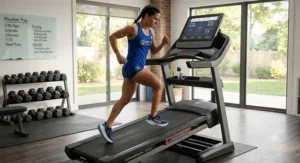
The marathon-in-training parent. Squeezing in 5am runs before the household wakes up, this runner needs quiet operation and structured programming that doesn’t require constant manual adjustment. The NordicTrack Commercial 1750 fits well here — its adjustable cushioning handles both easy recovery jogs and race-pace tempo work, and guided iFIT programs mean less mental energy spent planning workouts at 4:45 in the morning.
The budget-conscious college athlete. Training on a tight budget but unwilling to compromise on consistency, this runner benefits most from the Sole F63. It delivers genuine cushioning and incline variety without the price tag of commercial-grade options, making it realistic for a dorm room or first apartment.
The track sprinter cross-training indoors. This athlete needs explosive, instant-response training rather than steady mileage, and the Assault AirRunner matches that need directly — no motor lag between effort and belt speed means sprint mechanics translate more honestly than on any motorized deck.
The high-mileage veteran runner with joint concerns. Someone logging 50-plus weekly miles for years needs cushioning and durability above all else, making the Life Fitness Platinum Club Series or Woodway 4Front the more sensible long-term investment, even at a steeper upfront cost, given how much wear a machine like this absorbs before ever needing replacement parts.
The Serious Runner’s Buying Decision Framework
If you’re training for a specific race distance and want automatic terrain variation, choose a treadmill with decline training capability like the NordicTrack Commercial 2450 or Sole F85, because guided grade changes build race-specific fitness without you managing every dial manually.
If your primary goal is raw speed development and interval work, choose a specialist machine like the Assault AirRunner, because instant belt responsiveness trains the neuromuscular sharpness that motorized decks simply can’t replicate.
If your budget is the limiting factor but consistency still matters, choose an entry-tier commercial-adjacent machine like the Sole F63, because a cushioned deck and reliable motor beat an expensive machine you can’t actually afford to maintain.
If longevity and near-zero long-term maintenance outweigh upfront cost, choose a commercial-grade unit like the Woodway 4Front or Life Fitness Platinum Club Series, because the total cost of ownership over a decade often favors the more expensive, more durable option.
How to Choose a Treadmill for Serious Runners
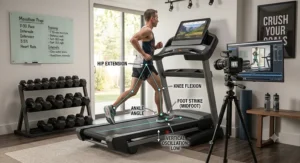
Choosing the right treadmill for serious runners comes down to seven practical criteria, evaluated in the order most likely to affect your daily training:
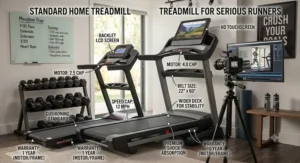
- Motor duty cycle — a continuous horsepower rating (CHP or true AC power) matters more than peak horsepower, since it reflects sustained performance under real training loads.
- Belt size — look for at least 20 inches wide and 60 inches long; taller runners or anyone doing speed work should prioritize 22-inch belts.
- Incline and decline range — a wider range supports more varied, race-specific training, particularly for anyone doing hill repeats or downhill-simulation work.
- Cushioning system quality — independent testing protocols consistently show that deck cushioning quality affects joint stress as much as running shoes do, so don’t treat it as an afterthought.
- Top speed — serious sprint work demands a machine that comfortably exceeds your fastest interval pace, with margin to spare.
- Warranty structure — lifetime frame and motor coverage signals genuine manufacturer confidence in long-term durability.
- Total footprint and folding capability — measure your space honestly before falling for a flagship machine that won’t fit through your doorway.
Weigh these criteria against your actual weekly mileage and goals rather than the flashiest touchscreen — a runner logging 15 miles a week has fundamentally different needs than one training for a Boston-qualifying time.
Treadmill Cushioning System: What Your Joints Actually Feel
A treadmill cushioning system isn’t just marketing language for “softer than concrete.” Most modern systems use either compression-based elastomers under the deck or, in Woodway’s case, individually shock-absorbing slats, and each approach changes how force travels through your joints on impact. Reviewers consistently note that adjustable systems, like the toggle-based cushioning on the NordicTrack commercial series, let a single machine serve both easy recovery days and firmer, race-simulation sessions — something fixed-cushioning decks can’t replicate.
Based on the spec comparison across this list, the reduction-in-impact claims range from roughly 30% to 40% versus outdoor pavement, though these figures come from manufacturer testing rather than independent clinical studies, so treat them as directional rather than precise. What most buyers overlook is that firmer cushioning generally trains a more road-realistic stride, while softer cushioning reduces cumulative joint stress — meaning the “best” cushioning setting genuinely depends on whether you’re building toward an outdoor race or simply logging safe recovery mileage.
Treadmill with Decline Training: Why Negative Grade Belongs in Your Program
A treadmill with decline training capability opens up a category of workout that flat-belt machines can’t touch: eccentric loading practice. Downhill running places unique stress on the quadriceps through eccentric contraction, and courses like Boston famously punish runners who haven’t specifically prepared for sustained downhill sections. Training on a negative grade, even briefly, conditions those muscles in a controlled environment before race day forces the issue.
Here’s what to weigh: decline settings on machines like the Sole F85 or NordicTrack Commercial 2450 typically top out between -3% and -6%, which is gentler than many real race descents but still meaningfully more useful than a flat deck. Reviewers consistently report that a shallow decline setting also makes an excellent active recovery tool, reducing knee loading after a hard uphill session while still keeping the legs moving. What most buyers overlook is that decline training isn’t just about race-day terrain simulation — it’s genuinely protective conditioning against the kind of quad soreness that derails post-marathon recovery.
VO2 Max Training on a Treadmill
VO2 max training on a treadmill remains one of the most reliable ways to build aerobic ceiling, precisely because treadmill-based protocols allow the kind of controlled, incremental grade and speed increases that outdoor terrain simply can’t standardize. Classic protocols increase speed or incline at fixed intervals until a runner reaches volitional exhaustion, and having a machine with reliable, evenly-spaced incline increments — like the 15-level systems on the Sole lineup — makes structured VO2 max intervals dramatically easier to execute consistently.
Based on the spec comparison, a treadmill with a strong continuous-duty motor is particularly important here, since VO2 max intervals demand rapid, repeated speed changes without motor lag or strain. What most buyers overlook is that consumer-grade heart-rate-based VO2 max estimates built into console displays tend to run less accurate than lab-based testing, so treat those on-screen numbers as a useful trend indicator rather than a precise clinical figure. Reviewers consistently note that runners using structured interval programming, such as iFIT’s guided workouts on the NordicTrack commercial series, find it easier to stay honest about pacing during max-effort intervals than when self-pacing alone.
Treadmill for Sprint Workouts vs Track Sprints
| Factor | Treadmill Sprints | Track Sprints |
|---|---|---|
| Speed control | Fixed or self-powered belt speed | Fully self-paced |
| Surface consistency | Identical every session | Weather and surface-dependent |
| Acceleration mechanics | Limited on motorized decks; natural on manual models | Full natural acceleration and deceleration |
| Best for | Controlled, repeatable interval structure | Race-specific pacing and turns |
The clearest takeaway from this comparison is that a treadmill for sprint workouts serves a genuinely different purpose than track sessions rather than replacing them outright. On a motorized machine, the belt sets the pace, which is excellent for controlled interval structure but poor for practicing the explosive acceleration phase of a real sprint. This is precisely where a manual option like the Assault AirRunner closes the gap — its self-powered belt lets acceleration mechanics translate far more honestly than any motorized deck, even if the curved surface still doesn’t perfectly replicate a track’s shape.
Common Mistakes Serious Runners Make When Buying a Treadmill
The single most common mistake is prioritizing top speed over motor duty cycle, leading buyers to choose a machine that hits an impressive number on paper but strains under sustained tempo work. A close second is skipping belt-size considerations entirely — a narrow 20-inch belt feels cramped fast once you’re doing genuine speed work rather than a casual jog.
Buyers also frequently underestimate footprint requirements, especially with non-folding commercial units like the Woodway 4Front, only to discover the machine doesn’t fit through a doorway or up a staircase. Another recurring error is assuming decline training is a “nice to have” rather than functionally useful, when in fact it’s one of the more overlooked variables in race-specific preparation, according to peer-reviewed treadmill protocol research. Finally, many shoppers focus entirely on console technology while ignoring warranty structure, which matters enormously more once a motor or deck component fails two years down the line.
Long-Term Cost and Maintenance
Long-term cost and maintenance math rarely favors the cheapest sticker price once you factor in motor replacement risk, belt wear, and subscription fees. A budget machine like the Sole F63 carries minimal ongoing cost beyond occasional lubrication, but a heavier training load may shorten its practical lifespan compared to commercial-grade options. Subscription-dependent machines, including both NordicTrack commercial series entries on this list, add a recurring cost that should be factored into any honest total-cost-of-ownership comparison — that’s real money over a five-year ownership window.
At the other extreme, the Woodway 4Front‘s 150,000-mile rating and near-zero maintenance profile can make its steep upfront price genuinely competitive over a decade, particularly for a household or facility putting serious combined mileage on the machine. The practical lesson here: calculate cost-per-mile over your expected ownership period rather than comparing sticker prices in isolation, since a $1,000 machine replaced every three years can easily cost more over a decade than a $4,000 machine that simply doesn’t break.
Frequently Asked Questions
❓ What treadmill speed is needed for serious sprint training?
❓ Is decline training on a treadmill actually useful for runners?
❓ How much does a good treadmill for serious runners cost?
❓ Can a treadmill accurately estimate VO2 max?
❓ What's the difference between the NordicTrack Commercial 1750 and 2450?
Conclusion
There’s no single “best” treadmill for serious runners — there’s only the best match for your mileage, your goals, and your budget. A runner building a base toward their first half marathon has little use for a five-figure slat-belt machine, just as a sprinter chasing 400m times gains nothing from a flat, motorized deck with no decline range. What matters is matching the machine’s actual engineering — motor duty cycle, cushioning system, incline and decline range — to the training you’re genuinely going to do week after week.
Across this list, the NordicTrack Commercial 1750 remains the strongest all-around pick for runners wanting genuine commercial-series performance without flagship pricing, while the Sole F63 proves serious training doesn’t require a serious budget. Specialists like the Assault AirRunner and long-haul investments like the Woodway 4Front exist for very specific training philosophies, and knowing which philosophy is yours is the real decision here — not just which machine has the flashiest screen.
Whichever direction you go, remember that consistency beats specs every time. The treadmill that actually gets used, week after week, will always outperform the one sitting unused because it never quite matched your real training life.
✨ Ready to find your match? Compare current pricing on today’s top picks and build the training setup that actually keeps you running.
Recommended for You
- 7 Best Treadmills for High Mileage Runners in 2026
- Treadmill For Interval Training At Home: 7 Top Picks (2026)
- 7 Best Mid-Range Treadmill Under $1000 Picks for 2026
Disclaimer: This article contains affiliate links. As an Amazon Associate, I earn from qualifying purchases. If you purchase products through these links, we may earn a small commission at no additional cost to you.
✨ Found this helpful? Share it with your friends! 💬🤗
