
In This Article
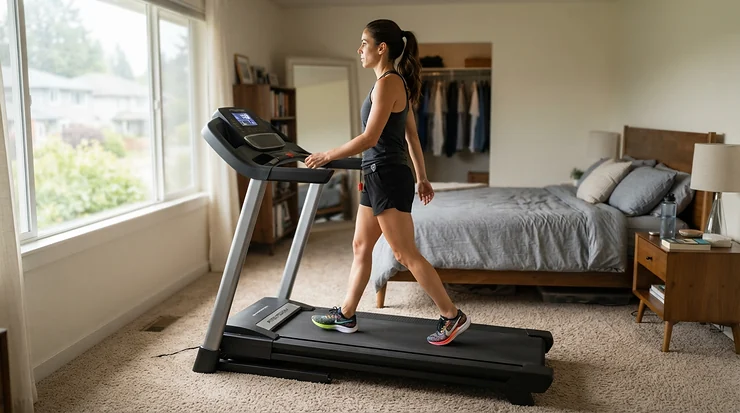
Here’s the uncomfortable truth about upstairs cardio: your neighbor will almost never complain about the motor. They’ll complain about the thump. Every footstrike drives a sharp pulse into your floor, and that pulse travels down through the joists or slab into the ceiling below. Finding a low vibration treadmill for second floor use means shopping for deck cushioning, frame stiffness and floor isolation, not just a low decibel number on a spec sheet.
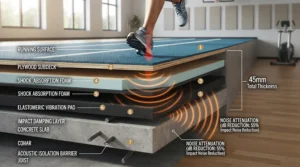
Engineers call this impact noise transmission, and they have a standard yardstick for it, the impact insulation class (IIC) rating. The catch is that the rating is measured from 100 Hz upward, while a lot of real footfall vibration sits below that. Your treadmill can look fine on paper and still rattle a downstairs light fixture.
One note on method. This guide synthesizes published specs, independent test data and recurring review themes. It is not a record of personal hands-on testing, and decibel figures from different reviewers use different methods, so treat them as directional. Prices are ranges that were current at the time of research, so check current pricing before you buy.
You’ll get seven real machines, an honest look at how each one behaves over a floor, and a setup playbook that matters as much as the treadmill itself.
Quick Comparison: 7 Low Vibration Treadmill for Second Floor Options
| Product | Price Range | Motor / Deck | Cushioning | Best For |
|---|---|---|---|---|
| Horizon T101 | $700–$1,000 range | 2.5 CHP, roughly 55″ deck | 3-zone | Budget walkers and light joggers |
| Sole F63 | $1,000–$1,300 range | 3.0 HP, 20″ x 60″ | Whisper-style deck | Value-minded runners |
| Sole F80 | $1,500–$2,000 range | About 3.25–3.5 HP, roughly 60″ deck | Firm CushionFlex | Taller or heavier users |
| Horizon 7.8 AT | $2,000–$2,500 range | Powerful motor, 22″ x 60″ | 3-zone, 375 lb capacity | HIIT and heavy use |
| NordicTrack Commercial 1750 | $1,800–$2,000 range | 3.75 CHP, 20″ x 60″ | Adjustable, soft | Softest landing |
| Peloton Tread | $2,500–$3,000 range | 3 HP, about 59″ x 20″ belt | Solid, firmer ride | Class lovers |
| WalkingPad C2 | $250–$300 range | Compact motor, roughly 47″ belt | Thin folding belt | Late-night walking |
The table sorts by price, but the real dividing line is how much footfall vibration each machine absorbs before it reaches your floor. The NordicTrack Commercial 1750 is the softest, the Sole F80 is firmer, and the WalkingPad C2 sidesteps the issue by capping speed at a walk. If you run, budget for deck cushioning first and extra features second.
💬 Just one click — help others make better buying decisions too!😊
Top 7 Low Vibration Treadmill for Second Floor Picks: Expert Analysis
1. Horizon T101 — cheapest ticket into a quiet-ish run
Budget machines rarely come with a reputation for politeness, yet the Horizon T101 earns one. Its 2.5 CHP motor runs at lower RPMs, which keeps motor hum modest, and the roughly 55-inch deck uses three-zone cushioning: softer at landing, firmer at push-off. That matters upstairs because a deck that gives a little leaves less impact energy to dump into the frame.
On paper, this is a walker’s and jogger’s machine. The shorter belt will cramp a long stride, and it is not built for sustained sprints, so think brisk walks, easy jogs and incline hikes. Reviewers broadly describe it as compact, easy to assemble and reasonably quiet for its class. A minority of owners report noticeable noise when running, so manage expectations. Check recall status for your exact model and serial number too, a point covered in the safety section below.
Pros:
- ✅ Three-zone deck softens each footstrike
- ✅ Folds compactly for small apartments
- ✅ Easy assembly and Bluetooth connectivity
Cons:
- ❌ Shorter belt limits longer strides
- ❌ Some owners report running noise
Expect to spend in the $700–$1,000 range. For walkers and light joggers, the value verdict is strong, provided you add a proper mat.
2. Sole F63 — most deck for the money
The Sole F63 packs a 3.0 HP motor, a 20″ x 60″ deck and a 15-level power incline into a folding frame. That 60-inch belt is the practical headline: a longer belt means a relaxed stride, and a relaxed stride lands softer than a cramped one.
Garage Gym Reviews found it quieter than expected, noting you will hear the incline motor ramp more than the belt itself. Front Desk Review’s summary of that testing logged roughly 66–68 dB at several feet away, which is typical treadmill territory, not whisper territory. In other words, this is a machine whose vibration problem is solved by your floor setup, not by magic inside the deck. Commonly cited gripes include some shakiness at top speed and a weak fan.
Who should buy it? A runner who wants a proper stride on a sane budget and is willing to pair it with a dense rubber mat. The F63 rewards the person who treats isolation as part of the purchase.
Pros:
- ✅ Full-length 60-inch belt for natural stride
- ✅ Folding frame with strong warranty reputation
- ✅ Powerful incline for quieter hill walking
Cons:
- ❌ Fan and console feel basic
- ❌ Reported shakiness near top speeds
Plan on the $1,000–$1,300 range. The Sole F63 is one of the best value plays here, as long as your mat budget is not an afterthought.
3. Sole F80 — firm deck, long-haul durability
Where some cushioning systems feel like running on a mattress, the Sole F80 takes a firmer, more road-like approach with its CushionFlex deck. Sole claims it reduces joint impact by up to 40 percent. Treat that as a manufacturer claim, but the practical point stands: a firm, stable deck rattles less at speed than a floaty one.
Its motor lands around 3.25–3.5 HP depending on the model year, and the deck is roughly 60 inches long. Reviewers praise its durability and subscription-free workouts. One lab-style review scored its noise modestly and found the cushioning felt unnatural at a full sprint, an effect softened by setting an incline. A head-to-head comparison from a long-running treadmill review site gave the noise edge to the NordicTrack Commercial 1750.
Analytically, the Sole F80 suits taller or heavier users who want a stiff, planted frame and a lifetime frame-and-motor warranty. Upstairs, the firm ride means you will lean on a good mat more than a NordicTrack Commercial 1750 owner would.
Pros:
- ✅ Sturdy frame that resists wobble
- ✅ Lifetime frame and motor warranty
- ✅ Streaming touchscreen without a subscription
Cons:
- ❌ Firmer deck than softer rivals
- ❌ Quieter rivals exist at similar prices
Expect the $1,500–$2,000 range. As a long-term keeper, it’s a solid pick that needs thoughtful floor isolation.
4. Horizon 7.8 AT — the heavyweight that stays planted
Mass is an underrated ally against footfall vibration, and the Horizon 7.8 AT has plenty. The frame is reported to weigh well over 300 pounds boxed, with a 22″ x 60″ deck, three-zone cushioning, 15% incline, a 12 mph top speed and a 375 lb user capacity. A heavy, rigid frame resists flexing, which trims the shaking that turns into noise below.
Reviewers consistently call the motor quick and quiet, and one long-term tester used it for HIIT without complaints. One caveat is structural: a machine this heavy concentrates load on four small feet. On a wood-framed second floor, that is another reason to spread weight with a full-length mat. Typical ranges from reviewers run roughly 48 dB at slow speeds to the high-60s dB at top speed for this brand family.
Pick this if you do interval work and want a machine that doesn’t dance across the floor. Skip it if you want decline training, because it has none.
Pros:
- ✅ Heavy, rigid frame reduces wobble
- ✅ Fast, quiet motor for HIIT
- ✅ Generous 22-inch-wide deck
Cons:
- ❌ Very heavy and awkward to move
- ❌ No decline settings
Budget the $2,000–$2,500 range. It’s pricey, but arguably the most “grown-up” frame in this group.
5. NordicTrack Commercial 1750 — the softest landing in the lineup
The NordicTrack Commercial 1750 is the cushioning champion. Its RunnersFlex deck is soft, and a lever lets you dial the cushioning down for a firmer feel. A 3.75 CHP motor and a 20″ x 60″ deck round out a machine one expert panel described as having some of the most cushioning around. OutdoorGearLab gave its noise performance a strong score.
Real-world numbers are useful here. A reviewer measured it at 60 dB at 1 mph with fans on, 70 dB at 6 mph and 78 dB at 12 mph, against a 50 dB room baseline. That is typical for running, not silent. Where it shines is the deck: a softer deck means a lower peak impact force on every strike, which is the number your downstairs neighbor actually feels. Reviewers do mention console shake at high speed and limited content without an iFIT membership.
If you run regularly upstairs, this is the top pick on cushioning alone.
Pros:
- ✅ Adjustable, very soft deck cushioning
- ✅ Strong motor with quick speed changes
- ✅ Folding frame with decline and incline
Cons:
- ❌ Console shakes at higher speeds
- ❌ Best features need an iFIT subscription
Expect the $1,800–$2,000 range. For footfall vibration control, the NordicTrack Commercial 1750 delivers the most for the money.
6. Peloton Tread — premium polish, honest noise trade-offs
The Peloton Tread has a sturdy carbon-steel frame and a 3 HP DC motor, and reviewers describe a solid feel with minimal frame vibration. TechRadar’s decibel testing logged about 65 dB for a gentle walk, 78 dB for varied jogging and 88 dB at maximum speed. Another reviewer clocked a HIIT class at 78 dB, similar to a vacuum cleaner.
The part the spec sheet won’t tell you comes from owner discussions. Several upstairs users report hearing noise below, though most call it manageable, and some use thick rubber stall-style mats underneath. The belt is a modest 59″ x 20″, the machine doesn’t fold, and there is no fan. You also pay for the class subscription to unlock the full experience.
This is a motivation machine, not a stealth machine. It fits someone who trains in class-length blocks at sensible hours and values the experience over silence.
Pros:
- ✅ Solid frame with minimal reported shake
- ✅ Motivating on-demand classes
- ✅ Low step-up height for easy access
Cons:
- ❌ Doesn’t fold, takes permanent floor space
- ❌ Running noise reaches high-70s dB
Expect the $2,500–$3,000 range, with subscription costs on top. Value hinges on whether you’ll actually use the classes.
7. WalkingPad C2 — the late-night walking specialist
Sometimes the quietest treadmill is one that refuses to let you run. The WalkingPad C2 tops out near 3.7 mph, with a belt around 15.75″ x 47″. One independent roundup calls it genuinely quiet and apartment-friendly. A cap at walking speed eliminates the high-force footstrike that causes most thump.
That makes it a natural fit for a treadmill for night workouts without waking neighbors. Walking pads differ from full-size machines: thin belts, lighter frames, lower weight limits (around 220 lb here). Still, a light machine with gentle footfalls often transmits less low-frequency shock than a runner pounding a heavy one. Treat “under 50 dB” claims as optimistic manufacturer figures.
Pros:
- ✅ Walking-speed cap limits footstrike impact
- ✅ Folds flat and slides under furniture
- ✅ Very low cost compared to full treadmills
Cons:
- ❌ No running and no incline
- ❌ Lower weight capacity than full-size units
Expect the $250–$300 range. For walkers, the WalkingPad C2 is a bargain with very little downside.
What Is a Low Vibration Treadmill for Second Floor Use?
A low vibration treadmill for second floor use is a treadmill that keeps the structure-borne shock of each footstep from reaching the unit below. It combines a cushioned deck, a stiff, heavy frame, a quiet motor and floor isolation underneath, so neighbors hear less thumping, even when you run.
Notice what that definition leaves out: “silent.” No treadmill is. One reviewer who spent months on this question put it bluntly, noting that no machine is completely silent, and the honest goal is “not noticed,” not “not heard.” Another practical guide warns that “ultra-quiet” labels usually describe the motor spinning without a person on it, so they ignore the heavy part: your body weight landing on the deck.
Two noise types are worth separating. Airborne noise is the motor and belt hum you hear in the room. Structure-borne noise is the vibration that moves through the floor into the ceiling below. Airborne noise is annoying but local. Structure-borne noise is what travels, and it is what this entire guide targets.
How to Choose a Low Vibration Treadmill for Second Floor Living
Start with the cushioning, then work outward. Here are seven steps in order of impact:
- Prioritize deck cushioning over motor decibels. A soft or adjustable deck lowers peak impact force on each strike, which is the thing neighbors feel.
- Match belt length to your stride. A 60-inch belt lets you stride naturally, while a short belt makes you shuffle and pound.
- Favor frame rigidity and weight. A stiff frame resists flex, but remember a heavy machine concentrates load, so plan for a full-length mat.
- Be honest about how you’ll exercise. Walkers and incline hikers produce far less impact than runners, so a walking-focused machine may be enough.
- Check folding mechanics. A frame that locks solidly when folded and sits level when open will rattle less.
- Read noise reviews at your speed. A figure at 3 mph says little about your 7 mph pace.
- Budget for the floor. Allocate part of your spend to mats, pads and maintenance supplies.
Follow those in order and you’ll avoid the classic mistake of buying features for the touchscreen and ignoring what’s beneath it.
Impact Noise Transmission: Why Your Downstairs Neighbor Hears You
Impact noise transmission happens when a sudden force, like a heel strike, shakes the floor structure directly. That vibration radiates as sound from the ceiling below. Because the pulse is short and sharp, it cuts through much better than the steady hum of a motor.
Building type changes the story dramatically. Published guides rate a concrete slab with carpet and pad in the IIC 65–75 range, while a wood-joist floor with no insulation can land around IIC 30–40. Many codes ask for roughly IIC 50 in the lab and 45 in the field between dwellings, though local rules vary. That spread explains why one tenant runs freely and another gets a knock on the ceiling after three minutes.
The scale is logarithmic, so a 10-point gain is a big step, not a rounding error. Field results also run several points lower than lab results because of flanking paths, meaning vibration sneaking through walls. So a wood-framed second floor demands the most from your machine and your mat. Concrete forgives; joists gossip.
Footfall Vibration: What Deck Cushioning Really Does
Footfall vibration is the repeated, low-frequency shock of your feet landing. The bad news is that much of it falls below the 100 Hz floor of standard IIC testing, so you can’t rely on a lab number alone.
Deck cushioning works by letting the surface compress under impact, spreading the force over more time. Spread the force out and the peak drops. A softer deck like the one on the NordicTrack Commercial 1750 does this more aggressively. A firmer deck like the Sole F80 transmits more, but feels more road-like and stable. Neither is “wrong,” but they ask different things of your mat.
Your behavior matters as much as your hardware. Walking on a steep incline generally produces far less footstrike impact than running flat, which means a simple shift from jogging to hill walking can quiet a session dramatically. Speed matters too: the difference between machines shows most at jogging and running speeds, not at a stroll.
Finally, level the machine. An unlevel frame loads one side harder, creating uneven deck flex and an irregular, louder beat. Adjust the feet until all four sit firmly.
Sound Dampening Flooring: What to Put Under and Around Your Treadmill
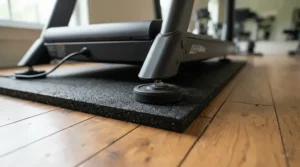
Sound dampening flooring is the single cheapest upgrade in this guide, and the easiest to get wrong. The key insight from material guides is that density beats thickness: soft foam can compress flat under a heavy frame and do almost nothing.
| Option | Thickness | Isolation Quality | Best For |
|---|---|---|---|
| Dense recycled rubber mat | About 1/4″–1/2″ | Strong | Most second-floor setups |
| Thin PVC or foam mat | About 3–7 mm | Modest | Floor protection, light walking |
| Yoga or exercise mat | Very thin | Negligible | Not recommended |
| Carpet and pad plus rubber mat | Combined layers | Very strong | Maximum isolation |
Looking at the table, dense rubber is the clear winner for most people, while thin PVC is mostly a scuff-guard. Layering a rubber mat over carpet with padding is the premium move, and one property-management source suggests exactly that: thick carpeting and padding topped by a half-inch rubber mat covering the full length and width of the treadmill. Budget buyers should accept a thinner dense rubber mat before they accept a thick foam one.
Size matters as well. The mat should extend past the machine’s footprint on all sides, and nothing should touch a shared wall, because vibration can shortcut sideways through it.
Apartment Treadmill With Rubber Isolation Pads: A Practical Setup Guide
An apartment treadmill with rubber isolation pads turns a “good” purchase into a quiet one. Think of the mat as the blanket and the pads as the shock absorbers. Here is a setup sequence you can finish in an afternoon.
Step 1: Pick the spot. Choose a place away from shared walls and, if you can, near a load-bearing wall or structural column, where the floor is stiffest and deflects least.
Step 2: Lay the base. Roll out a dense rubber mat that overhangs the frame on all sides. If your lease allows, add carpet padding underneath. Advice from Brick Underground’s treadmill-noise guide points the same way: a shock-absorbing treadmill plus a thick rubber mat under the full footprint.
Step 3: Add isolation pads. Slip rubber or rubber-and-cork pads or caster cups under each foot. They sit under the existing feet, so no permanent change and no warranty drama.
Step 4: Level and tighten. Check that every foot makes solid contact, then confirm nothing rattles.
Step 5: Maintain. Keep the belt lubricated per your manual, because dry-belt friction is a common cause of rising noise.
First-30-day mistakes? Skipping the leveling step, buying a mat that is too short, and leaving the machine pressed against a wall. Fix those three and most setups improve noticeably.
✨ Don’t Miss These Exclusive Deals!
🔍 Take your upstairs workouts to the next level with these carefully selected machines. Click any highlighted product name to check current pricing and availability, and give your downstairs neighbors a peaceful evening!
Treadmill for Night Workouts Without Waking Neighbors: A Scenario Guide
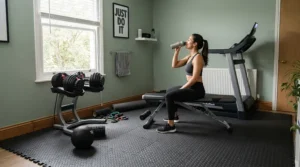
A treadmill for night workouts without waking neighbors is really a three-part system: the right machine, the right mat and the right workout. Quiet hours often run from roughly 10 p.m. to 7 a.m., but your lease and local rules decide, so check them.
Here are three profiles, with budget, building and frequency in mind.
The shift worker (walks nightly, wood-framed second floor, tight budget). The WalkingPad C2 plus a dense rubber mat is the sensible pairing. Walking-only speed removes most of the impact, and the low cost leaves room for a thicker mat. Daily use at modest volume is exactly what it is built for.
The early-morning runner (concrete slab, 4 days a week, mid budget). A Sole F63 or Horizon T101 works well. Concrete is forgiving, so a quality mat and pads usually suffice. Save the sprints for the gym.
The class lover (wood floor, 5 days a week, premium budget). The NordicTrack Commercial 1750‘s adjustable deck is the safest bet for footfall vibration, and the Peloton Tread is workable if you keep sessions earlier in the evening and add heavy isolation.
For any late session, shift your workout instead of fighting physics: choose walking or steep-incline hiking over running, keep speed moderate, and stay away from shared walls. A friendly heads-up to the neighbor below doesn’t hurt either. Nothing quiets complaints like being asked first.
Common Mistakes When Buying a Low Vibration Treadmill for Second Floor Units
Most noise problems trace back to a handful of avoidable errors.
- Trusting the “ultra-quiet” label. It usually describes the empty motor, not a body landing on the deck.
- Buying thin foam and calling it done. Soft mats flatten and isolate little.
- Ignoring your floor type. Wood joists need more mitigation than concrete, so match your effort to your building.
- Choosing features over cushioning. A big screen doesn’t absorb a single footstrike.
- Forgetting delivery logistics. Heavy frames, like the Horizon 7.8 AT, are hard to carry upstairs.
- Skipping maintenance. A dry belt or loose bolt turns a quiet machine into a loud one.
Avoid these and you’ve cleared most of the pitfalls that generate angry notes under the door.
Long-Term Cost and Maintenance for Upstairs Treadmills
The sticker price is only the opening bid. Add a quality rubber mat, isolation pads and a bottle of silicone belt lubricant, and you’re looking at a modest but real extra spend. Some retailers also charge for delivery to a room of choice or for assembly, so factor that in.
Over the years, ownership cost depends on durability. The Sole F80 and Sole F63 lean on strong warranty reputations, while premium machines add subscription costs, like the class membership the Peloton Tread relies on. On a cost-per-use basis, a WalkingPad C2 used daily is hard to beat, while a pricier machine pays off only if you actually run on it.
Maintenance doubles as noise control. Lubricate the belt on schedule, keep the deck level, and tighten hardware periodically. A machine that squeaks and rattles will annoy neighbors long before it fails.
Building Rules, Quiet Hours and Safety Checks
Before you buy, read your lease. Many buildings set quiet hours, and some restrict heavy exercise equipment on upper floors. A short conversation with management can save an expensive standoff.
Next, consider structure. Heavy treadmills concentrate weight on small contact points, so spreading the load with a large mat is both a noise and a floor-protection measure. If you have any doubt about a wood-framed floor’s capacity, ask your landlord or a qualified professional.
Finally, check recalls. Safety agencies have flagged specific Horizon T101 units, with Consumer Reports covering a recall tied to unexpected speed changes on particular T101-05 serial ranges. Confirm your exact model and serial number against current recall notices before buying new or used.
FAQ
❓ Can I use a low vibration treadmill for second floor apartments without complaints?
❓ How thick should a treadmill mat be for upstairs use?
❓ Is walking on a treadmill really quieter than running?
❓ Do treadmill isolation pads actually work?
❓ What time is too late to use a treadmill in an apartment?
Conclusion
Picking a low vibration treadmill for second floor living comes down to a simple ranking: cushioning first, frame second, floor third, behavior last. The NordicTrack Commercial 1750 leads on softness, the Sole F63 offers the best value stride, the Sole F80 and Horizon 7.8 AT bring durability and mass, the Horizon T101 keeps costs low, the Peloton Tread trades silence for motivation, and the WalkingPad C2 wins for late-night walking.
None of them is magic. Each becomes a polite neighbor when you add a dense rubber mat, isolation pads, a level frame and a workout that fits the hour. Do that, and you protect both your fitness routine and your relationship with whoever lives below.
✨ Ready to work out without the thump?
🏃♂️ Click any highlighted product name above to check current pricing and availability, pair it with a quality mat, and enjoy your quiet upstairs workouts, guilt-free!
Recommended for You
- Quiet Treadmill For Upstairs Apartment: 7 Proven Picks (2026)
- Small Treadmill For Seniors With Limited Space: 7 Safest Picks 2026
- Ultra Compact Treadmill For Small Bedroom: 7 Best Picks 2026
Disclaimer: This article contains affiliate links. As an Amazon Associate, I earn from qualifying purchases. If you purchase products through these links, we may earn a small commission at no additional cost to you.
✨ Found this helpful? Share it with your friends! 💬🤗
