In This Article
Here’s the annoying truth nobody tells you when your knees start complaining every time you walk down stairs: cardio doesn’t stop being good for you just because it hurts a little more than it used to. You still need to move. Your heart still wants its 150 minutes a week. Your joints, weirdly enough, often feel better with consistent low-impact motion than with none at all. The problem is that “just go for a run” advice ignores the fact that concrete is basically the least forgiving surface on Earth, and a treadmill for bad knees under $700 solves a specific, practical problem: how do you get real cardio without turning every session into a negotiation with your patella?
This guide skips the marketing fluff and gets into what actually matters — deck cushioning technology, motor durability, belt length, and honest aggregated review sentiment from real owners — for seven real machines you can buy today, all priced under $700. We’ll cover the budget-conscious picks, the ones with genuinely engineered shock absorption, and the compromises you’re making at each price point. An affordable knee-friendly treadmill exists; it’s just not always the one with the flashiest marketing copy. Let’s find yours.
Quick Comparison Table: Treadmills for Bad Knees Under $700
| Treadmill | Motor | Belt Size | Cushioning Type | Weight Capacity | Best For |
|---|---|---|---|---|---|
| Horizon T101 | 2.5 HP | 20″ x 55″ | 3-Zone Variable Response | 300 lbs | Best overall cushioning |
| Sunny Health & Fitness SF-T7515SMART | Standard duty | 20″ x 43.3″ | Double-Deck Shock Absorption | 300 lbs | Auto incline on a budget |
| Sunny Health & Fitness SF-T725067 | Brushless | 20″ belt | Multi-layer cushion deck | 300 lbs | No-assembly convenience |
| XTERRA Fitness TR150 | 2.25 HP | 16″ x 50″ | XTRASoft Cushioning | 250 lbs | Tightest budget |
| ASUNA 8730 | 2.5 HP | 17.75″ x 49″ | Multi-chamber cushioned deck | 220 lbs | Small apartments |
| Weslo Cadence G 5.9 | 2.25 HP | 16″ x 50″ | Comfort Cell Cushioning | 250-275 lbs | Absolute lowest price |
| UREVO 2-in-1 Under Desk | 2.5 HP | 17″ x 42.5″ | 8-point silica gel shock columns | 265 lbs | Walking during work |
Looking at the lineup, the Horizon T101 earns its spot at the top of most knee-focused buying guides because its 3-Zone Variable Response Cushioning was engineered specifically around joint impact reduction rather than bolted on as an afterthought. The Sunny Health & Fitness SF-T7515SMART and XTERRA Fitness TR150 trade some cushioning sophistication for auto-incline features and rock-bottom pricing, respectively. Notice the pattern: as belt length shrinks toward 16 inches, prices drop, but so does your stride freedom, which matters more than people expect when you’re compensating for a stiff or achy knee.
💬 Just one click — help others make better buying decisions too!😊
Top 7 Treadmills for Bad Knees Under $700: Expert Analysis
We’re covering all seven models below with honest, spec-grounded commentary — no invented test sessions, no fabricated star ratings. Where aggregated review sentiment is genuinely available, we say so and summarize it plainly. Where it isn’t, we tell you that instead of making something up.
1. Horizon T101 — best 3-zone cushioning for the price
The Horizon T101 built its reputation on one specific engineering decision: dedicating three distinct cushioning zones to three distinct phases of your stride. That’s not marketing spin — it’s a genuinely different approach than the single flat foam pad found on most sub-$700 machines. The front zone softens your heel strike, the middle zone stabilizes your transition, and the rear zone firms up for push-off, which matters because push-off is exactly when an unstable surface makes an already cranky knee twist wrong.
Specs-wise, you’re looking at a 2.5 continuous-horsepower motor, a 20-inch by 55-inch running surface, and a 300-pound weight capacity — solid numbers for this price tier, though the belt length means taller walkers (6’1″ and up) may feel slightly cramped during faster strides. What most buyers overlook about the T101 is its warranty structure: a lifetime frame and motor guarantee is unusually generous for a machine that regularly sells in the $600-$700 range, and it signals real confidence from the manufacturer.
Aggregated reviewer sentiment across major retail platforms consistently praises the cushioning as noticeably softer than typical budget decks, while a recurring complaint centers on mild frame vibration at higher speeds — several owners note that adding a rubber floor mat underneath largely resolves it.
Pros:
- ✅ 3-zone cushioning specifically engineered for joint impact reduction
- ✅ Lifetime frame and motor warranty is rare at this price
- ✅ 300 lb weight capacity accommodates most users comfortably
Cons:
- ❌ Some reported frame vibration at higher speeds
- ❌ 55-inch deck can feel short for runners over 6 feet tall
At a price typically landing in the $600-$700 range, the T101 delivers the best cushioning-to-dollar ratio of anything on this list — check current price before buying since retailers rotate promotions regularly.
2. Sunny Health & Fitness SF-T7515SMART — auto incline plus double-deck shock absorption
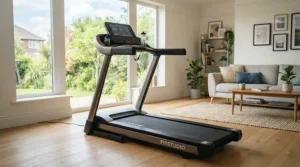
The SF-T7515SMART earns its spot by pairing motorized auto-incline — a feature usually reserved for pricier treadmills — with a double-deck shock absorption system designed to cut noise and joint impact simultaneously. In practice, this means the running surface itself has a secondary suspended layer beneath the visible belt, rather than just a thicker single pad, which is a more mechanically sound way to dissipate impact energy.
The 12 auto-incline levels (roughly 2.5% to 12%) let you vary training intensity without adding speed, which is genuinely useful advice for knee-conscious walkers: raising incline burns more calories per minute than raising speed, without the added joint stress of a faster foot-strike cadence. The tradeoff is a shorter 43.3-inch belt and an 8 mph top speed ceiling, positioning this firmly as a walking-and-incline machine rather than a running platform.
Real aggregated review sentiment on this model is mixed but generally positive for its category — reviewers who bought it specifically for joint concerns report satisfaction with the incline feature’s calorie burn, while a recurring theme is that assembly takes longer than expected without help.
Pros:
- ✅ 12-level auto incline adds intensity without extra joint strain
- ✅ Double-deck design reduces both noise and impact
- ✅ Bluetooth connectivity with SunnyFit app access
Cons:
- ❌ Shorter 43.3-inch belt limits stride length for taller users
- ❌ 8 mph top speed rules out serious running
Pricing on this model frequently swings between the high-$300s and just under $700 depending on retailer promotions, making it worth comparing current listings before committing.
3. Sunny Health & Fitness SF-T725067 — joint-protecting cushion, zero assembly
If setup anxiety is part of what’s keeping you from buying a treadmill in the first place — a legitimate concern when you’re already dealing with mobility limitations — the SF-T725067 solves that specific pain point by arriving fully assembled. You unbox it, plug it in, and you’re walking within minutes, which matters more than spec sheets usually acknowledge for someone managing joint pain day to day.
The multi-layer cushioned deck is explicitly marketed around impact protection, and the brushless motor design is worth understanding in plain terms: brushless motors typically run quieter and last longer than brushed alternatives because there’s less friction-based wear on internal components, translating into fewer maintenance headaches over years of use. The 300-pound weight capacity matches the Horizon T101, making this a legitimate alternative if the T101 is temporarily out of stock.
Because this is a newer release, independently aggregated customer review data is still limited compared to longer-running models like the TR150 — we can’t yet report a large, verified sentiment pattern, so treat the manufacturer’s cushioning claims with the same healthy skepticism you’d apply to any new product until more owner feedback accumulates.
Pros:
- ✅ Fully assembled out of the box — genuinely useful for limited mobility
- ✅ Brushless motor design reduces long-term maintenance needs
- ✅ Matches the 300 lb capacity of pricier competitors
Cons:
- ❌ Limited independent long-term review history so far
- ❌ Fewer workout programs than the SF-T7515SMART
Expect pricing in the mid-to-high $400s to upper $600s range depending on active promotions — always confirm the current price since this is a newer catalog addition.
4. XTERRA Fitness TR150 — the tightest budget with surprisingly real cushioning
The TR150 is the treadmill equivalent of a reliable used sedan: nothing flashy, but it does its one job — walking and light jogging — without drama, and it does it at a genuinely low price point. XTERRA’s XTRASoft cushioning system uses three shock-absorption elements positioned on each side of the deck, which independent reviewers have measured as reducing roughly 20% of foot-strike impact compared to walking on pavement.
Here’s the honest caveat: the 16-inch by 50-inch belt is noticeably narrower and shorter than the other machines on this list, which is fine for walking but becomes uncomfortable if you try pushing speeds much past 6 mph — the belt simply isn’t built for a full running stride. A 2.25 HP motor and 250-pound weight capacity round out a spec sheet clearly built for its price tier rather than punching above it.
Aggregated review sentiment is unusually extensive for a budget machine — the TR150 has accumulated well over 10,000 verified reviews on major retail platforms with a consistently strong average rating, and the recurring praise centers on value for walkers specifically, while the recurring complaint is belt tracking drift after several months of heavy use.
Pros:
- ✅ XTRASoft cushioning genuinely reduces measurable foot-strike impact
- ✅ Extremely low price point with a lifetime frame warranty
- ✅ Lightweight frame is easy to move and store
Cons:
- ❌ Narrow 16-inch belt is uncomfortable at faster jogging speeds
- ❌ Some owners report belt tracking issues after months of use
The TR150 typically sells for well under $400, leaving significant budget headroom if you’re prioritizing value above all else — check current price for the latest figure.
5. ASUNA 8730 (Sunny Health & Fitness) — low-profile space-saver with a cushioned deck
The ASUNA 8730 solves a problem the other machines on this list mostly ignore: floor space. Its low-profile design and slim folding mechanism make it genuinely apartment-friendly, sliding into closets or under furniture in a way a full-size folding treadmill can’t match. For knee-conscious walkers who simply don’t have room for bulkier equipment, that’s not a minor convenience — it’s the difference between exercising consistently and not exercising at all.
The multi-chamber cushioned deck reduces joint impact at the belt level, and the 2.5 peak-horsepower motor supports speeds from 0.6 to 8 mph, comfortably covering walking and light jogging paces. The tradeoff for that compact footprint is a smaller 220-pound weight capacity and a shorter 49-inch by 17.75-inch belt — noticeably tighter than the Horizon T101’s running surface.
Real aggregated sentiment from owners frequently highlights the low-profile design and quiet operation as standout features, particularly among apartment dwellers and older users who appreciate not stepping up onto an elevated deck.
Pros:
- ✅ Low-profile design minimizes fall-height risk for cautious walkers
- ✅ Slim folding mechanism fits genuinely tight spaces
- ✅ Quiet motor suits shared living situations
Cons:
- ❌ Lower 220 lb weight capacity than most machines on this list
- ❌ Narrower belt limits comfortable stride length
Price typically lands in the $300-$450 range depending on bundled accessories, positioning it as one of the more affordable knee-friendly treadmill options here.
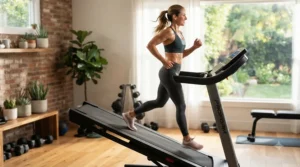
6. Weslo Cadence G 5.9 — the rock-bottom price point
We’re including the Weslo Cadence G 5.9 for one honest reason: it’s consistently one of the cheapest motorized treadmills available from a recognizable brand, and for some buyers, “cheapest that still works” is a completely valid priority. Its Comfort Cell Cushioning technology is real, but multiple independent reviewers note the cushioning effect is subtle rather than dramatic — you’ll notice less impact than bare pavement, but don’t expect the plush feel of the pricier decks on this list.
The 2.25 HP motor and 16-inch by 50-inch belt cap this firmly as a walking machine, and the two-position manual incline (rather than motorized) means you’ll need to physically adjust it before starting your workout, not mid-session. That’s a real limitation for interval-style training but a non-issue if your routine is steady-pace walking.
Aggregated review sentiment is candid about the tradeoffs: reviewers frequently describe the build as adequate for light, occasional use rather than daily heavy-duty training, with recurring notes about the short parts-and-labor warranty window.
Pros:
- ✅ Among the lowest prices for any motorized treadmill available
- ✅ Compact footprint suits small home gyms
- ✅ Simple, low-learning-curve console
Cons:
- ❌ Cushioning is noticeably milder than the T101 or TR150
- ❌ Short warranty coverage compared to competitors
Typically priced under $400, this is the machine to consider if your budget ceiling — not your knee comfort — is the deciding factor; verify current price before ordering.
7. UREVO 2-in-1 Under Desk Treadmill — walking pad by day, light jogger by evening
The UREVO 2-in-1 earns its place by doing something none of the other six machines attempt: functioning as a genuine under-desk walking pad and a foldable jogging treadmill in the same unit. Fold the handlebar down and you get a low-profile walking mode for desk hours; raise it up and the same machine handles light jogging up to roughly 7.6 mph. For anyone whose knee pain is partly aggravated by long periods of sitting, that dual functionality solves two problems with one purchase.
The 8-point silica gel shock-absorption columns underneath the belt are a genuinely different engineering approach than the foam-layer cushioning used elsewhere on this list, and aggregated reviewer feedback describes them as adequate but not exceptional — several testers note the cushioning is “neither particularly soft nor particularly firm,” which is an honest middle-ground assessment worth taking at face value rather than the more enthusiastic marketing language.
The 2.5 HP motor and 265-pound capacity are respectable for the compact form factor, though the narrower 17-inch by 42.5-inch belt means faster strides require more careful foot placement than on a full-size deck.
Pros:
- ✅ Genuine dual-purpose: under-desk walking pad and light jogging treadmill
- ✅ 8-point silica gel cushioning targets impact directly under the belt
- ✅ Compact enough to slide under a couch or bed when folded
Cons:
- ❌ Cushioning rated as adequate rather than exceptional by reviewers
- ❌ Narrower belt requires careful foot placement at higher speeds
Pricing generally sits in the $300-$450 range, making it a compelling pick if flexibility between desk-walking and light cardio matters more to you than raw running capability — always check the current price at the time of purchase.
✨ Don’t Miss These Exclusive Deals!
🔍 Take your home cardio setup to the next level with these carefully selected treadmills. Click on any highlighted model to check current pricing and availability. Protecting your knees while staying active starts with the right machine for your space and budget!
Practical Usage Guide: Setting Up Your Knee-Friendly Treadmill Right
Getting the machine home is only half the job. The first 30 days genuinely determine whether a treadmill for bad knees under $700 becomes a fixture in your routine or a very expensive coat rack. Start by placing it on a rubber equipment mat, even if the manufacturer doesn’t require one — most reviewer complaints about frame vibration and squeaking largely disappear with a quality mat underneath, and it adds an extra millimeter of shock absorption your knees will quietly thank you for.
Resist the urge to max out speed and incline in week one. A common mistake is treating a new cushioned deck like permission to push harder than your joints are ready for; the cushioning reduces impact, it doesn’t eliminate the need for gradual conditioning. Start with 10-15 minute sessions at a comfortable walking pace, adding two to three minutes every few days rather than jumping straight to 30-minute sessions.
Lubricate the belt according to the manufacturer’s maintenance schedule — typically every three months for regular use — because a dry, friction-heavy belt doesn’t just wear out faster, it also transmits more vibration up through the deck and into your joints. Finally, check your footwear: even the best shock-absorbing decks work in partnership with proper cushioned athletic shoes, not against worn-out sneakers with flattened midsoles.

Real-World Scenarios: Matching the Machine to Your Situation
Consider three common buyer profiles. First, the post-surgery walker rebuilding consistency after knee replacement or meniscus repair, working with a tight budget and a small apartment — the ASUNA 8730 or UREVO 2-in-1 make sense here, prioritizing low-profile safety and space efficiency over speed or incline range.
Second, the daily walker managing chronic knee osteoarthritis who wants genuine cushioning engineering and plans to use the machine five or six days a week for years — the Horizon T101 is the strongest match, since its 3-zone cushioning and lifetime motor warranty are built for sustained, frequent use rather than occasional sessions.
Third, the budget-first shopper who simply needs a treadmill, any treadmill, to replace outdoor walks during bad weather without breaking the bank — the XTERRA Fitness TR150 or Weslo Cadence G 5.9 deliver adequate function at the lowest possible entry price, with the understanding that cushioning sophistication is a secondary consideration for this buyer.
Problem → Solution: Common Knee Pain Triggers and Fixes
Problem: Knee pain increases specifically during incline walking. Solution: lower the incline percentage and increase duration instead — you get similar calorie burn over a longer session without the added joint torque steep inclines create.
Problem: Pain flares up mid-session, not at the start. Solution: this often signals fatigue-related form breakdown. Shorten sessions temporarily and rebuild endurance gradually rather than pushing through altered gait mechanics that can stress the joint further.
Problem: The deck feels harder than expected despite “cushioned” marketing. Solution: verify the mat underneath is rated for shock absorption (not just floor protection), and confirm belt tension isn’t over-tightened, which can flatten the felt cushioning effect considerably.
Problem: Knee discomfort after switching from outdoor walking to treadmill use. Solution: treadmill belts move under your foot rather than you moving over stationary ground, subtly changing stride mechanics — give your body two to three weeks to adapt before assuming the machine itself is the problem.
How to Choose a Treadmill for Bad Knees
- Prioritize cushioning engineering over marketing terms. Look for multi-zone or multi-chamber systems (like the T101’s 3-Zone design) rather than a single flat foam layer, since targeted cushioning responds differently to heel strike versus push-off.
- Match belt length to your height and gait, not just your budget. Shorter 50-inch belts work fine for walking but cramp taller users during faster paces.
- Check the weight capacity with margin, not at the limit. A machine rated exactly at your body weight will wear out faster and feel less stable than one with headroom.
- Read the warranty structure carefully. A lifetime frame and motor warranty, like the Horizon T101 offers, signals manufacturer confidence that shorter-warranty budget models can’t match.
- Consider incline availability over top speed. For knee-conscious cardio, motorized incline lets you increase intensity without the higher-impact foot strike that comes with faster running.
- Factor in assembly and mobility limitations honestly. If setup difficulty is a genuine barrier, prioritize pre-assembled options like the SF-T725067.
- Cross-reference aggregated review sentiment, not just star averages. A 4.3-star rating built on 10,000+ reviews (like the TR150) tells you more than a 4.6-star rating built on 40.
Shock-Absorbing Decks Explained: What Actually Protects Your Knees
“Shock-absorbing deck” gets used loosely across product listings, so it’s worth breaking down what’s actually happening mechanically. Most budget treadmills use one of three approaches: foam or rubber cushioning pads mounted beneath the belt, spring or elastomer suspension elements at specific deck zones, or a secondary suspended sub-deck layer beneath the primary running surface.
| Cushioning Approach | Example Model | How It Works | Impact Reduction |
|---|---|---|---|
| Multi-zone elastomer cushioning | Horizon T101 | Different firmness at heel-strike, transition, and push-off zones | Highest reported reduction |
| Double-deck suspension | Sunny Health & Fitness SF-T7515SMART | Secondary suspended layer beneath the visible belt | Moderate-high |
| Silica gel shock columns | UREVO 2-in-1 | Discrete gel columns positioned under the belt | Moderate |
| Single-layer foam pad | Weslo Cadence G 5.9 | Uniform foam cushioning across the deck | Mild |
The takeaway from this comparison is straightforward: zoned and multi-layer systems consistently outperform single flat-foam pads for genuine impact reduction, which explains why the Horizon T101 shows up at the top of nearly every knee-focused buying guide despite competing against machines with similar horsepower and price tags. That said, a shock-absorbing deck cannot treat an existing knee condition — it can only reduce the compressive forces your joint experiences during exercise, which is a meaningfully different (and more honest) claim than “cures knee pain.”
Treadmill for Bad Knees vs Other Home Cardio Alternatives
Treadmills aren’t the only low-impact option, and an honest buying guide should say so plainly. A large Harvard Health analysis of exercise research for knee osteoarthritis found that lower-impact aerobic activities including walking, cycling, and swimming rank among the most effective exercise types for easing knee pain and improving overall function.
| Cardio Option | Joint Impact | Home Setup Cost | Convenience | Best For |
|---|---|---|---|---|
| Treadmill (this guide) | Low-moderate | Under $700 | High — any weather, any time | Consistent daily walking/light jogging |
| Stationary/recumbent bike | Very low | $150-$600 | High | Users who find any weight-bearing painful |
| Elliptical trainer | Very low | $300-$1,200+ | Moderate | Zero-impact full-body cardio |
| Swimming/water aerobics | Lowest | Requires pool access | Low (facility dependent) | Severe joint sensitivity |
The analysis here matters: a treadmill delivers meaningfully more real-world carryover to daily walking mechanics than a bike or elliptical, since it trains the exact movement pattern — weight-bearing gait — that daily life demands. That said, orthopaedic specialists commonly note that cycling, swimming, or the elliptical put less weight-bearing stress on the knees than a simple walk does, which makes them worth considering as a rotation option alongside — not necessarily instead of — treadmill sessions, particularly on days when joint sensitivity is higher than usual.
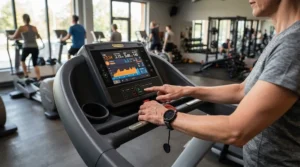
Do You Need Knee Braces for Treadmill Walking?
Knee braces come up constantly in treadmill-for-bad-knees conversations, and the honest answer is: it depends on what’s actually going on with your knee, which is a conversation for a doctor or physical therapist rather than a blog post. That said, here’s the practical framing worth understanding. Compression-style sleeves provide mild support and warmth, which some walkers find genuinely reduces perceived discomfort during longer sessions without restricting mobility. Hinged braces, by contrast, offer more structural support for specific instability issues but can feel restrictive during a natural walking gait if you don’t actually need that level of stabilization.
Mayo Clinic’s guidance on exercising with arthritis notes that if you have arthritis in your hips, knees, or ankles, a healthcare professional may recommend gentle, low-impact exercise specifically because it’s easier on the joints than higher-impact activity — and that same guidance extends naturally to bracing decisions, which should be individualized rather than assumed. What most buyers overlook is that a brace paired with a genuinely cushioned deck, like the Horizon T101‘s 3-zone system, often does more collective work than either intervention alone, since you’re reducing impact at both the ground-contact level and the joint-support level simultaneously.
If you’re using a treadmill specifically because a doctor recommended low-impact cardio during a knee recovery process, ask them directly whether bracing is appropriate for your specific diagnosis before assuming any commercially available brace applies to your situation.
Affordable Knee-Friendly Treadmill: Budget Buying Mistakes to Avoid
The single most common mistake buyers make when hunting for an affordable knee-friendly treadmill is prioritizing top speed over cushioning quality — a machine that hits 12 mph does you no favors if you’re walking at 3 mph and the deck feels like plywood. A second frequent misstep is skipping the weight capacity margin: buying a treadmill rated exactly at your body weight rather than with 50-75 pounds of headroom accelerates wear on the motor and belt, both of which affect how smoothly (and how safely) the deck performs over time.
A third mistake is ignoring belt length entirely because a listing’s price looks appealing. A 16-inch by 50-inch belt on a machine like the Weslo Cadence G 5.9 is perfectly fine for a 5’4″ walker and genuinely cramped for someone 6’2″ — and a cramped stride forces subtle gait compensations that can aggravate the exact joint you’re trying to protect. Finally, buyers frequently skip reading assembly requirements until the box arrives, which is a real problem if mobility limitations make solo assembly impractical; models like the Sunny Health & Fitness SF-T725067 solve this specific issue by arriving pre-assembled.
Long-Term Cost & Maintenance for a Budget Treadmill for Sore Knees
Sticker price is only part of total cost of ownership for a budget treadmill for sore knees. Budget for a weekly wipe-down of the belt and deck surfaces (five minutes, genuinely), a monthly check of the power cord and underside for dust buildup, and quarterly belt lubrication — most manufacturers, including Horizon and Sunny Health & Fitness, specify lubrication intervals in the owner’s manual, and skipping this step is the single fastest way to degrade both motor lifespan and cushioning feel simultaneously.
The CDC’s physical activity guidelines recommend adults get at least 150 minutes a week of moderate-intensity activity such as brisk walking, alongside at least two days a week of muscle-strengthening activity, which for treadmill owners translates to roughly five 30-minute sessions weekly — a workload that makes belt maintenance genuinely important rather than optional, since a well-maintained deck degrades far more slowly under that kind of regular use. Factor in an equipment mat (typically $30-$60) and, eventually, a replacement belt lubricant bottle every year or two, and your realistic total cost of ownership over three years still lands well below what a single year of a premium subscription-based treadmill would run — a meaningful consideration if a fixed budget is part of why you’re shopping under $700 in the first place.
What to Expect: Real-World Performance on a Sub-$700 Treadmill
Translating spec sheets into lived experience: expect noticeably quieter operation than you might assume from budget pricing, since most of these motors are designed around walking-pace use rather than sustained high-speed running. Expect the console displays to be functional but basic — LCD or LED readouts showing time, speed, distance, and calories, without the touchscreen interactivity of $1,000-plus machines. Expect incline, where available, to add a noticeably different training stimulus than flat walking; even 5-6% incline meaningfully raises heart rate without requiring faster foot-strike cadence.
What you shouldn’t expect: the plush, near-silent feel of premium decks costing three or four times as much. Reviewers across every model in this guide are consistent on this point — cushioning at this price tier ranges from “noticeably better than pavement” to “genuinely engineered joint protection,” but none of it fully replicates a commercial-grade treadmill’s feel. That’s a fair tradeoff for the price, as long as your expectations are calibrated honestly going in.
Safety, Regulations, and Compliance Guide for Knee-Conscious Treadmill Use
Treadmills sold in the United States for home use fall under general consumer product safety standards, but the practical safety considerations for knee-conscious users go beyond regulatory compliance. Always use the safety clip — the small magnetic key that attaches to your clothing and stops the belt if you fall back — since a sudden stumble is precisely the scenario most likely to twist a compromised knee joint.
The Arthritis Foundation’s guide to exercise benefits quotes Johns Hopkins sports medicine specialist Dr. Bashir Zikria advising people to exercise intelligently, noting that low-impact activities like walking, cycling, or using an elliptical machine are smart choices for joint health, and that guidance applies directly to how you use a treadmill, too: start slow, prioritize consistent moderate sessions over occasional intense ones, and stop immediately if you feel sharp (rather than mild, expected) discomfort. If knee pain is new, worsening, or accompanied by swelling, that’s a conversation for a doctor before your next treadmill session — no cushioned deck substitutes for a proper medical evaluation.
Frequently Asked Questions
❓ What is the best treadmill for bad knees under $700?
❓ Are cushioned treadmill decks actually better for knees than walking outside?
❓ Can you run on a treadmill for bad knees under $700, or only walk?
❓ Do I need knee braces to use a budget treadmill for sore knees?
❓ How long should I walk on a treadmill if I have knee pain?
Conclusion
Finding a treadmill for bad knees under $700 isn’t about chasing the single “best” machine on paper — it’s about matching real cushioning engineering, honest belt dimensions, and your actual budget to how your knees actually respond to movement. The Horizon T101 earns its reputation through genuinely zoned cushioning and a warranty that signals real confidence. The XTERRA Fitness TR150 and Weslo Cadence G 5.9 prove that rock-bottom pricing doesn’t have to mean zero shock absorption. The UREVO 2-in-1 and ASUNA 8730 solve space constraints that matter more than spec sheets usually admit.
None of these machines will cure existing joint damage — no treadmill can, and any listing implying otherwise deserves skepticism. What they can do is make consistent, low-impact cardio genuinely sustainable, which research consistently ranks among the most effective non-drug interventions for knee comfort and function over time. Pick the model that matches your space, your body, and your budget, and give your knees the consistency they actually respond to.
Recommended for You
- 7 Best Treadmill for Teenagers Under $300 Picks (2026 Guide)
- Compact Treadmill for Children’s Bedroom: 7 Safe Picks (2026)
- Treadmill for Kids Under 12: 7 Safe Picks Families Love (2026)
Disclaimer: This article contains affiliate links. As an Amazon Associate, I earn from qualifying purchases. If you purchase products through these links, we may earn a small commission at no additional cost to you.
✨ Found this helpful? Share it with your friends! 💬🤗
