
In This Article
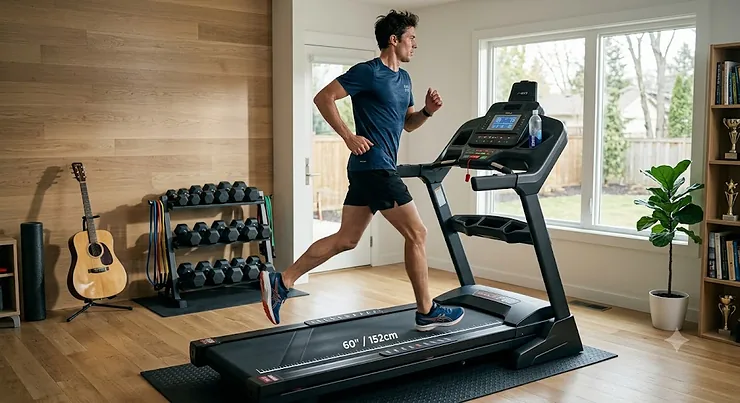
If you’ve ever finished a treadmill run feeling like you were tap-dancing along the back edge of the belt, you already know why a treadmill 60 inch belt matters more than any flashy touchscreen or built-in speaker. A short deck doesn’t just feel cramped — it clips your stride, forces you to shorten your gait mid-run, and eventually turns “cardio day” into “please don’t fall off the back of this thing” day. That’s a real problem for anyone over 6 feet tall, anyone with a long natural stride, or anyone who trains like an athlete rather than strolls like a window-shopper.
Here’s the honest version of what most buying guides gloss over: belt length is a spec that only matters once you understand your own stride, your height, and how you actually plan to use the machine. A 60 inch deck isn’t automatically “better” — it’s better for a specific kind of runner, and this guide is built to help you figure out whether you’re that runner. We’ve spent hours digging through real spec sheets, verified user reviews, and manufacturer documentation to pull together seven genuinely long-deck treadmills worth your money in 2026, from budget-friendly folding units to a motorless curved machine built for explosive athletes.
Cardio isn’t optional if you care about long-term health — the CDC’s physical activity guidelines for adults call for at least 150 minutes of moderate-intensity aerobic activity a week, or 75 minutes of vigorous activity like running, and a treadmill that actually fits your stride is what makes hitting that number sustainable instead of miserable. Let’s get into the deck lengths, the deals, and the details that actually matter.
Quick Comparison Table
Before the deep dive, here’s a fast-scan snapshot of all seven picks. Every one of these machines features a genuine 60-inch (or longer) running surface, which puts them well above the 50-to-55-inch decks you’ll find on most entry-level treadmills.
| Treadmill | Deck Size | Motor | Price Range | Best For |
|---|---|---|---|---|
| Horizon T202 | 20″ x 60″ | 2.75 CHP | Under $800 | Budget-conscious tall walkers |
| Sole F63 | 20″ x 60″ | 3.0 CHP | $1,000-$1,200 range | First-time long-deck buyers |
| Horizon 7.4 AT | 22″ x 60″ | 3.5 CHP | $1,500-$1,700 range | Serious mid-range runners |
| NordicTrack Commercial 1750 | 22″ x 60″ | 4.25 CHP | Around $2,000 | Streaming, interval training |
| Sole F80 | 22″ x 60″ | 3.5 CHP | $2,000-$2,300 range | Subscription-free heavy use |
| Sole F85 | 22″ x 60″ | 4.0 CHP | Around $2,300 | Daily mileage, larger frames |
| AssaultRunner Elite | ~62″ curved deck | Motorless | Around $4,000 | Basketball players, sprint work |
Look closely and a pattern jumps out: nearly every model in the mid-range and above ships with a 22-inch-wide deck to go with that 60-inch length, not just the 20-inch width you’ll find on the true entry-level machines. That extra two inches of width matters more than you’d think once you’re moving at 8+ mph, because a wider belt gives your natural side-to-side foot placement more forgiveness during fast strides. The AssaultRunner Elite breaks the mold entirely with its curved, motorless deck — a fundamentally different training tool that trades convenience for pure athletic output, which is exactly why it earns its spot for basketball players and sprint-focused athletes further down this list.
💬 Just one click — help others make better buying decisions too!😊
Top 7 Treadmills With a 60 Inch Belt: Expert Analysis
1. Horizon T202 — a genuine 60-inch deck for under $800
Most treadmills priced under $1,000 quietly shrink their belt to 50 or 55 inches to hit that price point, but the Horizon T202 doesn’t cut that corner. Its 20″ x 60″ running surface pairs with a 2.75 CHP motor and a 12% incline range, which is a surprisingly complete package for the price. Based on the spec comparison against other sub-$800 machines, the deck length here is the standout feature — the motor and screen are modest, but the thing that actually determines whether you can run comfortably is present and correct.
This is a smart pick for taller walkers and casual joggers who don’t need iFit subscriptions, giant touchscreens, or commercial-grade horsepower — just room to move. Reviewers consistently note that the T202 feels stable at walking and light jogging speeds, though a few mention the motor working harder at sustained speeds above 8 mph, which tracks with its modest CHP rating. If you’re 6’2″ and mostly walk or jog rather than sprint, this machine punches well above its price class.
Pros:
- ✅ Genuine 60-inch deck at a budget price point
- ✅ 12% incline range adds real workout variety
- ✅ Simple interface with no forced subscription
Cons:
- ❌ 2.75 CHP motor strains at higher sustained speeds
- ❌ Smaller LCD screen with limited workout data
Expect to pay somewhere under $800 at the time of research, and treat it as a walking-and-jogging machine rather than a sprint trainer — for that price range, it’s one of the better values on this list.
2. Sole F63 — the smartest first long-deck treadmill
The Sole F63 sits at the entry point of Sole’s lineup, but don’t mistake “entry point” for “stripped down.” What most buyers overlook about this model is that Sole builds its full 20″ x 60″ deck and 2-ply belt into even its cheapest treadmill, rather than reserving the long deck for pricier tiers the way some competitors do. A 3.0 CHP motor and a 325-pound weight capacity round out a machine that’s clearly aimed at everyday runners rather than elite athletes.
Here’s what the spec sheet won’t tell you, but owner feedback across Sole’s product line suggests: Sole treadmills earn their reputation from commercial hospitality use, where hotel gyms need machines that survive constant abuse without a service contract. That pedigree shows up in the F63’s welded (not bolted) frame joints. For a first “real” treadmill purchase, especially for a household transitioning from a short-deck hand-me-down, this is the logical step up.
Pros:
- ✅ Full 60-inch deck even at entry-level pricing
- ✅ Commercial-grade welded frame construction
- ✅ Simple to assemble and maintain long-term
Cons:
- ❌ 10 mph top speed limits serious sprint training
- ❌ Smaller 9-inch display compared to pricier siblings
The F63 typically runs in the $1,000-$1,200 range, and the value case is straightforward: you’re paying for durability and deck length, not bells and whistles.
3. Horizon 7.4 AT — the mid-range sweet spot for real runners
Step up to the Horizon 7.4 AT and the deck grows to a full 22″ x 60″, two inches wider than the entry-level Horizon T202. That width difference sounds small on paper, but based on the spec comparison with narrower decks, it’s the difference between feeling secure during interval sprints and feeling like you’re threading a needle. A 3.5 CHP motor backs it up, along with Horizon’s 3-Zone Variable Response Cushioning, which softens impact at heel-strike while staying firmer through toe-off.
This is the machine for someone who actually trains — HIIT intervals, tempo runs, Peloton or Zwift app workouts via Bluetooth — rather than someone who just wants a treadmill in the corner of the basement. Reviewers consistently note the belt feels planted even at higher speeds, though a handful of owners report occasional static shock issues, a known quirk in low-humidity homes that’s worth flagging honestly rather than glossing over.
Pros:
- ✅ 22-inch-wide, 60-inch-long deck built for hard training
- ✅ Bluetooth connects to Peloton, Zwift, and Studio apps
- ✅ Lifetime frame and motor warranty
Cons:
- ❌ Some owners report static buildup in dry climates
- ❌ No built-in touchscreen for on-console streaming
Priced in the $1,500-$1,700 range, the 7.4 AT earns its reputation as one of the better all-around picks for runners who take training seriously without needing a subscription-driven ecosystem.
4. NordicTrack Commercial 1750 — the long deck built for streaming
The NordicTrack Commercial 1750 brings a 22″ x 60″ belt and a genuinely powerful 4.25 CHP motor, the strongest on this list outside of the specialty pick. What most buyers overlook about this model is that its incline range runs from -3% to 12%, meaning it’s one of the few home treadmills that can simulate a downhill grade — useful for anyone training for a race with actual elevation changes, not just flat park loops.
The 16-inch swiveling HD touchscreen now streams Netflix and Spotify alongside iFit, and SmartAdjust technology automatically shifts speed and incline to match a trainer-led session or your real-time heart rate. Reviewers consistently praise the immersive workout catalog, though the honest trade-off is that iFit access carries an ongoing subscription cost, unlike several other machines on this list. For anyone who wants entertainment and guided coaching built directly into a long-deck treadmill, this is the strongest contender.
Pros:
- ✅ Powerful 4.25 CHP motor handles hard interval work
- ✅ Rare -3% to 12% incline/decline range
- ✅ Large streaming touchscreen with Netflix and Spotify
Cons:
- ❌ iFit subscription required to unlock full features
- ❌ 300-pound weight capacity is lower than some rivals
Expect to pay around $2,000 at the time of research. If subscription fatigue isn’t a concern for you, the 1750 delivers the most tech-forward package on a genuine 60-inch deck.
5. Sole F80 — the subscription-free workhorse for tall runners
The Sole F80 is where Sole’s lineup shifts from “solid” to “built like a tank.” A 3.5 HP brushless motor drives a 22″ x 60″ CushionFlex Whisper deck, and the 2.36-inch rollers — noticeably larger than the sub-2-inch rollers on cheaper machines — reduce strain on the motor and extend belt life. Based on the spec comparison, that roller size is a detail most shoppers never think to check, but it’s one of the clearer signals of long-term durability.
What most buyers overlook about the F80 is the complete absence of a required subscription. You get a 10.1-inch streaming touchscreen and full workout programming without a recurring fee, which reviewers consistently point to as the reason they chose Sole over NordicTrack or ProForm. One long-term owner reported the lifetime motor warranty came through without hassle after three years of use, which is exactly the kind of real-world signal that matters more than a spec sheet.
Pros:
- ✅ No monthly subscription required for full functionality
- ✅ Large 2.36-inch rollers extend belt and motor life
- ✅ 350-pound weight capacity suits larger, taller runners
Cons:
- ❌ Heavy 285-pound shipping weight complicates setup
- ❌ Optional white-glove delivery adds to the price
Pricing sits in the $2,000-$2,300 range depending on promotions. For a tall runner who wants a genuine long-term investment without recurring fees, the F80 is one of the strongest value propositions here.
6. Sole F85 — the premium 60-inch deck for daily mileage
The Sole F85 tops Sole’s folding lineup with a 4.0 CHP motor, a 22″ x 60″ deck, and a 375-pound weight capacity — the highest capacity of any folding treadmill on this list. Here’s what the spec sheet won’t tell you, but user reports suggest: multiple owners over 300 pounds describe the belt staying steady and wobble-free at full speed, which is a meaningful real-world confirmation of that capacity rating rather than just a marketing number.
A 15.6-inch HD touchscreen, wireless charging, and screen mirroring round out the tech package, while a -6% decline setting joins the 15% incline range for genuinely varied terrain simulation. One owner with a torn meniscus specifically credited the F85’s cushioned deck with reducing joint impact enough to keep running through recovery — the kind of aggregated review detail that speaks to real cushioning performance rather than just marketing copy. For daily heavy mileage, this is about as close to a home-commercial hybrid as you’ll find without stepping into true light-commercial pricing.
Pros:
- ✅ Highest weight capacity (375 lbs) of any folding pick
- ✅ Rare -6% decline plus 15% incline range
- ✅ Largest touchscreen in the Sole lineup
Cons:
- ❌ Around $2,300, the priciest folding option on this list
- ❌ 294-pound unit weight makes relocation a two-person job
At roughly $2,300 at the time of research, the F85 is the premium pick for anyone who runs most days of the week and wants the deck, motor, and cushioning to hold up to that volume.
7. AssaultRunner Elite — the motorless curved deck for explosive athletes
The AssaultRunner Elite breaks completely from the folding-motorized formula. It’s a self-powered, curved-deck treadmill with a slatted belt that moves entirely from your own foot strike — there’s no motor, no plug, and no top-speed ceiling other than your own legs. The curved running surface spans roughly 62 inches, and because the belt’s speed is dictated entirely by your stride rather than a preset motor speed, it naturally rewards explosive, powerful footstrikes over shuffling steps.
This is precisely why it earns a spot for basketball players and other athletes doing sprint intervals, suicides, or acceleration drills: the machine responds instantly to bursts of speed the way a motorized belt simply can’t, since there’s no lag while a motor spins up. Assault Fitness rates the belt to withstand roughly 150,000 miles of use, and the frame carries a 400-pound weight capacity — the highest on this list. Reviewers consistently note a real learning curve for new users, since running on a self-propelled curved belt requires different mechanics than a flat motorized deck.
Pros:
- ✅ Instant response for sprint and acceleration training
- ✅ No motor means near-zero long-term maintenance
- ✅ 400-pound weight capacity, the highest here
Cons:
- ❌ Real learning curve for first-time curved-treadmill users
- ❌ Around $4,000, by far the priciest option here
At around $3,999-$4,000, this isn’t a casual buy — it’s a specialty tool for athletes who need explosive, sport-specific conditioning, and the price reflects that narrower purpose rather than general household use.
Real-World Scenarios: Who Actually Needs a 60 Inch Deck
Specs only mean something once you match them to a real person and a real routine. Here are three profiles that show how the calculus changes depending on who’s stepping on the belt.
The 6’4″ home-office commuter. He works from home, walks during calls, and jogs three mornings a week at a moderate pace. He doesn’t need the AssaultRunner’s explosive response or NordicTrack’s downhill simulation — he needs a deck long enough that his natural stride doesn’t get clipped during a light jog. The Horizon T202 or Sole F63 covers this use case at a fraction of the cost of the premium picks, because his stride length at jogging pace rarely exceeds what a 60-inch deck comfortably handles.
The high school basketball player training for a growth spurt. She’s 5’11” as a sophomore and still growing, doing conditioning work between practices — sprint intervals, defensive slide drills, explosive acceleration bursts. A motorized deck with a spin-up lag actively works against this kind of training. The AssaultRunner Elite matches her effort instantly, which is exactly the point of self-propelled sprint conditioning.
The marathon-training software engineer. He’s 6’1″, logs 40+ miles a week, and wants downhill simulation to mimic race-day elevation drops. The NordicTrack Commercial 1750‘s -3% to 12% incline range and strong 4.25 CHP motor make it the clear fit, especially paired with iFit’s guided long-run coaching.
Problem → Solution: Fixing Common 60 Inch Belt Complaints
Problem: You feel like you’re still running off the back of the belt. Even a 60-inch deck can feel short if your stride outpaces your treadmill’s speed capability. Solution: check your treadmill’s top speed against your actual pace, and consider a model like the Horizon 7.4 AT or NordicTrack Commercial 1750, both of which top out at 12 mph with a wider 22-inch deck to match.
Problem: The treadmill wobbles or flexes noticeably during sprints. This usually traces back to roller size and frame welds rather than belt length. Solution: models like the Sole F80 and Sole F85, built with 2.36- to 2.75-inch rollers and welded steel frames, are specifically engineered to stay planted under hard footstrikes.
Problem: You’re paying a monthly fee just to unlock features you already paid for in the hardware. Solution: if subscription costs bother you, the Sole F80 and Sole F85 deliver full touchscreen functionality with zero recurring charges — a meaningful long-term savings compared to iFit-dependent machines.
Problem: Your motorized treadmill can’t keep up with explosive sprint drills. Motors take time to spin up, which creates real lag during interval work. Solution: a self-powered curved treadmill like the AssaultRunner Elite eliminates that lag entirely, since belt speed is dictated by your own foot strike.
Problem: You don’t know if 60 inches is even enough for your height. Solution: measure your actual stride (see the calculator method below) rather than guessing from height alone — a 6’0″ walker and a 6’0″ sprinter need very different deck lengths.
Buyer’s Decision Framework
Use this simple framework to cut through the spec-sheet noise:
- If you’re under 6 feet tall and mostly walk or jog, choose a 20″ x 60″ budget deck like the Horizon T202 because your stride rarely challenges a 60-inch length at moderate speeds.
- If you’re over 6 feet tall and run regularly at 7+ mph, choose a 22″ x 60″ mid-range deck like the Horizon 7.4 AT because the extra width matters as much as the length once speed increases.
- If you want guided coaching and downhill simulation for race training, choose the NordicTrack Commercial 1750 because its incline/decline range and iFit integration are built for structured training plans.
- If you want maximum durability with zero subscription costs, choose the Sole F80 or Sole F85 because their larger rollers and welded frames are built for years of daily heavy mileage.
- If you’re training for explosive sports like basketball, choose the AssaultRunner Elite because motorless curved decks respond instantly to sprint bursts in a way motorized belts cannot.
How to Choose a Treadmill With a 60 Inch Belt
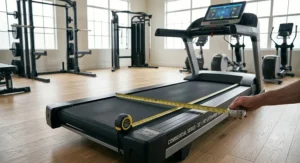
A treadmill 60 inch belt is generally the running-focused benchmark length recommended for taller users and anyone with a full running stride, as opposed to the shorter 50-to-55-inch decks built for walkers. Here’s how to actually pick the right one:
- Measure your real stride, not your height alone. Height correlates loosely with stride length, but pace changes everything — a slow jog and a fast sprint from the same person can differ by a foot or more.
- Match deck width to your training intensity. A 20-inch width is fine for walking and light jogging; serious runners benefit from 22 inches once speed climbs above 7-8 mph.
- Check the motor’s continuous horsepower (CHP), not peak horsepower. A 3.0+ CHP motor handles sustained running better than a lower-rated motor pushed to its limit.
- Verify the weight capacity against your actual body weight, not just the deck size. A long deck with a low weight rating still isn’t the right fit for a heavier or taller frame.
- Decide if you want motorized or motorless. Motorized decks suit steady-state training and guided coaching; motorless curved decks suit explosive, variable-speed athletic work.
- Factor in your ceiling height. A general rule is your height plus the deck’s height off the floor plus about 6 inches of clearance for safety.
- Budget for delivery and assembly, not just the sticker price. Long-deck treadmills are heavy — some retailers charge separately for room-of-choice delivery or setup.
Belt decks around 60 inches are generally recommended for runners, with shorter lengths suiting joggers and walkers, though as our treadmill sizing breakdown from BarBend notes, the right number always comes back to your individual stride rather than a one-size-fits-all rule.
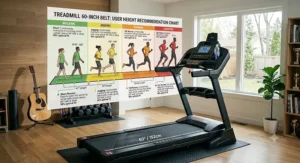
Treadmill Deck Length for Height Chart
Height correlates with stride length, but it’s not a perfect match — pace, leg proportion, and running form all shift the number. Use this as a starting reference, not gospel.
| Height | Typical Walking Stride | Typical Running Stride | Recommended Deck Length |
|---|---|---|---|
| Under 5’6″ | ~24-27″ | ~40-48″ | 48-55 inches |
| 5’6″ – 5’11” | ~27-30″ | ~48-56″ | 55-60 inches |
| 6’0″ – 6’3″ | ~30-33″ | ~56-62″ | 60 inches minimum |
| Over 6’3″ | ~33″+ | ~62″+ | 60-65+ inches |
Looking at the chart, the gap between walking and running stride length is the real story here — someone at 5’10” who only walks may never need a 60-inch deck, but the moment they start running intervals, that same height pushes comfortably past the 55-inch threshold. Garage Gym Reviews echoes this pattern in their own testing: their expert-tested breakdown of treadmills for tall runners recommends anyone around 5’9″ or taller shop exclusively for 55-to-60-inch decks once running enters the picture, which lines up closely with the ranges above.
Stride Length Calculator: Find Your Ideal Deck Length
You don’t need an app for this — a simple stride length calculator is just basic math you can do on your own floor. Here’s the method:
- Find a flat, safe surface at least 15 feet long.
- Run at your typical training pace for 10 full strides.
- Mark your heel position at the start and after the 10th stride.
- Measure the total distance, then divide by 10 to get your average stride length.
- Add roughly 10 inches of safety margin to that number.
- Compare the result against a treadmill’s running deck length, not its overall product length.
If your calculated number lands close to a manufacturer’s deck length rather than comfortably under it, size up. Fatigue lengthens some runners’ strides and shortens others’, and you want margin either way, especially during interval work when form tends to break down toward the end of a hard set.
Common Mistakes When Buying a Long Deck Home Treadmill
Shopping for a long deck home treadmill introduces a few pitfalls that don’t show up on shorter-deck machines:
- Ignoring belt width in favor of length alone. A 60-inch-long, 18-inch-wide deck still feels narrow at speed — width and length work together, not independently.
- Underestimating footprint requirements. A 60-inch deck typically needs roughly 3 feet by 7 feet of floor space for the machine itself, plus safety clearance behind and beside it.
- Assuming folded storage height won’t change. Longer decks generally stand taller once folded upright, which matters for anyone storing a unit in a room with a low ceiling or sloped basement wall.
- Skipping the ceiling-height math. Tall runners on incline settings need real headroom — add your height, the deck’s step-up height, and roughly 6 inches of margin to find your minimum ceiling clearance.
- Buying based on marketing screenshots instead of verified reviews. Aggregated user feedback on long-term belt tracking and motor durability tells you far more than a product photo ever will.
60 Inch Belt vs Standard 55 Inch Deck
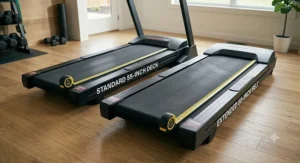
The difference between a 60-inch and 55-inch deck sounds small — five inches — but it shows up exactly where it matters most: the last few inches of your stride at speed.
| Factor | 60-Inch Deck | 55-Inch Deck |
|---|---|---|
| Best user height | 6’0″ and taller | Under 6’0″ |
| Best for | Running, sprint intervals | Walking, light jogging |
| Typical price premium | Moderate to high | Lower |
| Footprint | Larger | More compact |
| Common on | Mid-to-premium models | Entry-level and compact units |
The core trade-off here is space versus stride freedom: a 55-inch deck fits more comfortably into a small apartment or shared workout room, while a 60-inch deck gives a taller or faster runner the room to actually extend into a natural stride without constantly adjusting their gait. Neither is objectively “better” — the Sole F63 on a 60-inch deck serves a very different buyer than a compact 55-inch walker’s treadmill, and matching the deck to your actual training intensity matters more than defaulting to the longer option out of habit.
✨ Don’t Miss These Exclusive Deals!
🔍 Take your home cardio setup to the next level with these carefully selected long-deck treadmills. Click on any highlighted model to check current pricing and availability. These machines will help you build the consistent running habit your goals actually depend on!
Treadmill for Basketball Players: What Actually Matters
Basketball demands short, explosive bursts far more than steady-state pacing, and that changes what “best treadmill” even means for a player. A treadmill for basketball players needs to reward acceleration, not just accommodate a long stride at a fixed motor speed.
The biggest factor is response time. A standard motorized belt has to physically spin up to match a sudden sprint, which creates a split second of mismatch between your foot strike and the belt’s speed — annoying at best, and a fall risk at worst during max-effort work. This is exactly why a self-powered curved deck like the AssaultRunner Elite earns its place on serious athletes’ equipment lists: since the belt moves only as fast as your legs drive it, there’s no lag to fight against during suicides, defensive slides, or acceleration intervals.
That said, not every basketball player needs a $4,000 motorless machine. A player doing steady aerobic base-building work — longer, lower-intensity runs to build conditioning between seasons — is often better served by a motorized deck like the Horizon 7.4 AT, which handles that kind of structured, repeatable pacing more comfortably than a manual belt that requires constant self-generated effort. Match the tool to the training phase: explosive interval work favors motorless, steady conditioning favors motorized.
Treadmill for Tall Man: What to Check Before You Buy
A treadmill for tall man shopping isn’t just about deck length — height changes several specs that shorter buyers rarely think twice about. Start with step-up height: a taller frame combined with a high step-up (some premium decks sit 8-12 inches off the floor) means real ceiling clearance math matters, especially in basements with ductwork or low overhead beams.
Handrail height and console reach matter more than most spec sheets admit. A console designed for an average 5’8″ user can feel awkwardly low for someone well over 6 feet, forcing a hunched posture during incline work. Reviewers who are 6’4″ and taller consistently mention this in feedback on models like the Sole F80, where the reach to the console remains comfortable specifically because of the machine’s taller overall frame height. Weight capacity is the other overlooked factor — taller frames often carry more total body weight even at a lean build, so checking the capacity rating against your actual weight (not just assuming “it’s a big treadmill, it’ll be fine”) avoids a costly mismatch.
Finally, don’t ignore the belt’s usable width. A tall runner with broader shoulders and a wider natural gait benefits from the 22-inch width found on the Sole F85 and NordicTrack Commercial 1750 far more than the standard 20-inch width on budget decks, even at the same 60-inch length.
Long-Term Cost & Maintenance
The sticker price is only part of the real cost of a 60-inch treadmill. Subscription-dependent machines like the NordicTrack Commercial 1750 carry an ongoing iFit membership fee that, over three years, can add up to a meaningful chunk of the machine’s original purchase price — worth factoring into your total cost of ownership math before you buy, not after.
Belt maintenance is the other recurring cost most buyers underestimate. A quality 2-ply belt, properly lubricated on schedule, can last close to a decade of regular use, but neglect accelerates wear regardless of how premium the original deck was. Larger rollers, like the 2.36-to-2.75-inch versions on the Sole F80 and Sole F85, reduce strain on both the belt and motor over time, which is part of why those models carry lifetime frame and motor warranties with confidence. The AssaultRunner Elite flips this calculus entirely — no motor means essentially no motor-related maintenance costs, though its belt and frame components still need periodic attention given the mechanical stress of self-powered use.
Staying consistent with cardio pays off well beyond the treadmill itself. The American Heart Association’s physical activity recommendations echo the CDC’s guidance on weekly aerobic minutes, and a machine that fits your body comfortably is simply more likely to get used consistently — which, over years, is worth far more than any single spec on a sheet.
FAQ
❓ What is the average treadmill belt length?
❓ Do I need a 60 inch treadmill if I'm 6 feet tall?
❓ How much does a 60 inch treadmill cost?
❓ Is a wider treadmill belt better than a longer one?
❓ Can basketball players use a regular treadmill?
Conclusion
Choosing a treadmill 60 inch belt isn’t about chasing the biggest number on a spec sheet — it’s about matching deck length, width, and motor type to your actual height, stride, and training style. A casual walker at 5’11” and a sprint-training basketball player at the same height need genuinely different machines, even though both might technically “fit” on a 60-inch deck. Start with your real stride length, be honest about how you’ll actually train, and let that — not marketing copy — drive the decision.
From the budget-friendly Horizon T202 to the explosive, motorless AssaultRunner Elite, the seven picks above cover nearly every version of that decision. Whichever you land on, the goal is the same: a machine that lets you run like yourself, not like someone squeezed onto a deck too short for their stride.
Recommended for You
- Treadmill for Tall Runners: 7 Long-Deck Picks for 2026
- Extra Wide Treadmill Belt: 7 Best Picks for Stability (2026)
- Treadmill 500 Lb Weight Capacity: 7 Strongest Picks for 2026
Disclaimer: This article contains affiliate links. As an Amazon Associate, I earn from qualifying purchases. If you purchase products through these links, we may earn a small commission at no additional cost to you.
✨ Found this helpful? Share it with your friends! 💬🤗
