
In This Article
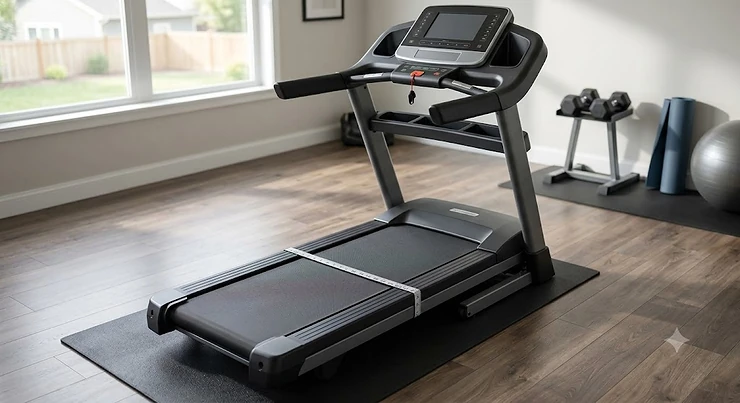
Ever felt like your treadmill was built for somebody two sizes smaller than you? You’re mid-stride, your arm swings out a little wide on a fast interval, and suddenly your knuckles are grazing the side rail. That’s not a “you” problem. That’s a belt problem. A standard treadmill 22 inch wide belt exists precisely because a huge chunk of runners — tall folks, broad-shouldered folks, anyone who runs with a bit of natural sway — simply don’t fit the narrow 18 to 20-inch decks that dominate the budget end of the market. This guide digs into seven real, currently-sold machines with genuinely wide running surfaces, breaks down what the spec sheets actually mean once your feet hit the belt, and shows you how to pick the one that fits your body instead of the other way around. We pulled real specs, real owner feedback, and real comparative data so you’re not just reading a rehashed product listing — you’re getting the analysis Amazon’s own pages never bother to give you. According to the Physical Activity Guidelines for Americans, adults need at least 150 minutes of moderate-intensity activity a week, and a treadmill that actually fits your frame is one of the easiest ways to make sure you keep showing up for those minutes instead of dreading them.
Quick Comparison Table: 22-Inch Wide Belt Treadmills at a Glance
| Model | Belt Size | Motor | Best For | Price Range |
|---|---|---|---|---|
| Horizon 7.4 AT | 22″ x 60″ | 3.5 CHP | Budget entry point | Around $1,600–$1,800 |
| Sole F80 | 22″ x 60″ | 3.5 HP | Best all-around value | $1,800–$2,000 range |
| Horizon 7.8 AT | 22″ x 60″ | 4.0 CHP | HIIT and interval training | Under $2,200 |
| NordicTrack Commercial 1750 | 22″ x 60″ | 4.25 CHP | Smart screen experience | $2,400–$2,800 range |
| Bowflex Treadmill 22 | 22″ x 60″ | 4.0 HP | Oversized touchscreen tech | $2,600–$3,000 range |
| NordicTrack X24 | 22″ x 60″ | 4.25 CHP | Incline/decline training | Around $2,900–$3,500 |
| 3G Cardio Elite Runner | 22″ x 62″ | 4.0 HP | Premium, subscription-free | $3,900–$4,500 range |
Look at that spread for a second: every single one of these machines clears the 22-inch mark, but the belts still aren’t identical, and neither are the buyers they’re built for. The Horizon 7.4 AT and Sole F80 prove you don’t need to spend commercial-gym money to get a genuinely wide, stable deck, while the 3G Cardio Elite Runner shows what happens when you stretch that belt to 62 inches long and skip the touchscreen entirely in favor of raw durability. If your budget caps out around $2,000, the first three models on this list deserve your attention first; if screen size and app integration matter more than price, jump straight to the NordicTrack Commercial 1750 or Bowflex Treadmill 22.
💬 Just one click — help others make better buying decisions too!😊
Top 7 Treadmills With a 22 Inch Wide Belt: Expert Analysis
1. Horizon 7.4 AT — best budget entry into true 22-inch comfort
The 7.4 AT proves that a wide belt doesn’t have to come with a premium price tag attached to it. Its 22″ x 60″ deck matches machines costing a thousand dollars more, which is honestly a little wild for the price bracket it lives in. The 3.5 continuous-horsepower motor and 15% max incline mean it isn’t just wide — it can also handle hill work without straining, and Horizon backs the frame and motor with a lifetime warranty that most competitors in this price range simply don’t offer. Based on the spec comparison against other sub-$2,000 machines, this is the one we’d point a first-time buyer toward if their main complaint has always been “the belt feels too small.” Reviewers consistently report that the deck feels noticeably more stable during faster intervals than the 20-inch models they’d previously owned, and several long-term owners specifically mention it accommodating tall training partners without complaint. It isn’t loaded with entertainment features, and the console is refreshingly simple — a strength if you hate fumbling through menus, a weakness if you were hoping for a big touchscreen.
Pros:
- ✅ 22″ x 60″ belt at a genuinely budget-friendly price point
- ✅ Lifetime frame and motor warranty is rare at this tier
- ✅ Rotary QuickDial controls make speed changes effortless
Cons:
- ❌ Console lacks a large touchscreen or app-driven workouts
- ❌ Fewer built-in programs than pricier Horizon models
At around $1,600–$1,800, the Horizon 7.4 AT is arguably the best value entry point on this entire list for anyone who just wants the deck without the tech premium.
2. Sole F80 — best all-around value for broad-shouldered runners
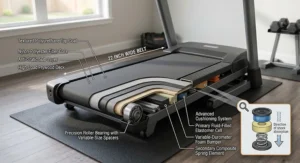
What most buyers overlook about the F80 is that its 22″ x 60″ Cushion Flex Whisper Deck isn’t just wide — it’s engineered to cut joint impact, with Sole claiming up to a 40% reduction versus a hard surface. The 3.5 HP motor and 2.36-inch rollers (noticeably larger than the sub-2-inch rollers on many rivals) mean the belt tracks smoothly even when a heavier or broader-framed runner is putting real force through it. The 10.1-inch touchscreen supports Netflix and YouTube without locking you into a mandatory monthly subscription, which is a genuine differentiator against app-dependent competitors. Reviewers consistently note the deck feels “unanimously” smooth and quiet, and testers weighing over 300 pounds have specifically reported the belt staying steady at full speed with no wobble. This is the machine we’d recommend to someone who wants commercial-grade bones without being locked into recurring fees.
Pros:
- ✅ 22″ x 60″ deck with genuinely joint-friendly cushioning
- ✅ No mandatory subscription for entertainment streaming
- ✅ Lifetime warranty on frame and motor
Cons:
- ❌ No decline setting, incline only
- ❌ Some owners note occasional belt squeaking without regular lubrication
Priced in the $1,800–$2,000 range, the Sole F80 is our pick for broad-shouldered runners who want the widest deck they can get without also signing up for a streaming platform.
3. Horizon 7.8 AT — best for HIIT and interval training
Here’s what the spec sheet won’t tell you outright: the 7.8 AT’s “Rapid Sync” motor technology means the belt accelerates and decelerates noticeably faster than most competitors when you’re bouncing between sprint and recovery pace, which matters enormously once you’re actually mid-interval and don’t want to wait a full second for the belt to catch up. Layer that onto the same 22″ x 60″ deck and 3-Zone Variable Response cushioning found across the Horizon lineup, and you get a machine explicitly tuned for HIIT rather than just steady-state jogging. The built-in Sprint 8 program gives structure to interval work without needing a subscription, and the included Bluetooth chest strap adds heart-rate tracking most machines charge extra for. Reviewers who’ve logged serious mileage on this model report the deck holds up well under repeated hard efforts, though a few flag that the incline mechanism can struggle under heavier loads at steep grades — worth noting if you’re over 250 pounds and planning aggressive hill work.
Pros:
- ✅ Rapid Sync motor built specifically for interval training
- ✅ 22″ x 60″ deck with 3-Zone cushioning
- ✅ Includes Bluetooth heart-rate chest strap
Cons:
- ❌ Incline mechanism reportedly strains under very heavy loads at max grade
- ❌ Screen is smaller and less flashy than iFit-style rivals
At under $2,200, the Horizon 7.8 AT earns its spot for anyone whose training plan revolves around structured intervals rather than long, easy miles.
4. NordicTrack Commercial 1750 — best smart screen experience
The 1750 takes the same 22″ x 60″ belt footprint as the budget options on this list and wraps it in a genuinely different console experience: a 16-inch HD touchscreen that pivots, full iFit integration, and a 4.25 CHP motor that’s simply stronger than anything below it in this roundup. What most buyers overlook is that the incline/decline range (up to 12% up, down to -3%) actually changes your training options, letting you simulate downhill running, which is something none of the Horizon models on this list can replicate. Based on the spec comparison, the 400-pound weight capacity is also the highest among the mid-tier machines here, giving it real headroom for heavier or taller users. The catch, and it’s a real one, is that you’re paying an ongoing iFit membership to unlock the screen’s full potential — treat that as part of the true cost of ownership, not an optional add-on.
Pros:
- ✅ 16″ pivoting touchscreen with full iFit compatibility
- ✅ 4.25 CHP motor, the strongest in this price tier
- ✅ 400-lb weight capacity with -3% to 12% incline/decline range
Cons:
- ❌ iFit subscription is effectively required to use the screen fully
- ❌ Bulkier footprint than the Horizon or Sole alternatives
Expect to pay in the $2,400–$2,800 range for the NordicTrack Commercial 1750, which makes the most sense for households that already plan on a fitness app subscription anyway.
5. Bowflex Treadmill 22 — best oversized touchscreen for immersive workouts
The name isn’t subtle: this is the model built around its screen, a full 22-inch HD touchscreen mounted above a matching 22″ x 60″ belt. On paper this means Bowflex designed the console and the deck to feel proportionate to each other, and in practice, testers describe the whole machine as feeling like a scaled-up, commercial-grade unit rather than a home compromise. The 4.0 HP motor and an incline range stretching from -5% to a full 20% actually out-climbs several pricier rivals, and the 400-pound weight capacity puts it in the same league as the NordicTrack Commercial 1750. What the spec sheet won’t spell out is that JRNY, Bowflex’s companion app, is required for the full interactive experience, and while its $149-per-year cost is more modest than some competitors, it’s still a recurring expense to plan around. Owners consistently describe the frame as “built like a tank,” with the 15-year frame and motor warranty backing that impression up.
Pros:
- ✅ 22″ x 60″ belt paired with a matching 22″ HD touchscreen
- ✅ 20% max incline, among the steepest in this roundup
- ✅ 15-year frame and motor warranty
Cons:
- ❌ JRNY subscription required for full interactive features
- ❌ Large 85″ x 40″ footprint demands a dedicated space
Priced around $2,700–$3,000, the Bowflex Treadmill 22 is the pick for buyers who want the screen and the belt to feel like one cohesive, premium package.
6. NordicTrack X24 — best for incline and decline training
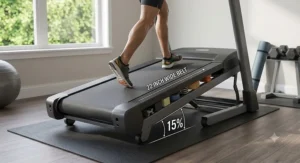
If your training goals lean toward hiking prep, rucking, or serious hill simulation, the X24 is the outlier on this list worth a hard look. It shares the same 22″ x 60″ belt and 4.25 CHP motor as the Commercial 1750, but the headline feature is an incline range that reportedly reaches as high as 40%, paired with a -6% decline setting most competitors don’t even attempt. Here’s what that means in practice: you can simulate steep mountain trails and downhill descents in the same session, something none of the flatter-incline machines on this list can touch. Based on the spec comparison, the 400-pound weight capacity keeps pace with the other premium entries, and the wide, stable deck becomes especially valuable at those extreme grades, where a narrower belt would feel genuinely precarious underfoot. Prices on incline trainers like this typically land in the $2,900–$3,500 range, and that premium mostly buys you the incline motor and reinforced frame rather than flashier entertainment features.
Pros:
- ✅ Extreme incline range up to roughly 40%, plus real decline capability
- ✅ 22″ x 60″ belt stays stable even at steep grades
- ✅ 4.25 CHP motor shared with NordicTrack’s Commercial line
Cons:
- ❌ Premium price mostly reflects the incline mechanism, not extra tech
- ❌ Overkill if you never plan to train on grades
Best suited to hikers, ruckers, and hill-training runners, the NordicTrack X24 typically runs in the upper-premium range discussed above.
7. 3G Cardio Elite Runner — best subscription-free premium pick
The Elite Runner stretches its belt even further than the rest of this list, at 22″ x 62″, giving taller runners genuine room to open up their stride length without worrying about clipping the front console. What most buyers overlook here is the Ortho Flex Shock suspension system, a thicker, more forgiving belt assembly that 3G Cardio specifically engineered to reduce impact stress compared to standard belts — and unlike several rivals on this list, none of it requires an ongoing app subscription to access. The 4.0 HP DC motor and 400-pound weight capacity put it firmly in commercial territory, and the company backs the drive motor with a lifetime residential warranty. Reviewers consistently frame this as “half the price of comparable commercial models,” which tracks with our own comparison against gym-grade equipment costing considerably more. The tradeoff is a genuinely premium price tag and a no-frills console that skips the big touchscreen entirely in favor of durability.
Pros:
- ✅ Extra-long 22″ x 62″ belt with Ortho Flex Shock cushioning
- ✅ No subscription required for any core feature
- ✅ Lifetime warranty on the DC drive motor
Cons:
- ❌ Premium price puts it out of reach for casual users
- ❌ Console is basic compared to touchscreen-driven rivals
At around $3,900–$4,500, the 3G Cardio Elite Runner is the choice for serious runners who want commercial-grade comfort and durability without ever thinking about a monthly bill again.
Practical Usage Guide: Setup, First 30 Days, and Belt Maintenance
Getting a wide-belt treadmill into your home is only step one — the next 30 days are where most owners either fall in love with the machine or start collecting excuses not to use it. First, give yourself real clearance: most manufacturers ask for three to four feet behind the machine, but running coaches typically recommend six feet of open space to avoid any risk of stumbling backward off the belt. Second, resist the urge to crank the incline and speed on day one just because the deck feels roomier than your last machine — a wider belt changes your confidence, not your cardiovascular fitness, so build back up gradually. Third, lubricate the belt on the schedule your manual specifies (commonly every three to six months) rather than waiting for squeaking to start, since a dry belt under a wider, heavier surface puts extra strain on the motor. Fourth, recalibrate belt tracking within the first two weeks; a brand-new wide belt can drift slightly off-center as it breaks in, and most consoles have a simple tensioning adjustment for this. Finally, resist over-tightening the belt “just in case” — a belt that’s too taut actually increases motor wear and defeats some of the cushioning benefits you paid for in the first place.
✨ Don’t Miss These Exclusive Deals!
🔍 Take your home cardio setup to the next level with these carefully selected, wide-belt treadmills. Click on any highlighted model to check current pricing and availability. These machines will help you build a comfortable running gait you’ll actually stick with!
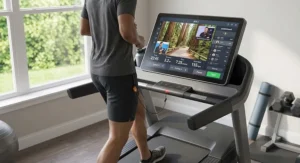
Real-World Scenarios: Who Actually Needs a 22-Inch Wide Belt
Picture Marcus, 6’3″ with broad shoulders from years of swimming, who spent two years running on a 20-inch belt and blamed his own form for the occasional side-rail bump during sprint work — turns out the belt was simply too narrow for his natural arm swing. For someone like Marcus, a machine like the Horizon 7.8 AT or Bowflex Treadmill 22 solves the problem directly rather than asking him to artificially narrow his gait. Then there’s Priya, a 145-pound recreational jogger who’s never felt cramped on a standard deck but wants a subscription-free machine she can hand down to her taller husband too — the Sole F80 hits that dual-use sweet spot nicely, wide enough for him, comfortable enough for her. And consider Dave, training for a mountain ultramarathon who needs serious incline and decline simulation more than he needs belt width alone; the NordicTrack X24‘s extreme grade range matters more to his training block than screen size ever will. None of these buyers have identical needs, but all three benefit from starting with belt width as the first filter, then layering in motor strength, incline range, and console features based on what their actual training demands.
What Is a Treadmill 22 Inch Wide Belt?
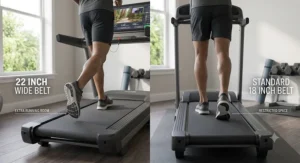
A treadmill 22 inch wide belt refers to a running surface measuring 22 inches across, roughly two inches wider than the 20-inch industry standard, designed to give taller, broader, or less centered runners extra lateral room so their natural stride and arm swing don’t clip the side rails during faster efforts.
That extra two inches sounds small until you’re actually running on it. Standard belts, sitting around 18 to 20 inches, work fine for runners with a compact, centered gait, but plenty of people naturally sway a bit side to side, especially as speed increases or fatigue sets in during longer sessions. A wider belt simply gives that natural movement somewhere to go without turning into a safety concern.
How to Choose a Treadmill 22 Inch Wide Belt
- Start with your height and stride, not the price tag. Runners over six feet generally benefit most from both the 22-inch width and a 60-inch (or longer) belt length, since a longer deck accommodates a longer stride without the risk of stepping off the back.
- Match motor size to your actual training style. A 3.0-3.5 CHP motor handles walking and light jogging fine, but serious interval or hill training benefits from 4.0 CHP or higher, as the motor won’t bog down during rapid speed changes.
- Decide upfront whether you’ll actually use a subscription app. iFit and JRNY unlock real value if you’ll use them weekly, but they add a recurring cost that should factor into your total budget comparison.
- Check the weight capacity against your actual body weight, not just your comfort zone. Manufacturers rate capacity conservatively, but running near the ceiling of a machine’s rating accelerates wear on motors and rollers.
- Consider incline (and decline) range based on your goals. Flat-focused runners can skip extreme incline machines entirely, while hikers or hill-training athletes should prioritize models with wider grade ranges.
- Measure your actual floor space before falling in love with a model. Wider belts mean larger overall footprints, and folding dimensions vary more than people expect between brands.
- Read the warranty terms on frame, motor, and parts separately. A “lifetime warranty” headline sometimes only covers the motor, so check what’s covered before assuming full protection.
Treadmill Belt Width Comparison: 20″ vs 22″ vs Slat Belt Decks
| Belt Type | Typical Width | Best Use Case | Tradeoff |
|---|---|---|---|
| Standard belt | 20 inches | Budget runners, compact frames | Less lateral room at speed |
| Wide belt | 22 inches | Taller or broader-shouldered runners | Larger footprint, slightly higher price |
| Slat belt | 20 inches, segmented | Low-impact walking/jogging | Different feel underfoot, less “give” |
The jump from 20 to 22 inches doesn’t sound dramatic on paper, but the comparison table above tells a more nuanced story: it’s not just about raw width, it’s about matching the deck type to how you actually move. A slat belt, like the one on Sole’s ST90, trades the continuous 2-ply fabric feel for individual segments that some runners find grippier but others describe as less forgiving on the joints during long runs. If hill-climbing on a budget is your priority, standard 20-inch belts remain perfectly viable for shorter, more centered strides, but anyone who’s ever bumped a side rail mid-sprint already knows which column they belong in.
Wide Belt Treadmill for Comfort: What Actually Changes Underfoot
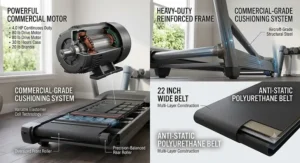
The comfort argument for a wide belt treadmill isn’t just psychological reassurance — it’s measurable. Cushioned decks on models like the Sole F80 and Horizon’s 3-Zone system are engineered to reduce peak impact forces, and manufacturers frequently cite reductions as high as 40% compared to running on a hard, unforgiving surface. Reviewers consistently note that a wider deck feels less “tunnel-like,” reducing the subconscious tension that builds when you’re worried about drifting toward an edge. That reduced tension matters more than it sounds: a runner who’s mentally relaxed tends to maintain smoother mechanics than one who’s subtly bracing against a narrow rail. The tradeoff is that wider, more heavily cushioned decks can feel slightly less responsive at very high speeds, since some of the energy return that a firmer surface provides gets absorbed into the cushioning instead — a fair exchange for most home users, but worth knowing if you’re training for track-specific speed work.
Treadmill for Broad Shoulders Runners: Matching Frame to Deck
Broad-shouldered runners face a specific, often-overlooked mismatch: shoulder width and stride width aren’t the same measurement, but they’re correlated closely enough that a naturally wider upper body often comes with a slightly wider arm swing and a bit more side-to-side sway during faster running. What most buyers overlook is that this isn’t a flaw to train out — it’s simply how your body moves efficiently, and fighting it by cramming onto a narrow belt can actually create compensatory movement patterns elsewhere in the kinetic chain. For this specific audience, prioritizing belt width over screen size or app features tends to deliver the most noticeable comfort improvement, and models like the Horizon 7.8 AT or 3G Cardio Elite Runner, both built with generous decks and sturdy frames rated for heavier users, tend to be the better long-term fit. If you’ve ever felt like you were “running in a hallway,” this is very likely the root cause, not your form.
Comfortable Running Gait & Treadmill Deck Specs Explained
Comfortable Running Gait
A comfortable running gait on a treadmill depends on more than belt width alone — deck length, cushioning firmness, and even motor responsiveness all shape how natural your stride feels. Research on stride length and running mechanics has found that a shorter stride tends to lower peak vertical ground reaction forces, which suggests the inverse also holds some truth: a deck that doesn’t artificially compress your natural stride or step width likely reduces unnecessary strain over a long run. Reviewers frequently describe the feeling of a wider, longer deck as “letting the stride open up naturally,” language that lines up with the biomechanical logic above — when you’re not subconsciously narrowing your gait to avoid an edge, your natural mechanics simply have room to happen.
Treadmill Deck Specs Explained
Deck specs on a spec sheet can look like alphabet soup, but three numbers matter most: width, length, and cushioning zone count. Width (commonly 20 or 22 inches) governs lateral room; length (typically 55 to 62 inches) governs how much stride room you have before your foot lands near the front console or back roller; and cushioning zones, like Horizon’s 3-Zone system, describe how the deck’s give varies from heel-strike to toe-off. A longer deck paired with a narrower belt, or vice versa, changes the running experience in genuinely different ways, so reading the full pair of numbers together — not just the marketing headline — tells you far more than either figure alone.
Common Mistakes When Buying a Wide Belt Treadmill
The most common mistake is buying based on motor horsepower alone and ignoring deck dimensions entirely, which leaves plenty of runners stuck with a powerful but cramped machine. A close second is assuming every “22-inch” listing refers to the belt when some manufacturers use that number to describe screen size instead, as seen with a few models on the market whose actual belt stays at the narrower 20-inch standard — always confirm the belt measurement specifically, not just the headline number. Buyers also frequently underestimate footprint: a wider belt almost always means a larger overall machine, and more than one owner has discovered their new treadmill barely fits through a doorway once assembled. Finally, skipping the subscription cost math is a frequent and expensive oversight — an iFit or JRNY membership can add hundreds of dollars a year on top of the treadmill’s sticker price, turning a “budget” screen-equipped model into one of the pricier options over a three-year span.
Long-Term Cost & Maintenance
The sticker price is only the opening bid in what a treadmill actually costs you over five years. Belt lubrication, typically needed every three to six months, runs a few dollars per bottle and takes ten minutes, but skipping it accelerates motor wear and can void certain warranty claims. Subscription-based models add real recurring costs: iFit commonly runs close to $39 a month if billed monthly, while JRNY’s roughly $149 annual fee is comparatively lighter — multiply either by five years and the gap between a subscription-free machine like the 3G Cardio Elite Runner and a screen-dependent rival narrows considerably. Motor and frame warranties matter enormously here too, since a lifetime guarantee on the drive motor (offered by several models on this list) can save you the cost of a full replacement motor, often running several hundred dollars out of warranty. When you tally lubricant, occasional belt replacement, subscription fees, and electricity use over five years, the “budget” machine with hidden subscription costs sometimes ends up pricier than the higher-sticker, subscription-free alternative.
Safety, Regulations & Compliance Guide
Treadmills are powerful pieces of equipment, and the extra size of a wide-belt model doesn’t reduce the need for basic precautions — if anything, it raises the stakes given the larger moving surface involved. The Consumer Product Safety Commission recommends leaving at least two feet of clearance on either side of a treadmill and six feet behind it to prevent falls into walls or nearby furniture. Always use the safety key or clip, and remove it whenever the machine isn’t actively in use, particularly in households with children or pets, since an inoperable belt simply can’t pose a moving hazard. Regularly inspect the belt for fraying or uneven wear, and don’t ignore unusual noises, which often signal a roller or lubrication issue before it becomes a bigger mechanical failure. None of this changes because your belt happens to be two inches wider — good habits scale with the machine, not against it.
Frequently Asked Questions
❓ What's the difference between a 20-inch and 22-inch treadmill belt?
❓ Are wide belt treadmills better for taller runners?
❓ Do I need a subscription to use a wide belt treadmill?
❓ How much does a 22 inch wide belt treadmill cost?
❓ Can a wide belt treadmill fit in a small home gym?
Conclusion
A treadmill 22 inch wide belt isn’t a luxury upgrade for the sake of it — it’s a fit correction for a huge number of runners who’ve spent years quietly adapting their stride to machines that were never built for their frame. Whether you land on the budget-friendly Horizon 7.4 AT, the subscription-free workhorse that is the Sole F80, or splurge on the 3G Cardio Elite Runner‘s extra-long deck, the through-line across every recommendation here is the same: match the belt and motor to how you actually move and train, not to whichever machine has the flashiest screen. Real comfort on a treadmill comes from spec sheets that translate into lived experience, not marketing copy, and that’s exactly what we’ve tried to unpack across every product and section above.
✨ Ready to Find Your Perfect Fit?
🔍 Compare these seven wide-belt treadmills side by side and pick the one that matches your height, budget, and training goals. Click through to check current availability before making your move!
Recommended for You
- Treadmill 60 Inch Belt: 7 Best Picks for Tall Runners (2026)
- Treadmill for Tall Runners: 7 Long-Deck Picks for 2026
- Extra Wide Treadmill Belt: 7 Best Picks for Stability (2026)
Disclaimer: This article contains affiliate links. As an Amazon Associate, I earn from qualifying purchases. If you purchase products through these links, we may earn a small commission at no additional cost to you.
✨ Found this helpful? Share it with your friends! 💬🤗
