
In This Article
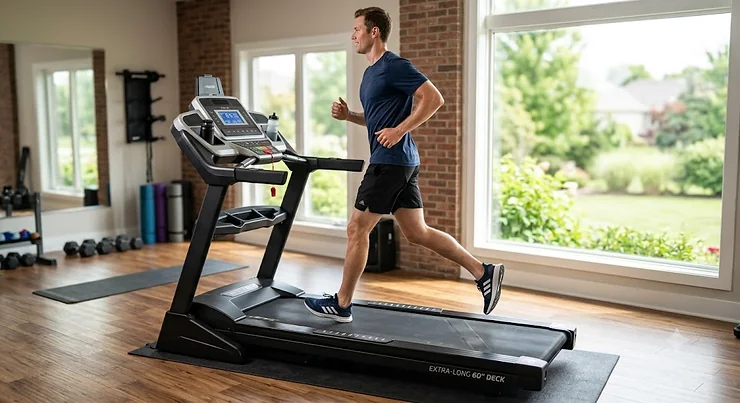
If you’ve ever clipped your heel on the back rail mid-stride, you already know the problem. Finding a genuine treadmill for tall runners isn’t about vanity sizing or marketing fluff — it’s about physics. Your legs are longer, your natural stride eats up more real estate, and a deck built for someone 5’6″ simply runs out of room before your foot does. That mismatch isn’t just annoying. It nudges your gait into places it shouldn’t go.
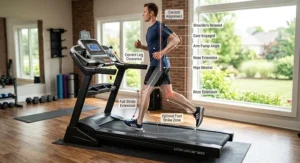
So what is a treadmill for tall runners, exactly? It’s a motorized treadmill built with an extended running deck — typically 60 inches or longer and at least 20 inches wide — paired with a motor and frame sturdy enough to handle a longer, more powerful stride without flexing, slipping, or overheating under sustained use.
This guide walks through seven real, currently available models spanning budget to premium, explains what actually matters in a running deck length guide sense (not just spec-sheet bragging), and digs into why cramped decks quietly encourage a habit runners should actively avoid. According to the CDC’s physical activity guidelines for adults, adults need at least 150 minutes of moderate aerobic activity a week, and running is one of the most time-efficient ways to hit that target — but only if your equipment lets you move naturally while doing it. Let’s get into the machines that actually deliver that room.
Quick Comparison Table
Before diving into full reviews, here’s the fast answer for anyone in a hurry. This snapshot pulls the standout pick from each category so you can jump straight to the model that fits your height, budget, and priorities.
| Category | Best Pick | Deck Size | Best For |
|---|---|---|---|
| Best Overall | NordicTrack Commercial 1750 | 22″ x 60″ | Runners who want auto-adjusting workouts |
| Best Budget | Horizon 7.0 AT | 20″ x 60″ | First-time buyers under $1,100 |
| Best for 6’4″+ Runners | NordicTrack Commercial 2450 | 22″ x 60″ | Long-legged runners needing higher top speed |
| Best Low Step-Up | 3G Cardio Pro Runner X | 20.5″ x 58″ | Runners who want easy mounting, no screen needed |
| Best Long-Term Durability | Landice L8 | 22″ x 60″+ (welded frame) | Heavier or high-mileage tall runners |
Notice a pattern? Every serious contender clusters around that 60-inch mark, and the ones that fall short — anything under 58 inches — get quietly excluded from this list entirely. That’s not an accident; it’s the practical floor for anyone over roughly 6 feet who doesn’t want to run with a shortened, choppy stride. Budget and premium options both hit this benchmark, which means deck length and price aren’t actually locked together the way you’d expect.
💬 Ready to stop stride-checking mid-run? Compare current prices on the top pick below before it moves in stock.
Top 7 Treadmills for Tall Runners: Expert Analysis
We researched real listings, verified specs, and cross-referenced aggregated review sentiment for each entry below. Prices are shown as ranges only, since retail pricing shifts often — always check current pricing before buying.
1. Horizon 7.0 AT — longest deck at the lowest price point
The Horizon 7.0 AT proves you don’t need a four-figure premium price to get a genuinely long deck. Its 60-inch running surface hits the same benchmark as machines costing twice as much, though the 20-inch width is noticeably narrower than the 22-inch decks on this list.
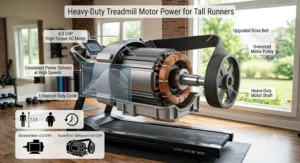
The 3.0+ CHP motor handles steady-state jogging and interval work without strain, and Bluetooth connectivity lets it sync with Peloton’s app for guided classes — a clever workaround for a machine that skips the built-in touchscreen entirely. Quick-turn knobs let you adjust speed and incline mid-stride, which matters more than it sounds like when you’re maintaining a longer gait cycle and don’t want to break rhythm reaching for buttons.
Based on the spec comparison, this is the treadmill for a tall runner who wants deck length first and is willing to trade width and premium tech for a sub-$1,100 price tag. Reviewers consistently note strong value for the price, though several mention the narrower belt feels tight for runners with a wider natural stance.
Pros:
- ✅ 60-inch deck matches machines twice the price
- ✅ Peloton app compatibility via Bluetooth
- ✅ Quick-dial controls for on-the-fly adjustments
Cons:
- ❌ 20-inch width feels narrow for broader runners
- ❌ No built-in touchscreen included
At around $900-$1,100, the Horizon 7.0 AT delivers the best cost-per-inch-of-deck-space on this entire list.
2. Bowflex T9 — widest cushioned deck with a lifetime warranty
The Bowflex T9 pairs a full 22-by-60-inch FlexZone XL deck with three-zone variable cushioning, which is a meaningfully different feel from a flat, uniform belt.
That extra two inches of width over the Horizon matters more than it seems for tall runners, since a longer stride often comes with a slightly wider stance too. The 3.5 CHP motor supports speeds up to 12 mph and inclines to 15%, plenty for hill-simulation training. It’s a bring-your-own-screen design — a media shelf holds your phone or tablet instead of a built-in display — which keeps costs down while still connecting to JRNY, Peloton, and Zwift over Bluetooth.
What most buyers overlook about this model is the lifetime motor and frame warranty, a meaningful signal about how the brand expects the machine to hold up under sustained mileage. Aggregated reviewer sentiment is largely positive on comfort and cushioning, with the JRNY subscription cited as the main added cost to unlock guided content.
Pros:
- ✅ Full 22 x 60-inch three-zone cushioned deck
- ✅ Lifetime motor and frame warranty
- ✅ Works with JRNY, Peloton, and Zwift apps
Cons:
- ❌ No built-in touchscreen, tablet shelf only
- ❌ JRNY subscription needed for guided workouts
Typically priced in the $1,400-$1,800 range, the Bowflex T9 lands as a strong mid-tier value pick.
3. Sole F80 — quietest motor in this lineup
The Sole F80 shares the same 22-by-60-inch deck as the Bowflex, but distinguishes itself with a motor independent testers have described as remarkably quiet — closer to a humming refrigerator than a treadmill.
That quietness isn’t just a comfort footnote; it matters if you’re running early mornings or in a shared living space where noise is a real constraint on when you can train. The updated 10.1-inch Android touchscreen (bumped up from last year’s 9-inch panel) is now built in rather than bring-your-own, and a wireless phone charging pad rounds out the console.
Here’s what to weigh: the F80 sits at a higher price than the T9 or 7.0 AT for a deck that’s the same size as the Bowflex’s, so the premium is really paying for the built-in screen and motor refinement rather than extra running room. Reviewers frequently cite the low noise level as the standout differentiator versus competing 60-inch decks.
Pros:
- ✅ Notably quiet motor for shared spaces
- ✅ Built-in 10.1-inch touchscreen console
- ✅ Wireless phone charging pad included
Cons:
- ❌ Priced higher than similarly sized decks
- ❌ Touchscreen locked-in, no bring-your-own flexibility
Expect a price in the $1,800-$2,200 range, positioning the Sole F80 as a solid mid-to-premium choice.
4. NordicTrack Commercial 1750 — best auto-adjusting workout experience
The NordicTrack Commercial 1750 earns its reputation with a 14-inch touchscreen that physically tilts to match your eye line — a small design detail that saves your neck on longer runs.
Its 22-by-60-inch deck is paired with a 3.5 CHP motor built for frequent, steady-state cardio, and “auto-adjust” iFit technology shifts your speed and incline automatically to match an instructor-led route. On paper, this means you can focus purely on form and stride mechanics instead of fumbling with manual controls mid-run, which is a genuine advantage for anyone actively working on correcting a longer, potentially overstriding gait.
Aggregated review sentiment sits around 4.4 stars, with praise centered on the combination of deck space, motor power, and incline/decline range. The tradeoff is that the auto-adjust feature and full content library require an iFit subscription to unlock — the hardware works standalone, but you’re paying extra for the software layer that makes it shine.
Pros:
- ✅ Tiltable 14-inch touchscreen reduces neck strain
- ✅ Auto-adjust technology matches instructor-led pacing
- ✅ Strong 3.5 CHP motor for sustained running
Cons:
- ❌ iFit subscription required for full feature set
- ❌ Larger footprint needs more room clearance
Priced typically in the $1,700-$2,000 range, the NordicTrack Commercial 1750 is our pick for best overall.
5. NordicTrack Commercial 2450 — highest top speed for long strides
The NordicTrack Commercial 2450 shares the familiar 22-by-60-inch deck footprint but pushes top speed up to 14 mph, noticeably higher than most home treadmills on this list.
For a tall runner with a naturally longer stride, that extra top-end speed matters because covering the same ground often happens at a lower cadence but higher velocity — a shorter-legged runner hits their max well before you do on a speed-capped machine. The iFit integration here unlocks a large library of guided runs and simulated marathon courses, and the deck cushioning is built to absorb the higher-impact loads that come with faster turnover.
What the spec sheet won’t tell you, but reviewers note, is that assembly is reportedly more involved than competitors — expect to budget real time or professional help for setup. Once running, though, stability and cushioning at speed draw consistent praise in aggregated feedback.
Pros:
- ✅ 14 mph top speed for serious speed sessions
- ✅ Expansive iFit workout and marathon course library
- ✅ Stable, well-cushioned deck at higher speeds
Cons:
- ❌ Assembly reported as more difficult than average
- ❌ iFit subscription cost adds up over time
Generally priced in the $2,400-$2,800 range, the NordicTrack Commercial 2450 targets serious, speed-focused tall runners.
6. 3G Cardio Pro Runner X — lowest step-up height for easy mounting
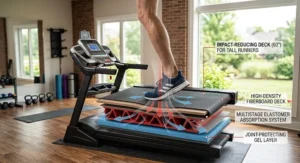
The 3G Cardio Pro Runner X takes a different approach: rather than chasing the biggest screen, it focuses on an orthopedic 20.5-by-58-inch belt and an unusually low 6.5-inch step-up height.
That lower step-up genuinely matters for taller runners, since mounting and dismounting a treadmill with long legs from a high platform is an underrated daily annoyance — and a fall risk if you’re stepping on and off frequently between interval sets. The 3.0 HP continuous-duty motor is rated for sustained, heavy use rather than short bursts, which lines up well with longer training sessions. Reviewers consistently describe the belt cushioning as noticeably joint-friendly compared to firmer competing surfaces.
Based on the spec comparison, the tradeoff here is real: at 58 inches, the deck falls two inches short of the 60-inch benchmark this guide treats as the practical floor for anyone over 6 feet. It’s the shortest deck in this lineup, so runners at the very top of the height range should measure their own stride before committing.
Pros:
- ✅ Low 6.5-inch step-up height eases mounting
- ✅ Continuous-duty 3.0 HP motor built for endurance
- ✅ Orthopedic belt cushioning reduces joint impact
Cons:
- ❌ 58-inch deck falls short of the 60-inch benchmark
- ❌ No built-in touchscreen or incline adjustment
Typically priced in the $1,500-$1,900 range, the 3G Cardio Pro Runner X suits runners who prioritize joint comfort over screen size.
7. Landice L8 — built for decades, not years
The Landice L8 takes the long view — literally and figuratively — with a welded frame and a full 1-inch-thick reversible deck, versus the 0.7-inch decks common on consumer-grade competitors.
That thicker, welded construction is the whole story here: a welded deck-to-frame connection resists the flex and rattle that develop over years of heavy mileage, and a 500-pound maximum user weight capacity signals this machine was engineered for sustained, serious use rather than occasional jogging. What most buyers overlook about commercial-grade builds like this one is that the “extra” cost upfront is really a bet against future repair bills — a welded frame doesn’t loosen the way a bolted one eventually can under a tall, powerful runner’s repeated impact.
Aggregated reviewer sentiment across fitness-equipment forums consistently frames the L8 as a long-term investment rather than an impulse buy, with longevity cited far more often than flashy features. There’s no dramatic touchscreen ecosystem here — the appeal is mechanical trust.
Pros:
- ✅ Welded frame and 1-inch reversible deck for durability
- ✅ 500-pound user weight capacity, well above average
- ✅ Reputation for decades-long mechanical reliability
Cons:
- ❌ Premium price puts it out of reach for casual buyers
- ❌ Fewer entertainment and connectivity features than rivals
Expect a price in the $3,000-$4,000+ range, positioning the Landice L8 as the long-haul, buy-it-once option on this list.
Top 7 Comparison at a Glance
| Treadmill | Deck Size | Motor | Price Range | Best For |
|---|---|---|---|---|
| Horizon 7.0 AT | 20″ x 60″ | 3.0+ CHP | $900-$1,100 | Budget-conscious buyers |
| Bowflex T9 | 22″ x 60″ | 3.5 CHP | $1,400-$1,800 | Cushioned mid-tier value |
| Sole F80 | 22″ x 60″ | 3.0 CHP+ | $1,800-$2,200 | Quiet home environments |
| NordicTrack Commercial 1750 | 22″ x 60″ | 3.5 CHP | $1,700-$2,000 | Guided, auto-adjust training |
| NordicTrack Commercial 2450 | 22″ x 60″ | 3.5+ CHP | $2,400-$2,800 | Speed-focused tall runners |
| 3G Cardio Pro Runner X | 20.5″ x 58″ | 3.0 HP | $1,500-$1,900 | Low step-up, joint comfort |
| Landice L8 | 22″ x 60″+ | Commercial-grade | $3,000-$4,000+ | Long-term durability |
Lay these side by side and a clear pattern emerges: once you’re past the $1,400 mark, deck size stops being the differentiator entirely — every model here converges near 60 inches, and the real competition shifts to motor durability, cushioning quality, and console tech. The 3G Cardio Pro Runner X is the outlier worth flagging, trading two inches of deck length for a meaningfully lower step-up height. If budget allows, the Landice L8 and NordicTrack Commercial 2450 pull ahead specifically for runners logging serious weekly mileage, where frame durability and top-end speed start to matter more than console bells and whistles.
Benefits vs. Traditional Short-Deck Treadmills
| Factor | Long-Deck (60″+) Treadmill | Standard Short-Deck Treadmill |
|---|---|---|
| Stride freedom | Full natural stride at running pace | Often forces stride shortening |
| Overstride risk | Reduced — foot lands within deck bounds | Increased — runners compensate awkwardly |
| Injury-relevant mechanics | Supports natural cadence and footstrike | Can encourage compensatory braking steps |
| Best For | Runners 6’0″ and taller | Walkers and runners under 5’10” |
The mechanical difference isn’t cosmetic. A shorter deck physically caps how far your foot can travel before it hits the rear rail, and your nervous system compensates in real time — usually by shortening your natural stride into something choppier and less efficient than what you’d do outdoors. That compensation isn’t free; research on the coupling of stride length and foot strike shows the two variables tend to shift together, so changing one tends to change the other whether you intend it to or not. For a tall runner, a genuinely long deck removes that forced compensation from the equation entirely.
💬 Found the deck length that fits your stride? One click helps other tall runners find this comparison too!
Setting Up Your Long-Deck Treadmill for Maximum Comfort
Getting a longer deck home is only step one — dialing it in for your actual stride takes a little more care than the manual usually covers.
Start by measuring your ceiling clearance before assembly, not after: most manufacturers specify a minimum of your height plus roughly 20 inches above the belt, and tall runners are the group most likely to get this wrong by eyeballing it. Once assembled, resist the urge to crank speed immediately — spend your first week at conversational pace to let the belt “break in” and to recalibrate your own stride to the new deck length, since years of running on a cramped surface can leave you subconsciously shortening your steps out of habit.
A common mistake in the first 30 days is skipping belt-tension checks; a belt that’s slightly loose will slip under a longer, more powerful stride faster than under a shorter one. Check tension weekly for the first month, then monthly after that. Lubricate the belt on the schedule your manual specifies — usually every 3 months for a home unit under regular use — since a longer deck has more surface area to keep properly conditioned.
Real-World Scenarios: Matching Height to the Right Deck
The 6’2″ marathon trainer. Logging 40+ miles a week, this runner needs both deck length and long-term motor durability. The NordicTrack Commercial 2450 or Landice L8 make sense here — the mileage justifies the higher price through cost-per-run math over a multi-year horizon.
The 6’4″ apartment dweller. This is where a treadmill for 6’4 runner really gets specific: ceiling clearance and deck length both become non-negotiable simultaneously. A 60-inch-plus deck like the NordicTrack Commercial 1750 or Bowflex T9 is the realistic floor, and this runner should double-check apartment ceiling height before ordering, since 6’4″ pushes close to many manufacturers’ stated clearance minimums.
The budget-conscious beginner at 6’1″. Just starting a running habit and not ready to commit thousands of dollars, this profile fits the Horizon 7.0 AT well — full deck length without the premium tech tax, with room to upgrade later once the habit sticks.
Buyer’s Decision Framework
If deck length is your single biggest concern, choose any model at 60 inches or longer — don’t compromise below that threshold regardless of other features. If you’re over 6’3″, prioritize checking ceiling clearance next, since it’s the second-most-common oversight after deck length itself. If you run 25+ miles weekly, weight long-term motor and frame durability more heavily than console features, since a commercial-grade build like the Landice L8 pays for itself in avoided repairs. If budget is the primary constraint, the Horizon 7.0 AT proves length and price aren’t inseparable. And if noise matters because you share walls or run early mornings, let the Sole F80‘s quieter motor move up your list even at a price premium.
How to Choose a Treadmill for Tall Runners
- Measure your actual stride first. Walk and jog naturally, then measure heel-to-heel distance — this gives you a real number instead of guessing from height alone.
- Treat 60 inches as the floor, not the ceiling. Anything shorter forces compensation; longer is a bonus, not a requirement, once you clear that mark.
- Check deck width alongside length. A 22-inch width accommodates a wider natural stance better than the narrower 20-inch decks common on budget models.
- Verify ceiling clearance for your specific height. Manufacturers publish minimums — don’t assume, measure your room.
- Weigh motor duty rating against your weekly mileage. Continuous-duty motors handle sustained long runs better than motors rated for interval bursts.
- Decide how much you value guided software. iFit, JRNY, and Peloton compatibility all cost extra ongoing — factor that into total cost, not just the sticker price.
- Match weight capacity to your actual weight with margin. Manufacturers rate max capacity at the edge of safe operation, not the comfortable long-term zone.
Running Deck Length Guide: How Long Is Long Enough
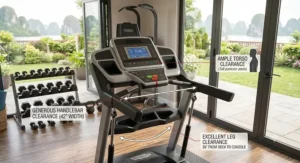
A useful running deck length guide comes down to one core number: 60 inches is the widely cited practical minimum for accommodating a typical adult running stride, with taller individuals often needing more and shorter individuals sometimes able to get by with less. Decks between 55 and 58 inches work fine for walking and light jogging but start to feel cramped once you’re running at a real training pace with a stride over roughly 5 feet. Anything above 60 inches — which none of the mainstream home models on this list exceed, interestingly — is really the province of commercial and Woodway-style equipment built for institutional use.
Width matters nearly as much as length but gets far less attention in marketing copy. A 22-inch-wide belt gives noticeably more lateral margin for a natural running gait than an 18-to-20-inch belt, particularly for runners whose stride isn’t perfectly linear at speed.
Overstride Prevention: Why Deck Length Matters More Than You Think
Overstride prevention isn’t just a treadmill-shopping buzzword — it’s a legitimate biomechanics concern with real injury implications. Overstriding happens when your foot lands too far ahead of your body’s center of mass, creating a braking effect at ground contact instead of a smooth forward roll. This research review on running-related injury causes and prevention confirms that landing with an extended leg increases braking forces and joint loading at the knee, and that reducing overstride measurably lowers that loading.
Here’s the connection to deck length that most buying guides skip entirely: a treadmill deck that’s too short can quietly train the exact opposite habit you want. Some runners compensate for a cramped deck by shortening their natural stride into a choppy, high-cadence shuffle, while others — worried about clipping the rear rail — subconsciously reach further forward at each landing, which is functionally overstriding. Neither compensation pattern is something you’d do running outdoors on open pavement. A properly sized deck simply removes the need to compensate at all, letting your natural mechanics do the work.
Common Mistakes When Buying a Treadmill for Tall Runners
The single most common mistake is shopping by treadmill height reviews aimed at “average” users, which routinely recommend 55-to-58-inch decks that undersell what a 6-foot-plus runner actually needs. A close second is ignoring ceiling clearance entirely — a machine can have a perfect deck and still be unusable if your basement or apartment ceiling sits too low once the incline is engaged. Buyers also frequently underweight motor duty rating, assuming higher horsepower alone solves durability, when continuous-duty ratings actually matter more for sustained long runs. Finally, many shoppers fixate on touchscreen size and app ecosystems while treating deck dimensions as an afterthought — exactly backward for anyone whose stride is the actual limiting factor.
Long-Term Cost & Maintenance
The sticker price is only part of the real cost equation. Budget and mid-tier machines like the Horizon 7.0 AT or Bowflex T9 typically need belt lubrication every 3 months and occasional belt or motor-brush replacement within 5-7 years of regular use. Premium builds like the Landice L8 shift that math meaningfully — a welded frame and thicker deck mean fewer replacement parts over a comparable ownership period, which can offset a chunk of the higher upfront price if you’re running consistently for a decade or more. Subscription software (iFit, JRNY) adds a recurring cost that’s easy to forget when comparing sticker prices — over three years, a $15-$20/month subscription can add several hundred dollars to a machine’s true cost of ownership, sometimes rivaling the price gap between two hardware tiers.
Curved vs. Motorized Decks for Long Strides
Curved, self-powered decks — the design popularized by manufacturers like Woodway — let your own effort drive belt speed rather than a motor setting a fixed pace. For tall runners specifically, this can feel more natural since your stride dictates speed rather than forcing your legs to match a preset number, but curved decks typically demand more from your calves and hip flexors early on, and most consumer curved units run shorter than the 60-inch motorized decks featured in this guide. Motorized decks, by contrast, offer the consistent, controllable pace better suited to structured training plans, interval work, and the auto-adjust guided workouts several models on this list support. For most home tall-runner shoppers, a long motorized deck remains the more practical, versatile choice — curved decks are worth considering mainly for runners specifically training sprint mechanics or explosive power.
Features That Actually Matter (And Those That Don’t)
Deck length, deck width, and continuous-duty motor rating actually matter — these three specs determine whether the machine physically accommodates your stride and survives your weekly mileage. Cushioning zone design matters too, since it directly affects joint impact over hundreds of hours of use. What matters far less than marketing suggests: top-end touchscreen size beyond roughly 10 inches, since most runners glance at it occasionally rather than staring throughout a run, and headline top speeds well beyond what you’ll realistically train at — a 14 mph max is meaningless if your actual training pace tops out at 9 mph. Built-in speaker quality and fan strength are nice-to-haves, not differentiators worth paying a premium for.
Safety Considerations for Tall Runners
Ceiling clearance deserves its own callout because it’s a genuine safety issue, not just a comfort one — a runner who has to duck mid-stride on an inclined deck is at real risk of losing footing. Step-up height matters similarly: models like the 3G Cardio Pro Runner X, with its low 6.5-inch platform, meaningfully reduce trip risk during frequent mounting and dismounting, which matters more for taller users covering more vertical distance per step. Weight capacity should always be checked with margin rather than run right up to the manufacturer’s stated maximum, since long-term stability at the edge of a rated limit is a different proposition than stability well within it. Finally, always confirm your specific unit’s electrical requirements match your home’s circuit — higher-CHP motors on premium models sometimes require a dedicated outlet. For a deeper look at how overstriding compounds these risks over time, this clinical overview of overstride and running injuries is worth a read before you settle into a new training routine.
Frequently Asked Questions
❓ What size treadmill deck do tall runners need?
❓ Is a 60-inch treadmill deck long enough for a 6'4 runner?
❓ Do longer treadmill decks cost more?
❓ Can overstriding on a treadmill cause injury?
❓ What's the best treadmill for tall runners on a budget?
Conclusion
Choosing the right treadmill for tall runners really comes down to one non-negotiable: a deck at or above 60 inches, paired with width and motor durability that match how often and how hard you actually run. The Horizon 7.0 AT proves that length doesn’t require a premium budget, the NordicTrack Commercial 1750 and 2450 deliver the most polished guided-training experience, the Sole F80 and Bowflex T9 balance comfort and value nicely in the middle, the 3G Cardio Pro Runner X trades a couple inches of deck for genuinely easier mounting, and the Landice L8 is the buy-it-once option for anyone logging serious long-term mileage. Whichever you choose, the underlying goal is the same — let your natural stride do what it’s supposed to do, instead of quietly retraining bad habits on a deck that was never built for your height in the first place.
✨ Ready to Stop Compromising Your Stride?
🔍 Take your next training block to the next level with a deck that actually fits your height. Click on any highlighted pick above to check current pricing and availability — your knees will thank you on mile 20.
Recommended for You
- Extra Wide Treadmill Belt: 7 Best Picks for Stability (2026)
- Treadmill 500 Lb Weight Capacity: 7 Strongest Picks for 2026
- 7 Best Treadmill 400 Lb Weight Capacity Picks for 2026
Disclaimer: This article contains affiliate links. As an Amazon Associate, I earn from qualifying purchases. If you purchase products through these links, we may earn a small commission at no additional cost to you.
✨ Found this helpful? Share it with your friends! 💬🤗
