In This Article
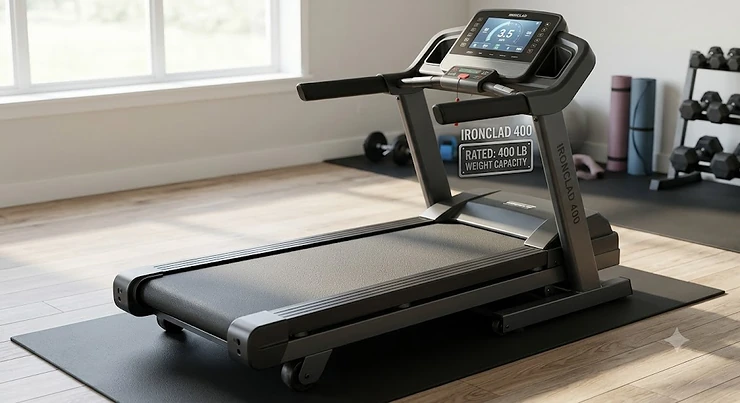
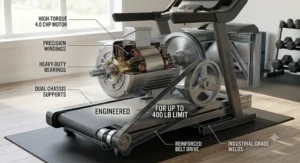
Here’s the thing nobody tells you when you start shopping for home cardio equipment: most treadmills are built for a 165-pound jogger who runs three times a week, not for someone who actually wants to sweat. Step onto a bargain-bin machine at anywhere close to 280 pounds and you’ll feel the deck flex like a diving board, hear the motor strain on an incline, and watch the belt drift off-center within a month. A treadmill 400 lb weight capacity is a different animal entirely — it’s a machine engineered from the frame up with thicker steel, bigger rollers, and a motor that isn’t gasping for air the moment you pick up the pace.
What is a treadmill 400 lb weight capacity, exactly? It’s a treadmill certified by its manufacturer to safely support a user weighing up to 400 pounds during normal walking or running, thanks to a reinforced frame, a stronger motor (typically 3.0 HP continuous duty or higher), and a wider, thicker deck. That’s a meaningful jump from the 250-300 lb ceiling on most consumer models sold at big-box stores.
This matters more than marketing copy suggests. According to CDC physical activity guidelines, adults need roughly 150 minutes of moderate aerobic activity a week — and a treadmill that can’t handle your body weight safely is a treadmill you’ll eventually stop using, or worse, one that breaks down mid-stride. Below, I’ve dug into real specs, aggregated review sentiment, and honest side-by-side analysis on seven genuine 400-lb-rated machines, from a $600 walking pad to a $4,000+ commercial-style unit, so you can pick the one that actually fits your body, your budget, and your goals.
Quick Comparison Table
Before we get into the weeds, here’s the fast version. If you’re the type who wants the answer before the homework, this table gets you 80% of the way there.
| Treadmill | Weight Capacity | Motor | Best For |
|---|---|---|---|
| Sole TT8 | 400 lbs | 4.0 HP | Best all-around heavy-duty runner’s pick |
| Bowflex Treadmill 22 | 400 lbs | 4.0 HP | Widest incline/decline range |
| NordicTrack Commercial 1750 | 400 lbs | 4.25 CHP | Best foldable option |
| Matrix T75 | 400 lbs | 3.0 HP AC | Closest to commercial gym quality |
| Life Fitness Run CX | 400 lbs | 3.0 HP (6.0 HP peak) | Best joint-friendly cushioning |
| NordicTrack X16 | 400 lbs | 4.25 CHP | Extreme incline training |
| Exerpeutic SuperMax 400 | 400 lbs | N/A (walking pad) | Best budget walking option |
Looking at the spread here, there’s a clear split between “runner’s machines” like the Sole TT8 and Matrix T75, which prioritize deck size and motor horsepower, and “walker’s machines” like the Exerpeutic SuperMax 400, which prioritize compactness and price over raw performance. The three NordicTrack and Bowflex entries sit in between, layering in touchscreens and app-driven training on top of the same 400-lb-rated hardware. If you already know whether you’re walking or running most days, that alone should narrow your list to two or three names before you read another word.
💬 Just one click — help others make better buying decisions too!😊
Top 7 Treadmill 400 Lb Weight Capacity Options: Expert Analysis
I picked these seven specifically to cover the realistic range of buyers searching for a heavy duty treadmill high weight capacity machine — from someone rehabbing a knee and just wanting to walk safely, up to a marathoner who needs a deck that won’t budge at mile 10. Every one of these actually lists a 400-lb user rating from the manufacturer, not a “should be fine” guess.
1. Sole TT8 — best all-around heavy-duty runner’s treadmill
The Sole TT8 is the treadmill most independent reviewers point to first when heavier or taller runners ask for a recommendation, and it’s not hard to see why once you look past the price tag. Its 4.0 HP motor is paired with a 10-pound commercial-grade flywheel that reduces torque strain, and the 22-inch by 60-inch deck is genuinely one of the largest available outside of true commercial gym equipment. In practice, that flywheel matters more than the horsepower number alone — it’s the difference between a motor that whines under load and one that just quietly keeps pace.
Reviewers consistently note the Sole TT8‘s 3-inch rollers as a standout detail, since larger rollers spread belt tension more evenly and typically mean less wear over years of heavy mileage. Aggregated review sentiment across major fitness outlets frames this as one of the sturdiest non-folding decks tested in its price range, with owners specifically praising how planted it feels even at a full sprint. The tradeoff, and it’s a real one: this machine does not fold, so you need a dedicated 7-foot-plus space for it.
Pros:
- ✅ 4.0 HP motor rarely strains, even on inclines
- ✅ Extra-wide 22″ x 60″ deck fits taller runners
- ✅ Lifetime warranty on frame, motor, and deck
Cons:
- ❌ Non-folding — needs a permanent dedicated space
- ❌ Pricier than folding competitors with similar specs
Expect to pay somewhere in the $2,000-$2,500 range at the time of research, though prices do fluctuate, so check current pricing before you buy. For a serious runner who wants a machine that will still feel tight in five years, the Sole TT8 is one of the better value stories in this category.
2. Bowflex Treadmill 22 — widest incline and decline range
If your training includes hill work, the Bowflex Treadmill 22 does something none of the other machines here quite match: a -5% to 20% incline and decline range, which is a genuinely unusual spread for a home unit. Paired with a 4.0 HP motor and the same 22-inch by 60-inch deck size as the Sole TT8, this is built for someone who wants to simulate real outdoor terrain rather than just log flat miles.
What most buyers overlook about the Bowflex Treadmill 22 is that the incline/decline range isn’t just a spec-sheet flex — it changes what kind of training you can actually do at home, letting you build downhill running tolerance (which is brutal on quads and something outdoor runners specifically train for) without leaving the house. Aggregated reviewer sentiment praises the build quality and the 22-inch HD touchscreen, though several owners note the JRNY app subscription is functionally required to unlock the machine’s full feature set, which adds an ongoing cost beyond the treadmill itself.
Pros:
- ✅ Rare -5% to 20% incline/decline range
- ✅ 4.0 HP motor matches premium competitors
- ✅ Large 22″ touchscreen with streaming apps
Cons:
- ❌ JRNY app subscription needed for full features
- ❌ Among the pricier options in this lineup
At the time of research, this one has been seen priced anywhere from the high-$2,000s to the mid-$3,000s range, so it pays to watch for a sale window. If hill and downhill training specifically is your priority, this is the standout pick on this list.
3. NordicTrack Commercial 1750 — best foldable heavy-duty option
Nearly every other treadmill on this list is a permanent floor fixture, which is exactly why the NordicTrack Commercial 1750 earns its spot: it’s rated for the same 400-lb capacity as the non-folding machines above, but it actually folds up when you’re done. The 4.25 CHP motor is shared across NordicTrack’s entire 400-lb-rated lineup, and the 22-inch by 60-inch deck gives you the same real estate as the premium Sole and Bowflex models.
Here’s what the spec sheet won’t tell you, but reviewer consensus does: the RunFlex cushioning genuinely softens impact compared to older NordicTrack generations, though longtime owners note you can no longer toggle it off to simulate firmer road-running conditions, which is a small but real downgrade for purists. Aggregated sentiment is overwhelmingly positive on the touchscreen and iFIT-powered trainer-led workouts, with the SpaceSaver folding design frequently singled out as the reason people chose this over a non-folding rival.
Pros:
- ✅ Folds away — ideal for shared or smaller rooms
- ✅ 4.25 CHP motor built for sustained daily use
- ✅ 16″ touchscreen with thousands of iFIT workouts
Cons:
- ❌ iFIT subscription required for full library access
- ❌ Cushioning can’t be firmed up for road-run feel
Price at the time of research sits in the low-to-mid $2,000s range, occasionally dropping several hundred dollars during sales. Based on the spec comparison, this is the easiest recommendation on the list for anyone in an apartment or multi-purpose room.
4. Matrix T75 — closest experience to a commercial gym treadmill
The Matrix T75 stands apart from every other machine here in one specific way: it uses a 3.0 HP continuous-duty AC motor instead of the DC motors found in the rest of this lineup. AC motors are what you’ll find in actual gym-floor equipment, and they run cooler and quieter over long, high-mileage sessions than DC counterparts. Combined with a welded steel frame that weighs in around 375 pounds on its own, the Matrix T75 is rated for the same 400-lb user capacity, but it gets there through sheer structural mass rather than clever engineering shortcuts.
Reviewers consistently frame this as the machine to buy if multiple people in a household are going to be logging serious miles on it weekly — the AC drive system is specifically built to handle that kind of repeated, high-volume stress better than typical residential motors. On paper this means less long-term wear per mile logged, which matters if you’re thinking in terms of cost-per-workout rather than just sticker price.
Pros:
- ✅ Commercial-grade AC motor built for daily heavy use
- ✅ Ultra-stable welded steel, non-folding frame
- ✅ Lifetime warranty on frame, motor, and cushioning
Cons:
- ❌ Among the most expensive machines on this list
- ❌ Extremely heavy — difficult to reposition once placed
This is a premium purchase, with pricing that climbs well above $3,000 depending on console choice, so treat it as an investment rather than an impulse buy. For a multi-user household putting real mileage on the belt every week, the math still works out in the Matrix T75‘s favor over time.
5. Life Fitness Run CX — best joint-friendly shock absorption
The Life Fitness Run CX brings genuine gym-floor DNA into a home unit, backed by the same FlexDeck Shock Absorption System used in Life Fitness’s commercial equipment. The company’s own testing claims roughly a 30% reduction in impact stress on joints compared to running without any shock absorption at all, which lines up with what independent reviewers report feeling in practice — a noticeably softer landing than flatter, harder decks.
What most buyers overlook here is the 6.0 HP peak motor rating alongside the 3.0 HP continuous rating; the peak number reflects short bursts of higher output, useful for quick pace changes, while the continuous number is what matters for sustained running. Aggregated review sentiment is strong on durability and quiet operation, with several owners specifically calling out how much less noise it makes than prior treadmills at comparable speeds — a real consideration if you’re training early mornings in a house where other people are still asleep.
Pros:
- ✅ FlexDeck system cuts joint impact meaningfully
- ✅ Lifetime warranty on frame and shock absorbers
- ✅ Noticeably quiet even at higher speeds
Cons:
- ❌ Non-folding — a dedicated 6.5-foot footprint needed
- ❌ No streaming touchscreen included standard
Expect a price in the $2,900-$3,000 range at the time of research. For anyone whose knees or hips are a bigger concern than incline range or app integration, this is the pick to look at first.
6. NordicTrack X16 — best for extreme incline training
The NordicTrack X16 takes the same 400-lb rating and 4.25 CHP motor found across NordicTrack’s Commercial Series and pushes the incline range to a genuinely extreme 40%, with a -6% decline on the other end. That’s steep enough to simulate serious hiking or rucking terrain, not just gentle hills, and its cantilevered frame is specifically engineered to flex slightly for comfort without the shakiness you’d expect from a machine tilted that far.
Here’s what the spec sheet doesn’t capture well: at max incline, your head sits close to ceiling height, so this machine genuinely needs a taller room than a typical treadmill — NordicTrack itself recommends roughly 8 feet of clearance behind the unit. Reviewers who’ve tested it describe it as one of the most stable machines available for all-out sprint work specifically because of that cantilevered design, which matters if stability at speed, not just weight capacity, is your priority.
Pros:
- ✅ Extreme 40% incline for hiking-style training
- ✅ Exceptionally stable frame even at high speed
- ✅ Large touchscreen with extensive iFIT library
Cons:
- ❌ Massive footprint demands high ceilings and space
- ❌ Among the priciest machines in this category
At the time of research, pricing for this model runs well into the $3,500-plus range. If rucking, hiking simulation, or extreme incline work is genuinely part of your routine, nothing else on this list comes close.
7. Exerpeutic SuperMax 400 — best budget pick for walking and rehab
Not everyone shopping for a 400-lb capacity machine wants — or needs — a 4.0 HP running deck. The Exerpeutic SuperMax 400 is a compact 2-in-1 walking pad rated for the same 400-lb user weight, but built specifically for walking rather than running, with a top speed around 4 mph in handlebar mode and roughly 3 mph in flat under-desk mode. Its 43.5-inch by 16-inch belt is longer and wider than most competing walking pads, which matters more than it sounds for taller users who’d otherwise feel cramped.
Aggregated customer feedback consistently highlights how quiet the motor runs, making it genuinely usable during work calls, and several buyers specifically mention appreciating that it requires no assembly out of the box. The honest tradeoff: this is not a jogging or sprinting machine, and treating it like one would be both unsafe and against its design intent — it’s built for sustained walking, not high-impact training.
Pros:
- ✅ Full 400-lb rating at a fraction of the price
- ✅ Quiet enough for calls and under-desk use
- ✅ Folds flat and needs no assembly
Cons:
- ❌ Walking only — not built for running or jogging
- ❌ Smaller motor than every other pick on this list
This one is priced well under $700 at the time of research, making it the clear entry point if budget and floor space both matter more than top speed. For rehab, seniors, or anyone easing back into movement, it’s a genuinely sound starting point.
Practical Usage Guide: Your First 30 Days
Buying a heavy duty treadmill high weight capacity machine is only half the job — how you set it up and use it in the first month determines whether it lasts a decade or starts squeaking within a year. Start with placement: every 400-lb-rated treadmill needs a stable, level floor, and most manufacturers recommend at least two feet of clearance on each side plus several feet behind the belt, especially on incline-heavy machines like the NordicTrack X16.
During week one, resist the urge to max out speed and incline immediately. Motors and belts on even the sturdiest frames benefit from a gentle break-in period — shorter, moderate sessions let the belt seat properly against the deck and let you notice any unusual noise before it becomes a real problem. Lubricate the belt on the schedule your manual specifies (typically every 3-6 months depending on usage), since a dry belt is one of the fastest ways to strain even a 4.0 HP motor prematurely.
A common first-month mistake: skipping the bolt check. Vibration during shipping and initial assembly can loosen fasteners, and a quick tightening pass after the first week of use prevents the wobble that owners often mistake for a manufacturing defect. Finally, keep the area under and around the belt clear of dust and debris — it’s a small habit that meaningfully extends motor life on any of the seven machines above.
Real-World Scenarios: Who Actually Needs a 400 Lb Capacity Machine
Picture someone at 285 pounds who’s six months into a walking-to-running progression. For them, a machine like the Life Fitness Run CX or Sole TT8 isn’t overkill — it’s the difference between a deck that flexes uncomfortably at their exact weight range and one still built with margin to spare, which safety engineers generally recommend when weight capacity ratings are tested. Reviewers note that treadmills perform best well under their max rating, not right at the edge of it.
Now picture a 240-pound recreational lifter who wants low-impact cardio between strength sessions without beating up already-tired joints. The Exerpeutic SuperMax 400 covers that need directly — it’s not built for sprint intervals, but for steady incline walks it’s more than capable, and its price means it’s not a huge investment for what amounts to supplementary cardio. Finally, consider a household with two adults over 220 pounds each sharing one machine daily. That’s where the Matrix T75‘s commercial-grade AC motor earns its higher price tag — daily, multi-user mileage is exactly the stress-test scenario that separates AC drive systems from standard DC motors over a multi-year timeline.
How to Choose a Treadmill 400 Lb Weight Capacity Model
Picking the right heavy-duty machine comes down to a handful of concrete decision points, not gut feeling:
- Confirm the actual weight rating, not just “heavy duty” marketing language. Look for a specific number in the spec sheet — 400 lbs should be stated plainly, not implied.
- Match the motor to your activity. Running and jogging call for at least 3.0-4.0 continuous horsepower; walking-focused use can get by with less.
- Prioritize deck size for your height and stride. A 60-inch-long deck comfortably fits most runners; shorter decks work fine for walkers.
- Decide folding versus non-folding early. Folding models save space but often trade off slightly on total frame mass versus non-folding rivals.
- Check the warranty structure, especially on the motor and frame. Lifetime frame/motor coverage, like several models above offer, signals real manufacturer confidence.
- Factor in incline range if hill training matters to you. Ranges vary wildly, from modest 12% inclines up to the NordicTrack X16‘s 40%.
- Budget for the real total cost, including any required app subscription. Several machines above effectively need a paid app to unlock their full workout library.
Heavy Duty Treadmill High Weight Capacity: Safety and Certification
Weight capacity numbers aren’t arbitrary marketing figures — they come from structural testing that manufacturers run against frame, deck, and motor tolerances, and treating that number as a soft suggestion is a genuine safety risk. According to CNN’s reporting on treadmill safety, treadmills are involved in more home exercise equipment injuries than any other category, which is a strong argument for buying a machine rated meaningfully above your actual body weight rather than right at the edge of its limit.
Beyond weight rating, a few habits matter regardless of which machine you choose: always use the magnetic safety clip, keep children and pets away from a running belt, and don’t ignore unusual vibration or noise, since it’s often an early warning sign rather than a cosmetic annoyance. You can check the U.S. Consumer Product Safety Commission for current recall notices before buying secondhand equipment specifically, since used units sometimes carry safety flags that aren’t obvious from a listing photo alone.
✨ Don’t Miss These Exclusive Deals!
🔍 Take your home cardio setup to the next level with these carefully selected heavy-duty treadmills. Click on any highlighted model to check current pricing and availability, and build the sturdy, joint-friendly workout routine your body actually deserves!
Extra Wide Running Deck: Why Deck Size Matters More Than You Think
Every treadmill on this list shares a 60-inch-long running surface, and that’s not a coincidence — a shorter deck forces taller users or faster runners to shorten their natural stride, which is both uncomfortable and, over enough miles, a genuine injury risk. Width matters just as much as length: the 22-inch width found on the Sole TT8, Bowflex Treadmill 22, Matrix T75, Life Fitness Run CX, and NordicTrack models gives meaningfully more side-to-side margin than the narrower 20-inch decks common on budget treadmills.
What most buyers overlook about deck width specifically is how much it matters for larger-framed runners, whose natural gait tends to have slightly more lateral movement than a narrower-framed runner’s stride. A deck that’s technically long enough but too narrow can still feel cramped and increase the chance of a misstep off the edge. The Exerpeutic SuperMax 400 is the exception here by design — at 43.5 inches by 16 inches, it’s intentionally compact because it’s built for walking, not running, so the calculus is different for that specific use case.
Reinforced Steel Frame Treadmill: What’s Actually Inside the Build
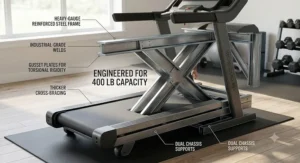
The phrase “reinforced steel frame” gets used loosely in treadmill marketing, but the real engineering differences are visible once you compare specs directly. The Matrix T75‘s welded, non-folding steel frame weighs roughly 375 pounds on its own — that mass isn’t wasted bulk, it’s what keeps the deck from flexing under load at higher speeds. Compare that to a typical 250-lb-capacity budget treadmill, where thinner steel and more plastic componentry keep costs down but sacrifice the stability heavier or faster users actually need.
Reviewers consistently point to welded joints, rather than bolted ones, as the more durable construction method for non-folding frames specifically, since bolted joints under repeated stress are more prone to developing play over years of use. Folding treadmills like the NordicTrack Commercial 1750 necessarily use a hinge mechanism, which is a reasonable space-saving tradeoff, but it’s worth knowing that non-folding frames generally edge out folding ones on raw long-term rigidity, all else being equal.
Treadmill Weight Limit Explained: The Engineering Behind the Number
A treadmill’s weight limit is not just about how much force the deck can bear standing still — it’s about repeated dynamic load, since running produces ground reaction forces significantly higher than your static body weight, sometimes two to three times higher depending on pace and stride. That’s why a 400-lb-rated motor and frame combination is engineered with real safety margin, not calculated right up to the edge of failure. For a deeper technical overview of how these machines are built and rated, Wikipedia’s treadmill entry offers useful background on belt, motor, and deck engineering fundamentals.
As a rough industry framework: standard consumer treadmills typically cap out around 250-300 lbs, lightweight portable models sit closer to 220 lbs, and heavy-duty models push up to 400 lbs, with true commercial gym-floor units sometimes rated even higher.
| Category | Typical Weight Capacity | Typical Motor |
|---|---|---|
| Lightweight/portable | ~220 lbs | Under 2.0 HP |
| Standard consumer | 250-300 lbs | 2.0-3.0 HP |
| Heavy-duty (this guide) | 400 lbs | 3.0-4.25 HP/CHP |
| Commercial gym-floor | 400+ lbs | 3.0+ HP continuous AC |
This table makes the jump obvious: heavy-duty models aren’t just a marginal step up from standard treadmills, they’re roughly a full category ahead in both capacity and motor strength. If you’re currently near or above the 250-300 lb range where standard machines top out, a heavy-duty pick isn’t a luxury purchase — it’s the only category actually engineered with real margin for your weight.
Best Treadmill for 300+ Lbs vs Standard Treadmills
If you weigh 300 pounds or more, the case for a heavy-duty machine over a standard one isn’t subtle once you line the numbers up side by side.
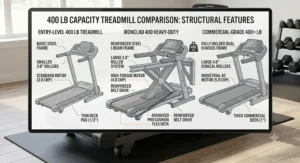
| Factor | Standard Treadmill (250-300 lb cap) | 400 Lb Capacity Treadmill |
|---|---|---|
| Motor | 2.0-3.0 HP | 3.0-4.25 HP/CHP |
| Deck Size | Often 18-20″ wide | Typically 22″ wide |
| Frame Material | Lighter-gauge steel | Reinforced/welded steel |
| Best For | Users under 250 lbs | Users 250-400 lbs |
Running the numbers this way, the gap isn’t just about the weight number on the box — it’s a meaningfully stronger motor, a wider deck, and a frame built to handle years of higher-impact use without developing the wobble or belt drift common on standard machines pushed past their comfort zone. For anyone over 300 lbs specifically, buying a standard-capacity treadmill and hoping it holds up isn’t really a value play — it’s a bet against physics that the machine is likely to lose within a year or two.
Common Mistakes When Buying a Heavy-Duty Treadmill
The most common mistake is buying right at the weight limit instead of below it — if you weigh 380 pounds, a 400-lb-rated machine gives you almost no safety margin, and most fitness engineers recommend a buffer of at least 50 pounds above your actual weight. A second frequent misstep is ignoring deck length in favor of touchscreen size; a beautiful display doesn’t matter if your stride is cramped on a too-short belt.
Buyers also commonly overlook ongoing subscription costs baked into machines like the NordicTrack Commercial 1750 or Bowflex Treadmill 22 — the sticker price looks competitive until you factor in a recurring app fee that’s effectively required to access the full workout library. Finally, many shoppers skip reading the folding mechanism’s real-world durability feedback, assuming all folding treadmills are equally sturdy, when non-folding frames generally hold up better under sustained heavy use over multi-year timelines.
Long-Term Cost and Maintenance
Sticker price is only part of the real cost of ownership here. A Sole TT8 or Matrix T75 costs more upfront than a budget machine, but aggregated owner reports suggest heavier-duty frames need belt replacement and major repairs far less often, which meaningfully changes the cost-per-year math over a 5-10 year ownership window. Add in optional but common costs: iFIT or JRNY subscriptions run roughly $30-40 a month if you want the full interactive library, belt lubricant every few months, and eventually a replacement belt or motor brush kit somewhere in year five to eight of heavy use.
Compare that to a standard-capacity treadmill pushed past its comfortable weight range — those machines commonly need belt or motor replacement within one to two years under heavy use, according to aggregated reviewer and owner feedback, which often makes the “cheaper” option the more expensive one within three years. When you annualize total cost, including subscriptions and repairs, a $2,500 heavy-duty machine that lasts eight years frequently comes out cheaper per year of use than a $700 standard treadmill replaced twice in that same span.
FAQ
❓ What is the highest weight capacity treadmill you can buy?
❓ Can a 400 lb person run on a treadmill safely?
❓ Do heavier users need a bigger motor?
❓ Is a folding or non-folding treadmill better for heavy-duty use?
❓ How much does a 400 lb capacity treadmill cost?
Conclusion
If there’s one takeaway from lining up seven real 400-lb-rated treadmills side by side, it’s that “heavy duty” isn’t one single spec — it’s a combination of motor strength, deck size, frame construction, and what you actually plan to do on the belt. The Sole TT8 and Matrix T75 make the most sense for serious, high-mileage runners who want a machine that won’t flex or strain years from now. The NordicTrack Commercial 1750 and Bowflex Treadmill 22 balance that same 400-lb durability with folding convenience or extreme incline range, respectively. The Life Fitness Run CX leans into joint comfort, the NordicTrack X16 into extreme hill training, and the Exerpeutic SuperMax 400 proves you don’t need a four-figure budget to get a genuinely rated 400-lb machine for walking.
Whichever one you land on, the underlying principle holds: buy a machine rated meaningfully above your current weight, prioritize the motor and deck specs over flashy screens, and treat the purchase as a multi-year investment rather than a one-off transaction. Get that right, and the treadmill becomes the easy part of your routine instead of the thing standing in its way.
✨ Don’t Miss These Exclusive Deals!
🔍 Take your home cardio setup to the next level with these carefully selected products. Click on any highlighted item to check current pricing and availability. These machines are built to support real, lasting fitness results!
Recommended for You
- 7 Best Treadmill for Heavy Person Picks (2026): Sturdy & Proven
- 7 Best High Performance Home Treadmill Picks for 2026
- Treadmill for Serious Runners: 7 Elite Picks for 2026
Disclaimer: This article contains affiliate links. As an Amazon Associate, I earn from qualifying purchases. If you purchase products through these links, we may earn a small commission at no additional cost to you.
✨ Found this helpful? Share it with your friends! 💬🤗
