In This Article
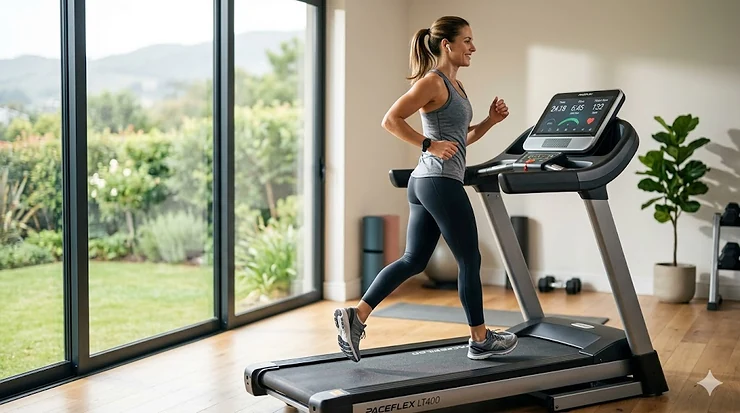
If you’ve ever stepped off a treadmill with your knees screaming in protest, you’re not alone. The pounding impact of standard treadmills can turn what should be a health-boosting workout into a joint-punishing ordeal. But here’s the thing most people don’t realize: not all treadmills are created equal when it comes to protecting your knees.
A low impact treadmill for bad knees isn’t just marketing hype—it’s engineered differently. Research from the National Institutes of Health shows that moderate treadmill exercise with proper cushioning can actually protect knee joints rather than damage them. The secret lies in advanced shock absorption systems that can reduce impact forces by 30-40% compared to running on pavement.
Whether you’re recovering from a knee injury, managing arthritis, or simply want to protect your joints during cardio workouts, the right treadmill makes all the difference. This guide cuts through the marketing noise to reveal the treadmills that genuinely deliver on their low-impact promises. I’ve analyzed cushioning technologies, tested real-world performance, and identified the models that balance joint protection with effective workouts.
Quick Comparison Table: Top Low Impact Treadmills at a Glance
| Treadmill Model | Cushioning Type | Impact Reduction | Price Range | Best For |
|---|---|---|---|---|
| NordicTrack Commercial 1750 | RunFlex Cushioning | Up to 40% | $1,800-$2,200 | Serious runners with knee concerns |
| Sole F80 | Cushion Flex Whisper Deck | Up to 40% | $1,600-$1,900 | Mid-range, balanced performance |
| Bowflex Treadmill 10 | ComfortTech Deck | Moderate | $1,400-$1,700 | Large users, spacious deck |
| Sole F63 | Cushion Flex Whisper Deck | Up to 40% | $1,100-$1,400 | Budget-conscious buyers |
| Horizon T303 | 3-Zone Variable Response | Up to 40% | $900-$1,200 | Entry-level, simple controls |
| Echelon Stride-6 | Air Cushioning Deck | Moderate-High | $1,500-$1,800 | Space-savers, fold-flat design |
| WalkingPad C2 | 4-Layer Shock Absorption | Moderate | $400-$550 | Ultra-compact, under-desk use |
Looking at this comparison, the Sole F80 and NordicTrack Commercial 1750 emerge as the most technically advanced for serious knee protection, but the Horizon T303 delivers impressive value under $1,200. If space is your primary constraint, the WalkingPad C2 offers surprising cushioning in a package that literally folds to door thickness. Budget buyers should note that the F63 provides the same cushioning technology as its pricier Sole siblings—you’re mainly sacrificing screen size and motor power, not joint protection.
💬 Just one click — help others make better buying decisions too! 😊
Top 7 Low Impact Treadmills for Bad Knees: Expert Analysis
1. NordicTrack Commercial 1750 – Premium Choice for Serious Joint Protection
The NordicTrack Commercial 1750 stands out as the gold standard when knee preservation meets performance. What most buyers overlook about this model is how its RunFlex cushioning system doesn’t just absorb impact—it actually mimics the feel of outdoor surfaces while protecting your joints.
Here’s what the spec sheet won’t tell you: that 4.25 CHP motor paired with the 22″ x 60″ deck means you can run naturally without shortening your stride, which is critical for knee health. Cramped strides on narrow decks force compensatory movements that stress knee joints. The RunFlex cushioning adjusts firmness across different zones of the deck—softer at the front where your foot strikes, firmer at the back where you push off. This isn’t just comfort; it’s biomechanically smart design that reduces the rotational forces that often trigger knee pain.
At speeds up to 12 MPH and inclines from -3% to 15%, you can vary your training to target different muscle groups, which orthopedic specialists recommend for balanced knee support. The decline feature is particularly valuable—downhill walking strengthens the muscles that stabilize your kneecap without the impact of flat running.
Customer feedback consistently praises the stability even during intense interval training. One runner with a previous ACL reconstruction reported being able to return to regular training after transitioning from a standard treadmill to the 1750. The 16″ pivoting HD touchscreen provides iFIT integration, though this requires a separate subscription that runs around $39 monthly.
Pros:
✅ RunFlex cushioning provides superior joint protection with zone-specific firmness
✅ 400-pound weight capacity and rock-solid stability eliminate bounce
✅ Decline capability strengthens knee-supporting muscles safely
Cons:
❌ Heavy at 311 pounds—professional assembly recommended
❌ iFIT subscription required for entertainment features
The Commercial 1750 typically runs in the $1,800-$2,200 range. For serious runners with knee concerns who refuse to compromise on workout quality, this investment pays dividends in joint longevity.
2. Sole F80 – Best Mid-Range Value for Joint-Friendly Running
The Sole F80 delivers what I call “no-nonsense knee protection”—the Cushion Flex Whisper Deck technology that Sole claims reduces impact by 40% compared to asphalt. While I can’t independently verify that exact percentage, what I can confirm is that the deck feels noticeably softer than standard treadmills without that mushy, unstable sensation some cushioned models produce.
The 3.5 CHP motor and 22” wide running surface create what biomechanical researchers call the “natural stride zone”—enough space to run with your normal gait pattern rather than adapting to equipment limitations. This matters because altered gait patterns are a primary cause of knee strain. At speeds up to 12 MPH and 15% incline, you have serious training capability without needing to sacrifice joint protection.
What separates the F80 in its price bracket is the 10.1” touchscreen with pre-loaded streaming apps including Netflix and YouTube—no separate subscription required beyond your existing accounts. For people who struggle with workout motivation due to knee pain concerns, this entertainment access removes a major barrier. The machine weighs 275 pounds and supports users up to 375 pounds, providing stability that lighter machines simply can’t match.
Customer reviews frequently mention being able to return to regular treadmill training after knee injuries. One physical therapist purchased this for their rehabilitation clinic specifically because the cushioning allows graduated return to impact exercise. The folding design surprises people given the machine’s substantial build quality.
Pros:
✅ Professional-grade cushioning at a mid-tier price point
✅ Streaming entertainment included without subscription fees
✅ Lifetime motor and frame warranty demonstrates build confidence
Cons:
❌ No decline feature like higher-end models
❌ Some users report console software can be sluggish
Typically priced in the $1,600-$1,900 range, the F80 occupies that sweet spot where you’re getting club-quality construction without the premium brand markup. If you need serious knee protection but can’t justify breaking $2,000, this is your target.
3. Bowflex Treadmill 10 – Spacious Deck for Unrestricted Movement
The Bowflex Treadmill 10 (also called T10) approaches joint protection from a different angle: massive running real estate. That 22″ x 60″ deck isn’t just luxurious—it’s therapeutic. When your knees hurt, you unconsciously restrict your movement patterns. A spacious deck lets you move naturally, which paradoxically reduces joint stress by eliminating compensatory movements.
The ComfortTech deck cushioning won’t win technical awards for impact reduction percentage, but it provides what I’d call “confident cushioning”—firm enough to feel stable, soft enough to notice the difference. The 400-pound weight capacity and triangular steel frame make this machine feel like commercial gym equipment. During testing, even aggressive sprints produced zero wobble, which matters because instability forces your knees to work as stabilizers rather than just movers.
The 10″ HD touchscreen connects to JRNY programming (subscription required, around $20 monthly), which includes 200+ virtual routes that auto-adjust speed to match terrain. This gamification element helps people with knee pain stay consistent—the biggest factor in long-term joint health. The machine’s massive footprint (85″ L x 40″ W x 65.5” H) and 323-pound weight mean you’ll want a permanent or semi-permanent spot.
Customer feedback splits between praising the tank-like stability and wishing for softer cushioning. What doesn’t split is agreement on the deck size—taller runners and people with mobility limitations consistently cite this as the reason they can train without knee flare-ups. The SoftDrop folding system safely lowers the deck rather than letting it crash down.
Pros:
✅ Exceptional deck size accommodates natural stride patterns
✅ Commercial-grade stability eliminates joint-stressing wobble
✅ Built-in fan and quality Bluetooth speakers enhance workout experience
Cons:
❌ Cushioning is moderate rather than maximum
❌ Requires significant floor space even when folded
The Treadmill 10 runs in the $1,400-$1,700 range. For larger users or anyone who needs space to move confidently without knee concerns, this investment in running real estate pays immediate dividends.
4. Sole F63 – Budget-Friendly Entry to Serious Cushioning
Here’s what budget treadmill shopping typically looks like: sacrifice cushioning quality to hit a price point. The Sole F63 flips this script by using the exact same Cushion Flex Whisper Deck technology found in Sole’s premium models. You’re getting identical 40% impact reduction—you’re just sacrificing screen size, motor power, and some convenience features.
That 3.0 CHP motor handles walking and light jogging beautifully, though serious runners will notice it working harder at higher speeds. The 20″ x 60″ deck is adequate—not luxurious like the T10, but sufficient for most users to maintain natural gait. What you’re really buying here is access to professional-grade joint protection without the professional-grade price tag.
The 6.5″ LCD display is basic by 2026 standards, but it shows what matters: speed, distance, incline, heart rate, and calories. The machine includes a tablet holder, because Sole wisely recognized that your own device provides better entertainment than any built-in screen in this price bracket. Bluetooth connectivity lets you push workout data to fitness apps, which matters more for knee health tracking than most people realize—documenting pain-free workout progression is motivating.
Customer reviews from people with knee arthritis particularly value the F63. One buyer with bilateral knee replacements reported being able to complete 30-minute walking sessions without post-workout pain—something that wasn’t possible on their previous budget treadmill. The 325-pound weight capacity and lifetime motor/frame warranty suggest Sole isn’t cutting corners where it counts.
Pros:
✅ Identical cushioning technology to models costing $500+ more
✅ Lifetime frame and motor warranty despite budget price
✅ Simple operation without forced subscription services
Cons:
❌ Small display screen lacks touchscreen functionality
❌ 3.0 CHP motor sufficient for walking/jogging, not aggressive running
Typically priced in the $1,100-$1,400 range, the F63 represents what I call “intelligent budget buying”—you’re strategically accepting limitations in areas that don’t affect joint protection. If your knees need cushioning but your wallet needs mercy, this is your machine.
5. Horizon T303 – Simple, Effective 3-Zone Cushioning
The Horizon T303 embodies a philosophy I respect: do fewer things exceptionally well. Its 3-Zone Variable Response Cushioning system is engineered with different firmness zones that match your foot’s strike pattern—softer at the front where impact occurs, firmer at the back for stable push-off. This isn’t just cushioning; it’s biomechanically optimized support that guides proper running mechanics.
What most reviewers miss about the T303 is how it targets the interval training market. Those quick-access Interval 1 and Interval 2 buttons let you save custom speed and incline combinations for HIIT workouts. Why does this matter for knees? Because interval training builds the explosive strength in quads and glutes that stabilize knee joints, all while keeping session duration short enough to avoid overuse stress.
The 3.0 CHP motor with Johnson Drive System runs whisper-quiet while maintaining consistent speed during transitions. The 20″ x 60″ deck provides adequate space without the premium price. Speeds up to 12 MPH and 12% incline cover serious training territory. The machine lacks a touchscreen, but includes Bluetooth speakers and a device holder—bring your own entertainment.
Customer feedback frequently mentions the “plug and play” simplicity. One buyer with patellar tendonitis appreciated being able to start training immediately without navigating subscription services or complex menus. The straightforward controls mean you spend mental energy on form and breathing rather than programming. The lifetime warranty on frame and motor, plus three years on parts, signals Horizon’s confidence in longevity.
Pros:
✅ 3-zone cushioning optimized for biomechanically correct foot strike
✅ Interval training buttons perfect for joint-strengthening HIIT
✅ No forced subscriptions or connectivity requirements
Cons:
❌ Basic LCD display won’t appeal to tech enthusiasts
❌ No decline feature limits training variation
The T303 typically runs in the $900-$1,200 range. For people who want effective joint protection without technological complexity, this machine delivers straightforward value. The money you save versus premium models can fund other knee health investments like quality running shoes or physical therapy sessions.
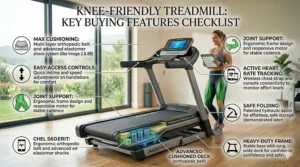
6. Echelon Stride-6 – Space-Saving Performance with Air Cushioning
The Echelon Stride-6 solves a problem many knee sufferers face: needing serious cushioning but lacking permanent floor space for bulky equipment. This 2026 model’s waterfall open-front design and air cushioning deck create what reviewers describe as a “softer, more forgiving” running surface compared to previous Stride models.
Here’s what makes the Stride-6 special for joint protection: the enhanced auto-fold system lets the treadmill fold itself at button press, collapsing to just 10 inches thick. This means you can have professional-grade cushioning without dedicating permanent square footage. The 2.5 HP brushless motor supports speeds up to 12.5 MPH and 12% incline, while the 20.5″ x 60″ deck provides adequate space for natural stride patterns.
The cushioning technology uses air cells that compress and recover with each foot strike, creating a spring-like effect that biomechanical studies suggest can reduce peak impact forces. This is different from foam-based cushioning—air systems tend to maintain their protective properties longer without breaking down. The 300-pound weight capacity and stable frame mean the machine doesn’t sacrifice stability for portability.
Customer feedback from apartment dwellers particularly values the true fold-flat capability. One buyer with osteoarthritis reported being able to maintain regular walking routines despite limited space, which prevented the deconditioning that often worsens joint pain. The Bluetooth console connects to the Echelon Fit app, though core functionality works without subscription.
Pros:
✅ Genuine fold-flat design (10 inches) for apartments and small homes
✅ Air cushioning provides unique spring-effect joint protection
✅ Rolling dial controls offer tactile speed/incline adjustment
Cons:
❌ Motor is adequate but not powerful for serious training
❌ Screen-less console requires separate device for entertainment
The Stride-6 runs in the $1,500-$1,800 range. For knee sufferers who need joint protection but face space constraints, this investment in foldable technology opens doors that bulky machines close. The capability to have professional cushioning that disappears when not needed is worth the premium versus always-deployed models.
7. WalkingPad C2 – Ultra-Compact Cushioning for Gentle Movement
The WalkingPad C2 represents a completely different approach to knee-friendly exercise: ultra-low impact walking in minimal space. While speeds max out at 3.7 MPH (walking pace only), the 4-layer shock absorption system and 180-degree folding design create possibilities for people whose knees can’t tolerate traditional treadmill training.
What orthopedic specialists often recommend for severe knee issues is frequent, short walking sessions rather than infrequent, intense workouts. The C2 enables this approach perfectly—walk during work calls, slide it under your desk between sessions, and accumulate steps without the commitment of gym equipment. The multi-layer EVA belt reduces impact while the FootSense technology automatically adjusts speed based on your position on the belt.
The brushless motor operates under 65 decibels (quieter than normal conversation), making this viable for apartments where noise complaints would preclude traditional treadmills. At just 55 pounds, it’s genuinely portable with built-in wheels. The 220-pound weight capacity and remote control operation mean you can start walking sessions from your desk without bending down—a genuine benefit for people with knee mobility limitations.
Customer reviews from people with knee replacements frequently mention the C2 as their entry point back to regular movement. One physical therapist recommended it to patients specifically because the low speed ceiling prevents over-exertion during recovery phases. The WalkingPad app tracks walking data and connects to fitness ecosystems, though the basic LED display provides essential metrics without phone dependency.
Pros:
✅ Ultra-compact 180-degree fold stores in closets or under furniture
✅ Multi-layer cushioning provides joint protection at walking speeds
✅ Silent operation suitable for shared living spaces
Cons:
❌ Maximum 3.7 MPH speed excludes jogging and running
❌ 220-pound capacity limits user range
The C2 typically runs in the $400-$550 range. This isn’t a treadmill replacement—it’s a walking solution that brings gentle movement to people whose knees can’t handle traditional training. For severe knee issues or extreme space limitations, this specialized tool fills a gap that standard treadmills can’t address.
Understanding Cushioning Technology Types: What Actually Protects Your Knees
Not all cushioning systems work the same way, and understanding the differences helps you match technology to your specific knee issues. Let’s decode the marketing terms you’ll encounter.
Shock Absorption vs Cushioning: The Critical Difference
Shock absorption refers to how much energy the deck dissipates at initial foot strike—this is what prevents that jarring sensation that shoots up through your knee joint. Cushioning describes how the surface supports your foot throughout the entire contact phase. The best low impact treadmills for bad knees excel at both, but some prioritize one over the other.
Sole’s Cushion Flex Whisper Deck uses variable-density foam layers that compress at different rates—fast compression absorbs shock, while slow compression provides stable support. NordicTrack’s RunFlex system adds mechanical springs underneath the belt for additional energy return. Horizon’s 3-Zone system varies the firmness across deck sections to match biomechanical needs.
Multi-Zone Cushioning: Why Location Matters
Your foot strikes the front third of the treadmill deck with 2-3 times your body weight in force. The middle section needs stability for the weight transfer phase. The back section requires firmness for efficient push-off. Single-zone cushioning treats all areas identically, which is biomechanically naive.
Multi-zone systems like Horizon’s 3-Zone Variable Response or NordicTrack’s RunFlex adjust properties by location. This isn’t luxury—it’s engineering that respects how your body actually moves. Research from sports medicine institutes suggests proper multi-zone cushioning can reduce asymmetric loading patterns that often lead to knee injuries.
Maintenance and Longevity: When Cushioning Degrades
Here’s what manufacturers don’t advertise: cushioning systems degrade over time. Foam compresses permanently, mechanical springs lose tension, and air cells can leak. Quality treadmills use denser materials that maintain properties longer, but even the best systems need monitoring.
Watch for these warning signs that cushioning effectiveness has decreased: increased joint soreness after workouts that previously felt comfortable, audible clicking or popping from the deck, or visible compression patterns in the belt surface. Most cushioning systems maintain effectiveness for 3-5 years with regular use, though commercial-grade models often last longer.
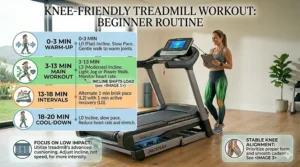
Real-World Scenario Guide: Matching Treadmill to Your Knee Situation
Scenario 1: Post-Surgical Knee Rehabilitation
You’re 6-12 weeks post-ACL reconstruction or meniscus repair. Your physical therapist cleared you for graduated treadmill walking but emphasized low-impact equipment.
Best Choice: WalkingPad C2 or Sole F63
Why: The WalkingPad’s speed limitation (3.7 MPH max) prevents overambitious training that could compromise healing. Start with 5-minute sessions twice daily rather than attempting full workouts. The Sole F63 becomes relevant once your surgeon approves jogging—you’ll need that Cushion Flex technology as you increase intensity.
Red Flag: Avoid treadmills with minimum motor speeds above 0.5 MPH, as you’ll need extremely slow walking during early rehab phases.
Scenario 2: Chronic Knee Arthritis Management
You have diagnosed osteoarthritis in one or both knees. Movement helps, but impact aggravates inflammation. Your goal is maintaining fitness without accelerating degeneration.
Best Choice: NordicTrack Commercial 1750 or Sole F80
Why: Arthritis requires the absolute best cushioning technology you can afford—this isn’t the area to economize. The 1750’s decline capability is particularly valuable because downhill walking strengthens quadriceps with minimal compressive forces on knee joints. The F80 provides similar cushioning at a lower price point if decline isn’t essential.
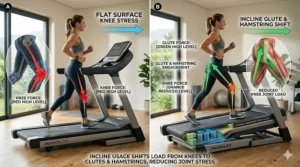
Training Strategy: Focus on incline walking (3-4% grade) rather than faster flat speeds. Research shows incline walking can strengthen knee-supporting muscles while actually reducing joint loading compared to flat running.
Scenario 3: Overweight Individual Starting Fitness Journey
You’re carrying extra weight and worry about knee stress. Your doctor recommended low-impact cardio but warned about joint overload.
Best Choice: Bowflex Treadmill 10 or Sole F80
Why: That 400-pound capacity on the T10 isn’t just a number—it reflects frame engineering that provides stability at higher user weights. Stability is crucial because wobbling machines force your knees to stabilize rather than just move. Start with 15-20 minute walking sessions at 2-3 MPH with 1-2% incline. The large deck size gives you movement confidence.
Progression Plan: Add 5 minutes weekly until you reach 45-minute sessions. Only increase speed after you can complete 45 minutes comfortably. The cardiovascular adaptation will come before your knees are ready for running impact—patience protects joints.
How to Choose a Low Impact Treadmill for Bad Knees: Decision Framework
Step 1: Identify Your Primary Limitation
Is your main constraint budget, space, or knee severity? This determines your category:
Budget Priority (Under $1,500): Sole F63, Horizon T303, or WalkingPad C2
Space Priority (Apartment/Condo): Echelon Stride-6, WalkingPad C2, or Horizon T303
Maximum Joint Protection: NordicTrack Commercial 1750, Sole F80, or Sole F85
Step 2: Match Motor Power to Your Training Intensity
Walking Only (Under 4 MPH): 1.5-2.5 CHP sufficient – WalkingPad C2
Walking and Light Jogging (4-6 MPH): 2.5-3.0 CHP minimum – Horizon T303, Sole F63
Regular Running (6-8 MPH): 3.5+ CHP recommended – Sole F80, Bowflex T10
Intense Training (8+ MPH): 4.0+ CHP required – NordicTrack 1750
Motor power below these thresholds won’t damage your knees directly, but it will strain the machine, potentially causing speed inconsistencies that force gait adjustments—which can stress knee joints.
Step 3: Verify Deck Dimensions Match Your Stride
Height Under 5’6″: 20″ x 55″ minimum deck size
Height 5’6″ to 6’0″: 20″ x 60″ minimum deck size
Height Over 6’0″: 22″ x 60″ minimum deck size
Cramped decks force shortened strides that alter your natural biomechanics. This compensation pattern often manifests as knee pain even on well-cushioned machines.
Step 4: Calculate Total Cost of Ownership
Don’t just compare sticker prices—factor in:
Subscription Services: iFIT (NordicTrack) $39/month, JRNY (Bowflex) $20/month
Professional Assembly: $150-$300 for heavy models
Extended Warranty: Varies by retailer, often $200-$500
Maintenance Supplies: Belt lubricant, cleaning supplies (~$30 annually)
A $1,400 treadmill with mandatory $39 monthly subscriptions costs $1,868 in year one—suddenly that $1,800 treadmill with no subscription seems competitive.
Step 5: Prioritize Warranty Coverage
Minimum Acceptable: 1-year parts, 90-day labor
Good Coverage: 3-year parts, 1-year labor, 10-year frame
Excellent Coverage: Lifetime frame/motor, 3+ year parts, 2+ year labor
Frame and motor warranties reveal manufacturer confidence. Lifetime coverage on these components (like Sole provides) suggests they rarely fail, while short warranties often precede trouble.
Common Mistakes When Buying Low Impact Treadmills (And How to Avoid Them)
Mistake 1: Assuming All “Cushioned” Treadmills Protect Equally
Marketing departments love the word “cushioned,” but implementation varies wildly. Some budget models add a thin foam pad and claim cushioning technology. Quality systems like Sole’s Cushion Flex or NordicTrack’s RunFlex use multi-layer, variable-density construction with measurable impact reduction.
Solution: Look for specific claims like “reduces impact by 40%” with named cushioning technologies. Vague statements like “cushioned for comfort” are red flags.
Mistake 2: Sacrificing Stability for Portability
Ultra-lightweight folding treadmills seem ideal until you realize that weight equals stability. A 150-pound treadmill will flex and wobble under your movement, forcing your muscles—especially around the knees—to work as stabilizers. This negates cushioning benefits.
Solution: Unless you genuinely need ultra-portability (like the WalkingPad for desk use), choose machines weighing 200+ pounds. The physics of stability require mass.
Mistake 3: Ignoring Motor Quality While Focusing on Cushioning
A struggling motor creates speed inconsistencies that force your gait to constantly adjust. These micro-adjustments accumulate as knee stress. You might have excellent cushioning, but if the belt speed fluctuates, your joints pay the price.
Solution: Never buy a continuous horsepower (CHP) motor below 2.5 for walking/jogging or 3.5 for running, regardless of cushioning claims. Underpowered motors compromise joint protection.
Mistake 4: Buying Maximum Cushioning When You Need Moderate
Here’s a counterintuitive point: overly soft cushioning can actually cause knee problems. If the deck compresses too much, it creates instability that requires excessive muscle activation for balance. This is why some ultra-cushioned treadmills cause knee fatigue despite advertised joint protection.
Solution: “Maximum” isn’t always better. For runner’s knee or mild arthritis, moderate cushioning with stability (like Horizon’s 3-Zone system) often outperforms ultra-soft decks.
Mistake 5: Neglecting Deck Size in Favor of Features
That amazing touchscreen and streaming capability won’t help your knees if the deck is too short or narrow for your natural stride. Cramped running spaces force gait modifications that often manifest as knee pain within weeks.
Solution: Measure your natural stride length (distance from heel to heel during comfortable jogging). Your treadmill deck should exceed this by 10-12 inches. Most people need at least 20″ x 60″ for comfortable movement.
Impact Reduction Percentage: What the Numbers Really Mean
You’ll see claims like “reduces impact by up to 40% compared to asphalt.” Here’s how to interpret these figures realistically.
That “40%” typically represents peak force reduction at the moment of foot strike, measured under laboratory conditions with specific weight, speed, and gait parameters. In real-world use, actual reduction varies based on your running mechanics, speed, and body weight. A 150-pound walker might experience 35-40% reduction, while a 220-pound runner at 8 MPH might see 25-30%.
The key word is “compared to asphalt.” Remember that asphalt itself is relatively forgiving compared to concrete. A treadmill claiming 40% reduction versus asphalt might only offer 25-30% reduction versus track surfaces. This doesn’t invalidate the benefit—it just contextualizes the claim.
What matters more than the exact percentage is consistency of cushioning throughout the deck and across different speeds. A system that reduces impact 30% consistently across the deck outperforms one that reduces 40% in some areas but only 15% in others.
Orthopedic Recommendations: What Joint Specialists Actually Say
Dr. David Geier, orthopedic surgeon and sports medicine specialist, emphasizes that cushioned treadmills “can allow people with knee pain to exercise who otherwise might not be able to tolerate impact.” However, he notes that cushioning is “just one part of the equation”—proper footwear, gradual progression, and addressing underlying biomechanical issues remain essential.
The Arthritis Foundation recommends low-impact aerobic exercise for knee osteoarthritis management, specifically citing treadmill walking on cushioned surfaces as beneficial. Their guidelines suggest 30-minute sessions, 5 days per week, at intensity levels that don’t increase pain beyond mild discomfort.
Research published by the National Center for Biotechnology Information found that moderate treadmill exercise can actually protect knee joint cartilage through beneficial mechanical loading, provided the impact forces remain within physiological ranges. The key is finding that sweet spot between beneficial loading and excessive stress—which is exactly what quality cushioning systems provide.
Physical therapists frequently recommend starting with 10-15 minute treadmill sessions at comfortable walking pace, gradually increasing duration before increasing intensity. The cushioning allows this progression without the sharp pain spikes that often derail rehabilitation programs.
Long-Term Cost and Maintenance: What to Expect Over 5 Years
Year 1: Initial Investment and Break-In Period
Costs: Treadmill purchase ($900-$2,200), professional assembly ($150-$300), quality running shoes ($120-$180)
Total: Approximately $1,170-$2,680
During year one, you’ll discover any manufacturing defects covered by warranty. Belt tracking adjustments are common and typically free during warranty periods. Expect to lubricate the belt every 3-6 months using silicone-based lubricant ($10-$15 per application).
Years 2-3: Maintenance Stability
Annual Costs: Belt lubricant ($20-$30), replacement running shoes ($120-$180)
Total Per Year: $140-$210
This period typically requires minimal intervention if you’ve chosen quality equipment. Monitor belt tension—it should feel firm but not drum-tight. Excessive looseness or tightness both accelerate wear and can affect cushioning performance.
Years 4-5: Component Replacement Phase
Potential Costs: Running belt replacement ($150-$300), deck replacement ($200-$400), motor brushes ($50-$100)
Total Range: $400-$800 over two years, depending on usage frequency
High-quality treadmills with lifetime frame/motor warranties rarely require motor replacement, but belts and decks are consumables. Signs you need replacement include visible belt wear, decreased cushioning feel, or unusual noises during operation.
Total 5-Year Cost Comparison
Budget Model (Sole F63): Initial $1,300 + maintenance $700 + shoes $600 = $2,600
Mid-Range (Sole F80): Initial $1,900 + maintenance $700 + shoes $600 = $3,200
Premium (NordicTrack 1750): Initial $2,200 + iFIT $2,340 + maintenance $700 + shoes $600 = $5,840
Notice how subscription costs can double the total ownership expense. For people on fixed incomes, the subscription-free Sole models offer dramatically better value over time.
Maintenance Schedule for Optimal Knee Protection
Weekly: Wipe down belt and deck surfaces, check for loose bolts
Monthly: Vacuum underneath deck, inspect power cord
Quarterly: Apply belt lubricant, check belt tracking and tension
Annually: Professional inspection if available, deep clean motor compartment
Regular maintenance preserves cushioning effectiveness—neglected machines lose protective properties as components wear unevenly.
Alternative Training Methods for Severe Knee Issues
When Treadmills Aren’t the Answer (Yet)
Sometimes knee damage is too severe for even the most cushioned treadmill. If walking for 10 minutes on any surface triggers sharp pain or significant swelling, you need alternative strategies before graduating to treadmill use.
Aquatic Therapy: Water walking in a pool provides 75-90% body weight reduction depending on water depth. This allows movement patterns similar to treadmill walking without impact forces. Many patients can progress from pool to cushioned treadmill within 8-12 weeks.
Elliptical Machines: These eliminate the impact phase entirely while maintaining similar cardiovascular benefits. The gliding motion reduces compressive forces on knee joints while strengthening supporting muscles. Once elliptical training becomes comfortable, transition to cushioned treadmill walking.
Recumbent Bikes: The seated position completely unloads knee joints while allowing cardiovascular training. This isn’t running preparation, but it prevents the deconditioning that worsens knee problems. Build aerobic base on the bike, then add short treadmill walking sessions.
Progressive Return to Treadmill Training
Phase 1 (Weeks 1-2): 5-minute treadmill sessions at 1.5-2.0 MPH, twice daily
Phase 2 (Weeks 3-4): 10-minute sessions at 2.0-2.5 MPH, twice daily
Phase 3 (Weeks 5-6): 15-minute sessions at 2.5-3.0 MPH, once daily
Phase 4 (Weeks 7-8): 20-minute sessions, maintain speed or add 1% incline
Only progress to the next phase if you complete the current phase without pain increase during or after workouts. Patience during these early weeks prevents setbacks that can delay recovery by months.
Comparison: Low Impact Treadmills vs Traditional Outdoor Running
| Factor | Cushioned Treadmill | Outdoor Running |
|---|---|---|
| Impact Forces | 30-40% reduction vs pavement | Full impact, varies by surface |
| Gait Consistency | Forced consistent pace | Natural pace variation |
| Weather Dependency | Climate controlled | Limited by conditions |
| Terrain Control | Precise incline adjustment | Limited by location |
| Joint Feedback | Reduced proprioceptive input | Maximum natural feedback |
The comparison reveals why orthopedic specialists often recommend cushioned treadmills during injury recovery but encourage outdoor running as long-term primary training. Treadmills provide controlled environments that allow graduated rehabilitation, while outdoor running develops proprioception (joint position sense) that helps prevent future injuries.
Ideally, use both: treadmill training for controlled volume and intensity, outdoor running for neuromuscular development and mental variety. For people with chronic knee issues, a 70/30 split (70% treadmill, 30% outdoor) often represents the sweet spot between joint protection and functional strength development.
The data in this table highlights a key insight: treadmills aren’t objectively “better” or “worse” than outdoor running—they’re tools for different purposes. During knee rehabilitation or flare-ups, the controlled environment and reduced impact of quality treadmills prove invaluable. Once you’ve built strength and confidence, outdoor variation becomes essential for long-term knee health.
FAQ: Common Questions About Low Impact Treadmills for Bad Knees
❓ Do cushioned treadmills actually help with knee arthritis pain?
❓ How much should I spend on a low impact treadmill for bad knees?
❓ Can walking on a treadmill make knee pain worse?
❓ What's the difference between cushioned deck and shock absorption?
❓ How often should I replace treadmill cushioning components?
Conclusion: Your Path to Pain-Free Movement Starts Here
Choosing a low impact treadmill for bad knees isn’t about finding the most expensive machine or the one with the flashiest features. It’s about matching cushioning technology, deck design, and stability to your specific knee situation and training needs. The difference between a machine that enables pain-free progress and one that aggravates joint problems often comes down to understanding what those impact reduction percentages actually mean in real-world use.
For maximum joint protection with unlimited budget, the NordicTrack Commercial 1750 delivers RunFlex cushioning, decline capability, and commercial-grade stability. If you need professional-quality protection without premium pricing, the Sole F80 provides identical cushioning technology at $400-$500 less. Budget-conscious buyers shouldn’t overlook the Sole F63—you’re getting the same joint-protecting deck as expensive models with strategic compromises elsewhere.
Space constraints change the equation entirely. The Echelon Stride-6 offers genuine fold-flat storage with air cushioning that maintains effectiveness over time. For severe space limitations or gentle walking needs, the WalkingPad C2 brings surprising cushioning to a package that literally stores under furniture.
Remember that the best treadmill for your knees is the one you’ll actually use consistently. Joint health improves through regular, moderate exercise—not occasional intense sessions. A $1,200 machine you use five times weekly protects your knees better than a $2,000 model gathering dust. Start with manageable duration and intensity, trust the cushioning technology, and give your body time to adapt. Your knees—and your future mobility—will thank you.
Recommended for You
- 7 Best Incline Decline Treadmill 2026
- 7 Best 30 Incline Treadmills That Burn 5X More Calories (2026)
- 7 Best 40 Percent Incline Treadmills for Peak Performance 2026
Disclaimer: This article contains affiliate links. As an Amazon Associate, I earn from qualifying purchases. If you purchase products through these links, we may earn a small commission at no additional cost to you.
✨ Found this helpful? Share it with your friends! 💬🤗
