
In This Article
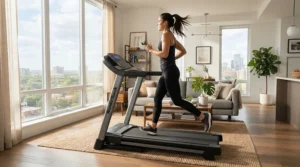
The quietest treadmill for apartment living is a machine that keeps airborne motor noise near conversation level (roughly 45-55 dB at walking speed), uses a smooth brushless or well-rated continuous-duty motor, and has enough deck cushioning to keep footfall thuds from traveling through the floor into your neighbor’s ceiling.
Here’s the uncomfortable truth nobody prints on the box: your downstairs neighbor doesn’t hear your motor. They hear your feet. A treadmill annoys people in two different ways. There’s airborne noise, the hum and whir you hear across the room. Then there’s structure-borne noise, the dull, rhythmic thud that rides through the floor slab and turns a ceiling into a speaker cone. Most product listings obsess over the first and ignore the second. This guide tackles both.
A quick yardstick helps. The American Academy of Audiology’s everyday noise chart puts a quiet library around 40 dB, normal conversation and a running dishwasher around 60 dB, and a vacuum or busy traffic near 70 dB. Every 10 dB step roughly doubles how loud something sounds to your ears. So the gap between a 45 dB walking pad and a 65 dB runner isn’t cosmetic. It’s the difference between “background” and “complaint.”
A note on sourcing: this guide leans on published decibel figures, spec sheets, and independent testing roundups. It does not invent owner quotes or star ratings. Where a number comes from a single reviewer or a manufacturer, it’s flagged. Treat every dB figure as a ballpark, because your floor, your body weight, and your stride will move the needle.
Ahead: seven real machines, a decoder for motor claims, a plain-English look at noise ordinances and lease rules, and a setup guide that makes even a so-so treadmill behave.
Quietest Treadmill for Apartment Living: Quick Comparison Table
Before the deep dives, here’s the field at a glance. Noise notes come from published figures and testing roundups, and the table says so when a number rests on a single source.
| Product | Type | Reported Noise Notes | Best For |
|---|---|---|---|
| LifeSpan TR1200-Glow Up | Under-desk walking pad | 2.25 HP motor, 4 mph cap keeps sound low | Work-from-home walkers |
| WalkingPad C2 | Folding walking pad | One 2026 roundup lists about 55 dB | Tiny studios, light walking |
| Echelon Stride | Folding smart treadmill | One roundup lists about 45 dB at walking pace | Walk-and-jog hybrids |
| Horizon T101 | Budget folding treadmill | Described as quiet by independent testers | First-time buyers |
| ProForm Carbon TLX | Folding treadmill with incline | 3.0 CHP motor, up to 12% incline | Joggers who want incline |
| Horizon 7.0 AT | Full-size folding runner | Named top quiet pick in one testing lab’s roundup | Regular runners |
| NordicTrack Commercial 1750 | Premium incline/decline trainer | Named best quiet treadmill with incline by the same lab | Serious trainers |
Read the table in two passes. If raw decibels are your priority, the walking-pad class (LifeSpan TR1200-Glow Up, WalkingPad C2, Echelon Stride) wins on paper, and the Echelon Stride‘s reported 45 dB is the lowest figure here. If you want to run, the Horizon 7.0 AT and ProForm Carbon TLX trade some quietness for a real running experience. The NordicTrack Commercial 1750 adds incline and decline for people who treat the treadmill as a training tool.
💬 Just one click — help others make better buying decisions too!😊
Top 7 Quietest Treadmills for Apartment Living: Expert Analysis
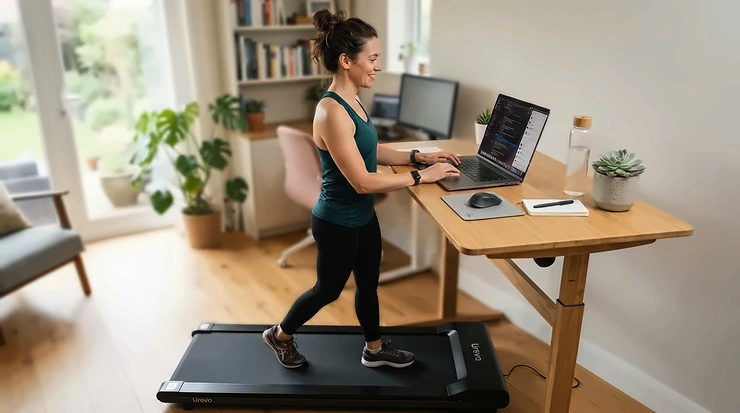
1. LifeSpan TR1200-Glow Up — quietest under-desk walker
The quiet here is partly structural: a 4 mph speed cap means the belt never reaches the pitch where treadmills start to whine. A 2.25 HP motor on a walking-only machine is loafing, not straining, and a motor that isn’t working hard doesn’t shout.
LifeSpan publishes noise figures for its treadmill desks of roughly 47 dB at 1 mph, climbing to about 60 dB at 4 mph (see LifeSpan’s own breakdown). Those numbers describe its desk line generally, not this exact unit, but they’re a sensible ballpark. The 350 lb capacity and fully assembled delivery matter more than they sound. No assembly means no under-tightened bolt rattling loose in month three.
Based on the spec comparison, this is the pick when your apartment sits above someone’s bedroom and your goal is steps, not sprints. LifeSpan’s own guidance notes that the walker, not the motor, makes most of the sound, so a mat and a soft gait matter as much as the machine.
On reviewer sentiment, Garage Gym Reviews names it the quietest under-desk walking treadmill it recommends. Large-scale owner-review aggregates couldn’t be verified for this article, so no star rating is claimed.
Pros:
- ✅ Very quiet motor at walking speeds
- ✅ Arrives fully assembled
- ✅ 350 lb weight capacity
Cons:
- ❌ 4 mph cap rules out jogging
- ❌ Pricier than many walking pads
Price: roughly $400-$600 at the time of research (check current price). Verdict: you pay for polish and quiet, which is a fair trade if you’ll use it daily.
2. WalkingPad C2 — the tuck-away apartment classic
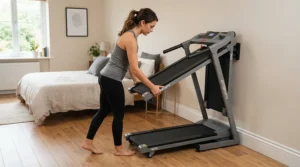
If a treadmill has to disappear when guests arrive, foldable walking pads like the WalkingPad C2 are the category’s answer. It folds flat and slides out of sight, which in a studio apartment counts as a feature on par with horsepower.
On noise, one 2026 apartment roundup lists the WalkingPad C2 at about 55 dB, while it lists the Echelon Stride at 45 dB. If those figures were taken under comparable conditions (which can’t be verified), that 10 dB gap is roughly a doubling of perceived loudness. It’s still comfortably under the 60 dB level of ordinary conversation, but it’s a reminder that “quiet” is a spectrum.
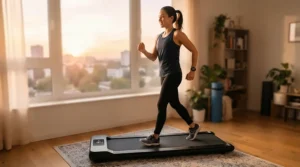
This is the machine for light walking: podcasts, phone calls, a daily step goal. It is not the machine for a training plan. Because walking pads keep speeds low, there’s less belt and motor noise to manage, and footfall is gentle if you walk like a human instead of a marching band.
The same roundup ranks it as its best apartment treadmill overall. That’s one outlet’s opinion, not an aggregate of verified owner reviews.
Pros:
- ✅ Folds flat for storage
- ✅ Under 60 dB in the one roundup that lists it
- ✅ Simple, low-fuss walking setup
Cons:
- ❌ Louder than the quietest claims
- ❌ Not built for running
Price: around the $300-$500 range (check current price). Verdict: strong value for walkers in tight spaces.
3. Echelon Stride — lowest reported dB in this lineup
The headline number is 45 dB at walking pace, according to one 2026 apartment roundup. That’s the lowest figure in this guide and sits between a whisper and a quiet library on the Audiology chart.
Treat it as promising rather than proven. Single-source decibel claims are exactly the kind of figure worth double-checking against the manufacturer’s spec page. The Echelon Stride is a folding, app-connected treadmill, so it sits between a bare walking pad and a full-size machine. That makes it appealing if you want to walk quietly most days and add the occasional jog.
Garage Gym Reviews has praised the quiet operation of the related Stride-6s while saying it prefers other machines at that price. Read that as a value verdict, not a noise complaint. If silence is your top criterion and features are secondary, the Echelon Stride deserves a spot on your shortlist. If you want the most treadmill per dollar, the Horizon T101 and Horizon 7.0 AT make stronger cases.
Pros:
- ✅ Lowest reported noise figure here
- ✅ Folds for apartment storage
- ✅ Suits walking plus light jogging
Cons:
- ❌ Noise figure rests on one source
- ❌ Reviewed as middling value at its price
Price: roughly the mid-$400s to $700 range depending on version (check current price). Verdict: a quiet-first buyer’s choice.
4. Horizon T101 — the no-frills budget quiet pick
Some treadmills try to be your personal trainer. The Horizon T101 just wants to be a quiet, compact folding treadmill. Garage Gym Reviews names it its best budget quiet treadmill, describing a durable, no-frills folder aimed at walkers and joggers.
That description matters for apartment life. Fewer screens, servos, and gadgets mean fewer parts to buzz, rattle, or fail. A basic frame that folds up is also easier to shove into a closet than a smart-treadmill monolith. The tester’s lukewarm take, that it’s nothing special but delivers a good workout, is exactly what a budget apartment treadmill should earn.
What the spec sheet won’t tell you is how your floor reacts. Even a quiet motor can’t fix a hollow wooden subfloor, so pair this machine with a dense mat and daytime hours. For a first treadmill in a first apartment, it’s a low-drama choice.
Independent testers describe it as quiet. Owner-review aggregates weren’t verifiable here.
Pros:
- ✅ Compact folding design
- ✅ Described as quiet by testers
- ✅ Budget-friendly entry point
Cons:
- ❌ Basic feature set
- ❌ Not built for heavy training
Price: around the $500-$700 range (check current price). Verdict: the sensible starter pick.
5. ProForm Carbon TLX — folding runner with incline
Here’s where apartment treadmills get serious. The ProForm Carbon TLX pairs a 3.0 CHP motor with a 300 lb capacity and up to 12% incline, plus iFIT compatibility for guided workouts. CHP means continuous horsepower, the sustained rating that actually predicts how hard a motor works at your pace.
Why does that matter for noise? A motor with real headroom doesn’t strain at jogging speeds, and strain is where whining comes from. A tester also found it moved easily despite shipping near 250 pounds. Weight is a double-edged sword in an apartment. It’s miserable on stairs, but heavier machines with good deck cushioning generally transmit less vibration than flimsy ones.
This is the stepping stone between a walking pad and a full runner. Walking and brisk jogging make sense on a second floor with a mat. Hard running upstairs is a different conversation, and a lease conversation at that. Confirm iFIT membership costs before assuming the guided classes are included.
Pros:
- ✅ 3.0 CHP motor with headroom
- ✅ Up to 12% incline
- ✅ 300 lb capacity and folding frame
Cons:
- ❌ Heavy to move up stairs
- ❌ Guided classes typically need a subscription
Price: roughly $700-$1,000 (check current price). Verdict: strong value for joggers who want incline.
6. Horizon 7.0 AT — Garage Gym Reviews’ top quiet pick
Garage Gym Reviews ranked the Horizon 7.0 AT its best quiet treadmill overall, noting it comes in under $1,000 and suits people who actually want to run. That’s a rare combination: a runner-grade machine that earned a quiet-treadmill title.
The summary doesn’t publish a single headline dB figure, so check the manufacturer’s spec page for deck size and motor rating before you buy. What’s reported is durability and a solid, no-nonsense feel. For apartment dwellers, durability is a noise issue in disguise. Machines that stay tight and aligned stay quiet, while loose ones start clicking and thumping within months.
Keep expectations honest. A full-size runner still makes footfall, and footfall is what neighbors hear. Based on the testing criteria this lab describes, thicker belt cushioning and a sturdy frame reduce that impact. Even so, a mat and sensible hours remain non-negotiable if you run above someone else’s ceiling.
The lab’s verdict is the review sentiment available here. Owner-review aggregates weren’t verified.
Pros:
- ✅ Top quiet pick in one lab’s roundup
- ✅ Built with running in mind
- ✅ Under-$1,000 pricing
Cons:
- ❌ Larger footprint than walking pads
- ❌ Runner’s footfall still carries upstairs
Price: under $1,000 (check current price). Verdict: the best fit for regular runners.
7. NordicTrack Commercial 1750 — premium incline and decline
The NordicTrack Commercial 1750 is the splurge here. Garage Gym Reviews calls it the best quiet treadmill with incline, notes it’s one of the few with decline training, and says it pairs with iFIT. Its tester described it as a sturdy machine.
Sturdiness is the apartment-relevant bit. A rigid frame doesn’t flex, and flex is what converts footfall into thumps and rattles. Incline and decline also let you build challenge without raising speed, a clever trick for quiet training. Hills beat sprints when your neighbor works nights.
The cons are practical. It’s big, it’s heavy, and it costs real money. If you’re on a third floor without an elevator, delivery and placement need a plan. For ground-floor townhouses and first-floor condos, it’s a legitimate long-term training platform.
The lab’s view is the review sentiment available. Owner-review aggregates weren’t verified for this article.
Pros:
- ✅ Incline and decline training
- ✅ Sturdy, rigid-feeling build
- ✅ iFIT compatibility
Cons:
- ❌ Premium price tier
- ❌ Bulky for small apartments
Price: premium tier, think $1,500 and up, before promotions (check current price). Verdict: worth it only if you’ll train seriously.
Side-by-Side: The 7 Quietest Treadmills for Apartment Living
| Product | Key Spec Note | Price Range | Best For |
|---|---|---|---|
| LifeSpan TR1200-Glow Up | 2.25 HP, 4 mph max, 350 lb capacity | $400-$600 | Desk walkers |
| WalkingPad C2 | Foldable walking pad | $300-$500 | Studio apartments |
| Echelon Stride | About 45 dB reported at walking pace | Mid-$400s-$700 | Quiet-first buyers |
| Horizon T101 | Compact no-frills folder | $500-$700 | Budget starters |
| ProForm Carbon TLX | 3.0 CHP, up to 12% incline | $700-$1,000 | Joggers |
| Horizon 7.0 AT | Built for running, under $1,000 | Under $1,000 | Regular runners |
| NordicTrack Commercial 1750 | Incline and decline | $1,500+ | Serious trainers |
Price ranges are approximate and move often, so check current prices before buying. The smart money here is at the extremes. The Horizon T101 and WalkingPad C2 are the budget winners, and the Horizon 7.0 AT is the standout runner’s value. The NordicTrack Commercial 1750 only makes sense if you’ll use incline and decline weekly.
Soundproof Treadmill Mat and Machine: A Setup Guide That Actually Works
Buying quiet is half the job. The other half is setting up a soundproof treadmill mat and machine combo that stops vibration before it leaves your living room.
Step 1: Decouple the machine from the floor
Structure-borne noise travels best through hard contact. A dense rubber equipment mat absorbs vibration instead of passing it along. One walking-pad guide claims a thick rubber mat can cut transmitted vibration by up to 40 percent. Treat that figure as a ballpark, not a promise, since results vary with mat density and building construction.
Step 2: Level, tighten, center
Adjust the floor stabilizers until the frame doesn’t rock. Tighten frame bolts, because loose hardware rattles. If the belt drifts to one side, center it, since rubbing creates grinding noise and wears the belt faster, according to LifeSpan’s maintenance advice.
Step 3: Lubricate per the manual
Friction under the belt becomes noise. Follow the manufacturer’s lubrication schedule and use the lubricant type it specifies.
Step 4: Kill the beeps, add headphones
LifeSpan notes that audible start and speed-change beeps can be switched off on some desk models. Bluetooth headphones also let you hear your music without turning up speakers that carry through walls.
Common first-30-day mistakes
- Placing the treadmill touching a standing desk, which turns the desk into a resonator
- Skipping the mat “until it’s a problem”
- Running at 10 p.m. before checking quiet hours
A good soundproof treadmill mat and machine pairing won’t make a runner silent. It will make a walker practically invisible.
Real-World Scenarios: Matching the Quietest Treadmill for Apartment Living to Your Life
Specs only matter in context. Here are three profiles, each with a budget, environment, and usage pattern.
The remote worker on the second floor
Budget: around $500. One-bedroom with hardwood floors and a downstairs neighbor. Usage: three to four hours of slow walking daily. The best fit is the LifeSpan TR1200-Glow Up for its desk-friendly quiet, or the WalkingPad C2 if storage is tight. Add a thick mat and keep the pace around 2 mph. At that speed, LifeSpan’s published treadmill-desk figures put noise near 50 dB.
The couple in a third-floor condo
Budget: under $1,000. Two joggers, four sessions per week, mostly mornings. The Horizon 7.0 AT or ProForm Carbon TLX makes sense, with a heavy-duty mat, daytime sessions only, and a friendly heads-up to the neighbor below. Honest caveat: jogging above someone is a negotiation, not a guarantee.
The ground-floor townhouse trainer
Budget: $1,500 or more. Serious weekly volume with hill work. The NordicTrack Commercial 1750 fits, since incline and decline add challenge without extra speed. With no one below, you can focus on training, not tiptoeing.
✨ Ready to Find Your Quiet Match?
🔍 Take your apartment workouts to the next level with these carefully selected machines. Click any highlighted product name to check current pricing and availability, then pair it with a good mat to keep the peace at home!
How to Choose the Quietest Treadmill for Apartment Living
Use these six steps in order. They’re ranked by how often they decide whether you keep the machine or return it.
- Check your floor level first. Upstairs apartments demand walking pads or well-cushioned folders. Ground floors have more freedom.
- Decide walk, jog, or run. Walking pads cap at low speeds, which keeps both motor and impact noise down. Running raises everything.
- Prefer brushless motors with a stated continuous rating. Ignore peak horsepower claims (more on that below).
- Look for deck cushioning and a sturdy frame. Thin belts and plastic-heavy frames amplify footfall and rattle.
- Demand a decibel figure with a speed attached. “Under 45 dB” means little without knowing the pace and distance.
- Budget for a mat. It’s part of the machine’s real cost, not an accessory.
The pattern is simple: low speed, solid build, honest motor ratings, and a mat. Skip any of those and you’re gambling with your neighbor’s patience.
Motor Decibel Ratings: How to Read the Fine Print
Motor decibel ratings are the most abused numbers in treadmill marketing. A few rules make them useful.
Rule 1: Speed changes everything
LifeSpan’s published treadmill-desk figures climb from about 47 dB at 1 mph to roughly 50 dB at 2 mph, 54 dB at 3 mph, and nearly 60 dB at 4 mph. A listing that quotes one number without a speed is quoting the flattering one.
Rule 2: Distance matters
Garage Gym Reviews measured treadmills at distances from 1 to 10 feet and found the machines it tested averaged around 68.5 dB at 5 feet, about the same as a running dishwasher. That’s a useful reality check against “whisper quiet” marketing.
Rule 3: The scale is logarithmic
A 10 dB jump means about ten times the sound intensity and roughly double the perceived loudness. A claimed 45 dB and a measured 55 dB are not neighbors on the dial.
Rule 4: Many “quiet” claims cluster identically
One walking-pad roundup observed that nearly every quiet pad claims the same under-45 dB number. When everyone claims the same figure, nobody’s figure tells you much. Look for independent measurements and for buyers noting what happens under load, such as at incline.
Motor decibel ratings are a starting point. Pair them with build quality and a mat before you trust them.
Low-Noise Treadmill Motor Review: Brushless, Brushed, and the Horsepower Trap
A proper low-noise treadmill motor review starts with two questions: what type of motor is it, and what horsepower is it actually rated for?
Brushless vs brushed
Brushed motors use carbon brushes pressing on a spinning commutator. As the brushes wear, dust builds up and noise tends to rise. Brushless (BLDC) motors use electronic controllers instead, so there’s no brush friction. One walking-pad motor guide claims about 30 percent quieter operation, and manufacturer-side sources agree that brushless designs run quieter and last longer. Brushless motors cost more to make, so they historically showed up in pricier models, though they’re increasingly common on walking pads.
CHP vs peak horsepower
Continuous horsepower (CHP) is what a motor can sustain without overheating. Peak horsepower is a brief theoretical maximum. A listing proudly stating “2.25 HP” may be quoting peak, with a real continuous rating well below it. Garage Gym Reviews looks for at least 2.5 CHP when scoring runner-oriented treadmills on durability. For walking-only machines, a lower continuous rating can be fine as long as it’s honest.
What to do with this
Search the listing for “brushless” or “BLDC,” and for a continuous rating or an S1 duty code. If a brand won’t tell you, assume the flattering number is peak. The ProForm Carbon TLX advertises a 3.0 CHP rating, which is the kind of transparent claim worth looking for. For other models, verify motor type on the manufacturer’s page rather than assuming.
Walking Pad vs Folding Treadmill: Which Is Quieter?
Noise doesn’t only depend on brand. It depends on category.
| Type | Typical Noise Profile | Footfall Impact | Best For |
|---|---|---|---|
| Under-desk walking pad (LifeSpan TR1200-Glow Up, WalkingPad C2) | Often reported around 45-55 dB | Low at walking speeds | Upstairs walkers |
| Folding motorized treadmill (Horizon T101, ProForm Carbon TLX) | Higher at jogging speeds | Moderate, depends on cushioning | Joggers with a mat |
| Full-size runner (Horizon 7.0 AT, NordicTrack Commercial 1750) | Highest at running speeds | Highest, needs strong decoupling | Ground-floor runners |
| Non-motorized manual treadmill | No motor, but belt slats can still clack | Depends on stride | Experienced users |
Garage Gym Reviews’ guidance is that motorized treadmills add motor and drive-system noise, while manual machines often produce far less, though slat spacing and speed can still make noise. Walking pads win the apartment noise contest mainly because they cap speed. Folding treadmills offer more workout variety at the cost of more sound. For anyone living above another household, the pad is the safest default.
Noise Ordinances: What the Law Actually Measures
Understanding noise ordinances saves you from guessing. There is no single federal residential noise standard, so rules vary city by city.
Here is what published ordinances show:
- Washington State caps residential-to-residential noise at 55 dBA at the property line.
- Boulder, Colorado lists residential limits of 55 and 50 dBA.
- San Antonio’s quiet-hours notice sets a 63 dB limit on residentially zoned property from 10 p.m. to 6 a.m. Sunday through Thursday, with 11 p.m. to 6 a.m. on Friday and Saturday.
- A North Richland Hills, Texas notice lists 75 dB from 7 a.m. to 10 p.m. and 60 dB overnight in residential districts.
Three details matter more than the numbers. First, most limits are measured at the property line, not inside your neighbor’s bedroom. Second, many cities use subjective standards like “unreasonable” or “disturbs the peace,” which are harder to enforce but easier to file. Third, a few cities, Pittsburgh among them, go further and regulate apartment-to-apartment noise relative to background levels in the complainant’s unit.
For treadmill owners, the practical reading is that a 45-55 dB walking pad is rarely the problem. Impact thump at night is. Check your local code and note this is general information, not legal advice.
HOA/lease noise rules: What to Check Before You Click Buy
Even when the city is fine with your treadmill, your building may not be. HOA/lease noise rules often go further than ordinances, and they’re the ones that actually get enforced.
Lease clauses to hunt for
RentCafe’s overview of quiet hours notes that quiet hours in rentals most commonly run from about 10 p.m. to 7 or 8 a.m., and that renters generally have a right to “quiet enjoyment.” Look for sections on permitted activities, exercise equipment, weight loads per square foot, and general noise or disturbance clauses. Even a lease that never says “treadmill” likely contains a general noise clause that covers one.
HOA and condo rules
Some rule sets explicitly require padding or carpet under exercise equipment and prohibit equipment that creates disturbing noise or vibration. A condo board can also adopt new rules about equipment use or required soundproofing, so one complaint can turn into a policy.
The cheap insurance policy
Tell the neighbor below. Share your planned hours and ask what bothers them. A two-minute conversation costs less than a mat and prevents most escalations. Then document your setup: mat, quiet model, daytime hours. If a complaint arrives, you’ll have a reasonable answer ready.
Reading your HOA/lease noise rules before you buy is the cheapest quiet upgrade there is.
Noise Problems and Solutions: Fix It Before the Neighbor Knocks
Even a quiet machine can misbehave. Here are the common problems and what to do about each.
Problem: A dull thudding downstairs. The fix is better decoupling. Use a denser mat, check stabilizer feet, shorten your stride, and walk instead of jog if the building is wood-framed.
Problem: Rattling or clicking. Tighten frame bolts. If the treadmill touches a desk or wall, create a gap so vibration doesn’t transfer. Loose items nearby can also buzz in sympathy.
Problem: Grinding or squealing from the belt. Center the belt and lubricate according to the manual. A walking pad can get louder over time without maintenance.
Problem: A whine from the motor. A strained or aging brushed motor is often the culprit. Reduce load, check belt tension, and consider whether the motor was ever rated for continuous use.
Problem: Beeps at start-up. Disable audible alerts if your model allows it.
FAQ
❓ Can I use a treadmill in an upstairs apartment without annoying neighbors?
❓ What dB is considered a quiet treadmill?
❓ Does a treadmill mat really reduce noise for the downstairs neighbor?
❓ Can a landlord or HOA ban my treadmill?
❓ Are walking pads quieter than folding treadmills?
Conclusion
The quietest treadmill for apartment living isn’t a single model. It’s a system: the right category for your floor level, an honest motor, a dense mat, sensible hours, and a lease you’ve actually read.
If you’re walking above someone, start with the LifeSpan TR1200-Glow Up for desk-friendly quiet or the WalkingPad C2 for tight storage, with the Echelon Stride as the quiet-first wildcard. If you want a starter machine that won’t dent your budget, the Horizon T101 is the sensible choice. For jogging and running, the ProForm Carbon TLX and Horizon 7.0 AT offer real capability with a reputation for restraint, and the NordicTrack Commercial 1750 is the premium option for ground-floor trainers.
Remember the two noises. Motor hum is the one you hear, and footfall is the one your neighbor hears. Fix both, and an apartment treadmill goes from a liability to the best piece of fitness gear you own.
Recommended for You
- Compact Treadmill For Small Apartments: 7 Proven Picks 2026
- Foldable Treadmill For Weight Loss At Home: 7 Best Picks (2026)
- Budget Treadmill For Beginners Weight Loss: 7 Best Picks (2026)
Disclaimer: This article contains affiliate links. As an Amazon Associate, I earn from qualifying purchases. If you purchase products through these links, we may earn a small commission at no additional cost to you.
✨ Found this helpful? Share it with your friends! 💬🤗
