In This Article
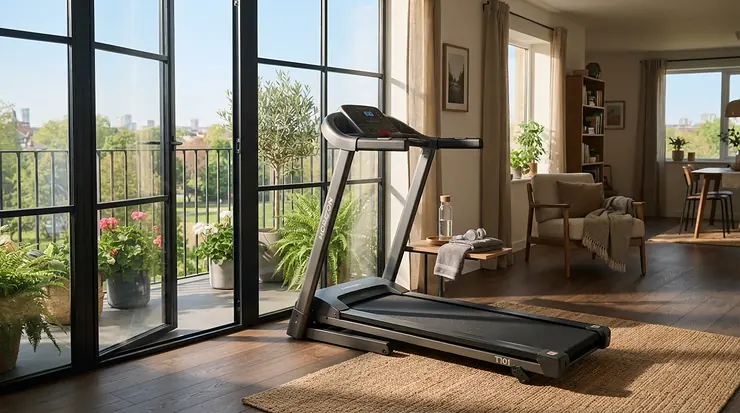
A compact treadmill for small apartments is a space-saving running or walking machine, typically folding flat or upright, with a belt between roughly 40 and 55 inches long, a motor quiet enough for shared walls, and a stored footprint small enough to slide under a bed or stand beside a closet.
Now the plot twist: the machine that fits your floor plan isn’t automatically the one you’ll use. Plenty of tiny-apartment treadmills end up as very expensive coat hangers. The difference between a keeper and a clothes rack usually comes down to three unglamorous details: how fast it folds away, how loud it is at 7 a.m., and whether the belt is long enough that your stride doesn’t feel like a shuffle.
The stakes are real, too. The CDC’s adult activity guidelines call for at least 150 minutes of moderate-intensity activity a week, and they note it doesn’t have to happen all at once. Thirty minutes, five days a week, is the classic split. A treadmill that lives behind your bedroom door makes that math painfully easy. One you have to wrestle into position makes it painfully hard.
Here’s how I built this guide. Everything below comes from spec sheets, manufacturer pages, and published roundup reviews. None of it is hands-on testing, and I won’t pretend otherwise. Where sources disagree, I flag it. Where I couldn’t verify a number, I say so. You’ll get seven real machines across budget, mid-range, and premium tiers, plain-English interpretation of every spec, and practical guides for measuring, placing, and quieting a treadmill in a space where every square foot is already spoken for.
Quick Comparison: 7 Best Picks at a Glance
Before the deep dives, here’s the whole field on one page. Prices are ranges, not quotes. They move constantly, so check the current listing before you decide.
| Product | Top Speed | Belt (L × W) | Stored Profile | Price Range | Best For |
|---|---|---|---|---|---|
| Goplus 2-in-1 Folding Treadmill | 7.5 mph | 39.5 × 14.2 in | 5.1 in thick | $300–$330 | Under-sofa storage |
| Sunny Health & Fitness SF-T7705 | 9 mph | 49 × 16 in | Hydraulic upright fold | $380–$400 | Budget jogging |
| XTERRA Fitness TR150 | 10 mph | 50 × 16 in | 28 in deep | $430–$500 | Incline in narrow closets |
| WalkingPad R2 Walk&Run | 7.5 mph | 52 × 16.5 in | 5.4 in thick | $450–$800 | Best all-rounder |
| Horizon Fitness T101 | 10–12 mph (listings vary) | 55 × 20 in | 46 × 34 × 61 in folded | Around $700 | Regular runners |
| WalkingPad X21 | 7.5 mph | 47.6 × 18.1 in | Double-fold, upright | $800–$1,000 | Premium walkers and joggers |
| Echelon Stride-6 | 12.5 mph | 60 in long | Hands-free Auto-Fold | $1,600–$1,800 | Low ceilings, serious runners |
Look at the table sideways and a pattern jumps out. Flat-fold machines like the Goplus 2-in-1 Folding Treadmill and WalkingPad R2 Walk&Run win on storage but cap out near 7.5 mph. Machines with longer belts and higher speeds, like the Horizon Fitness T101 and Echelon Stride-6, ask for more floor, more weight to move, and more money. If you mostly walk, buy for storage. If you run, buy for belt length and accept the bigger stored footprint.
💬 Just one click — help others make better buying decisions too!😊
The 7 Best Options for a Compact Treadmill for Small Apartments, Analyzed
I ordered these from lowest to highest price so you can find your budget tier fast. Each entry decodes what the specs mean for daily life, then summarizes what published reviewers report. That is aggregated sentiment, not my own testing.
1. Goplus 2-in-1 Folding Treadmill — thinnest fold for under-sofa storage
Five point one inches. That’s how thick this machine gets when folded, and in a studio where every closet is already spoken for, that number matters more than any horsepower rating. The Goplus 2-in-1 Folding Treadmill pairs a 2.25 HP motor with a 0.5–7.5 mph range and a 39.5 × 14.2-inch belt. Translation: a very good walker and a tolerable light jogger, but the short, slim deck will feel cramped if you have a long stride. Removable handrails switch it between desk-walking mode (speed capped near 2.5 mph) and a standard workout mode, and there’s no assembly: unfold, plug in, go.
Based on the spec comparison, this is the right buy for someone who wants a treadmill to vanish, not someone chasing mileage goals. The trade-off is the modest motor, which published roundups describe as strained at brisk-jog speeds. Reviewers consistently praise the flat fold and tool-free setup, and the short belt is the recurring complaint. I couldn’t verify a current live star breakdown, so read the latest reviews before buying.
Pros:
- ✅ Folds to just 5.1 inches thick
- ✅ Zero assembly, ready out of the box
- ✅ Desk mode and workout mode in one machine
Cons:
- ❌ 39.5-inch belt feels short for jogging
- ❌ 2.25 HP motor strains at higher speeds
Expect to pay around $300–$330. Strong value for walking-first apartment dwellers.
2. Sunny Health & Fitness SF-T7705 — cheapest route to real jogging speed
Most sub-$400 folding machines are walking pads wearing a treadmill costume. The Sunny Health & Fitness SF-T7705 is a rare exception: a 2.2 HP motor, a 9 mph ceiling, and a 49 × 16-inch belt that gives a normal jogger more room than the 40-inch decks above it. Three manual incline positions and nine preset programs mean you aren’t paying a subscription tax for variety.
The soft-drop hydraulic fold matters less for storage size than for sanity. The deck lowers with assistance, so you’re not wrestling a slab in a room with no elbow space. At roughly 106 pounds it’s movable by one person, but it’s not a machine you’ll shuffle daily.
My read: it suits the renter who wants to jog twice a week, walk the rest, and park it upright in a closet corner. Roundups frame it as dependable budget value. The common gripes are no Bluetooth or app layer and incline you must adjust by hand while stopped. Verify live review counts before you buy.
Pros:
- ✅ 9 mph top speed at a budget price
- ✅ Nine built-in programs, no subscription
- ✅ Soft-drop hydraulic folding
Cons:
- ❌ No Bluetooth or app connectivity
- ❌ Manual incline only
Around $380–$400. Best entry point for apartment jogging.
3. XTERRA Fitness TR150 — one of the slimmest folded profiles with real incline
Here’s a stat that rewires how you think about “small”: the XTERRA Fitness TR150 reportedly stands just 28 inches deep when folded. For a narrow closet or the gap beside a dresser, depth is the number that decides everything. The machine pairs a 2.25 HP motor with a 10 mph top speed, a 50 × 16-inch belt, and manual incline up to 10%.
That incline range is the quiet hero for upstairs renters. Climbing at a brisk walk raises your heart rate without the foot-strike thump of jogging, so your downstairs neighbor hears less. Built-in grip heart-rate sensors mean no chest strap for basic tracking, though grip sensors are famously rough estimates, so treat the numbers as trends.
Reviewers in roundups call it a solid mid-range pick for tight storage. The recurring caveat is assembly: reported at about an hour, which is a long afternoon if you have no floor space to spread parts. Expect to pick one clear weekend morning.
Pros:
- ✅ Only about 28 inches deep when folded
- ✅ 10% manual incline for low-impact intensity
- ✅ Built-in grip heart-rate sensors
Cons:
- ❌ Roughly one hour of assembly
- ❌ Incline changes require stopping
Around $430–$500. A smart middle-tier pick for narrow storage nooks.
4. WalkingPad R2 Walk&Run — best balance of thin fold and usable belt
The WalkingPad R2 Walk&Run solves the classic compact-treadmill dilemma better than most: a 52-inch belt, which is long enough for a natural stride, in a body that folds to about 5.4 inches thick. The 2.5 HP brushless motor covers 0.5–7.5 mph, and the whole machine weighs around 62 pounds, light enough to wheel under a bed without a negotiation.
Brushless motors are the spec that matters for shared walls. They tend to run quieter than brushed designs at equal speeds, which is why roundup writers keep singling this machine out for apartment use. Sync with Apple Health and Google Fit via the KS Fit app removes the logging chore, and for habit-building, automation beats willpower.
The honest limits: a 7.5 mph cap won’t satisfy fast runners, and reviewers mention a short learning curve with the auto-speed mode. Pricing swings widely depending on promotions, so watch it for a few days.
Pros:
- ✅ 52-inch belt in a flat-fold body
- ✅ Brushless motor suited to shared walls
- ✅ Lightweight at around 62 pounds
Cons:
- ❌ 7.5 mph cap limits faster runners
- ❌ Auto-speed mode takes a few sessions
Typically $450–$800 depending on timing. Best all-rounder if you value storage and stride room equally.
5. Horizon Fitness T101 — widest, longest belt for regular runners
If you run, the arithmetic changes. The Horizon Fitness T101 brings a 20 × 55-inch belt, a 300-pound capacity, and hydraulic folding, with a stored size around 46 × 34 × 61 inches. That 20-inch width is the roomiest in this guide, and it’s the difference between “I’m balancing” and “I’m running.”
A caution on specs: published sources disagree on top speed. One lists 10 mph, another 12 mph, so confirm on the live product page. Roundups also describe 0–10% incline, built-in workouts, and Bluetooth that pairs with apps like Peloton and Zwift without extra subscription fees. Verify that last claim for your own setup.
The cost is mass. At about 180 pounds, this is a machine you position once and fold in place, not one you wheel between rooms. It’s a good fit if you have a dedicated corner, a ceiling comfortably above its folded height, and mileage goals. Reviewers praise the deck cushioning and straightforward controls; the weight and footprint draw the complaints.
Pros:
- ✅ 55 × 20-inch belt suits real running
- ✅ 300-pound capacity with cushioned deck
- ✅ Hydraulic fold and Bluetooth connectivity
Cons:
- ❌ About 180 pounds, hard to relocate
- ❌ Bulkier folded profile than flat-fold rivals
Around $700. Fair value for runners who can spare a corner.
6. WalkingPad X21 — double-fold upright storage
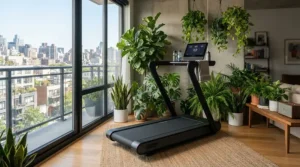
The WalkingPad X21 takes a different approach to storage: a double-fold design that collapses the whole machine into a slim upright package you can lean against a wall. Per the manufacturer’s own listing, it reaches 7.5 mph, has a 47.6 × 18.1-inch belt, supports 240 pounds, and weighs around 82 pounds.
Notice the 18.1-inch width. It’s wider than the 14–16-inch belts on most slim pads, which makes walking feel less like a tightrope. The 47.6-inch length is better for walking and light jogging than for long-stride running.
A fairness note: the ranking that calls this machine “best overall compact” comes from the brand’s own blog, so weigh it accordingly. I found no independent review base I could verify, so treat this as a promising spec sheet rather than a proven favorite. Its appeal is polished, upright storage and a roomier belt, but you pay a premium for a 7.5 mph ceiling.
Pros:
- ✅ Double-fold upright storage
- ✅ Wider 18.1-inch belt for stable walking
- ✅ Moderate weight of around 82 pounds
Cons:
- ❌ Premium price for 7.5 mph
- ❌ Limited independent review verification
Roughly $800–$1,000. Worth it only if upright storage and belt width are priorities.
7. Echelon Stride-6 — full-length 60-inch deck with hands-free fold
The Echelon Stride-6 is the “I refuse to compromise on running” pick. Listings show a 12.5 mph top speed, a 60-inch deck, adjustable incline, and a hands-free Auto-Fold mechanism, at about 182 pounds. One older roundup flagged it for low ceilings, since the fold-flat approach avoids the tall vertical profile of upright-folding machines.
That matters more than it sounds. Hydraulic uprights can add several vertical inches when stored, which becomes a problem under soffits and low ceilings. For space planning in older buildings, a fold-flat deck changes the equation.
The trade-offs are weight, price, and ecosystem. As a connected-fitness brand, Echelon may steer you toward paid classes, so check whether the workouts you want require a subscription before counting total cost. Reviewers in published roundups praise the running feel; its size isn’t “compact” in the ultra-slim sense, only compact for a full-size runner.
Pros:
- ✅ Full 60-inch deck and 12.5 mph speed
- ✅ Hands-free Auto-Fold storage
- ✅ Fold-flat helps with low ceilings
Cons:
- ❌ About 182 pounds, not movable
- ❌ Premium price plus possible subscription costs
Around $1,600–$1,800. Right for serious runners with a permanent spot.
Space Planning for a Tiny Floor Plan: Measure Before You Buy
Space planning is where most treadmill purchases are won or lost, and almost nobody does it properly. Grab a tape measure and collect three numbers before browsing.
Measure the in-use footprint
Take the belt length from the spec sheet, then add about two feet behind for safe dismount and a foot beside for arm swing. A 52-inch belt like the WalkingPad R2 Walk&Run needs a rectangle closer to 7 × 3 feet than the 4.3 × 1.4 feet of the belt itself.
Measure the stored footprint
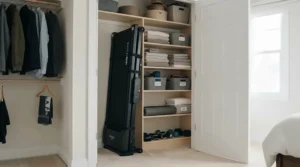
This is the one that matters most. Flat-fold models such as the Goplus 2-in-1 Folding Treadmill at 5.1 inches thick slide beneath beds and sofas. Upright designs such as the XTERRA Fitness TR150 need floor depth instead, around 28 inches by the listing. Always compare actual folded dimensions, not “foldable” marketing.
Measure vertical clearance and the route
Hydraulic uprights add height. The Horizon Fitness T101‘s listed folded height is about 61 inches, which is fine under a standard ceiling but not under a loft bed. Also measure the doorway and the path from storage to workout spot. A 180-pound machine can’t squeeze around a bed frame easily.
Space planning also means being honest about habits. If you’ll only use it when setup takes thirty seconds, buy the lightest, flattest option you can afford.
Studio Apartment Fitness: Three Real-World Scenarios
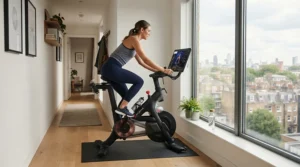
Studio apartment fitness has its own physics: one room serves as office, bedroom, and gym. These are hypothetical profiles, not real customers, built to show how the specs map onto life.
Scenario 1: The remote worker, 450 square feet
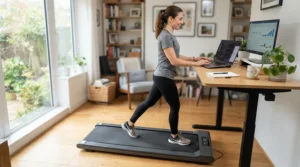
She walks during calls and wants the CDC’s 150 weekly minutes without leaving the building. Budget: around $400. The Goplus 2-in-1 Folding Treadmill suits desk-height walking, and its flat fold disappears under the bed. If she wants to jog occasionally, the Sunny Health & Fitness SF-T7705 offers 9 mph and a 49-inch belt for slightly more money.
Scenario 2: The upstairs renter who jogs
He runs three mornings a week and worries about thumping floors. The XTERRA Fitness TR150 gives 10 mph and 10% manual incline, so he can alternate incline walking and jogging. Pair it with a rubber mat, and move heavy intervals to times when the downstairs neighbor is awake.
Scenario 3: The couple in a one-bedroom
One partner runs, the other walks. They have floor space for a permanent corner. The Horizon Fitness T101‘s 20-inch belt and 300-pound capacity serve both, and its hydraulic fold clears the room when guests visit. If the runner is serious, the Echelon Stride-6 gives a 60-inch deck, at roughly triple the price.
The takeaway: match the machine to your most frequent workout, not your most ambitious one.
Problem → Solution: Noise, Wobble, and Cramped Strides
Four problems account for most “I regret this treadmill” stories. Each has a fix.
Problem 1: The neighbors can hear you. Brushless motors help, but footfall is usually louder than the motor. Roundup guides suggest a thick rubber mat can cut transmitted vibration substantially; claimed figures vary, so treat any specific percentage cautiously. Stay at walking or jogging speeds in shared buildings and avoid early and late hours.
Problem 2: The machine creeps or wobbles. Place it on a level, solid floor with a mat that grips. Check rubber feet after the first week, because small gaps create rattles.
Problem 3: The belt feels too short. A 39.5-inch deck like the Goplus 2-in-1 Folding Treadmill suits walking, while joggers do better with the Sunny Health & Fitness SF-T7705‘s 49 inches or the Horizon Fitness T101‘s 55 inches. If your stride is long, don’t compromise here.
Problem 4: Setup friction kills the habit. If unfolding takes more than a minute, you’ll skip workouts. Prioritize weight and fold mechanism. The roughly 62-pound WalkingPad R2 Walk&Run wins on frictionless daily use.
How to Choose a Compact Treadmill for Small Apartments: 7 Steps
Choosing a compact treadmill for small apartments comes down to seven decisions, in this order.
- Measure storage first. Decide where it lives when not in use, then measure depth, height, and thickness. A treadmill that doesn’t fit its parking spot is a return waiting to happen.
- Decide walk, jog, or run. Walking tops out around 4 mph, brisk walking runs 3–5 mph, and jogging 5–7. If you’ll run at 8 mph or more, you need a longer deck.
- Match belt length to stride. Published guides suggest roughly 45 inches for walking, 50+ for jogging, and 55–60 for running.
- Check motor type and power. For walking and light jogging, 2.0–2.5 HP is typically adequate. Brushless designs tend to run quieter.
- Compare weight honestly. A lighter machine moves daily. A 180-pound one stays put.
- Look at incline. Incline raises intensity without raising speed, which is gentler on shared floors.
- Budget for extras. Mat, lubricant, and any subscription cost add up, so include them in your total.
Notice what’s missing: console size and touchscreens. In a small apartment, those rarely decide whether you use the machine.
Narrow Treadmill for Tight Spaces: When Slim Belts Make Sense
A narrow treadmill for tight spaces trades width for convenience, and the numbers show how steep the trade is. The Goplus 2-in-1 Folding Treadmill has a 14.2-inch belt, the Sunny Health & Fitness SF-T7705 and XTERRA Fitness TR150 sit at 16 inches, the WalkingPad R2 Walk&Run at 16.5, the WalkingPad X21 at 18.1, and the Horizon Fitness T101 at 20.
What a few inches mean in practice
For walking, a 14–16-inch belt works fine, because your feet track nearly straight. For jogging, lateral drift is real. A wider belt gives a margin for error, which feels safer at speed.
A simple rule
If your top speed is under about 4 mph, a narrow treadmill for tight spaces is a smart choice. Between 5 and 7 mph, look for 16–18 inches. Above that, go for 20 inches.
The hidden cost of narrow
Slim belts usually pair with lighter frames, and lighter frames can feel less planted at higher speeds. That’s not a flaw in design, just physics. A narrow treadmill for tight spaces rewards moderate speeds, so be honest about whether you’re a walker or a runner before you buy one.
Small Footprint Treadmill Review: What the Spec Numbers Actually Mean
Think of this as a small footprint treadmill review without the marketing gloss: decoding what each spec buys you.
| Product | Motor | Weight | Storage Style | Best For |
|---|---|---|---|---|
| Goplus 2-in-1 Folding Treadmill | 2.25 HP | Not listed | Flat fold | Walking, desk use |
| Sunny Health & Fitness SF-T7705 | 2.2 HP | About 106 lb | Hydraulic upright | Budget jogging |
| XTERRA Fitness TR150 | 2.25 HP | Not listed | Upright, 28 in deep | Incline in tight nooks |
| WalkingPad R2 Walk&Run | 2.5 HP brushless | About 62 lb | Flat fold | Daily convenience |
| Horizon Fitness T101 | 2.5 CHP | About 180 lb | Hydraulic upright | Runners |
| WalkingPad X21 | Not listed | About 82 lb | Double-fold upright | Premium walking |
| Echelon Stride-6 | Not listed | About 182 lb | Auto-Fold flat | Serious running |
In this small footprint treadmill review, weight is the sleeper spec. Light machines (WalkingPad R2 Walk&Run, WalkingPad X21) get used because they’re easy to deploy. Heavy ones (Horizon Fitness T101, Echelon Stride-6) feel more planted at speed but demand a permanent home.
Motor ratings deserve skepticism: “HP” figures on compact machines are marketing-grade, and continuous-duty ratings (CHP) are the more meaningful measure. The practical takeaway of this small footprint treadmill review is simple: match weight to how often you’ll move it, and match belt length to how fast you’ll go.
Compact Treadmill vs Walking Pad vs Full-Size Treadmill
Treadmills have been the biggest-selling exercise equipment category by a large margin, which explains why so many shapes now exist. Here’s how the alternatives stack up for a small space.
| Option | Typical Top Speed | Storage | Noise Potential | Best For |
|---|---|---|---|---|
| Compact folding treadmill | 7.5–12.5 mph | Upright or flat fold | Moderate | Mixed walking and jogging |
| Walking pad | Often 4–7.6 mph | Under bed or couch | Low | Under-desk walking |
| Full-size treadmill | 10–12+ mph | Permanent floor space | Higher | Dedicated gym rooms |
A walking pad is generally better for under-desk walking, daily steps, and tiny storage. A compact treadmill makes sense when you want handrails, jogging, incline, or structured workouts. A full-size machine delivers the best running feel but swallows a corner.
Looking at the comparison above, a compact folding treadmill is the best default for most apartments because it covers walking and jogging without permanent floor commitment. Walking-only households should consider a pad, since the extra size buys nothing. Serious runners are the only group for whom a full-size deck justifies its footprint.
Minimalist Home Gyms: Building Around One Treadmill
Minimalist home gyms work because they’re boring in the best way: one cardio machine, one strength station, no clutter. The treadmill is your anchor.
The minimal kit
Add a mat for the treadmill, a yoga mat for floor work, and a set of resistance bands or adjustable dumbbells. The CDC also recommends muscle-strengthening activity on two or more days per week, so a bands-and-bodyweight routine fills that gap in under two feet of floor.
Placement logic
Keep the treadmill closest to the door or window, since cardio benefits from airflow. Store bands in a drawer rather than leaving them out. Visual clutter, not square footage, is what makes a tiny apartment feel cramped.
Why one machine beats three
Minimalist home gyms thrive on friction removal. A single flat-fold machine like the WalkingPad R2 Walk&Run can live under the bed, while the rest of the kit fits in a basket. Compare that to a rower, a bike, and a treadmill competing for the same 20 square feet.
If you want one more tool, a stationary bike is the quietest complement, but it’s optional. A minimalist setup earns its keep through consistency, not equipment count.
Long-Term Cost & Maintenance
Sticker price is only part of ownership. Here’s a clearer way to think about it.
Cost per use. As a hypothetical: a machine in the $400 range used three times a week for three years comes out to around 450 sessions, or under a dollar per workout. Compare that against whatever a gym membership costs in your city. If you’d go to a gym only occasionally, the math tilts further toward owning.
Hidden costs. Budget for a mat, lubricant, and any subscription. Connected brands like Echelon Stride-6 may add recurring fees for classes, so check before buying.
Maintenance routine. Published guides suggest wiping the belt after use, lubricating every 3–6 months (follow your manual, since requirements vary by model), and checking belt tension monthly. A loose belt slips, and an over-tight one strains the motor. Fix new noises quickly, because small rattles become expensive repairs.
Lifespan. Roundups claim compact machines can last 5–10 years with care, though that figure is optimistic for lighter motors like the Goplus 2-in-1 Folding Treadmill at heavy use. Heavier frames such as the Horizon Fitness T101 tend to age better under frequent running.
Safety, Standards, and Being a Good Neighbor
Treadmills are covered by industry standards. The ASTM F2115 standard for motorized treadmills is one reference point, and it’s worth knowing that reputable manufacturers design to recognized safety norms. Still, the most important safety work happens in your living room.
Do these first
Use the safety key every time. Keep two feet clear behind the belt. Make sure the cord isn’t a trip hazard, and plug into a wall outlet rather than a stretched extension cord when possible. Pets and kids should stay out of the zone while the belt moves.
Check your lease
Many leases mention exercise equipment or noise rules. A quick read now beats a complaint later. Also check floor type: hardwood needs a thick mat, and upstairs units benefit most.
Neighbor etiquette
Schedule jogging for reasonable daytime hours, keep early and late sessions to walking pace, and add incline instead of speed when noise matters. A treadmill you use quietly is a treadmill you get to keep.
FAQ
❓ How much floor space does a compact treadmill for small apartments need?
❓ Is a 2.25 HP motor enough for apartment use?
❓ Is a treadmill or a stationary bike better for studio apartment fitness?
❓ Can a narrow treadmill for tight spaces handle jogging?
❓ How often should I lubricate a compact treadmill belt?
Conclusion
A compact treadmill for small apartments isn’t about finding the smallest machine. It’s about finding the one you’ll actually unfold. If your life is mostly walking, the Goplus 2-in-1 Folding Treadmill and WalkingPad R2 Walk&Run give you the thinnest, lightest storage. If you want to jog on a budget, the Sunny Health & Fitness SF-T7705 is the clearest value, and the XTERRA Fitness TR150 adds incline in a slim upright profile. Runners with a permanent corner should look at the Horizon Fitness T101, and those with bigger budgets and low ceilings can consider the Echelon Stride-6 or the polished WalkingPad X21.
Whatever you choose, do the unglamorous work first: measure your space, check the folded dimensions, and be honest about how fast you’ll go. Pair the machine with a mat, a small strength kit, and a realistic schedule, and you’ll hit the CDC’s 150 minutes without leaving home.
✨ Ready to Reclaim Your Floor and Your Fitness?
🏃♂️ Compare the options above, check current pricing and availability, and pick the machine that fits your space and your stride. Your future self will thank you at 7 a.m.
Recommended for You
- Foldable Treadmill For Weight Loss At Home: 7 Best Picks (2026)
- Budget Treadmill For Beginners Weight Loss: 7 Best Picks (2026)
- HIIT Treadmill Workout Machine Review: 7 Proven Picks 2026
Disclaimer: This article contains affiliate links. As an Amazon Associate, I earn from qualifying purchases. If you purchase products through these links, we may earn a small commission at no additional cost to you.
✨ Found this helpful? Share it with your friends! 💬🤗
