In This Article
Most treadmills are built for people who want to go somewhere slowly. HIIT asks for the opposite: go somewhere fast, stop caring about the destination, then do it again. That mismatch is why a belt that feels perfect for a 30-minute jog can turn laggy or downright nervous the first time you ask it to leap from 4 mph to 10 mph. This HIIT treadmill workout machine review is built around that single stress test.
Instead of ranking machines by screen size, this guide looks at what decides whether an interval session feels crisp or miserable. That means motor strength, speed and incline response time, deck length, cushioning, top speed, and the real cost of living inside an app ecosystem. Seven real machines made the cut across budget, mid-range, and premium. One of them is a curved manual outlier that plays by different rules.
A little context helps. High-intensity interval training alternates short, near-maximal efforts with easier recovery periods. The effort is hard enough that the body leans heavily on anaerobic energy systems. That’s why it’s so time-efficient, and why equipment matters more here than it does for easy cardio. A high-intensity interval treadmill has to accelerate on demand, hold speed under a pounding stride, and survive repeated incline changes without complaint.
Everything below comes from published specs, manufacturer data, and aggregated reviewer sentiment from independent testing sites. There are no invented tests and no made-up quotes. Prices appear as ranges because they change constantly, so check current price before you buy.
Quick Comparison: 7 HIIT Treadmills at a Glance
| Machine | Top Speed | Incline | Price Range | Best For |
|---|---|---|---|---|
| Sunny Health & Fitness SF-T723030 | 10 mph | 0–15% (15 levels) | Under $800 | Small spaces, tight budgets |
| Bowflex T6 | 12 mph | 0–15% | $900–$1,300 | First-time interval runners |
| Horizon 7.4 AT | 12 mph | 0–15% | $1,500–$2,200 | Fast transitions, 30/90 sprints |
| Bowflex T9 | 12 mph | 0–15% | $1,600–$1,800 | Wider deck, quiet power |
| Sole F80 | 12 mph | 0–15 levels | $1,500–$2,500 | Rigid, road-like feel |
| NordicTrack Commercial 1750 | 12 mph | -3% to 12% | Mid-$2,000s | Power headroom, decline work |
| TrueForm Trainer | Set by you | None (curved) | $3,000–$3,500 | Pure sprint mechanics |
Looking at the comparison above, the Bowflex T6 delivers the most speed per dollar. It offers a 12 mph ceiling where the Sunny Health & Fitness SF-T723030 stops at 10 mph. If transition speed is your priority, the Horizon 7.4 AT justifies the step up. The NordicTrack Commercial 1750 is the pick when you want horsepower headroom plus decline training. The TrueForm Trainer sits outside the pack, a premium spend for people who value sprint mechanics over incline.
💬 Just one click — help others make better buying decisions too!😊
Top 7 HIIT Treadmill Workout Machine Review Picks: Expert Analysis
1. Sunny Health & Fitness SF-T723030 — budget auto incline, zero assembly
This one arrives fully assembled and folds with a single click. It’s built for people whose biggest HIIT obstacle is a studio apartment and a modest budget. Its 2.5 HP brushless motor tops out at 10 mph, a 6:00-per-mile pace that’s genuinely quick for most recreational athletes. Track-trained sprinters will outgrow it. The 15 auto-incline levels let you build intensity with grade instead of raw speed, a smart workaround at this motor size. The 20-inch belt is comfortably wide, but the roughly 53-inch deck falls under the 55-inch minimum many testers use as an ergonomics benchmark. Taller runners may feel cramped as stride length opens up at sprint pace.
Based on the spec comparison, this suits beginners and walkers-turned-joggers doing 20-to-40-second efforts at hill-style incline. Check the listed 300 lb capacity if you’re a heavier user. Reviewers consistently highlight the easy setup, quiet running, and incline variety. Independent long-term durability data for this specific model is thin, so treat longevity as unproven.
Pros:
- ✅ Arrives assembled, folds in one click
- ✅ 15 incline levels up to 15%
- ✅ Quiet brushless motor suits apartments
Cons:
- ❌ 10 mph ceiling limits flat-out sprints
- ❌ Shorter deck cramps longer strides
It typically lands under $800, so check current price. Verdict: strong value for incline-driven intervals, not for top-speed work.

2. Bowflex T6 — best entry ticket to a true 12 mph
The Bowflex T6 is the treadmill equivalent of a well-priced rental car that somehow came with the sports package. It reaches 12 mph and 15% incline at a price where many rivals stop at 10 mph. A 3.0 HP motor drives a 20″ × 60″ FlexZone deck with three cushioning zones, softer at the front and firmer at the rear. That rear firmness matters because it’s where your push-off happens once you pass 10 mph. Capacity is 325 lbs, and the frame and motor carry a lifetime warranty.
For first-time interval runners graduating from walking, this is the sweet spot. Where it may struggle is sustained, repeated max-speed work. One roundup flags that the motor may not love extended sprint-heavy sessions, and 12 mph can feel limiting to faster runners. Reviewers praise the value, build, and incline range. The common gripe is the basic console. Full JRNY app features need a subscription after a two-month trial, though the treadmill works without one.
Pros:
- ✅ 12 mph and 15% incline at a budget price
- ✅ Lifetime frame and motor warranty
- ✅ Works with JRNY, Peloton, and Zwift apps
Cons:
- ❌ Basic console with no touchscreen
- ❌ Motor may strain under heavy sprint volume
Expect roughly $900–$1,300, with frequent discounts, so check current price. Verdict: the smartest first purchase for serious beginners.
3. Horizon 7.4 AT — fastest speed and incline changes
If HIIT had a house treadmill, this would be a leading candidate. It ships with Sprint 8, a preset that wraps a short warm-up and cool-down around eight 30-second sprints, each followed by 90 seconds of recovery. That’s a ready-made interval workout you can start without any app. Horizon’s Rapid Sync drive pairs the main motor with a 500-lb-thrust incline motor. The brand claims speed and incline changes are about a third faster than typical, and independent testers do single out the quick adjustments. QuickDial controls and custom interval keys mean you jump to sprint settings without hunting for buttons. The deck is 22″ × 60″, with 0.5–12 mph and 0–15% incline.
Interval training lives and dies by transition time, and quicker transitions mean less of your 30-second sprint is wasted waiting for the belt. Most sources list a 3.5 CHP motor. At least one retailer lists a 2.5 continuous-duty rating for a newer revision, so verify the exact version. Reviewers praise the control layout and responsiveness. The trade-offs are firm cushioning and a modest console.
Pros:
- ✅ Rapid speed and incline response
- ✅ Sprint 8 preset and quick-dial controls
- ✅ Lifetime frame and motor warranty
Cons:
- ❌ Firm deck feel for some runners
- ❌ Modest console, no big touchscreen
It runs around $1,500–$2,200 depending on promotions, so check current price. Verdict: the best interval-first machine below the premium tier.
4. Bowflex T9 — quiet power with a wider deck
The Bowflex T9 is what the T6 would be after a year of serious training. A 3.5 HP motor sits under a 22″ × 60″ FlexZone XL deck, and Quick Response Technology speeds up transitions. It reaches 12 mph and 15% incline with 350 lb capacity. Those extra two inches of width are real margin when your form frays at the end of a sprint. Apple Watch and Samsung Watch compatibility and JRNY, Peloton, and Zwift support round out the tech. Bowflex states that no subscription is required.
Who is it for? Runners who want gym-feel quiet and a roomy belt without being locked into an app. Independent reviewers praise the quiet motor and smooth incline transitions. A minority of owner reports on the manufacturer’s page describe electronics glitches and slow support replies. That’s a good reason to buy from a retailer with a generous return window.
Pros:
- ✅ 22-inch deck leaves sprint-stride margin
- ✅ Quiet motor and smooth incline changes
- ✅ Lifetime frame and motor coverage
Cons:
- ❌ Small LCD console, no touchscreen
- ❌ Heavy at roughly 280 pounds to move
Plan on the $1,600–$1,800 range, and check current price. Verdict: the best balance of power and quiet for mixed-use households.
5. Sole F80 — rigid, road-like deck with fold-up storage
The Sole F80 feels built like furniture you can run on. Quick speed keys jump to 3, 6, 9, and 12 mph, and quick incline keys jump to 0, 5, 10, and 15. That’s exactly the shortcut layout interval work wants. Specs have shifted across revisions. Earlier versions list a 3.5 HP motor and a 22-inch deck, while the current listing shows a 3.25 HP brushless motor, a 20″ × 60″ deck, a 10.1-inch touchscreen, and 350 lb capacity. Verify the revision you’re buying.
Here’s what the spec sheet won’t tell you. In Consumer Reports’ lab, the unit it tested measured a top speed just above 12 mph but a maximum incline closer to 12.8%. Don’t count on a full 15% grade. The deck feel is described as firm and road-like, which suits runners who want honest pacing but may not suit sore knees. Reviewers praise stability at top speed and the lifetime frame and motor warranty.
Pros:
- ✅ Quick keys jump between 3, 6, 9, 12 mph
- ✅ Rigid, stable frame at top speed
- ✅ Lifetime frame and motor warranty
Cons:
- ❌ Firm deck feel is not for everyone
- ❌ Measured incline fell below listed maximum
Expect roughly $1,500–$2,500 depending on revision, so check current price. Verdict: a durable, no-nonsense choice for runners who value feel over flash.
6. NordicTrack Commercial 1750 — premium horsepower and decline training
The NordicTrack Commercial 1750 earned a 4.4-out-of-5 rating and the top overall spot in Garage Gym Reviews’ 2026 home-gym roundup. Its 4.25 CHP motor is largely about headroom. A motor loafing at a fraction of capacity holds speed better when you slam from walk to sprint, then repeat that 12 times. The 22″ × 60″ deck, 12 mph ceiling, and -3% to 12% incline range add variety. Decline lets you add downhill repeats, though 12% is lower than the 15% on several rivals. The 16-inch pivoting touchscreen runs iFIT classes and swings around for off-belt strength and HIIT.
Reviewers like the sturdy build and the programming. The caveat is cost. iFIT is sold separately, and garage-gym owners should read the warranty terms because some conditions can void coverage.
Pros:
- ✅ 4.25 CHP motor with real headroom
- ✅ Decline to -3% adds training variety
- ✅ Pivoting 16-inch touchscreen with iFIT classes
Cons:
- ❌ Max incline tops out at 12%
- ❌ iFIT subscription adds ongoing cost
List pricing sits in the mid-$2,000s, so check current price. Verdict: worth it if you’ll actually use the classes and the decline.
7. TrueForm Trainer — self-powered curved belt for true sprints
The TrueForm Trainer has no motor, no cord, and no speed button. The belt moves when you move it. That means zero lag between walking and sprinting, and no ceiling except your legs. Its shallow curve is meant to encourage upright posture and a mid-foot strike. A Power Bar supports sprint starts, a 400 lb capacity suits most users, and the redesigned version pairs with Zwift and Strava through Bluetooth FTMS. Research on curved non-motorized treadmills, including a 2018 study in the Journal of Science and Medicine in Sport, found higher physiological and perceptual demand than motorized running. In plain terms, the same effort feels harder.
Expect a learning curve. There’s no incline, and older units displayed heart rate only with a Polar strap. Reviewers love the instant transitions and the cushioned slats.
Pros:
- ✅ Instant walk-to-sprint transitions, zero lag
- ✅ No electricity, minimal maintenance
- ✅ 400 lb capacity for heavier users
Cons:
- ❌ No incline option at all
- ❌ Premium price for a basic console
Expect roughly $3,000–$3,500, so check current price. Verdict: the purist’s choice for sprint work.
Spec Showdown: How the 7 Machines Compare
| Machine | Motor | Deck | Review Theme | Best For |
|---|---|---|---|---|
| Sunny Health & Fitness SF-T723030 | 2.5 HP brushless | 20″ × ~53″ | Easy setup, quiet; durability data thin | Apartment beginners |
| Bowflex T6 | 3.0 HP | 20″ × 60″ | Great value, basic console | Budget interval runners |
| Horizon 7.4 AT | 3.5 CHP (verify) | 22″ × 60″ | Fast adjustments, firm deck | 30/90 sprint training |
| Bowflex T9 | 3.5 HP | 22″ × 60″ | Quiet; some support complaints | Quiet, roomy home gyms |
| Sole F80 | 3.25–3.5 HP | 20–22″ × 60″ | Rigid, durable, firm feel | Road-feel runners |
| NordicTrack Commercial 1750 | 4.25 CHP | 22″ × 60″ | Powerful; iFIT cost | Tech-driven households |
| TrueForm Trainer | None (manual) | Curved slats | Instant transitions, harder effort | Sprint purists |
The data shows a clear split at the 3.5 HP line. Everything from the Horizon 7.4 AT upward has the motor headroom to treat repeated sprints as routine. The Bowflex T6 can do the job but with less margin. Deck width is the quieter differentiator, since the 22-inch machines forgive sloppy foot placement when you’re gasping.
✨ Don’t Miss These Exclusive Deals!
🔍 Take your home cardio to the next level with these carefully selected machines. Click on any highlighted product to check current pricing and availability. These treadmills will help you create the sprint-ready workouts your legs will remember!
What Is a HIIT Treadmill Workout Machine?
A HIIT treadmill workout machine is a treadmill built to survive and support high-intensity interval training: repeated bursts of near-maximal effort followed by recovery. The defining traits are a strong continuous-duty motor, fast speed and incline response, a long deck, solid cushioning, and a top speed of at least 10–12 mph.
Why Standard Treadmills Struggle With Intervals
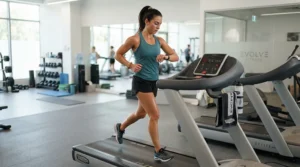
A walking-focused treadmill can feel fine at a steady 3.5 mph and fall apart when asked for dramatic changes. Small motors overheat or slow down mid-sprint. Narrow decks leave you guessing where your feet should land. Slow incline motors turn a 30-second hill sprint into a 10-second sprint plus 20 seconds of waiting. A properly specified high-intensity interval treadmill erases most of that friction. That’s why spec sheets matter more here than they do for casual use.
How to Choose a High-Intensity Interval Treadmill
Use these seven steps in order. Each narrows the field faster than browsing screen sizes.
- Start with the motor. For HIIT-heavy use, look for at least 3.0 continuous horsepower. Continuous ratings reflect sustained output, while peak ratings flatter the number.
- Confirm top speed. Plan for at least 10 mph. Twelve covers nearly all recreational athletes, since 12 mph is a five-minute mile.
- Check response time. Quick-speed keys, dials, and programmable interval buttons save seconds on every transition.
- Measure the deck. A 60-inch length is the practical standard, and 22 inches of width offers extra margin at sprint pace.
- Decide on incline and decline. Fifteen percent incline is common, and decline is a nice-to-have for variety.
- Balance cushioning and feel. Softer decks protect joints, while firmer decks feel more like pavement.
- Price the ecosystem. Subscriptions and warranty terms change the true cost, so factor them in before comparing machines.
Apply these steps and the field narrows quickly. The Bowflex T6 passes most steps on a budget. The Horizon 7.4 AT and Bowflex T9 pass nearly all of them, and the NordicTrack Commercial 1750 passes them with the most headroom.
Treadmill for Sprint Intervals: The Specs That Actually Matter
Shopping for a treadmill for sprint intervals means ignoring half the marketing. Here’s what earns attention and what doesn’t.
What Matters
Acceleration and incline response. The time it takes to reach your target speed is dead time inside a 30-second effort. Horizon 7.4 AT‘s Rapid Sync drive exists for this reason.
Continuous motor power. Marketing often shows “peak” horsepower. For repeated sprints, continuous figures tell the real story.
Verified top speed and incline. As the Sole F80 shows, measured performance can differ slightly from claims. Consumer Reports’ lab found a top speed just above 12 mph but an incline max near 12.8%.
Incline as a lever. Research on uphill running by Padulo and colleagues, published in PLOS ONE, is frequently cited for the finding that a 7% grade raises heart rate by about 15% compared with flat running. In practice, incline lets machines like the Sunny Health & Fitness SF-T723030 create serious intensity without a high top speed.
What Doesn’t
Calorie counters are rough estimates at best, since an exercise physiologist quoted by Garage Gym Reviews notes they ignore body composition and metabolism. Massive screens add cost without improving a single sprint. Treat them as entertainment, not training tools.
Interval Training Programs You Can Run Today
Good interval training programs share a pattern: warm-up, repeated hard efforts, recovery, cool-down. Use effort ratings from 1–10 rather than chasing exact speeds, because fitness levels differ widely.
Beginner: The 30/90 Builder (about 20 minutes)
Warm up for 3 minutes at an easy jog or brisk walk. Then run eight rounds of 30 seconds at effort 8, followed by 90 seconds of easy walking at 3–3.5 mph. Cool down for 2.5 minutes. This mirrors the structure of the Horizon 7.4 AT‘s Sprint 8 preset, and the Sole F80‘s quick keys make the speed jumps painless.
Intermediate: The Hill Surge (about 25 minutes)
After a 4-minute warm-up, run ten rounds of 45 seconds at 5–7% incline at a hard but controlled pace. Follow each with 45 seconds of easy jogging at 0–1%. Machines with speedy incline motors, like the Bowflex T9, shine here.
Advanced: The 4×4 (about 35 minutes)
Warm up for 8 minutes. Complete four 4-minute hard intervals at roughly 85–95% of max heart rate, with 3 minutes of easy recovery between. Cool down for 5 minutes. This longer-interval format appears in interval-training research. Only attempt it once the shorter versions feel routine.
Progression Rules
Change one variable at a time: duration, speed, incline, or rounds. Schedule two sessions per week, spaced at least 48 hours apart, building toward three. If form degrades or your stride gets sloppy, end the interval early. Quality beats quantity.
Home HIIT Routines: Pair the Belt With Floor Work
The best home HIIT routines don’t live exclusively on the belt. Mixing treadmill sprints with bodyweight moves keeps heart rate high while giving your running muscles a break.
The 20-Minute Hybrid
Warm up for 4 minutes. Then complete four rounds of this circuit:
- 30 seconds sprinting (effort 8–9)
- 60 seconds walking recovery
- 40 seconds squat jumps or fast bodyweight squats, off the belt
- 20 seconds standing rest
Finish with a 3-minute cool-down walk.
Safety Rules for Hybrid Routines
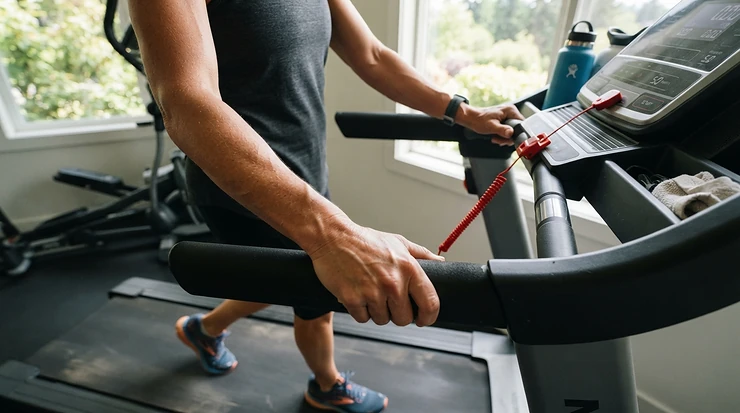
Never do burpees, mountain climbers, or jumping moves on a moving belt. Stop the belt or step off completely. Straddle the side rails when changing speeds, and clip the safety key to your clothing every time.
Small-Space Setup
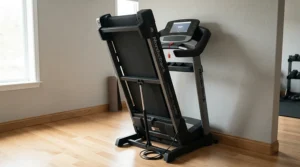
Folding models help apartments. The Bowflex T6 stows at roughly 44 inches long, and the Bowflex T9 needs user height plus about 21 inches of ceiling clearance. Measure doorways, stairwells, and ceilings before delivery. The Sunny Health & Fitness SF-T723030 arrives pre-assembled, skipping the tool-and-bolt marathon entirely.
Anaerobic Conditioning on a Treadmill: What Your Body Is Actually Doing
Anaerobic conditioning is the capacity to produce hard, fast efforts without relying on steady oxygen delivery. During short, near-maximal sprints, the body leans heavily on anaerobic energy pathways, and recovery periods let oxygen delivery catch up. Repeat the cycle and both systems adapt.
A sports-medicine perspective on interval training notes there’s no universally agreed definition of HIIT. It also describes a more extreme variant called sprint interval training. For buyers, the practical takeaway is simple. The harder your efforts, the more your equipment must absorb repeated stress without lag.
Practical Rules of Thumb
Efforts of roughly 10–30 seconds with generous recovery tend to emphasize power. Efforts of 30–60 seconds with shorter recovery push tolerance for fatigue. Treadmills give you precise control over both variables, which is a major advantage over running outdoors.
Manual vs. Motorized for Anaerobic Work
On a motorized machine you can coast if you lose focus, because the belt keeps moving. On the TrueForm Trainer, the belt stops when you do. That built-in honesty makes it a favorite for athletes who want effort they can’t fake. The same sports-medicine paper warns that high volumes of hard training must be managed to limit overreaching and injury, so more isn’t automatically better.
Real-World Scenarios: Which Machine Fits Which Runner?
The College Student in a Studio Apartment
Budget: tight. Space: minimal. Frequency: three 20-minute sessions weekly. The Sunny Health & Fitness SF-T723030 keeps costs low, arrives assembled, and folds away. When discounted, the Bowflex T6 is a stronger step up if you can stretch the budget.
The Marathon Trainee Adding Hill Intervals
Budget: moderate. Environment: spare bedroom or finished basement. Frequency: two quality sessions weekly. The Horizon 7.4 AT or Bowflex T9 offers the incline response and motor headroom for repeated hill surges. Skip garage placement if the warranty is picky.
The Former Athlete Chasing Sprint Mechanics
Budget: generous. Space: a dedicated corner. Frequency: three short sessions weekly. The TrueForm Trainer rewards good form and punishes sloppy mechanics. Its lack of incline is a real limitation, so supplement with hill work outdoors.
The Family That Shares One Machine
Budget: premium. Environment: living space. Frequency: daily, multi-user. The NordicTrack Commercial 1750 or Sole F80 brings higher capacity and durability, and the NordicTrack Commercial 1750‘s screen supports varied classes for different fitness levels.
HIIT Treadmill vs Curved Manual Treadmill vs Outdoor Sprints
Each option answers a different question. A motorized machine answers “how do I control this precisely?” A curved manual answers “how do I make this brutally honest?” The sidewalk answers “how do I make this free?”
| Option | Control | Joint Load | Cost | Best For |
|---|---|---|---|---|
| Motorized HIIT treadmill (e.g., Horizon 7.4 AT) | Precise speed and incline | Cushioned deck | $900–$2,500 | Structured programs |
| Curved manual (TrueForm Trainer) | You set pace | Cushioned slats, high effort | $3,000–$3,500 | Sprint mechanics |
| Outdoor sprints | Variable | Hard surfaces | Free | Budget athletes |
Treadmills offer consistent surfaces, weather-proof training, and easy pacing. Outdoor running adds terrain variety and wind resistance, which is why an exercise physiologist quoted by Garage Gym Reviews suggests a 1% incline to approximate outdoor effort.
The table shows motorized machines win on programmability and recovery control, since you can walk off a hard effort at an exact speed. The curved manual wins on honesty and transition speed. Outdoor sprints win on price but lose on consistency, especially in bad weather or after dark.
Long-Term Cost & Maintenance
The purchase price is only the opening bid. Subscriptions, upkeep, and warranty terms decide the real cost over five years.
Subscriptions
JRNY memberships have been reported at roughly $149 annually after the trial period. NordicTrack’s iFIT is also sold separately. The Bowflex T6, Bowflex T9, and Horizon 7.4 AT run built-in programs without any membership. If you plan to rely on classes, add that yearly cost to your budget.
Maintenance Schedule
Lubricate the belt about once a month per your owner’s manual. Wipe down the belt and vacuum underneath monthly. Tighten the belt if it stutters, and install software updates when prompted. Curved manuals like the TrueForm Trainer need far less upkeep because there’s no motor or belt-drive electronics.
Cost-Per-Use Reality
A machine in the $1,600–$1,800 range used three times weekly for five years comes to roughly $2.00–$2.50 per session before subscriptions. Spread the cost over a household and the figure drops further.
| Tier | Price Range | What You Get | Hidden Cost | Best For |
|---|---|---|---|---|
| Budget | Under $1,300 | Sunny Health & Fitness SF-T723030, Bowflex T6 | App fees, lighter motors | First-time interval runners |
| Mid-range | $1,500–$2,500 | Horizon 7.4 AT, Bowflex T9, Sole F80 | Revision differences | Serious home training |
| Premium | $2,500+ | NordicTrack Commercial 1750, TrueForm Trainer | Subscription or no incline | Specialized goals |
The mid-range tier offers the best long-term value, because lifetime frame and motor warranties and stronger motors reduce repair risk. Budget machines save money upfront but may need replacing sooner under heavy sprint volume. Premium machines make sense only if you’ll use their specific strengths, such as decline training or manual-belt sprint work.
Safety, Regulations & Compliance Guide
Vigorous exercise is safe for most healthy adults, but it deserves respect. Federal guidance, as summarized by the CDC on what counts as physical activity for adults, calls for 150 minutes of moderate or 75 minutes of vigorous activity weekly. One vigorous minute counts roughly as two moderate minutes. That’s why short HIIT sessions can fit the guideline neatly.
Before You Start
If you’ve been inactive, are overweight, or have health concerns, talk to your doctor before beginning vigorous exercise. The CDC specifically advises this for people starting activities like jogging.
On the Machine
Always clip the safety key to your clothing. Keep the cord clear of your stride and plug directly into an appropriate outlet. Place the machine on a flat, stable surface. A concrete garage floor is ideal, and a creaky upper-floor bedroom isn’t. Respect weight capacities, which range from 300 lbs on the Sunny Health & Fitness SF-T723030 to 400 lbs on the TrueForm Trainer.
Incline Caution
Steep grades can strain the Achilles tendon and lower back, especially for people new to incline work. Build up gradually, using the Bowflex T9‘s or Horizon 7.4 AT‘s quick incline controls only after your body has adapted.
FAQ
❓ Can I do HIIT on a treadmill under $1,000?
❓ Do interval training programs on a treadmill require a monthly subscription?
❓ How fast should a treadmill go for sprint intervals?
❓ Is a curved manual treadmill better than a motorized one for HIIT?
❓ How often should I do home HIIT routines on a treadmill each week?
Conclusion
Buying for HIIT is different from buying for jogging. The best HIIT treadmill workout machine review comes down to a short list of questions. Can the motor take repeated sprints? Do speed and incline respond fast? Is the deck long enough for a full stride? Will you actually enjoy the ecosystem?
For most readers, the Bowflex T6 is the budget entry point and the Horizon 7.4 AT is the interval specialist. The Bowflex T9 is the quiet, roomy upgrade. The Sole F80 rewards runners who like a rigid, road-like feel. The NordicTrack Commercial 1750 is the premium all-rounder with decline and classes. The Sunny Health & Fitness SF-T723030 keeps tiny spaces in the game, and the TrueForm Trainer is for sprint purists with room in the budget.
Whichever you choose, pair it with sensible interval training programs, respect your recovery days, and let anaerobic conditioning build gradually. Intensity is a skill, and the right machine simply keeps the practice honest.
🚀 Ready to Sprint?
🏃♂️ Pick the machine that matches your space, your budget, and your goals, then click through to check current pricing and availability. Your fastest 30 seconds are waiting!
Recommended for You
- Incline Treadmill For Calorie Burning: 7 Proven Picks 2026
- Treadmill For Weight Loss Under $1000: 7 Best Picks (2026)
- Treadmill For Desk Workers With Back Pain: 7 Proven Picks 2026
Disclaimer: This article contains affiliate links. As an Amazon Associate, I earn from qualifying purchases. If you purchase products through these links, we may earn a small commission at no additional cost to you.
✨ Found this helpful? Share it with your friends! 💬🤗
