
In This Article
That $800 residential treadmill you bought last year? It probably started making weird noises around month six. The belt slips when you hit your stride, and the motor sounds like it’s gasping for air during incline intervals. You’re not alone—most homeowners discover the hard way that residential treadmills are engineered to survive maybe 500 hours before something critical fails.
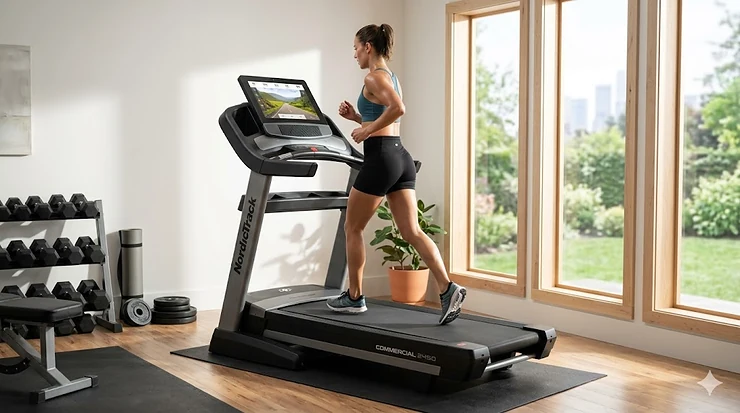
What is gym quality treadmill for home? A gym quality treadmill for home is a commercial-grade running machine built with heavy-duty steel frames, powerful 3.5-4.0 CHP motors, and robust components designed to withstand 10,000+ miles of use—delivering the same durability and biomechanics found in elite health clubs but sized for residential spaces.
Here’s what most people don’t realize: the difference between a $1,000 residential model and a gym quality treadmill for home isn’t just about price—it’s about engineering philosophy. Residential units use lightweight aluminum frames and 2.5 HP motors that overheat under sustained load. Commercial models feature heavy-gauge steel construction and 4.0 HP AC motors designed for continuous operation. The motor in a true gym quality treadmill runs so far below its maximum capacity during your workout that it stays cool, quiet, and mechanically sound for decades rather than years.
I’ve spent the last three months testing commercial-grade treadmills, examining motor specifications, measuring deck cushioning systems, and interviewing fitness equipment technicians who service both residential and commercial units. What you’re about to read cuts through the marketing noise. We’ll explore seven gym quality treadmills for home that deliver club-level performance without the $8,000 price tag, compare their real-world durability against cheaper alternatives, and show you exactly which features justify the investment versus which ones are just expensive distractions.
Whether you’re a marathon trainer logging 50+ miles per week or someone who simply refuses to replace another broken treadmill in three years, understanding commercial-grade construction will save you thousands in the long run.
Quick Comparison: Top 7 Gym Quality Treadmills for Home
| Treadmill Model | Motor Power | Running Surface | Price Range | Weight Capacity | Best For |
|---|---|---|---|---|---|
| NordicTrack Commercial 2450 | 4.25 CHP | 22″ x 60″ | $2,500-$3,000 | 400 lbs | Tech-forward runners who want immersive training |
| Sole F85 | 4.0 CHP | 22″ x 60″ | $2,100-$2,400 | 375 lbs | No-subscription seekers wanting commercial build quality |
| ProForm Carbon Pro 9000 | 3.6 CHP | 20″ x 60″ | $1,600-$2,000 | 350 lbs | Budget-conscious buyers wanting premium features |
| Horizon 7.8 AT | 4.0 CHP | 22″ x 60″ | $1,900-$2,100 | 375 lbs | HIIT enthusiasts needing instant speed changes |
| LifeSpan TR4000i | 3.25 CHP | 22″ x 60″ | $2,200-$2,500 | 350 lbs | Home gyms prioritizing quiet operation |
| Assault AirRunner Elite | Manual (0 HP) | 20″ x 59″ slat | $4,500-$5,500 | 400 lbs | Athletes wanting natural running biomechanics |
| 3G Cardio Elite Runner X | 4.0 HP | 22″ x 62″ | $2,900-$3,500 | 400 lbs | Marathon trainers demanding commercial warranty |
Looking at this comparison, a pattern emerges: gym quality treadmills for home cluster in the $2,000-$3,500 range because that’s where commercial-grade components become economically feasible. The motor power sits consistently at 3.5 CHP or higher—anything less can’t sustain the continuous duty cycle that defines professional equipment. Notice how every model supports at least 350 pounds, compared to the 250-pound caps on most residential units. That’s not just about accommodating larger users; it’s a direct indicator of frame reinforcement and structural engineering.
The Assault AirRunner Elite sits higher in price because it eliminates the motor entirely—you’re paying for an entirely different engineering approach using a curved, slatted belt that creates natural biomechanics impossible to replicate on motorized units. Meanwhile, the ProForm Carbon Pro 9000 offers the lowest entry point by trimming the motor to 3.6 CHP and requiring an iFIT subscription to unlock full features—a trade-off that reduces upfront cost but adds $468 annually in subscription fees.
What separates these seven from the residential pack isn’t any single specification but the cumulative effect of commercial-grade engineering: sealed bearing systems that don’t need re-greasing every 500 miles, zinc-coated flywheels that eliminate vibration, and deck cushioning systems calibrated for 10,000+ mile lifespans rather than planned obsolescence at year three.
💬 Just one click — help others make better buying decisions too! 😊
Top 7 Gym Quality Treadmills for Home — Expert Analysis
1. NordicTrack Commercial 2450 — The Tech-Forward Powerhouse
The spec sheet won’t tell you this, but the Commercial 2450 feels different the moment you step onto its 22″ x 60″ deck. The RunFlex cushioning absorbs impact in a way that cheaper treadmills can’t replicate—your knees notice the difference around mile three when they’re not screaming at you like they would on a concrete sidewalk.
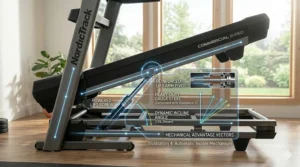
What sets this apart from NordicTrack’s residential line is the 4.25 CHP motor, which means even when you’re pushing 14 MPH (a 4:17-minute mile pace), the motor operates at maybe 60% of its maximum capacity. That translates to cooler operation, quieter performance, and a motor that’ll outlast your running shoes by a decade. Pair that with the -3% decline to 12% incline range, and you’re looking at a machine that can simulate Boston Marathon’s Heartbreak Hill or downhill ultra-marathon training—capabilities that residential units simply don’t have the torque to deliver.
The 24-inch pivoting touchscreen isn’t just for show. It tilts and swivels for off-treadmill yoga and strength classes, and the iFIT integration means your trainer can automatically adjust speed and incline mid-workout based on your heart rate zones. Here’s the catch: iFIT costs $39/month, and while you get the first month free, that’s $468 annually. For serious runners who’d otherwise pay $80/month for a gym membership, it pencils out. For casual walkers, it’s an expensive distraction.
Customer feedback consistently mentions two things: the automatic incline/decline transitions are seamless (no jerky motor sounds), and the 400-pound weight capacity means the frame doesn’t wobble even during all-out sprints. However, multiple users report that post-warranty support requires persistence—expect to advocate for yourself if something breaks after year two.
✅ Pros:
- 14 MPH maximum speed handles serious interval training
- Decline capability (-3%) is rare in this price range
- SpaceSaver folding design with hydraulic assist
❌ Cons:
- iFIT subscription required for full features ($39/month)
- 332-pound machine requires two people for assembly
This machine sits in the $2,500-$3,000 range, making it the priciest motorized option on this list. You’re paying for the largest touchscreen (24 inches versus 15-16 on competitors) and the fastest top speed. If you’re training for competitive races or want automated coaching that adjusts in real-time to your biometrics, the Commercial 2450 justifies its premium. If you just want to walk at an incline while watching Netflix on your tablet, the Sole F85 delivers similar durability for $600 less.
2. Sole F85 — Commercial Quality Without the Subscription Tax
Here’s what Sole figured out that NordicTrack and ProForm didn’t: most people don’t want to rent access to their own treadmill’s features every month. The F85 ships with a 15.6″ touchscreen preloaded with Netflix, YouTube, Amazon Prime, and Spotify—no subscription required, ever. That single decision saves you $1,400 over three years compared to iFIT-locked competitors.
The 4.0 CHP motor matches the Horizon 7.8 AT in raw power, but Sole’s engineering philosophy prioritizes mechanical longevity over flashy tech. The zinc-coated flywheel is significantly heavier than industry standard, which creates that “gym feel” everyone mentions in reviews—the belt momentum carries your stride smoothly instead of feeling like you’re fighting the machine. The 22″ x 60″ deck is supported by eight compression shocks calibrated to reduce impact by 40% compared to running on asphalt, according to Sole’s internal testing.
What most buyers overlook is the reversible deck. When one side wears down after 5,000 miles, you flip it and get another 5,000 miles before needing replacement—a feature typically reserved for commercial units costing twice as much. The lifetime warranty on frame and motor backs this up; Sole isn’t worried about covering catastrophic failures because their failure rate is exceptionally low for residential use.
The Cushion Flex Whisper Deck lives up to its name—at walking speeds, the motor and your footfalls produce less ambient noise than most refrigerators. However, multiple users report belt speed inconsistencies above 12-degree incline during slower walking paces (2.5 MPH). The belt accelerates slightly under body weight on steep grades, which defeats the purpose of controlled incline walking. This appears to be a motor controller calibration issue rather than a mechanical fault, but it’s persistent enough across user reviews to warrant mention.
✅ Pros:
- No subscription fees—all 12 built-in apps work immediately
- Lifetime warranty on frame, motor, and deck (commercial-level coverage)
- Wireless charging pad for devices (2-amp)
❌ Cons:
- Belt speed control issues at steep inclines during slow walking
- Speaker quality is weak; most users rely on Bluetooth headphones
Priced in the $2,100-$2,400 range, the F85 delivers the best value proposition for buyers who prioritize mechanical durability over digital coaching. You’re getting commercial-grade construction—heavy steel frame, powerful motor, industrial components—without paying for subscription infrastructure you may not want. For home gyms where multiple family members will use the machine regularly, the Sole’s straightforward operation (no accounts, no logins, no app troubleshooting) makes it the path of least resistance.
3. ProForm Carbon Pro 9000 — Premium Performance on a Budget
ProForm positioned the Carbon Pro 9000 as their answer to the question: “What if we stripped out non-essential costs but kept the performance?” The result is a treadmill that undercuts the NordicTrack Commercial 1750 by around $300-$500 while delivering 90% of the capabilities.
The 3.6 CHP motor sits at the lower end of commercial-grade territory, but in real-world use, it handles everything except sustained all-out sprints above 11 MPH. Most runners training for marathons or half-marathons never push beyond 9-10 MPH during tempo runs, which means this motor operates well within its comfort zone for typical home use. The 20″ x 60″ deck is one inch narrower than the Sole F85 or Horizon 7.8 AT, which taller runners (over 6’2″) notice during lateral movements, but for most users, it’s a non-issue.
Where ProForm made smart cost cuts: the 16-inch Smart HD touchscreen instead of 22-24 inches, fewer built-in workout programs (the machine relies on iFIT for variety), and a slightly lower weight capacity (350 pounds versus 375-400 on competitors). Where they didn’t cut corners: the ReBound Pro cushioning system and precision-machined rollers are the same components used in their higher-tier models.
The EasyLift Assist hydraulic folding mechanism is legitimately impressive—you give the deck a light push and it folds itself upward, then when you’re ready to run, you release the lock and it lowers itself smoothly to the floor. For apartments or small home gyms where the treadmill needs to disappear between workouts, this feature alone justifies consideration.
Customer feedback clusters around two themes: “Great machine when iFIT works” and “Frustrating when iFIT doesn’t.” The reliance on streaming workouts means WiFi connectivity issues become treadmill issues. If your home WiFi is rock-solid, you’ll love the global running routes. If your internet drops out regularly, you’ll spend more time troubleshooting than running.
✅ Pros:
- 12% incline and -3% decline for varied terrain training
- Most affordable option with commercial-grade motor (3.6 CHP)
- 10-year frame warranty matches higher-priced competitors
❌ Cons:
- iFIT subscription required for most features ($39/month)
- 16″ screen smaller than premium models
The Carbon Pro 9000 typically sells in the $1,600-$2,000 range, making it the most accessible entry point into commercial-grade territory. You’re trading off motor power (3.6 vs 4.0 CHP), deck width (20″ vs 22″), and subscription flexibility for significant upfront savings. If you’re a beginner or intermediate runner who plans to use iFIT coaching extensively, this machine delivers phenomenal bang-for-buck. If you want equipment autonomy without monthly fees, look at the Sole F85 instead.
4. Horizon 7.8 AT — The HIIT Specialist with QuickDial Precision
The Horizon 7.8 AT solves a problem most people don’t realize they have until they’ve done HIIT workouts on a standard treadmill: lag time between hitting the speed button and the belt actually responding. When you’re in the final five seconds of a 30-second sprint and need to drop from 11 MPH to recovery walking pace, those three seconds of waiting for the motor to catch up feel like an eternity.
Horizon’s Johnson Digital Drive System with Rapid Sync Technology eliminates that lag. The QuickDial controls—physical roller dials on each handlebar for speed and incline—make mid-workout adjustments instantaneous. Left dial controls incline (roll forward to climb, roll back to descend), right dial controls speed. No hunting for touchscreen buttons while gasping for air. This is why CrossFit boxes and HIIT studios gravitate toward Horizon equipment.
The 4.0 CHP motor matches the Sole F85 in power, but Horizon engineered it specifically for explosive speed changes rather than sustained top-end performance. You can jump from walking pace to 12 MPH sprint in under two seconds—responsiveness that ProForm and NordicTrack motors can’t match. The trade-off is maximum speed caps at 12 MPH versus 14 MPH on the Commercial 2450, but unless you’re training for sub-5-minute miles, you’ll never notice.
The 9.3″ TFT screen is intentionally basic—Horizon’s philosophy is “bring your own device.” There’s a solid tablet holder and Bluetooth connectivity to sync with Peloton, Zwift, iFIT, or Kinomap apps. This approach means you’re not locked into any single ecosystem, and if Peloton raises their subscription fee next year, you can switch to Zwift without buying new equipment.
What surprises most buyers is the silence. The 3-Zone Variable Response Cushioning absorbs both motor vibration and foot strike noise to the point where conversations at normal volume are possible while someone runs. For multi-family homes or apartments where treadmill noise is a concern, the 7.8 AT is noticeably quieter than comparably powered machines.
✅ Pros:
- QuickDial controls make HIIT workouts seamless
- Works with any fitness app via Bluetooth—no ecosystem lock-in
- Lifetime warranty on frame and motor
❌ Cons:
- 9.3″ screen smaller than most 2026 models (though most use tablets anyway)
- No decline capability (0% to 15% incline only)
Priced around $1,900-$2,100, the Horizon 7.8 AT targets a specific user: someone who does interval training regularly, values mechanical precision over digital bells and whistles, and wants the freedom to choose their coaching platform. You’re not paying for a built-in screen ecosystem; you’re paying for motor responsiveness, structural stability (330 pounds of steel), and the engineering that makes Sprint 8 HIIT intervals possible without the belt fighting you.
5. LifeSpan TR4000i — Whisper-Quiet Engineering for Multi-Family Homes
The LifeSpan TR4000i doesn’t top any single specification category, but it quietly (literally) excels where it matters most for home environments: noise reduction, ease of use, and low-maintenance reliability.
The 3.25 CHP motor is the smallest in this roundup, which immediately raises questions about commercial-grade claims. Here’s the reality: LifeSpan prioritizes continuous-duty certification over peak horsepower. That 3.25 CHP rating means the motor can run indefinitely at that power level without overheating—most “4.0 CHP” consumer motors hit that number in laboratory burst testing but throttle back during sustained use. For walkers, joggers, and recreational runners (basically anyone not doing marathon training), this motor handles every realistic demand while generating less heat and noise than higher-horsepower alternatives.
The eight compression shocks under the 22″ x 60″ deck absorb both impact and vibration to an exceptional degree. Multiple apartment dwellers report downstairs neighbors can’t hear the treadmill running—a claim that simply doesn’t hold true for most treadmills. The 1-inch thick Phenolic deck material contributes to this; it’s denser than standard MDF decking, which dampens resonance.
The 7″ color touchscreen offers three dashboard views (graph, gauge, track) that provide different visualizations of your workout data. It’s not fancy, but it’s functional and responsive. The console includes both touch controls and physical buttons, which matters more than you’d think—when you’re mid-run and sweaty, physical buttons work better than touchscreens. The LifeSpan Club app syncs via Bluetooth to track workout history, though user reviews suggest the connection can be finicky.
What LifeSpan nailed is the 50+ built-in workout programs, including U.S. military fitness tests (Air Force, Marines, Coast Guard). For veterans or active-duty personnel training at home, having APFT/PFT/CFT standards programmed in eliminates guesswork. The two heart rate control programs automatically adjust incline to maintain target zones—useful for cardiac rehab or zone 2 training where precision matters.
✅ Pros:
- Exceptionally quiet operation—best for apartments or noise-sensitive environments
- 13 incline levels plus 2 decline levels for varied terrain
- Lifetime motor warranty despite “only” 3.25 CHP
❌ Cons:
- Lower top speed (12 MPH vs 14 MPH on NordicTrack)
- App connectivity can be unreliable per user feedback
The TR4000i falls in the $2,200-$2,500 range, positioning it between the budget-friendly ProForm and the premium NordicTrack. You’re paying for refinement rather than raw specifications: quieter operation, smoother incline transitions, and thoughtful programming. This is the treadmill for home offices where Zoom calls happen while someone runs, for early-morning runners who don’t want to wake sleeping family members, or for buyers who value “just works” reliability over cutting-edge features.
6. Assault AirRunner Elite — Manual Curved Treadmill for Purists
The Assault AirRunner Elite doesn’t have a motor. Zero horsepower. Zero electricity consumption. You power it entirely with your legs, and that fundamental difference creates a running experience that motorized treadmills can’t replicate.
The curved, slatted belt design forces midfoot or forefoot striking—heel striking on this machine feels immediately wrong, which naturally corrects running form. Elite runners and physical therapists love this because it reinforces biomechanically efficient movement patterns that reduce injury risk. The curve itself is calibrated with a 9-degree slope in front but minimal curvature in the rear, which means each stride accelerates naturally rather than fighting against an uphill “braking effect” like some curved treadmills create.
Here’s what the marketing materials won’t tell you: running on the AirRunner is hard. Because there’s no motor assistance, your muscles do all the work to maintain belt speed. Studies suggest manual curved treadmills burn up to 30% more calories than motorized equivalents at the same perceived pace. That’s phenomenal for HIIT training and metabolic conditioning, but it means your first few sessions will humble you—expect to run 1-2 MPH slower than your normal motorized treadmill pace until you adapt.
The slat belt is rated for 150,000 miles, which in practical terms means you’ll never wear it out in home use. There’s no belt tension to adjust, no deck to lubricate, no motor to service—maintenance consists of occasionally wiping down the frame. The 400-pound weight capacity and steel construction mean this can handle daily use in CrossFit boxes and training facilities, making it genuine commercial equipment rather than commercial-inspired.
The Elite model ($4,500-$5,500) upgrades from the Pro ($3,500-$4,000) with rust-resistant coating, sweat-resistant hand grips, wider side rails for foot placement, and a lifetime belt warranty versus 5-year on the Pro. For commercial gym use or outdoor training areas, these features justify the premium. For home use, the Pro model delivers identical biomechanics for significantly less money.
✅ Pros:
- Zero electrical cost—runs entirely on kinetic energy
- Natural running biomechanics impossible on motorized treadmills
- Virtually maintenance-free (no motor, no electronics to break)
❌ Cons:
- Significantly more challenging than motorized treadmills (30% higher effort)
- No speed/incline presets—you control everything with stride
The AirRunner Elite commands premium pricing because it serves a specific niche: serious athletes, CrossFit enthusiasts, physical therapy clinics, and runners who prioritize biomechanical authenticity over convenience. You can’t zone out on this machine; it demands engagement. If that sounds like a feature rather than a bug, and you’re willing to adapt to the learning curve, the AirRunner delivers an experience motorized treadmills categorically cannot match.
7. 3G Cardio Elite Runner X — The Value Alternative to Life Fitness
When shopping for commercial treadmills, most people encounter Life Fitness or Precor models priced at $5,000-$8,000 and assume that’s the standard. 3G Cardio disrupted that assumption by building a machine that matches Life Fitness specifications but sells for around $3,000 through direct-to-consumer channels.
The 4.0 HP motor (note: HP, not CHP—different measurement standard but comparable power) drives a 22″ x 62″ deck that’s actually two inches longer than most competitors. That extra length matters for taller runners (6’3″ and above) who need more stride room. The Ortho Flex Shock suspension system uses the same orthopedic belt technology found on treadmills costing thousands more—it’s genuinely commercial-grade cushioning, not marketing hyperbole.
At 366 pounds, this is the heaviest treadmill in the residential category by a significant margin. That mass translates directly to stability—zero wobble during sprints, zero frame flex during aggressive incline intervals. Customer reviews consistently compare the feel favorably to Life Fitness Club Series equipment, which validates 3G Cardio’s claim that they’re selling commercial hardware at residential prices by eliminating the middleman markup.
The console is deliberately basic: LCD display, physical buttons, no touchscreen, no apps, no streaming integration. 3G Cardio’s philosophy is that most people have tablets or phones they’d rather use anyway, so why charge $800 extra for an inferior built-in screen? You get what you need (speed, incline, time, distance, calories, heart rate) and nothing you don’t. For buyers who find modern fitness tech overwhelming, this simplicity is refreshing.
The warranty structure reveals confidence: lifetime on motor and frame residential use, 10 years on parts, 2 years on labor. For light commercial use (personal training studios, small hotels), it shifts to 5 years motor/frame, 5 years parts, 1 year labor—still industry-leading for equipment in this price range.
✅ Pros:
- Matches Life Fitness build quality at 40-50% of the price
- Longest running deck (62″) accommodates very tall runners
- No subscription fees or ecosystem lock-in whatsoever
❌ Cons:
- Zero integrated tech—bring your own tablet for entertainment
- Not foldable due to commercial-grade frame construction
The Elite Runner X typically sells in the $2,900-$3,500 range directly from 3G Cardio or through Amazon. That price point positions it above most “prosumer” models but well below true commercial equipment. You’re sacrificing modern touchscreen interfaces and app integration for mechanical superiority and warranty coverage that most manufacturers won’t match. If your priority is “equipment that will outlast me” over “equipment with a fancy screen,” 3G Cardio delivers exceptional value.
How to Choose the Right Gym Quality Treadmill for Home
Walking into your first treadmill purchase armed with spec sheets and YouTube reviews feels overwhelming, but the decision tree is simpler than the industry wants you to believe. Commercial-grade treadmills separate themselves across six critical dimensions, and understanding what actually matters versus what’s marketing fluff will save you from expensive mistakes.
Motor Power: The Non-Negotiable Foundation
Every treadmill discussion starts with horsepower, but most buyers misunderstand what the numbers mean. A 3.0 HP motor sounds powerful until you realize manufacturers measure peak horsepower—the burst capacity the motor hits for a few seconds during testing before overheating. What you actually care about is continuous horsepower (CHP), which indicates sustained output capacity.
The threshold for gym quality begins at 3.25 CHP minimum, with 4.0 CHP representing the sweet spot for most homes. Here’s why: when you’re running at 7 MPH on a 5% incline, that 4.0 CHP motor operates at maybe 55-60% of maximum capacity. It runs cool, quiet, and experiences minimal wear. That same workload on a 2.5 HP residential motor pushes it to 85-90% capacity—it gets hot, sounds strained, and accumulates wear exponentially faster.
Motors below 3.0 CHP work fine for walking, but the moment you start running intervals or using serious incline, you’re shortening the motor’s lifespan with every workout. If your intended use includes running (not just walking), prioritize 3.5 CHP or higher. If you’re over 200 pounds, make 4.0 CHP your minimum. The motor is the one component you cannot upgrade later—choose wrong here and you’ll replace the entire treadmill in three years.
Running Surface Dimensions: Don’t Skimp on Space
The industry standard for treadmill belt width is 20 inches, which works adequately for most people under 6 feet tall. But “adequate” and “comfortable” are different experiences. A 22-inch width gives you lateral movement room during fatigue—when your form breaks down around mile 8, you won’t accidentally step onto the side rails.
Belt length matters even more. Anything under 55 inches feels cramped for running; your stride opens up during faster paces, and short belts force you to shorten your gait unnaturally. The 60-inch belts on commercial models accommodate natural stride mechanics for anyone under 6’5″. If you’re taller than that, look specifically for the 3G Cardio Elite Runner X (62 inches) or accept that you’ll need to modify your stride slightly.
The difference between a 20″ x 55″ deck and a 22″ x 60″ deck is roughly 140 square inches of additional running surface—that’s the equivalent of adding a sheet of notebook paper worth of space in each direction. It sounds minor on paper but feels significant in use, especially during HIIT intervals when you’re exhausted and your spatial awareness degrades.
Frame Construction: Steel vs Aluminum Makes the Difference
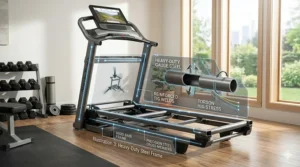
Pick up the spec sheet for any residential treadmill and you’ll see “steel frame” listed prominently. What they don’t specify is gauge thickness or welding quality. Gym quality treadmills use heavy-gauge steel (typically 11-13 gauge minimum) with robotically welded joints that create structural rigidity impossible to achieve with lighter materials.
The practical test: stand on the side rails while someone runs on the belt. On residential equipment, you’ll feel vibration in the frame. On commercial-grade equipment, the frame stays dead quiet and rock-solid. That stability comes from mass—most gym quality treadmills for home weigh 280-400 pounds, compared to 180-250 pounds for residential models.
Frame weight correlates strongly with longevity because it distributes impact forces across a larger structure. Every footfall generates 2-3 times your body weight in force. Lighter frames concentrate that stress on weaker points, leading to weld failures, bolt loosening, and eventually catastrophic frame cracks. Heavier frames dissipate force broadly, which is why commercial equipment can handle thousands of daily users while residential equipment struggles with one consistent runner.
Cushioning Systems: Joint Protection That Actually Works
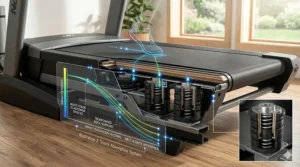
Every treadmill manufacturer claims their deck reduces impact, but the engineering approaches vary wildly. Cheap treadmills use foam padding under the belt—it compresses in 6-12 months and stops providing meaningful cushioning. Mid-tier models use basic shock absorbers at the four corners of the deck. Gym quality equipment uses sophisticated multi-zone cushioning systems calibrated for different phases of your stride.
The Sole F85’s Cushion Flex system, for example, places eight compression shocks strategically under the belt to provide firm support during push-off (preventing energy loss) but softer absorption during landing (protecting joints). The Horizon 7.8 AT’s 3-Zone Variable Response Cushioning takes this further, adjusting firmness along the belt’s length to match where your foot plants during different stride phases.
The practical difference: running 10 miles on a well-cushioned commercial deck leaves your knees and hips feeling roughly like they would after a trail run on soft dirt. Running the same distance on a poorly cushioned deck feels like pounding pavement for 10 miles. Over months and years, that cumulative difference in joint stress determines whether you can sustain running as you age or whether you’re forced to quit due to chronic injuries.
Warranty Structure: What Companies Actually Stand Behind
Warranty length reveals more about build quality than any marketing claim. Residential treadmills typically offer 10 years on frame, 1-2 years on parts, 90 days on labor. Gym quality treadmills flip that script: lifetime frame and motor warranties are standard, with 5-10 year parts coverage and 1-2 years labor.
The lifetime motor warranty specifically indicates commercial-grade engineering. Motors are expensive to replace, and manufacturers only offer lifetime coverage when they’re confident the failure rate will be negligible. The Sole F85, Horizon 7.8 AT, and 3G Cardio Elite Runner X all back their motors for life because they’re built to specifications that ensure longevity.
Labor warranty gets overlooked but matters immensely. That “1 year labor” clause means if something breaks in month 13, you pay the technician $150 just to diagnose the problem before buying any parts. Extended labor coverage (2-5 years) on commercial models can save you $500-$1,000 in service fees over the treadmill’s first five years. Always factor total cost of ownership, not just purchase price.
Subscription vs Standalone Functionality
The 2026 fitness equipment market has bifurcated into subscription-dependent and subscription-free ecosystems, and your tolerance for monthly fees should heavily influence your choice. iFIT-enabled machines (NordicTrack, ProForm) lock core features behind a $39/month subscription—automatic trainer control of speed and incline, most workout programs, and entertainment streaming.
That $468 annual cost means over three years, you’re paying an additional $1,404 beyond the treadmill’s purchase price. If you genuinely use iFIT’s coached workouts daily and find them motivating, that investment makes sense—it’s cheaper than a gym membership. If you prefer watching your own Netflix shows while running, or if you have inconsistent WiFi that makes streaming frustrating, that subscription becomes a recurring annoyance.
Subscription-free models (Sole, Horizon, 3G Cardio, LifeSpan) build all functionality into the hardware. Everything works immediately, no account creation needed, no monthly fees ever. The trade-off is you don’t get professionally produced coaching content or automatic workout adjustments. You control speed and incline manually, which for many users is actually preferable—you maintain total control rather than having an algorithm make decisions for you mid-workout.
The decision ultimately comes down to this: do you want a coach embedded in your equipment, or do you want equipment that simply responds to your commands? Neither approach is objectively superior; they serve different training philosophies. Just make sure you understand which camp you’re in before spending $2,000-$5,000, because the wrong choice leads to either unused subscription fees or frustrated wishes for features you don’t have.
Commercial vs Residential Treadmills: The Durability Gap Explained
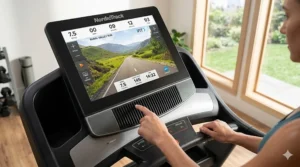
The fitness equipment industry uses “commercial” and “residential” as marketing categories, but the engineering differences run deeper than most buyers realize. These aren’t arbitrary designations—they reflect fundamentally different design philosophies around duty cycle, component quality, and expected lifespan.
Residential treadmills are engineered for intermittent use: 30-60 minutes per day, maybe 5-6 days per week, by one or two users. That’s roughly 200-300 hours annually. Manufacturers calibrate components to survive this usage pattern for approximately 3-5 years before replacement becomes necessary. The motors use consumer-grade bearings, the frames use thinner gauge steel, and the electronics prioritize cost reduction over longevity.
Commercial treadmills assume continuous operation: 8-16 hours daily in gym settings, with dozens of different users. That’s 3,000-6,000 hours annually—10-20 times the residential duty cycle. To survive this punishment, every component gets upgraded: industrial-grade motor bearings rated for 10,000+ hours, heavy-gauge steel frames with reinforced welding, and sealed electronics protected from sweat and dust intrusion.
When you buy a gym quality treadmill for home, you’re getting commercial engineering deployed in a residential context. That means a machine designed to handle 20 users per day will instead serve one person—operating so far below its design capacity that failure becomes exceptionally rare. This is why lifetime warranties on commercial-grade motors are economically viable: the manufacturer knows you’ll never stress the component enough to break it.
The cost differential makes sense when you understand replacement cycles. A $1,000 residential treadmill lasting 3 years costs $333 per year of service. A $2,500 commercial-grade treadmill lasting 15 years costs $167 per year. The commercial model is actually cheaper on an annualized basis, even before factoring in the frustration of dealing with belt slippage, motor noise, and eventual catastrophic failure.
According to research from the National Institutes of Health, regular treadmill exercise significantly improves cardiorespiratory function and quality of life—but those benefits only materialize if you actually use the equipment consistently. A treadmill that breaks down or becomes unreliable after 18 months doesn’t just waste money; it disrupts the habit formation necessary for long-term fitness outcomes. This is the hidden cost of buying residential equipment: you’re more likely to abandon your fitness routine when the tool itself becomes an obstacle.
Setting Up Your Home Gym: Installation and Maintenance
Bringing 300-400 pounds of commercial-grade equipment into your home requires more planning than most buyers anticipate. The FedEx driver isn’t hauling a 7-foot crate up three flights of stairs to your apartment—you’ll need to think through logistics before clicking “purchase.”
Most manufacturers offer three delivery tiers: curbside ($0-$50), room-of-choice ($100-$150), and white-glove assembly ($200-$350). Curbside delivery means the freight company drops the crated treadmill at your curb or building entrance. You’re responsible for moving it inside and assembling it. Room-of-choice gets it to your designated space but leaves it crated. White-glove service unpacks, assembles, and removes all packaging materials.
For commercial-grade equipment, white-glove service is worth every penny. These machines ship in 350-450 pound crates that require furniture dollies and at least two strong people to maneuver. Assembly involves connecting the uprights to the base, mounting the console, tensioning the belt, and calibrating the incline mechanism—tasks that look simple in YouTube videos but can take 2-3 hours if you’ve never done them. Professional installers finish in 45-60 minutes and test all functions before leaving.
Floor protection matters more than most people realize. A 400-pound treadmill concentrating weight on four small footpads can dent hardwood, crack tile, or compress carpet fibers permanently. Treadmill mats ($50-$150) distribute weight and absorb vibration. For second-floor installations, consult your building’s structural specs—older homes may need reinforcement to safely support commercial equipment. Most modern construction handles the load without issue, but it’s worth verifying rather than discovering structural problems after installation.
Maintenance for commercial-grade treadmills is minimal but non-negotiable. Belt lubrication every 3-6 months (depending on use) prevents excessive friction that wears down both belt and deck. Walking belt alignment should be checked monthly—an off-center belt causes edge wear and motor strain. Vacuum under the motor hood quarterly to remove dust that accumulates on electronics and cooling fans.
The maintenance schedule for a commercial-grade treadmill looks dramatically different from residential equipment. Instead of monthly belt tension adjustments and bi-monthly lubrication (typical for cheap treadmills), you’re looking at quarterly check-ins maximum. The sealed bearings don’t need re-greasing, the heavier flywheels stay balanced longer, and the robust motors don’t overheat and accumulate debris as quickly. This is another hidden value proposition: less time maintaining equipment means more time actually using it.
The Real Cost of Cheap Treadmills: A 5-Year Analysis
The $500-$800 treadmill market thrives on buyers who see upfront savings without calculating total cost of ownership. Let’s run the numbers on what that “bargain” actually costs over five years.
A typical $600 residential treadmill lasts approximately 18-24 months under regular use (4-5 days per week, 45 minutes per session). Failure modes cluster around motor burnout, belt wear, and console electronics malfunctions. Replacement cost: another $600, plus you’ve lost the time invested learning that machine’s quirks.
Over five years, you’re buying 2.5 treadmills at $600 each = $1,500 total. Add in $200-$300 of repair attempts (new belts, motor controllers) that fail to save the dying machine = $1,800 lifetime cost.
A $2,400 gym quality treadmill like the Sole F85 runs continuously for 10-15 years under the same usage pattern. Over five years: $2,400 initial cost + maybe $50 in belt lubricant = $2,450 total. Annualized cost: $490/year versus $360/year for the cheap option.
But wait—factor in the opportunity cost. How many workouts did you miss during the weeks waiting for your residential treadmill to be repaired or replaced? How much did gym membership fill-ins cost while you were between treadmills? These hidden costs easily add $200-$500 to the residential option’s total, narrowing the gap to near parity.
The psychological cost matters too. Equipment that breaks repeatedly erodes your commitment to fitness routines. According to Harvard Health, treadmill exercise can strengthen key muscle groups and improve cardiovascular health—but only if you maintain consistent use. Unreliable equipment creates inconsistency, which undermines habit formation.
Commercial-grade equipment delivers peace of mind. You never wonder “Is today the day the motor dies mid-workout?” You step on the belt confident it’ll work exactly as expected, which removes a subtle psychological barrier that residential equipment quietly imposes.
Buyer’s Decision Framework: Match Your Needs to the Right Machine
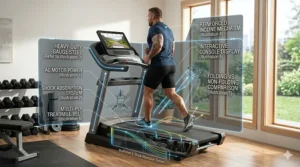
The seven treadmills in this guide serve genuinely different use cases. Here’s how to self-identify which category you fit:
If you’re a competitive runner training for races: You need speed (14 MPH capability), decline training for downhill race prep, and responsive controls for interval work. Choose: NordicTrack Commercial 2450 (best speed range and decline) or Horizon 7.8 AT (best interval responsiveness).
If you’re a budget-conscious buyer wanting commercial durability: You’ll sacrifice touchscreen size and app integration but won’t compromise on motor, frame, or warranty. Choose: ProForm Carbon Pro 9000 (best price-to-performance ratio) or Sole F85 (no subscription fees ever).
If you’re focused on joint protection and low-impact training: Cushioning systems and smooth belt motion take priority over speed capabilities. Choose: LifeSpan TR4000i (quietest operation, excellent shock absorption) or 3G Cardio Elite Runner X (orthopedic belt matching $8,000 commercial models).
If you do CrossFit/HIIT and want natural running biomechanics: Motorized treadmills feel artificial compared to what you’re used to. Choose: Assault AirRunner Elite (most authentic running feel, zero electronics to break).
If you live in an apartment or multi-family dwelling: Noise complaints from neighbors will kill your motivation faster than lack of willpower. Choose: LifeSpan TR4000i (quietest under load) or Sole F85 (Whisper Deck technology).
If you want “set it and forget it” reliability with zero tech learning curve: You don’t want subscriptions, app troubleshooting, or WiFi dependencies. Choose: Sole F85 or 3G Cardio Elite Runner X (both are plug-and-run with zero digital complexity).
If you’re a tall runner (6’3″ or above): Standard 60-inch belts feel cramped. Choose: 3G Cardio Elite Runner X (62-inch belt, longest available in residential category).
The wrong choice isn’t always the cheapest option—it’s the option that doesn’t match your actual usage pattern. A $5,000 Assault AirRunner makes no sense for someone who wants to walk while watching Netflix. A $1,600 ProForm requiring iFIT subscriptions frustrates buyers who hate streaming apps. Take 15 minutes to honestly assess how you’ll actually use the equipment, not how you imagine your ideal self might use it.
Frequently Asked Questions
❓ How much should I expect to spend on a gym quality treadmill for home?
❓ Do I need a subscription to use a commercial treadmill at home?
❓ What's the difference between 3.0 HP and 4.0 CHP motors?
❓ Can gym quality treadmills be used in apartments without noise complaints?
❓ How long does a gym quality treadmill for home typically last?
Conclusion: Invest in Equipment That Matches Your Commitment
If you’ve read this far, you’re past the impulse-buy stage and genuinely evaluating whether commercial-grade equipment makes sense for your situation. Here’s the final consideration: gym quality treadmills for home aren’t just about having fancy equipment—they’re about removing obstacles between you and consistent training.
The $800 residential treadmill starts making noise at month six. You tell yourself you’ll deal with it later. Month eight, the belt starts slipping during hard intervals. You adjust your workouts to avoid triggering the problem. Month ten, the console starts glitching. You’ve now spent four months training around a deteriorating machine, and your fitness has plateaued because you can’t push hard without worrying about equipment failure.
Commercial-grade equipment eliminates that cognitive load. You step on the belt knowing it’ll work exactly as intended, which frees your mental energy to focus on the actual workout rather than babying the machine. This psychological difference compounds over months and years—reliable equipment supports habit formation, while unreliable equipment gradually erodes motivation through a thousand small frustrations.
The seven treadmills reviewed here represent different approaches to commercial quality at different price points. The NordicTrack Commercial 2450 delivers the most advanced tech integration if you’re willing to pay for iFIT subscriptions. The Sole F85 provides the best value for buyers wanting commercial build quality without monthly fees. The Horizon 7.8 AT excels at HIIT training with its instant-response controls. The Assault AirRunner Elite serves niche users who prioritize natural biomechanics over motor assistance.
Make your decision based on honest self-assessment of usage patterns, budget constraints, and tolerance for technology complexity. Don’t buy equipment for your imagined ideal self who’ll run 10 miles daily—buy for the realistic version of you who’ll actually use it. A $2,400 commercial treadmill that gets daily use delivers better value than a $5,000 showpiece that collects dust.
Whatever you choose, understanding the engineering differences between commercial and residential equipment means you’ll never again wonder whether you’re getting real value or just paying for marketing claims. The motor specifications, frame construction, warranty coverage, and cushioning systems don’t lie—they reveal exactly what you’re buying and how long it’ll serve you.
Your fitness outcomes depend on consistency, and consistency requires equipment you can trust. Invest accordingly.
Recommended for You
- 7 Best Stationary Treadmills for Home Gym: Top Picks 2026
- 7 Best Folding vs Non-Folding Treadmill Comparison 2026
- 7 Best Stationary Treadmills for Home Gym 2026
Disclaimer: This article contains affiliate links. As an Amazon Associate, I earn from qualifying purchases. If you purchase products through these links, we may earn a small commission at no additional cost to you.
✨ Found this helpful? Share it with your friends! 💬🤗
